

In 2016, Japan imported 2,235,652 cbms of lumber from North America, 4.4% less than in the previous year. This is the third consecutive year that the lumber imports declined. Continue reading "Japan’s lumber imports from North America reach third year in a row decline"
Article archive
Rörvik Timber closes Boxholm and Myresjö sawmills in southern Sweden
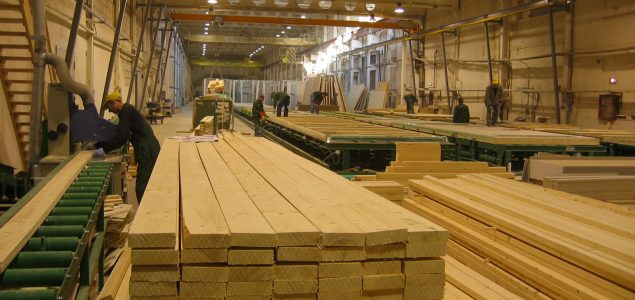
Rorvik Timber AB will soon close two of its southern sawmills in Sweden, with a combined production volume of 480,000 m3. Continue reading "Rörvik Timber closes Boxholm and Myresjö sawmills in southern Sweden"
German furniture industry with positive results in 2016

The German furniture industry got very positive results in 2016, when the exports for the full year amounted to EUR 10.4 billion, at an increase of 1.3%.
The export rate has been increased to 32% in the past ten years, from 2006, when it was 24.6%. The positive economic development in Europe contributed to the good result in the past year, Continue reading "German furniture industry with positive results in 2016"
Wemhöner to invests € 12 million in Herford production site

In 2017, Wemhöner will invest € 12 million in the company’s production facility in Hertford, Germany. The investment is mainly aimed at improving the logistics structures and assembly areas.
In addition, replacement investments are to be made in new machine tools. Headquartered in Herford, Germany and, since 2007, with a manufacturing plant in Changzhou near Shanghai, China, Wemhöner has secured by existing orders capacity utilization in both locations up to 2018.
After a satisfactory financial year 2016 and a group turnover of € 110 million, the world’s leading short-cycle press line manufacturer, expects year 2017 to bring a significant increase in sales to € 130 million. The main markets in the current year are North America, Eastern Europe and China. After two weaker years, the Chinese operation, Wemhoener Changzhou Machinery Manufacturing, is an important sales driver and accounts for about 30% of group sales.
Wemhöner produces machines and systems for upgrading of wood based panels. The product portfolio ranges from short-cycle press systems to 3D membrane and vacuum pressing lines. Wemhöner’s product range includes digital and direct printing systems, lacquering lines, lightweight panel systems, throughfeed press lines, special plants and special press lines. Wemhöner is the world leader for short-cycle press lines and 3D VARIOPRESS® equipment.
Cameroon confirms the 20% tax on exports of logs
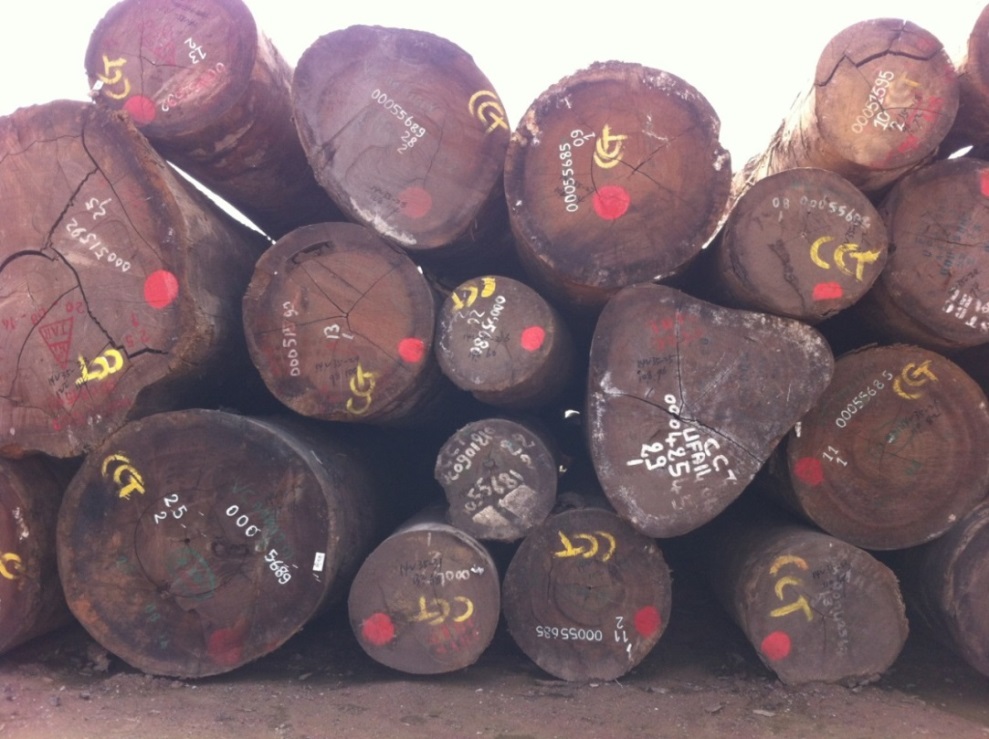
Cameroon has confirmed the log export tax will be increased to 20% and has signalled it will further tighten checks on export documentation. It has also been announced that a mandatory bar code system for log identification, as used for sawnwood, is to be introduced.
It is understood that Cameroon is ordering a one year complete halt on felling and export of bubinga. Producers report that it is their understanding that existing stocks of bubinga logs and sawnwood are to be inspected and inventoried by the Forest Department and then a decision will be made on whether stocks can be exported.
This increase can be explained in two ways. First of all, with the continuous drop in oil revenues, the Cameroonian government is planning to create new income sources or increase the contribution of existing sources, to replenish a treasury increasingly called upon due to the major ongoing projects in the country and additional expenditure incurred by the fight against Boko Haram.
Thus, wood would be the adequate product to boost customs revenues. During 2015, there was a global volume of 938,455 tons of wood logs export from Cameroon to the world.
Second, the increase on the log export tax would be like a government strategy meant to encourage logging operators to move into local processing. This could also create added value for the entire national economy, as well as it could be a source of employment.
US wooden furniture imports reach all-time high in 2016
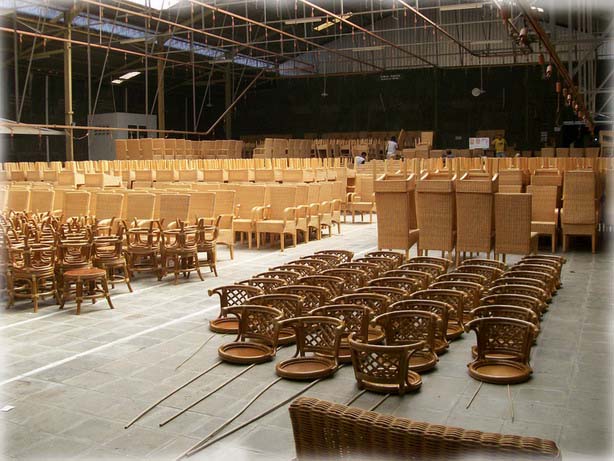
US wood furniture imports reached a new record high in 2016. Wooden furniture imports were worth US$16.71 billion, up 3% from 2015. Imports from all major suppliers increased except Malaysia and Indonesia.
Furniture imports from Malaysia grew strongly in 2015, but declined 5% in 2016 to US$673.3 million. Imports from Indonesia were down 9% from 2015.
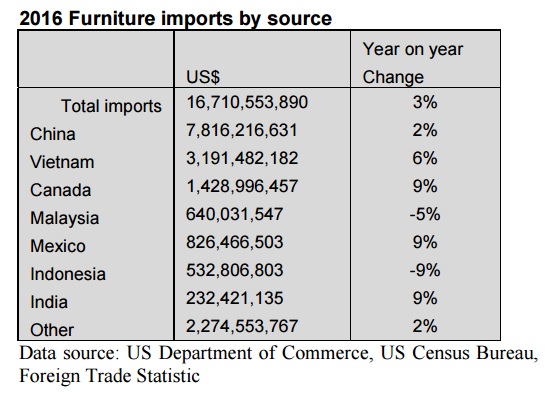 China’s share in total imports decreased again this year to 46.8%, while Vietnam’s share grew to 19.1%. Malaysia’s share in total imports was with 3.8% the same as two years ago (2014).
Wooden furniture imports from China increased 2% to US$7.82 billion in 2016. Imports from Vietnam were worth US$3.19 billion (+6%), but strongest year-over-year growth was in imports from Canada, Mexico and India.
Furniture imports from India amounted to US$232.4 million in 2016.
Italian wood machinery sales give cause for optimism
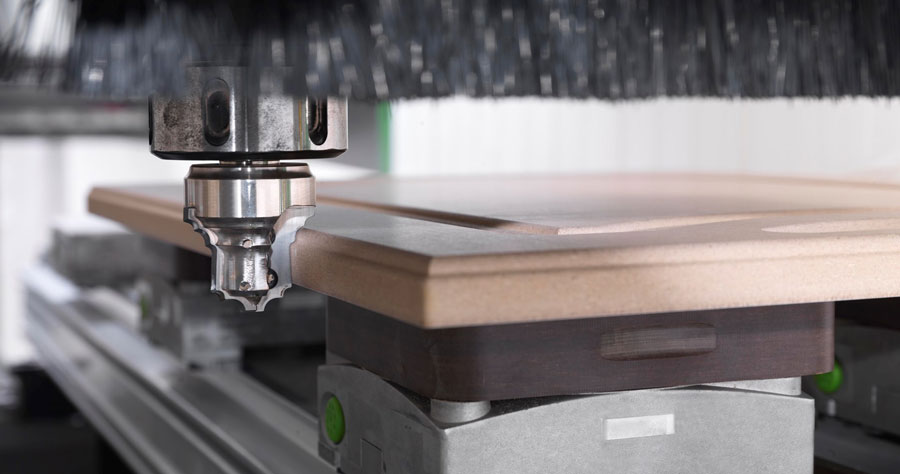
The wood market in Italy has been depressed now for several years. However newly released data on wood machinery sales suggests there was a significant upturn in capital investment in the industry last year.
Data from Acimall, the Italian association of woodworking machinery manufacturers, show that total sales by members to domestic industry were Euro 592 million in 2016, 31.6% more than the previous year.
Export sales of woodworking machinery also increased in 2016, but at a slower rate of 5.1% to Euro 1486 million. Much of the recent growth in export sales has been concentrated in North America.
Acimall suggest that increase in sales last year was driven both by public incentives and measures to support industrial activity and by rising wood product consumption.
Taken together, the data shows that Italian machinery manufacturers’ total sales increased by 11.5% to Euro 2078 million in 2016. This is close to the industry’s record production level of Euro 2159 million in 2007.
Germany: Prices for wood products largely stable at the beginning of the year

In January 2017, the German producer price index shows signs of stability with few exceptions. KVH (finger-jointed squares and beams) price has fallen quite considerably. Pellets’ price again increased after a short pause.
Compared to the same month last year, Germany’s producer price index is higher on almost all wood products. All except beech blocks, particle and HDF boards which are cheaper over January 2016. The highest increase was registered in pellets’ price. By far, pellets are followed by wood chips from softwood and KVH (that, yes, however, recovered from a low level).
Noticeable changes from December to January, can be seen in wide width boards and pellets, which are up significantly. Particleboards recovered a bit and are now only 1% below December 2016. Conversely, KVH, planed-finger jointed softwood and wood chips are on a downward trend. Nevertheless, all three are still well above last year's level.
| Germany's Producer Price Index Commercial Products (2000=100) |
January 2016 |
December 2016 |
January 2017 |
Change Jan. '16 to '17 |
| Spruce and Fir lumber (Picea abies Karst.) | 108.3 | 113.6 | 113.3 | 4,62% |
| Lumber according to DIN 4074/S10 | 111.7 | 117.5 | 117.3 | 5,01% |
| Finger-jointed squares and beams (KVH) | 98.2 | 106.9 | 104.4 | 6,31% |
| Boards, width over 16 cm | 112.5 | 117.2 | 119.2 | 5,96% |
| Boards, width from 8 to 16 cm, size from 15 to 24 mm | 109.8 | 111.8 | 111.1 | 1,18% |
| Roof battens according to DIN 4074/S10 | 109.2 | 114.6 | 114.4 | 4,76% |
| Reserve squared timber, A/B, 10X10 - 12X12 | 108.5 | 113.5 | 113.8 | 4,88% |
| Softwood, size>6mm, planed, sanded, finger-jointed | 108.1 | 113.9 | 112.6 | 4,16% |
| Wood chips from softwood | 108.0 | 117.3 | 115.7 | 7,13% |
| Pellets and Briquets, compressed | 123.8 | 136.0 | 137.8 | 11,31% |
| Hardwood lumber | 105.7 | 106.4 | 107.0 | 1,23% |
| Beech blocks, A/B, size 50-60 mm, length 3m, damped | 104.8 | 102.3 | 102.3 | -2,39% |
| Beech frames, size 26-32 mm, length 3m, undamped | 105.8 | 106.9 | 107.5 | 1,61% |
| Particle boards, raw or sanded | 107.7 | 105.7 | 106.6 | -1,02% |
| Particle boards, laminated with decor | 113.7 | 114.4 | 114.8 | 0,97% |
| HDF panels, size > 800 kg/m³, raw/sanded | 112.1 | 110.5 | 110.7 | -1,25% |
| Laminate floorings, density > 800 kg/m³ | 109.4 | 110.2 | 109.9 | 0,46% |
Tropical timber supplier’s share of EU market maintained in 2016

The value of EU imports of wood products from tropical countries declined 0.8% to Euro 3.79 billion in 2016, reversing the rising trend of 2014 (+6.1%) and 2015 (+15.3%).
Continue reading "Tropical timber supplier’s share of EU market maintained in 2016"
Hardwood logs prices in Russia, Poland, Romania and Croatia during January-February 2017

Prices for hardwood logs during January and February 2017 can be found below: Continue reading "Hardwood logs prices in Russia, Poland, Romania and Croatia during January-February 2017"
Leroy Merlin ends collaboration with Schweighofer

Leroy Merlin, has announced that it would stop any collaboration with companies which do not have certification of sustainability FSC and PEFC. Continue reading "Leroy Merlin ends collaboration with Schweighofer"
Lumber prices in the US make first drop of the year
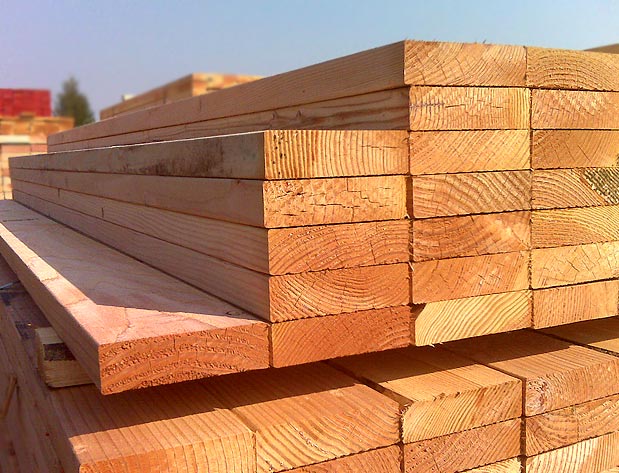
Last week recorded slow sales at the framing lumber mills in the US, which resulted in lower prices. Continue reading "Lumber prices in the US make first drop of the year"
New EU ecolabel criteria for wood flooring
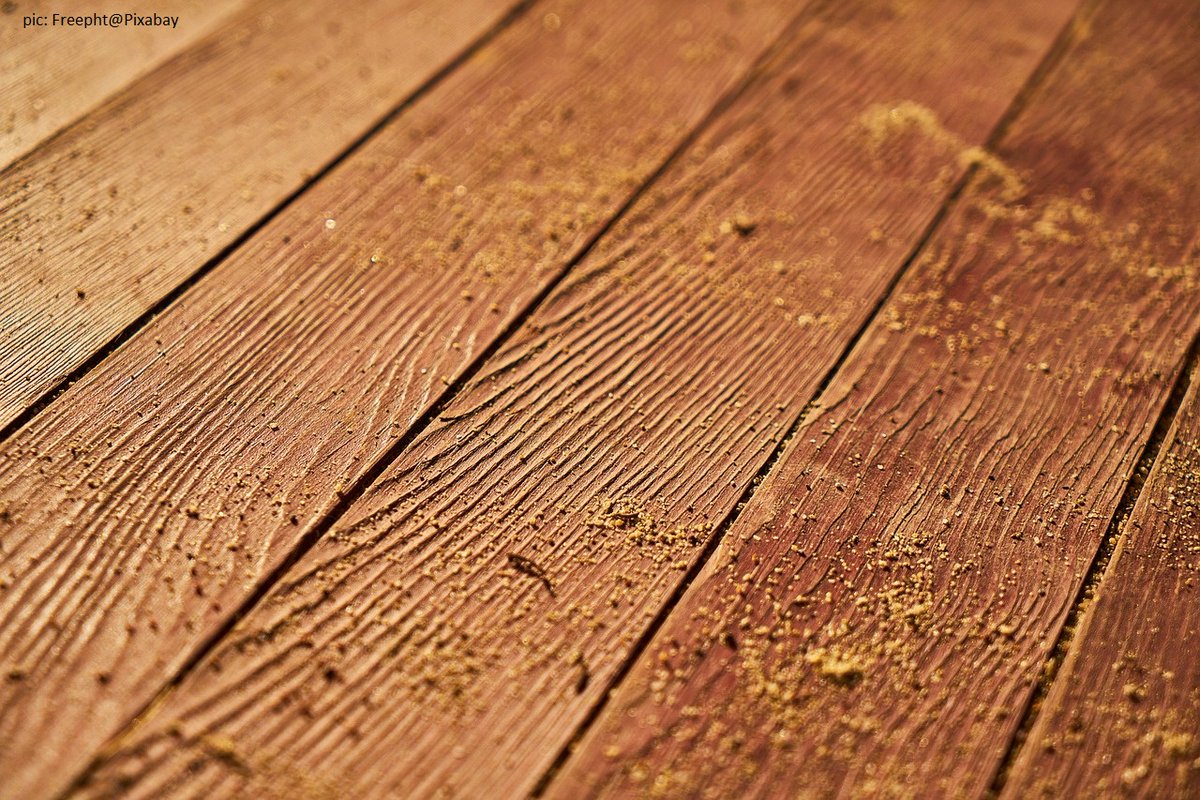
On 25 January 2017, the EU published Decision (EU) 2017/176 in the official EU Journal establishing EU Ecolabel criteria for wood, cork and bamboo based floor coverings.
The new criteria require that any virgin wood, cork, bamboo and rattan in the finished products originate from certified sustainably managed forests.
In addition, the Ecolabel criteria include a set of measures to ensure low energy consumption for manufacturing, drastically limit the VOC (Volatile Organic Compound) content, and ban use of harmful chemicals for flame retardant, binding and finishing applications.
The EU Ecolabel is a voluntary scheme, which means that producers, importers and retailers can choose to apply for the label for their products.
While not mandatory for the specified product, the green procurement policies of many EU authorities now recognize and may give preference to products bearing the EU Ecolabel.
Tokyo Olympic stadium will be built out of laminated lumber

The original plan for the National Stadium for the 2020 Tokyo Olympic Games were withdrawn in last July due to extreme high cost then there are two new proposals. The Ministers Conference selected plan A in late December.
The new stadium has theme of ‘wood and green’ and the roof is hybrid structure with combination of steel and wood.
The wood used is laminated lumber made of all domestic officially certified wood. Use of large amount of wood for the Olympic Stadium should trigger building of more wooden structures and common use of certified wood in Japan.
The new plan includes traditional Japanese design. Structural laminated lumber of both cedar E65-F225 and larch E95-F270 are used for the roof.
Materials are medium sized laminated lumber of 120x450 mm with length of less than 6 meters, which can be manufactured by any domestic laminated lumber plants.
A total of 1,800 cbms of laminated lumber will be procured. The use of forest certified products is inherited from the London Olympic.
Rising prices for softwood lumber in Austria

Prices for softwood lumber in Austria rose again in February. The increase compared to January is on average between EUR 1 to 3 per cubic meter.
The highest increase was registered in edged boards prices, which rose by about EUR 6/ per cbm. At the same time, prices for rough boards are the same in February as in January.
Compared to the same month last year, the increase fluctuates from EUR 3 to 6/ cbm or over. Only the upper price limit for rough boards has stagnated.
| Softwood Lumber Spruce/Fir | Feb. '16 | Jan. '17 | Feb. '17 | Change Feb. '16 to '17 € / cbm EXW |
| Edged Boards, 0-IIIa, 23 mm + | 229-244 | 230-241 | 236-247 | +7 / +3 |
| Rough boards in fixed dimensions, 18-22 mm | 227-240 | 230-240 | 230-240 | +3 / - |
| Squared timber, standard dimensions, I/II, 4-6 m | 206-216 | 210-217 | 211-219 | +5 / +3 |
| Reserve squared timber, II/III | 150-160 | 154-161 | 156-162 | +6 / +2 |
| Boards, III-IV, 8-16 cm, 4-6 mcm, 4-6 m | 145-151 | 147-154 | 150-155 | +5 / +4 |
| Boards, III-IV, 8-16 cm, just 4 m | 146-152 | 149-155 | 151-156 | +5 / +4 |
| Boards, III/IV, 23 mm, 4-6 m | 146-152 | 150-155 | 152-157 | +6 / +5 |
| Boards, III/IV, 28 mm +, 3-6 m | 150-157 | 155-163 | 157-166 | +7 / +9 |
Rising trend in EU sawnwood and plywood imports

The value of EU imports of sawnwood increased 4.3% to Euro 3.2 billion last year, continuing the rising trend which began in 2013.
There was a particularly significant increase in the value of EU sawnwood imports from Africa in 2016 which offset a sharp decline in imports from South East Asia.
EU imports of sawn wood from Russia and other CIS countries also continued to rise last year, helped along by the relative weakness of currencies in the region.
EU imports of panels (mainly plywood) increased 3.1% to Euro 2.52 billion in 2016 following an 11% in 2015. A significant increase in plywood imports from Russia offset declining imports from China and Latin America. There were also gains in EU plywood imports from Africa in 2016.
The long-term rise in EU imports of energy wood continued in 2016 to reach an all-time high of Euro 1.93 billion, up 9% compared to the previous year and nearly four times the value of a decade ago. EU imports of energy wood (now dominated by pellets) increased sharply from the U.S. and CIS region last year.
China: Wooden flooring manufacturers shift focus to second and third tire cities

According to statistics from the Flooring Special Committee within the China National Forestry Products Industry Association, sales of wooden flooring rose 4% to 396.8 million square metres last year.
Of the total, sales of solid wood flooring grew 10% to 43.9 million square metres, composite wooden flooring increased 9% to 104.5 million square metres, laminated flooring rose 2% to 210.5 million square metres with a 7% growth in sales of other wooden flooring. However, bamboo flooring sales fell 3%.
In recent years the domestic market for wooden flooring has evolved from being concentrated in the major cities to being more diverse in the so-called second and third level cities. Manufacturers have found that the market in the main urban areas has become over supplied and have therefore been forced to look to new markets.
China’s sales of wooden flooring are rising but analysts point out that the number of large and medium-sized enterprises is relatively small compared to the number of small scale companies that accounted for almost 90% of the wooden flooring industry output last year.
Finland’s largest CLT-factory starts production in Alajärvi

Alajärven Hoisko industrial area in Finland is currently under test run for the country's largest CLT-factory. Finland began the CLT production at the end of 2015, and this year the plant aims to bring 6,000 cubic meters of production. Continue reading "Finland’s largest CLT-factory starts production in Alajärvi"
Raw wood prices in Germany accelerated in 2016
Germany's situation on the raw materials market has been significantly reduced during the past two years. Continue reading "Raw wood prices in Germany accelerated in 2016"
Poland: Latest prices for softwood and hardwood logs

Below, there is a list for the average prices for pine, oak, beech, spruce and birch in Poland, during February 2017. Continue reading "Poland: Latest prices for softwood and hardwood logs"

