Article archive

Decline in US hardwood plywood imports from tropical countries

US imports of hardwood plywood declined 4% in 2016 from the previous year. In 2015 plywood imports increased 12%. A total of 3.14 million cu.m. of hardwood plywood were imported in 2016, valued US$1.82 billion.

Continue reading "Decline in US hardwood plywood imports from tropical countries"
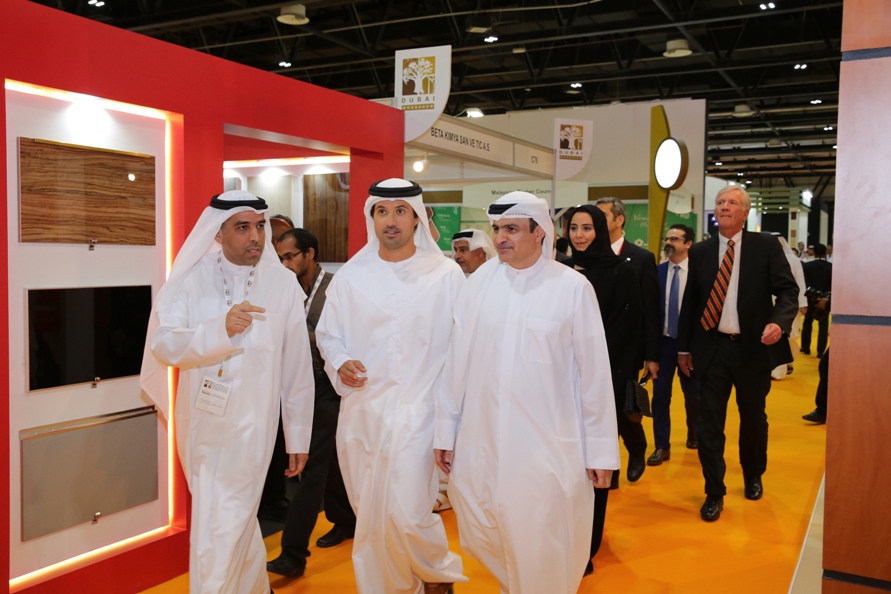
UAE examines potential of building wooden houses

New ideas and innovations were presented during the second day of the 12th edition of Dubai WoodShow (DWS 2017) and the 1st edition of Dubai International Furniture Accessories & Components & Semi-Finished Products Show (DIFAC 2017) on Wednesday (March 08).

Many initiatives were also presented at the show, one of which targets building 100 per cent wood-manufactured houses in the UAE.

“Statistics show that houses built using steel increase the CO2 emissions, followed by buildings made of concrete. While studies reveal that buildings using wooden building materials don’t only reduce CO2 emission, but also have positive impact on the environment by helping achieving sustainability,” said Juha Peltomaki, senior advisor from Finland.

“In Finland, it’s allowed to build 8 floors building using only wood. This experience proved to be successful and many countries in Europe are applying it now. I think this experience can be helpful in this region to support Dubai’s ongoing effort toward green economy in the attempts to provide affordable eco-friendly houses with great quality,” continued Peltomaki.

Sven Gustavsson, the director of Bois Resineux said that Canada and many other countries only use certified forests, where whenever any trees would be cut, another one will be planted to replace, which helps keeping the forests and achieve environmental sustainability.

Gustavsson praised Dubai efforts to focus on environment, by making strategies to achieve sustainability. He added that Middle East needs such responsible actions to reach green economy. Gustavsson said that there is an increasing demand on wood in the region, because of the rising number of projects in the area.

He explained that the demand in this region depends on quality, good design and national trend and peoples taste.

In Dubai people focus more on Red Oak and White Oak, plus the hard Maple which is Canadian specialty.

On the other hand, The American Hardwood Export Council (AHEC), the leading international trade association for the US hardwood industry, representing a committed team of U.S. hardwood exporters, are participating at the show.

The Council promotes the full range of American hardwood in over 50 export markets. AHEC has participated in all previous editions of the Dubai WoodShow, which signifies the importance of the exhibition globally.

"The American Hardwood Export Council has been a consistent participant at the Dubai WoodShow ever since its inception. The Council plays host to a number of U.S. hardwood exporting companies who exhibit under the prestigious show under American hardwood pavilion," stated Roderick Wiles, the director (Africa, Middle East, South Asia & Oceania) American Hardwood Export Council.

"This year, we have several new players joining us at the pavilion. These companies are displaying US hardwood lumber, and veneers," he noted.

The Dubai WoodShow, he stated, was a significant opportunity for its members to meet and network with existing and new customers in the region.

"As one of the most influential shows, Dubai WoodShow has been one of the best trade events in the Middle East and the wider Mena region. It has become an annual meeting destination for experts and businessmen from the industry and a focal point for trade and investments," added Wiles.

The Dubai WoodShow is one-of-its-kind in the region, and is considered the biggest trade event worldwide catering to the wood industry, according to its organisers.

"Year after year, Dubai reconfirms its position as an international platform for key players of the wood industry to meet and exchange their best practices, experiences and methodologies," stated Dawood Al Shezawi, Chairman, Strategic Marketing & Exhibitions, organisers of Dubai WoodShow.

"The show provides the key industry players with the right set of tools needed to present their products, which boosts the market share of the wood market in the region and worldwide," stated Al Shezawi.

According to him, AHEC has been a part of Dubai WoodShow since its commencement. "This is a reflection of Dubai’s leading position as a strategic destination for experts and specialists to gather under one roof to share and discuss best practices governing the industry," he added.

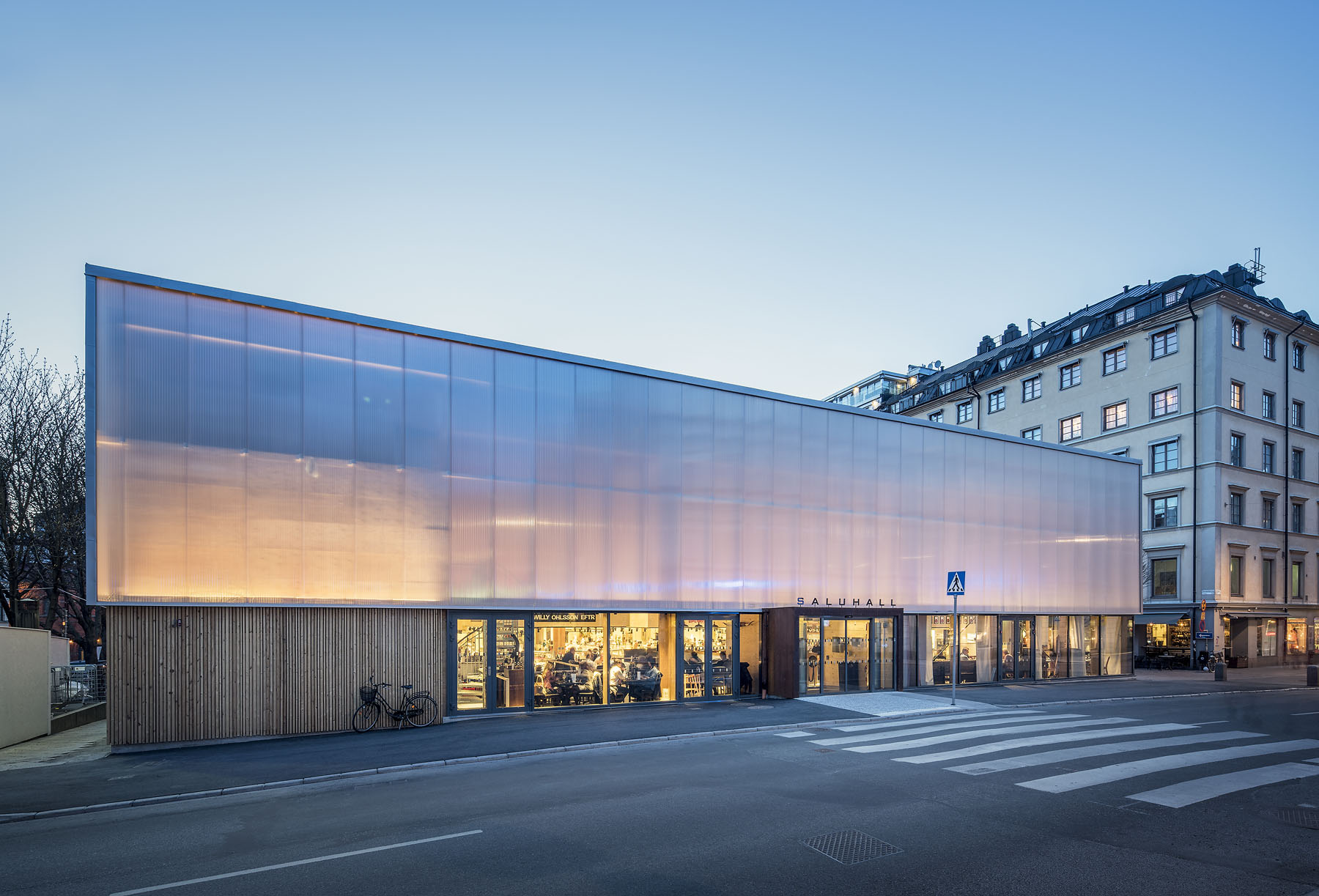
Metsä Wood builds temporary Kerto LVL wooden market hall in Stockholm

The distinctive new building in Stockholm’s Östermalm is a temporary market hall that was built as a temporary space while the old market hall is being renovated.

Metsä Wood’s Kerto® LVL built the temporary market hall, which now won Sweden’s most prestigious design award.The architectural agency Tengbom designed the concept of a temporary, modular wooden building that could built alongside the old hall. Tengbom wanted to promote sustainable construction, and Kerto LVL was the ideal choice for that.

“A standard solution for a temporary building would have been a marquee with an aluminium or steel frame. But this solution would have clashed with the prestigious brand of the market hall. And that is what we needed to cherish”, says principal architect Mark Humphreys.

The temporary market hall is actually a interesting of wood, glass and plastic. All these materials are lightweight, easy to work with and affordable, making them the best choices for temporary use.

The building’s roof structure consists of glulam columns and Kerto LVL beams in a grid structure, which is a strong shape, but makes the construction appear lighter and requires less material. The roof above the grid is made of plywood clad with sound-absorbing insulation made from wood fibre. 

The plastic used in the building is multichannel plastic with lots of air pockets, giving the material a very good insulation value. The plastic parts are completely prefabricated and they are airtight, watertight and naturally insulated. The glass in the windows is also insulated glass.

A fire protection treatment on the wooden parts guarantees the fire safety of the temporary market hall. The beams are painted with a transparent fire-retardant coating on site, and the plywood of the desks and floors has had a similar treatment. The floors and the columns were covered with plasterboard up to a height of three metres.

The refurbishment of the old market hall will be completed in 2018.

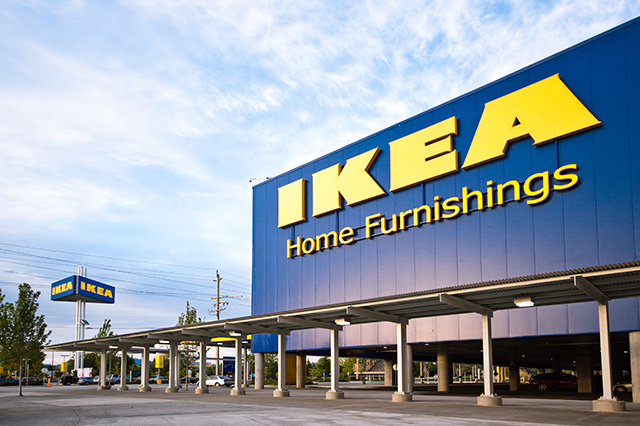
IKEA to introduce furniture that doesn’t require tools and snaps together

IKEA is ready to introduce products with an innovative new snap-together assembly system across its entire range of flat-packed furniture. Continue reading "IKEA to introduce furniture that doesn’t require tools and snaps together"

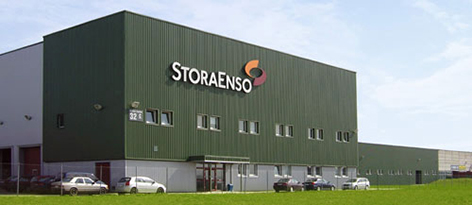
Stora Enso started LVL supplies from new Varkaus mill in Finland to the US, the UK and France

Stora Enso started supplies of laminated veneer lumber (LVL) from its new production facility  in Varkaus, Finland. Continue reading "Stora Enso started LVL supplies from new Varkaus mill in Finland to the US, the UK and France"

EPLF and MMFA plan to sell 50 million square meters of flooring in Iran in the medium term

Fifty million square metres per year as medium-term sales potential for laminate and multilayer flooring is estimated by the association management of the EPLF and MMFA in Iran.

Since the sanctions have been lifted, the two flooring associations are strongly committed to support and promote market access for their ordinary and extraordinary members.

On the occasion of talks with Iranian government bodies and related associations in February, managing director Peter H. Meyer was spontaneously invited to open the Woodex 2017 (International Exhibition of Accessories & Furniture Machinery, Equipment & Related Industries) in Tehran together with the General Director of the Iranian Ministry of Industry, Mining and Trade, Mr. Amir Hossein Shiravi.

Northern Softwood Lumber Bureau to merge into NELMA

The Northern Softwood Lumber Bureau (NSLB) has merged into the Northeastern Lumber Manufacturers Association (NELMA).

The NELMA name will remain in place to represent mills and associate members located in both regions.

“We are very excited to join forces with the Northern Softwood Lumber Bureau and welcome their members into NELMA. We look forward to working with them to extend NELMA programs across the Great Lakes area,” said Jeff Easterling, president of NELMA. “To address specific needs of our new members, a Red Pine Subcommittee will be added to the NELMA structure, with a kick-off meeting to be scheduled for early spring.”

Both associations enjoy an existing long-standing relationship, as NELMA has provided inspection services for the NSLB since 1985.

NELMA’s region now includes mills in Michigan, Minnesota, and Wisconsin. (Worth noting: NELMA’s export wood packaging program reaches currently as far west as North Dakota.)

As a result of the merger, NSLB members will have access to marketing programs and industry support not available before. NSLB members produce approximately half a billion board feet of lumber production, with Red Pine the dominant species of the Great Lakes states region but also includes Eastern Spruce, Balsam Fir, Jack Pine, and Eastern White Pine.

The Northeastern Lumber Manufacturers Association (NELMA) is a non-profit trade organization that has represented the softwood lumber industry located in the New England and Mid-Atlantic states since 1933.

South Korea unveils large wooden frame construction

South Korea has jumped on the tall wood bandwagon, unveiling a four-storey research institute that currently holds the record for the country’s largest wooden frame construction.

The central laboratory of the Forest Genetic Resources Department (FGRD) at the Korea Forest Research Institute (KFRI) in Suwon City, Gyeonggi province, sits on a land area of 4,500m2 and was designed as a post and beam construction using glulam made of Korean Larch.

Bae Ki-Cheol, principal architect of IDS Architects, who designed the laboratory was inspired by multi-storey and hybrid buildings made of wooden frames during a trade mission to Canada organised by Canada Wood’s Korea office in 2014. He was since interested in wood frame construction and proposed it for the new lab, which won first place in a design competition in June 2013.

As glulam is structurally sound for multi-storey and large-scale wood frame construction, the engineered wood product has drawn keen attention from the building industry.

Professor Park Moon-Jae, director of the Department of Forest Products at KFRI said, “The completion of this building is recorded as the first successful example for boosting multi-storey wood frame constructions in Korea. Based on this, KFRI will continue research and development, aiming to build a five-storey wood frame construction by 2018 and a 10-storey wood framed apartment by 2022.”

UK's sawn timber imports face large price increase

UK's imports of sawn timber have faced the largest price increase in the year to January 2017. The construction material price index for all work increased 5.8% in the year to January and 1.4% on a monthly basis. Continue reading "UK's sawn timber imports face large price increase"

UK’s sawn timber imports face large price increase

UK's imports of sawn timber have faced the largest price increase in the year to January 2017. The construction material price index for all work increased 5.8% in the year to January and 1.4% on a monthly basis. Continue reading "UK’s sawn timber imports face large price increase"

Record order intake of EUR 162 million for Raute in 2016

Raute has recently released its results for the financial year 2016. The Finnish woodworking machinery supplier ended the year with 11% improvement in order intake, amounting to EUR 162 million, also setting up a new record for the company. Continue reading "Record order intake of EUR 162 million for Raute in 2016"

Softwood lumber prices in the US up 15% since January; forecast to continue growth this year

The price of lumber in the US, from framing to structural panels, has increased in recent weeks with some prices rising more than 30%.
Softwood lumber prices have been relatively steady since 2014.  During this period, the largest one-week price increase of framing lumber (+6.8%) occurred in the middle of the recent price escalation.
The largest one-month swing of softwood lumber during this period was 2.9% in 2014 according to the Bureau of Labor Statistics Producer Price Index(PPI). Continue reading "Softwood lumber prices in the US up 15% since January; forecast to continue growth this year"

Interview with the newly president of EUMABOIS, Mr. Juergen Koeppel

“Möbelfertigung” magazine’s Doris Bauer had an in-depth interview with the newly appointed Eumabois President. Several topics were discussed, all very interesting... Here is a summary of the most significant.

möbelfertigung: Mr. Köppel, in the previous term you were Vice President, now you have taken the top position within Eumabois. What’s the key driver for your new role within the federation?

Jürgen Köppel: It’s the opportunity to represent some 850 companies worldwide. Besides that, I can have an influence and get things moving for companies. For instance, there are decisions to be made in Brussels. On a political level, there is quite a lot of academic discussion. An example is the topic of sustainability at machine level: sometimes decisions are made that definitely sound good, but then they turn out to be very hard to implement. In such cases, it may be sensible to involve as many companies as possible and collect their requirements... Eumabois is perfectly fit for this task.

It is always difficult for companies alone to tackle specific issues. We have a very effective approach to a large number of companies from different national associations in Europe. No matter if it’s about political issues that involve our business or the definition of technical standards.

möbelfertigung: What’s the main reason why you accepted to step up from Vice President to President?

Jürgen Köppel: The main reason for me was that the Vice President standing next to me is an operating figure, and even the rest of the board is comprised of persons who have operating roles in the daily business of their companies. In this way, when it comes to consulting activities and markets, we can offer all our expertise and bring different points of view about various topics.

We have succeeded in covering all board positions with this approach. For instance, since September I have been working very closely with Vice President Luigi De Vito, who is the managing director of SCM Group’s woodworking machinery division.

möbelfertigung: What’s the mission of Eumabois?

Jürgen Köppel: Before I took over the role of Vice President, Eumabois’ activity to me was mainly focused on the international exhibition calendar, as well as on specific exhibitions that the federation promotes to support their growth. In this respect, one of my ambitions was to maximize the effectiveness of this action, in order to improve how the federation presents itself and what it stands for. Apart from exhibition-related activity – which is definitely important – Eumabois is a loudspeaker for its members in several areas, from DIN standards to customs regulations.

möbelfertigung: What’s the most important task of the federation, in your opinion?

Jürgen Köppel: Definitely, consulting for its members. That’s why I cannot understand why sometimes smaller companies say: “This association is not for me.” Exactly those companies often don’t have the resources to carry out expensive analysis and surveys, whereas the community of an association can do that and actually does.

In my position at Homag Group, for instance, I turned to the German association VDMA to get reliable information about a specific market. And even for the association it was difficult to make resources available to collect such market information.

Imagine a small manufacturer considering the possibility to produce in China in order to increase its competitiveness: where can they get industry-specific market information other than from their national association or Eumabois?

möbelfertigung: Is there anything you would like to change?

Jürgen Köppel: We always have ideas to improve things, building on very solid foundations. For instance, an important task of the association is to collect useful information, such as import and export figures, revenues and similar data. These figures are generated by the associations of each country and flow into a common data platform at Eumabois, so that we can have a clear picture at the end. Statistic structures are partially outdated, as machines have changed a lot, for instance. In this case it would be useful to update the classification.

Of course we have identified a few key activities, which we formulated last November so that we can bring them forward together.

The awareness and knowledge of external events is one example. I like to make a comparison with the European Union: why has “Brexit” happened? Because, in the end, there was little discussion about the positive sides of the European community, while the negative aspects became more and more visible. In this respect, we want to carry out a stronger marketing action. For instance, we must inform that an exhibition has increased area prices by 10 Euro per square meter, instead of 50, as a result of fruitful discussion with Eumabois. It is necessary to promote our positive action to the public.

Another topic on our agenda, for instance, is the Code of Conduct. In some member associations such rules were introduced long ago, but not in others. We want to identify the core concepts centrally, to be used then by our member associations.

möbelfertigung: Are you getting additional benefits from your exhibition activity?

Jürgen Köppel: There are basically two key benefits, both for exhibitors. On one side, single companies from national associations can participate in collective booths and do not need to organize their participation completely on their own.

Also the member associations do not need to set up a small booth on their own, instead they can show up more attractively as association under the umbrella of Eumabois. We are developing and expanding these options and we believe they will be appreciated. This strategy would also provide each company with an attractive “remote” point of contact at the Eumabois collective booth. Active companies recognize each other and are happy to exchange views and opinions in foreign markets.

We want to expand this type of initiatives in the future: at “Ligna” 2015, Euambois promoted the creation of a real “federation marketplace” where exhibitors and visitors could meet. We want to apply this concept to other exhibitions.

möbelfertigung: Which part of the association’s work at European level do you value most?

Jürgen Köppel: We have to be aware of our role in the global scenario. There is hardly any other region in the world that can set standards. If you consider a Big Europe with a strong expansion to East, this will generate not only trends, but also standards. And such an agile federation will bring benefits also to smaller businesses, as someone will also listen to them, and not just to the big brands. We must keep this concept very clear in our mind. With such a forward-looking concept, business will become certainly much better.

Source: Eumabois

ATIBT to publish new guide to using African timbers in Europe

The Association Technique Internationale des Bois Tropicaux (ATIBT - International Tropical Timber Technical Association) has just released Volume 1 of their "User Guide for Eco-certified African Timber in Europe".

The aim is to help transform attitudes to tropical timber in Europe, enhancing awareness that it offers an efficient, technically superior and responsible material for use in a wide range of applications.

The ATIBT Guide shows how certified African species can supplement and complement temperate timber species, thereby helping to expand the total market for wood products in Europe.

To achieve these goals the guide promotes both the natural properties of tropical timber and the major effort to independently certify and verify the legality of forests and wood products in tropical Africa.

The ATIBT Guide was prepared by Patrick Martin and Michel Vernay, both qualified timber engineers and recognised experts in the use of tropical timber in construction. Financial support was provided by PPECF (Programme de Promotion de l'Exploitation Certifiée des Forêts - Programme for the Promotion of Certified Forest Operations) and the AFD (Agence Française de Développement - French Development Agency).

Volume 1 of the Guide is intended for European users of African timber, as well as all suppliers, distributors, designers, public buyers and instructors whose activities are linked to the timber sector. Volume 2, yet to be published, will target African consumers.

The Guide is divided into two sections. The first section provides technical information on the various aspects of tropical timber. It explains in layman's terms the principles of sustainable tropical forestry and its implications for land-use change, carbon sequestration and other environmental impacts, and describes the African production region, progress to achieve certification and its implications and benefits.

The first section also explains the various technical properties of tropical timbers (mechanical resistance, hardness, resilience, aesthetics, durability), provides information on drying and other treatments and appropriate applications, and thereby highlights the benefits of using tropical timber in construction.

The second section of the Guide describes the wide range of applications for which tropical timber offers clear technical, aesthetic and environmental advantages, including exterior and interior joinery applications, waterprotection and other heavy duty structural and industrial applications, boat building, and high value items like musical instruments and turnery products.

For each application, the guide provides information on the required properties of timbers, relevant standards, and a list of appropriate tropical timber species.

Central/West Africa: FOB prices for sawnwood begin to stir

Sawnwood FOB prices in Central/Western Africa have begun to stir on the back of steady demand from buyers for the Chinese market and active buying by Middle East importers.
Demand in Europe has improved slightly but remains only moderate. A recovery in demand in China is expected to continue but is likely to be focused on a few selected species, say analysts.
There is virtually no interest in sapele sawnwood either in Europe or Asian markets so prices are under pressure. Producers report that, currently, it is the more dense species such as okan, tali, padouk and bomanga that are favoured.
Peeler mills short of okoume logs
Newly established veneer peeler mills in Gabon, many of which are Indian, are struggling to source okoume peeler logs. This shortage, along with the beginnings of an improvement in export demand for okoume logs, is likely to result in higher log prices.
At the moment in Gabon the rains are very heavy and hindering logging and transport operations which is adding to the problem of millers.
Sentiment amongst producers in Gabon is depressed, the economy is struggling and there are no signs the refunds of TVA (value added tax) will be made any time soon. On top of this the government is mulling new taxes on industry to pay for the additional checks being made transport operations.

Log Export Prices

West Africa logs, FOB € per m³
Asian market
LM
B
BC/C
Acajou/ Khaya/N’Gollon
240
240
160
Ayous/Obéché/Wawa
240
240
190
Azobe & Ekki
230
230
160
Belli
240
235
Bibolo/Dibétou
180
170
Bilinga
220
220
-
Iroko 325
300
265
Okoume (60% CI, 40% CE, 20% CS) (China only) 210 190 160
Moabi 330 300 235
Movingui 210
210
160
Niove
175
160
Okan
210
190
Padouk
300
280
230
Sapele 290 280 220
Sipo/Utile
310
290
255
Tali 330 320

 
Sawnwood Export Prices

West Africa sawnwood, FOB
€ per m³
Ayous FAS GMS 420
Bilinga FAS GMS 515
Okoumé FAS GMS
340
Merchantable 290↑
Std/Btr GMS 300↑
Sipo FAS GMS
540↓
FAS fixed sizes 560
FAS scantlings 560
Padouk FAS GMS 810↑
FAS scantlings 920
Strips 645
Sapele FAS Spanish sizes 505↓
FAS scantlings 510↓
Iroko FAS GMS 620
Scantlings 710
Strips
420↓
Khaya FAS GMS
450
FAS fixed
470
Maobi FAS GMS
620↑
Scantlings
630
Movingui FAS GMS
430

Source: ITTO

Brazil: Exports of wood products up 20%

In January 2017 Brazilian exports of wood-based products (except pulp and paper) increased 20.0% in value compared to January 2016, from US$175.2 million to US$210.3 million.

The value of pine sawnwood exports fell 82% between January 2016 (US$20.2 million) and January 2017 (US$3.7 million). In terms of volume the change was 102,000 cu.m in January 2015 to just 18,000 cu.m this January.

In contrast, the volume of tropical sawnwood exports rose 32% from 24,800 cu.m in January 2016 to 32,800 cu.m in January this year.

However the value of these exports increased by just 13% from US$12.1 million in January last year to US$ 13.7 million this year.

Brazil’s pine plywood exports increased 31% in value in January 2017 in comparison with January 2016 levels, from US$26.6 million to US$ 34.8 million. In volume terms exports increased 29% over the same period.

Tropical plywood exports from Brazil increased significantly in volume and in value in January this year rising from 6,200 cu.m (US$2.2 million) in January 2016 to 10,600 cu.m (US$3.9 million).

The value of wooden furniture exports also rose in January from US$23.6 million in January 2015 to US$26.6 million in January this year.

Universal Forest Products enters hardwood business with new acquisition

Universal Forest Products Inc. plans to break into the hardwood products with the acquisition of an Indiana-based manufacturer.

The Grand Rapids-based Universal said that one of its affiliates had closed on a deal to buy certain assets of Quality Hardwood Sales LLC of Nappanee, Ind., according to a statement.

Quality Hardwood is a manufacturer and supplier of hardwood products and cabinetry components for homes and recreational vehicles. The company had net sales of about $30 million in 2016.

According to a statement, Quality Hardwood’s management team planned to stay on with the company following the sale.

The deal marks Universal’s first foray into hardwood products, which it sees as a move to further diversify and grow, according to CEO Matt Missad.

In announcing the deal, Missad praised the company’s “exceptional manufacturing expertise,” “strong management team” and products “known in the industry for their superiority.”

Terms of the deal were not disclosed.

Newsletter

Subscribe to our digital newsletter for your daily digest of essential news, views and analysis from the international wood industry delivered directly to your inbox.


0