Article archive

EPAL reports best year ever in 2016

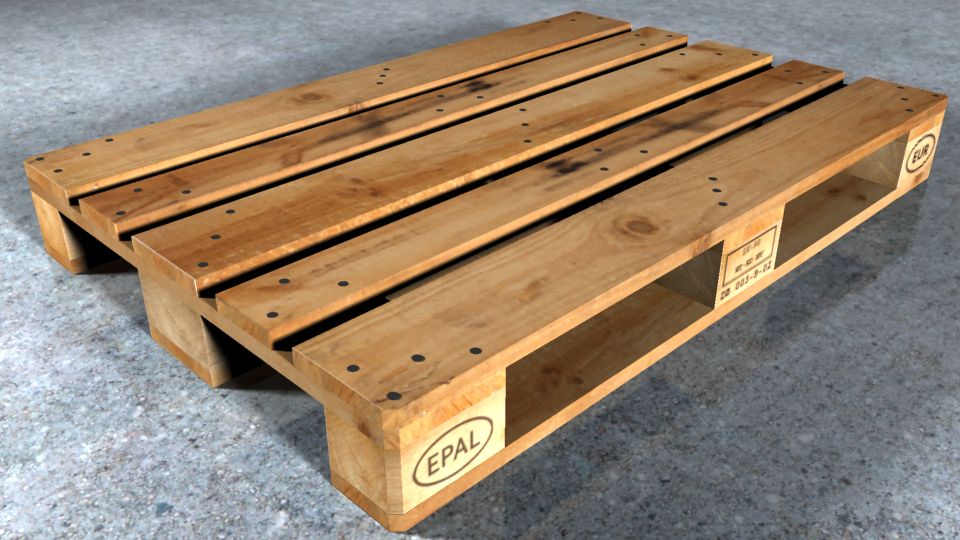
In 2016, the European Pallet Association e.V. (EPAL) achieved another record result of 105.5 million EPAL pallets in total (production and repair): up 4.35% in comparison to the previous year.

Production figures rose by 8.93% to 80.5 million EPAL pallets, while repairs rose by 1 million to 25 million repaired EPAL pallets.

Martin Leibrandt, CEO of EPAL, comments: “It is truly impressive that we could top 2015, our best year ever, and we are proud of all our EPAL licensees and the work of the EPAL National Committees, without whom this superb result would not have been possible.”

The European Pallet Association e.V. (EPAL) ensures a smooth flow of goods in the logistics world with over 450 million EPAL Euro pallets and 20 million box pallets in the world’s biggest open exchange pool.
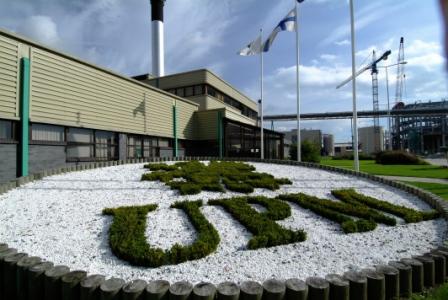
UPM bets on Chinese market opportunities

Foreign companies are more and more interested in developing businesses in China due to the country's supply-side structural reform, priority in innovation and other efforts in economic transformation. Continue reading "UPM bets on Chinese market opportunities"

Sweden: Tall buildings in wood may represent a good example for increasing production

Multi-storey buildings in wood are on the rise in Sweden as their many advantages become clear. The buildings have no drying times and are quick to construct, which reduces costs and generates less disruption for neighbours. Since the structural frame is light compared with other materials, laying the foundations is also easier.

Continue reading "Sweden: Tall buildings in wood may represent a good example for increasing production"

Thermally modified American ash showcased by AHEC in Turkey project

The American Hardwood Export Council (AHEC) has launched a new case study showcasing the use thermally-modified American ash to create a new integrated coastal attraction in Izmir, Turkey.

The ‘Bostanlı Footbridge’ and ‘Bostanlı Sunset Lounge’ have been designed by Studio Evren Başbuğ Architects as part of the 'Karşıkıyı' concept created for the 'İzmirSea' coastal regeneration project. These two architectural installations, which are positioned in close proximity and in reference to each other, have generated a new, integrated coastal attraction, where the Bostanlı Creek flows into the bay, on a very special and unique spot due to the geometric form of the coastline. Opened in July 2016, the site has become one of the top public attractions in Karşıyaka, İzmir and has been embraced and visited by residents from all over the city.

The ‘Bostanlı Footbridge’, oriented in its unique position and providing a view of the bay on one side and the city on the other, has been designed with an asymmetrical cross-section. This special section is formed by several cascading thermally-modified American ash boards, produced and provided by Novawood, installed on a steel frame, allowing users to enjoy the view of the bay either sitting or sprawling. In this way, the bridge goes beyond being just an infrastructural urban element, solely used as a thoroughfare, and instead, serves as a public leisure and attraction piece in relation to its environment.

“Given that the site was so unique in terms of its location and geography, as designers we did not need any more inspiration from the outside. The 'Bostanlı Footbridge’ and 'Bostanlı Sunset Lounge’, both promise a new urban space to experience different forms of 'idleness', by employing the social, geographical and historical backgrounds of this unique location. These new coastal installations fit perfectly with the 'Easy Way of Living' vision established for the city of İzmir, by the 'İzmirSea' coastal regeneration project,” said Evren Başbuğ, Founding Partner, Studio Evren Başbuğ Architects.

“All the materials are open to the corrosive effects of salty sea water. Also as a Mediterranean city, İzmir has a relatively high percentage of sunny days, leaving the thermally-modified ash vulnerable to the ultraviolet sunlight. These conditions made us think twice at the design phase but we decided to give it a try. It has been almost a year since the opening, and we frequently visit the site to see if there is any significant material degrade, but the wood is performing well. Wood ages nicely,” added Başbug.

Montréal Wood Convention’s 5th edition hosted over 110 exhibitors

With over 900 attendees representing some 400 companies from 14 countries, and over 110 exhibitors at the trade show, the success of the 5th edition of the Montréal Wood Convention exceeded all expectations of the associations organizing the event.

"For players in the wood products industry, it was essential to be present in the exhibition hall of the Convention, which was held from March 28 to 30 in Montréal. It was the key venue for discussions and exchanges between manufacturers and distributors,” said Sven Gustavsson, director of the softwoods group at the Quebec Wood Export Bureau (QWEB), one of four host associations.

The keynote speaker, Manjit Minhas, a 35-year-old beer baroness and the newest dragon on the hit TV show Dragons’ Den, recounted her career as a woman entrepreneur in a traditionally male industry. "Find your passion and count on your mentor,” she said enthusiastically.

During the different presentations, guest speakers were optimistic. Consumer demand for wood products in North America is growing steadily according to CIBC analysts. For the American Wood Council, the future is bright for multi-storey wood construction.

The Council is seeking to see construction codes allow wooden buildings up to 20 storeys by 2021. Scientific research confirms that the best way to sequester CO2 to tackle climate change remains the use of wood in construction.

As for tomorrow's trade tools, the industry needs to be prepared, as the "Amazon" way of doing business is on our doorstep due to the habits of younger generations. Finally, the hardwood industry can also look to the future with confidence considering that global furniture production is still growing and 40% of the global value of furniture is composed of wood or wood panels.

In terms of international participation, the Convention was also a success. "Some 60 qualified overseas buyers took part in industrial visits and had the opportunity to meet directly with local manufacturers to do business," said Sven Gustavsson.

The organizers, the Quebec Wood Export Bureau, the Quebec Forest Industry Council, the Ontario Forest Industries Association and the Maritime Lumber Bureau are pleased to invite the industry to the 2018 edition that will be held from March 20 to 22 at the Fairmont The Queen Elizabeth in Montréal.

Austria: Prices for softwood lumber fell slightly in March but still higher yoy

In March, the prices for softwood lumber in Austria declined slightly compared to February. The decline is of 1-2 euro per cubic meter on almost all of the assortments.
Only edged boards gained a minor price increase. Prices for rough boards have remained constant.
However, as compared to March 2013, prices have increased by about 2-4 euro per cubic meter. The maximum increase was of 7 euro. Only prices for rough boards and squared timber have stagnated year-on-year.

Softwood Lumber Spruce/Fir Mar. '16 Feb. '17 Mar. '17 Change Mar. '16 to '17
€ / cbm EXW
Edged Boards, 0-IIIa, 23 mm + 229-244 236-247 235-248 +4 / +4
Rough boards in fixed dimensions, 18-22 mm 227-240 230-240 230-240 +3 / -
Squared timber, standard dimensions, I/II, 4-6 m 207-217 211-219 209-218 +2 / +1
Reserve squared timber, II/III 150-160 156-162 154-160 +4 / -
Boards, III-IV, 8-16 cm, 4-6 mcm, 4-6 m 145-151 150-155 147-154 +2 / +3
Boards, III-IV, 8-16 cm, just 4 m 146-152 151-156 149-155 +3 / +3
Boards, III/IV, 23 mm, 4-6 m 147-152 152-157 149-155 +2 / +3
Boards, III/IV, 28 mm +, 3-6 151-157 157-166 156-164 +5 / +7

EU tropical sawn hardwood imports remain static in 2016

In 2016, EU imports of tropical sawn hardwood were 1.04 million m3, unchanged from the previous year. The value of EU imports increased by 2% to Euro775 million.

The average unit value of tropical sawn hardwood imports into the EU in 2016 was Euro747 per cubic meter, up from Euro730 per cubic meter the previous year.

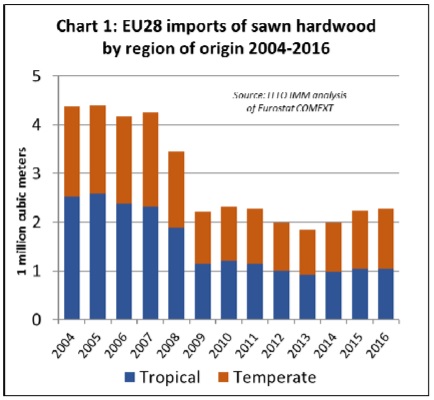
The volume of EU imports of tropical sawn timber remains stalled at historically very low levels. Import volume in 2016 was 12% higher than the all-time low of 930,000 m3 recorded in 2013 but remains 40% below the levels prevailing before the global financial (Chart 1).

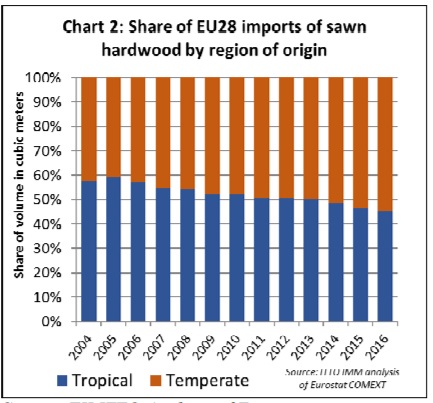
The share of tropical in total EU sawn hardwood imports declined from 46.5% in 2015 to 45.6% in 2016, continuing a long term downward trend (Chart 2).

In 2016, EU imports of temperate sawn hardwood increased 3% to 1.24 million m3. This was mainly due to a 13% increase in EU imports of sawn oak from Ukraine in response to tighter controls on log exports from that country and extreme weakness of the Ukrainian currency.

EU importers warned on Myanmar teak

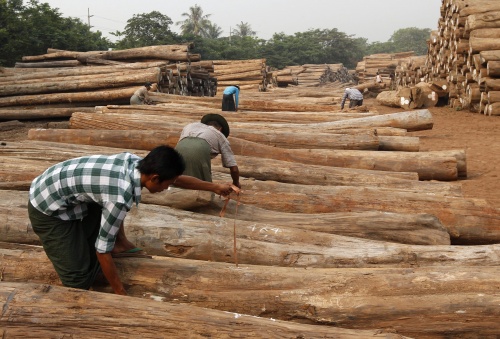
First Sweden then Denmark and now the UK Timber Trade Federation (TTF) have warned importers they could be in contravention of the EUTR if they import teak from Myanmar.  The UK TTF has gone further and called for EU wide action.

Having profited for decades from the teak trade now is not the time to penalise the timber industry and forest authority in Myanmar.

As Myanmar opens to international scrutiny, moves to stop forest devastation and tables a draft legality verification system the forest authority and industry should be encouraged and assisted.  Now is the time to offer support.

A press release from NepCon, a Danish non-profit organisation, says the Danish Competent Authority asked seven local companies to strengthen their due diligence systems if they wish to continue to market Myanmar teak in the EU.

This, once again, raises questions on whether it is currently possible for importers of timber from Myanmar to satisfy the EU Timber Regulation.

NepCon says Danish authorities audited some companies that had imported teak from Myanmar after being alerted to allegations by the Environmental Investigation Agency.

The Danish authorities concluded that the system in place in all seven companies was not robust enough to demonstrate a negligible risk of illegality.

The problem, says NepCon, is that the authorities in Myanmar are not allowing importers in the EU access to information on the origin of the timber and that they do not have systems in place to adequately assess the risk that illegal timber is entering the supply chain.

This allegation has been raised before but during the February 2017 timber legality assessment system ‘Gap Assessment Workshop’ involving the EU and various stakeholders, representatives of the Myanma Timber Enterprise (MTE) denied this saying they had not been approached for information, adding that the Forestry Department is the final authority to be approached.

Competent Authorities in Belgium, Italy, Netherlands, Spain and the UK are also investigating possible breaches of the EU Timber Regulation as a result of the import of teak from Myanmar. These cases were also brought to them by the Environmental Investigation Agency.

In an apparent reaction to the Danish ruling, the Myanmar Ministry of Natural Resources and Environmental Conservation released a statement in which they acknowledged the challenges in tracing timber back to the forest because, at present, their system is primarily designed for the recording statistics.

UK TTF warns members do not import Myanmar teak

In response to the actions taken in Sweden and Denmark against importers of Myanmar teak, David Hopkins, Managing Director of the UK Timber Trade Federation, writes in the March TTF Newsletter “If the EUTR is to be successfully implemented then there must be a level playing field in Europe. This means we should respect the decisions made in Sweden and Denmark and accept them across the continent.”

The TTF says “Since the authorities in Myanmar are, as yet, unable to offer sufficient evidence of legality TTF members should cease to trade in teak sourced from Myanmar.”

Drax Group provisionally acquires Louisiana Pellets for $35.4 million

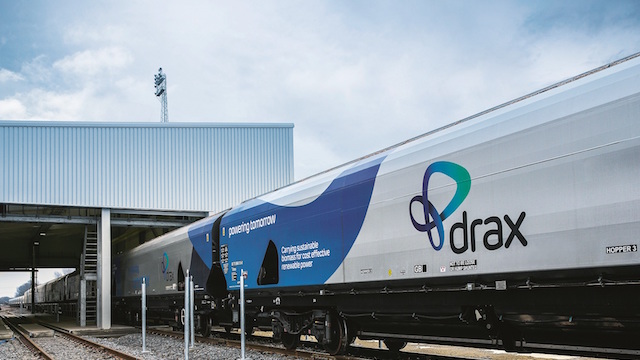
Drax Group PLC said on Monday that it has been provisionally successful in its bid to acquire Louisiana Pellets out of bankruptcy at auction. Continue reading "Drax Group provisionally acquires Louisiana Pellets for $35.4 million"

Schilliger Holz extends glued laminated timber production in Switzerland

Schilliger Holz replaces a glued laminated timber (glulam) production line in Haltikon, Switwerland with a new, more productive machinery. Continue reading "Schilliger Holz extends glued laminated timber production in Switzerland"

Kährs Group closes hardwood flooring production in Finland

Kährs Group is reorganizing its hardwood flooring production. The company announced a closure of its production unit in Tuupovaara, Finland. 

The company is starting the implementation of the decision immediately and the reorganization affects 21 employees.

Christer Persson, President and CEO of Kährs Group, commented: “Streamlining our supply footprint and adjusting our production network to what is in demand is necessary to secure our long-term ability to provide customers with competitive, high-quality hardwood floors.”

Earlier Kährs Group signed an agreement to supply wood flooring to Stena Fastigheter. Deliveries under the new agreement will start during the first half of 2017.

The company is a world-leading flooring manufacturer in hardwood and resilient flooring with a number of strong brands in its product portfolio, including Kährs, Karelia and Upofloor. Kährs Group, which delivers products to more than 70 countries, is the market leader in Sweden, Finland, Norway and Russia and holds a strong position in other key markets, such as the UK and Germany. The Group has approximately 1,600 employees and annual sales of EUR 300 million.

Global softwood lumber exports reach new record-high in 2016

Global softwood lumber trade increased 12% year-over-year to reach a new record-high of 121 million cu. ft. in 2016.  Since the global financial recession in 2009, there has been a steady climb in international trade of lumber, with shipments the past seven years increasing as much as 66%.

While it’s no surprise that China is a major driver for the dramatic rise in lumber shipments worldwide the past seven years, it is interesting to note that the U.S. has actually increased softwood lumber imports more than China, according to Wood Resources International.

Lumber exports from British Columbia reached their highest levels since 2006 in 2016. Lumber shipments from the province to the U.S. were up 25%, while exports to Asia fell about 8%.

Lumber prices in the Nordic countries were at historically low levels during most of 2015 and 2016. During the first 10 months of 2016, Finland increased lumber exports by 10%, on pace for a record year. It is interesting to note that the three biggest export markets for Finnish sawmills are all outside Europe: Egypt, Japan and China.

China imported record high volumes of softwood lumber in 2016, with import volumes in the fourth quarter up about 20% compared to the year earlier.

Japanese softwood lumber imports in 2016 were the highest they have been in three years as total wood demand in the country picked up 3.6% from 2015. There has been a slow but steady shift in the sourcing of lumber away from North America to Europe and Eastern Russia the past few years. From 2015 to 2016, the North American market share fell from 39% to 35%, while the market share of lumber from Russia and the Nordic countries increased from 39% to 42% year-over-year.

Exports of Russian lumber jumped 10% in 2016, contributing to a 26% increase over the last three years. More than half the wood was shipped to China.

Raute to acquire US grading technology for lumber and veneer company Metriguard Inc

Raute Corporation and the owners of Metriguard, Inc. have agreed on the purchase of the business of Metriguard Inc., Pullman, Washington, USA.

Metriguard, established in 1972, is the world leader in high speed strength grading technology for lumber and veneer. Metriguard sells and provides services for its equipment globally, with installations in North and South America, Europe, Asia, Africa, Australia and New Zealand.

Metriguard’s products and technology are complementary to Raute’s current product offerings. Over the years, Metriguard’s products have been integrated into dozens of Raute’s deliveries. Metriguard’s net sales were USD 4.6 million in 2016, with an EBIT of USD 0.8 million, and it employs 26 people.

Metriguard’s business will continue by a newly established Raute’s subsidiary Metriguard Technologies, Inc.. Its financials will be reported as part of Raute’s wood products technology segment. The acquisition is deemed to have a positive effect on Raute’s net sales in 2017 and on its financial results starting from 2018.

The acquisition is made as an asset purchase. Intangible assets, working capital and fixed assets, except real estate, are acquired. Metriguard’s personnel will transfer in along with the acquisition. The purchase price, estimated at USD 4.5 million, is paid in two installments. A base purchase price of USD 3.1 million is paid at closing, additionally there will be an earn-out payment based on net sales for a 12-month period following closing of the transaction.

Raute’s President and CEO Tapani Kiiski said: “Metriguard's technology has evolved over more than four decades and has proven to provide veneer and lumber mills with significant benefits in terms of enabling capturing the highest possible value of the given raw material. Raute's strategy is to provide technology to our customers to help them run their business in a profitable way, but strength grading technology has been missing from our offering. With Metriguard's technology, and its solid and well recognized brand, we will be able to offer even more comprehensive solutions. We believe this acquisition will help Raute grow and open new opportunities for Metriguard."

US wooden furniture imports remain at record high levels

The value of wooden furniture imported in January was almost unchanged from the previous month at US$1.58 billion. Imports were 13% higher than in January 2016.

Furniture imports from China declined 2% month-overmonth to US$768 million in January, but imports were 12% higher than at the same time last year.

The strongest growth was in wooden furniture imports from Vietnam, which increased 10% from December to US$339 million. Imports from Vietnam were 24% higher than in January 2016. Furniture imports from Canada, Mexico and India were also up compared to January 2016.

Malaysian furniture exports to the US were US$58.9 million in January, unchanged from December and slightly down from January last year. Imports from Indonesia were slightly down in January at US$45.9 million.

Imports of non-upholstered wooden seats grew for the third consecutive month in January. Upholstered seating imports declined 3% from December. Imports of wooden kitchen and bedroom furniture were up in January, while office furniture imports declined.

Finnpulp receives environmental permit for the world’s largest softwood pulp mill

The Regional State Administrative Agency has granted the environmental permit for Finnpulp's bioproduct plant, which is to be built in Sorsasalo, Kuopio, and the wastewater treatment facility connected to the plant.

The environmental permit defines the terms for the pulp plant's operation in the production phase, as well as for pipeline installation work and changes made to the shore line during the construction phase.

Production is planned to start in 2020, and the plant's annual production capacity will be 1.2 million tons of softwood pulp. Additionally, the plant will produce other bioproducts, including 60,000 tons of tall oil and 1.5 TWh of bioelectricity per year. 1 TWh of the electricity will be fed into the national grid.

Finnpulp considers the terms of the permit to be strict. The authorities have further tightened the low levels presented in the company's permit application, which already met the EU's best practice requirements for the industry. Finnpulp will carefully contemplate how to achieve the permit terms.

Once Finnpulp's project is completed, it will be the world's largest softwood pulp plant. In the project phase, the employment effect of the 1.4 billion euro facility investment is 5,700 full-time work years. The bioproduction plant, once completed, will create 1,500 new permanent jobs in Northern Savonia and 3,400 in the national value chain. Once production starts, 200 people will work in the plant area. The plant will use 6.7 million cubic metres of raw wood material per year.

Greenply builds a new plywood plant in Sandila

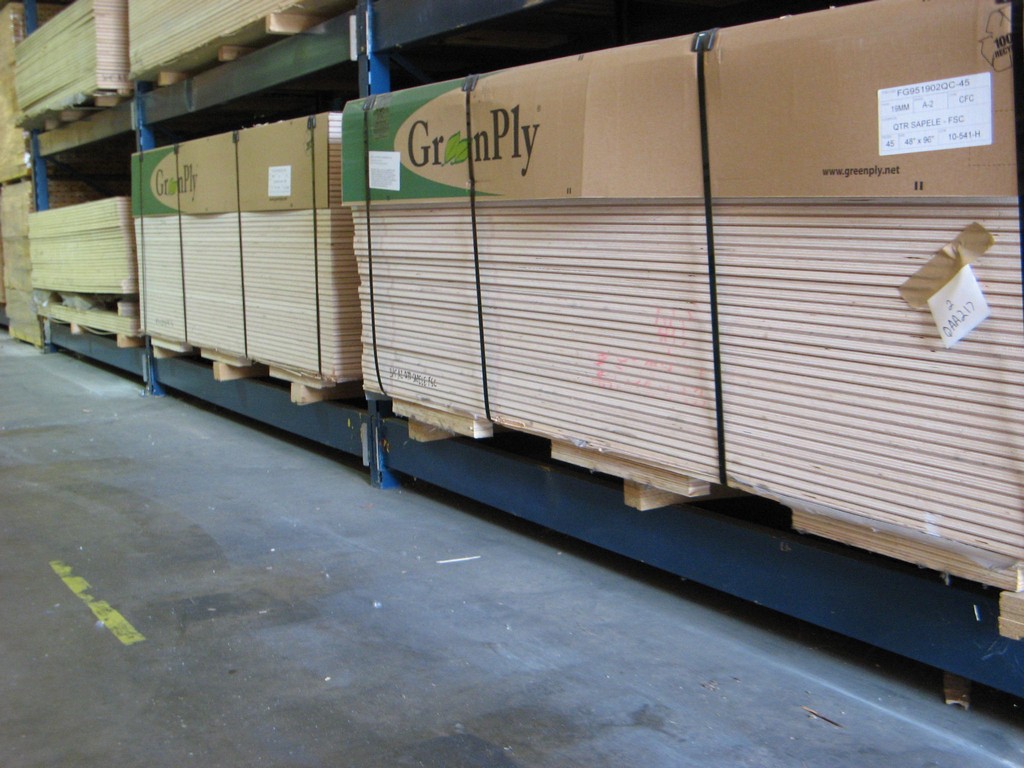
Greenply Industries said last month it will set up a new manufacturing unit in Uttar Pradesh for plywood and allied products.

The Board of Directors of the company has approved setting up of a new unit in Sandila industrial area, Hardoi district, UP for manufacturing of plywood and allied products, the company said in a BSE filing.

The plant, which will probably start operating towards the end of 2018, will be configured for annual capacity of 13.5m m².

CEO V. Venkatramani states that the total sum involved in this Greenfield investment is INR1.2bn, which is the equivalent of €17.0m, of which INR800m are to be financed with new loans and INR400m with internal reserves.

German furniture producer Vivonio acquires Dutch Noteborn

Dutch wardrobe manufacturer Noteborn has been acquired German furniture firm Vivonio Furniture GmbH as it expands its European presence.

Further strengthening its position within the European furniture market, the acquisition will see Noteborn expand into the German, Austrian and Swiss furniture Retail markets, forecasting to build on its turnover of €11m achieved in 2016.

As for Munich-based Vivonio, the acquisition adds to its recent purchase of Leuwico GmbH, which specialises in height-adjustable desks, as the group continues to develop its portfolio of financial strong furniture manufacturing companies.

Noteborn will be the fifth daughter company and the sixth manufacturing site within the Vivonio group, which was founded in 2012 and generates an annual group volume of around €300m.

Commenting on the deal, which remains undisclosed, Michael Bork, senior partner and member of the Equistone management team – with the latter a European equity investor firm that controls Vivonio funds, said: “With this acquisition, we are taking another step forward towards participating more actively in the consolidation process of the Industry.

“Over the years of our collaboration, turnover for the Vivonio Furniture Group increased by more than 40%.”

Norman Noteborn, managing director at Noteborn, added: “We are confident that we can achieve the growth objectives we have been aspiring to significantly faster under the umbrella of the Vivonio Group, without losing sight of who we are: a family-run business with a long-standing tradition.”

Rising dependence in EU on tropical sawnwood from Cameroon

The most notable trend in the supply of tropical sawn timber to the EU in 2016 was the rising dependence on imports from Cameroon. EU imports from Cameroon increased 19% to 395,000 m3 in 2016, growing particularly rapidly into Belgium but with robust increases also into Italy, France, Spain, the UK and the Netherlands. Continue reading "Rising dependence in EU on tropical sawnwood from Cameroon"

Newsletter

Subscribe to our digital newsletter for your daily digest of essential news, views and analysis from the international wood industry delivered directly to your inbox.


0