Article archive

India: Plywood mills prepare for impact of tax on competiveness

Indian millers report supplies of logs and veneers are improving. Mills in Northern India are ramping up production and the latest from the mills in the south of the country is that they are expanding production of decorative plywood and concrete shuttering grades.

Developments in the southern mills are related to the upcoming introduction of the Goods and Services Tax (GST).

With application of the GST all factories will have to pay similar electricity charges and taxes including the central government excise.

At present, small factories (as defined by the authorities) benefit from some exemptions in the case of central government excise and this offers them an advantage over the large commercial mills. This advantage will mostly be removed when the standardised GST comes into force.

In response to this change, small mills are adjusting production. For example, instead of making plain plywood they are considering production of marine quality plywood or concrete shuttering plywood.

Some are considering production of decorative plywood. This move into higher value-added plywood should allow them to generate more revenue and remain competitive with the bigger mills.


Pinnacle Renewable Energy to build a $85 million wood pellet plant in Alberta

Pinnacle Renewable Energy Inc. will soon build its first wood pellet plant outside of British Columbia.

Parkland County officials announced on May 3 that the company will build a new, $85 million pellet plant near Entwistle in central Alberta. The new facility will bring Pinnacle’s total number of pellet plants to eight, and add 400,000 metric tons to its existing capacity of more than 1.5 million metric tons.

All of Pinnacle’s plants, located in Houston, Burns Lake, Meadowbank, Quesnel, Williams Lake, Armstrong and Lavington, B.C., run 24-7, according to the company. Pinnacle also owns and operates the Westview port in Prince Rupert, B.C., the first dedicated wood pellet terminal in the world capable of handling Panamax vessels.

Most of Pinnacle’s output are pellets that are exported to overseas markets, but the company also manufacturers a range of other products, including softwood pellet fuel for home heating, animal bedding and natural sorbent.

"We are thrilled to welcome Pinnacle Renewable Energy Inc. to Parkland County and the Hamlet of Entwistle," said Entwistle Mayor Rod Shaigec. "The positive economic impact this investment will have on our community is tremendous. We look forward to a long-term relationship with Pinnacle."

“Parkland County is excited to work with Pinnacle Renewable Energy Inc. on its expansion into Alberta,” said Mike Heck, chief administrative officer of Parkland County.  “With the recent launch of our Major Business Attraction Program, welcoming Pinnacle to the Entwistle community shows the opportunities and success this program can create for our communities.”

The most recent Pinnacle plant to come online was the Lavington plant, built about a year and a half ago, according to CEO Rob McCurdy. He said that as the company expanded throughout B.C., it saw opportunity in Alberta. "We've got a strong bench strength of talent, we had the team for building the plant, and as we learned more about the fiber basket, it all came together," he said. "We’re quite happy to be in Alberta—it’s a pretty natural growth for our company."

McCurdy said dirt and heavy equipment work began at the site on May 1. "We're underway, and we anticipate to have most of the equipment assembled and start commissioning by the end of the year, with a phased commissioning through the first quarter of next year," he said.

Once in production, the plant will create approximately 70 full-time positions in the community of roughly 30,000 people.

Resolute Forest Products will pay more than $75 million a year in duties

Resolute Forest Products Inc., the world’s largest newsprint maker, announced that it will be forced to fork over as much as $75 million a year in duties, after the new US government decision takes effect. Continue reading "Resolute Forest Products will pay more than $75 million a year in duties"

China: Value of wood products in 2016

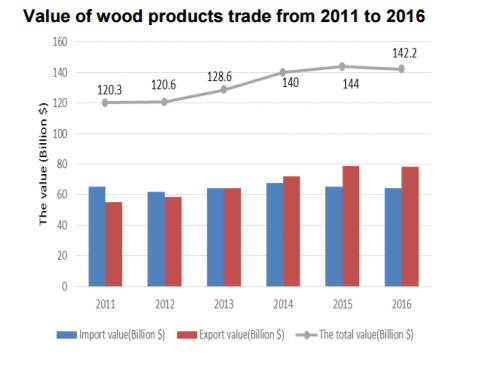
The total value of China’s wood products trade in 2016 fell 1.28% to US$142.2 billion. Of the total, the value of forest products exports dropped 0.72% to US$78.12 billion, the value of forest products imports declined 1.95% to US$64.09 billion.

Softwood log imports volumes

The main imported softwood log species in 2016 were radiata pine (14.09 million cu.m, 41%), spruce and fir (5.55 million cu.m, 16%), Korean pine and Scots pine (4.64 million cu.m, 14%), larch (2.41 million cu.m, 7%) and Douglas fir (1.87 million cu.m, 6%).

The volume of Douglas fir, spruce and fir, radiata pine, Korean pine and Scots pine imports rose 17%, 16%, 15%, and 3%, but larch imports fell 5% year on year. The above-mentioned species accounted for 84% of total softwood log imports.

Main hardwood log imports

The main imported hardwood log species in 2016 were okoume (852,000 cu.m, 5.79%), oak (849,000 cu.m, 5.77%), redwood (800,000 cu.m, 5.4%), beech (600 000 cu.m, 4%), North America hardwood (430,000 cu.m, 3%) and Merbau (250,000 cu.m, 2%).

The volumes of North America hardwoods, merbau, okoume and redwood rose 38%, 36%, 33%, and 7% respectively, but beech and oak imports fell 16% and 5% year on year respectively.

Monthly change in China’s log imports

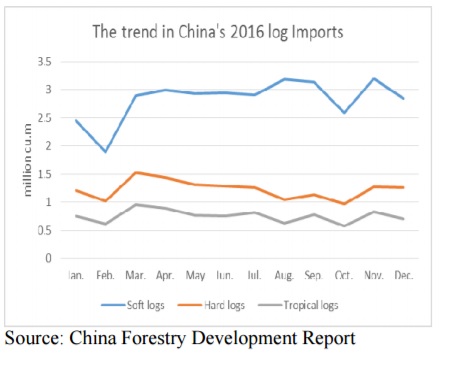
China’s timber importers reduced log inventories around the 2016 Chinese New Year celebrations inFebruary and at the time of the National Day Holiday in October 2016.

As can be seen in the graphic there was a fall in log deliveries in February and October.

The average monthly volume of softwood log imports in 2016 rose 13% to 283 million per cubic metres.

The average monthly volume of hardwood log imports rose 2% to 123 million cubic metres per cubic metres.

Softwood log imports were largest at 3.2 million cu.m in November and lowest in February at 1.9 million cu.m. A similar trend can be seen between hard log imports and tropical log imports.

Hardwood log imports and tropical log imports were largest at 1.53 million cu.m and 0.96 million cu.m respectively in March and lowest at 970, 000 cu.m and 580, 000 cu.m respectively in October 2016.

Russian softwood lumber exports reach historic peak on booming Chinese demand

During the Q1 of 2017, the global wood markets registered a high demand for softwood lumber. Russian export sales grew 16% on-year and reached 6.1 million m3, worth $761 million (+26% yoy). Continue reading "Russian softwood lumber exports reach historic peak on booming Chinese demand"

Metsä Group appointed Ilkka Hämälä as CEO

Metsäliitto Cooperative’s Supervisory Board has appointed Ilkka Hämälä the CEO of Metsäliitto Cooperative as of 1 January 2018.

Hämälä starts as the President and CEO of Metsä Group on 1 April 2018. Kari Jordan, the President and CEO since 2006, is responsible for Metsä Group’s result until the end of 2017 and will retire on 1 April 2018.

Hämälä has worked for Metsä Group since 1988. Since 2008 he has been the CEO of Metsä Fibre Oy and a member of Metsä Group Executive Management Team.

Metsä Group is a forerunner in sustainable bioeconomy utilising renewable wood from sustainably managed northern forests.

Lumber trading and prices in the US stalled last week

Trading in framing lumber was low last week because of the post-countervailing duty standoff. Yet, buyers and sellers made some strides toward getting back to the give and take of normal relations. Continue reading "Lumber trading and prices in the US stalled last week"

Norbord reports better earnings on higher North American OSB prices and shipment volumes

Norbord Inc. reported Adjusted EBITDA of $103 million for the first quarter of 2017 versus $61 million in the first quarter of 2016 and $115 million in the fourth quarter of 2016.  The year-over-year improvement is primarily due to higher North American OSB prices and shipment volumes, while the quarter-over-quarter decrease is due to higher resin prices and the timing of annual maintenance shuts and related costs.

North American operations generated Adjusted EBITDA of $102 million compared to $53 million in the same quarter last year and $108 million in the prior quarter.  European operations delivered Adjusted EBITDA of $6 million versus $10 million in both comparative quarters.

“We are enjoying robust market conditions in North America reflecting strong growth in US housing starts that continues to drive increasing demand for OSB,” said Peter Wijnbergen, Norbord’s President and CEO.  “Our first quarter Adjusted EBITDA result is a significant improvement over the first quarter of last year even though we undertook maintenance activity to ensure our mills were ready for the spring home building season that is now underway.  As we enter the second quarter, demand from all our key customers is strong, supply chain inventories remain at minimal levels and benchmark prices are currently 35% higher than this time last year.”

“In Europe, we continue to face a post-Brexit translation headwind from the weaker Pound Sterling, and this quarter included the additional impact of higher resin prices that exceeded the panel price increases we’ve seen to-date.  Our key markets remain strong, with double-digit demand growth in both the UK and Germany as OSB continues to gain market share versus plywood.  Our project to modernize and expand the Inverness, Scotland OSB mill to serve this rapidly growing customer demand remains on budget and on track to start up in the second half of this year.”

Market Conditions

In North America, year-to-date US housing starts were up 8% versus the same period in 2016.  The seasonally adjusted annualized rate was 1.22 million in March, 9% higher than the pace this time last year, while the pace of permits (the more forward-looking indicator) was 1.26 million.  Single-family starts, which use approximately three times more OSB than multi-family, increased by 6%.  The consensus forecast from US housing economists is for approximately 1.26 million starts in 2017, which suggests an 8% year-over-year improvement.

North American benchmark OSB prices improved significantly in the first quarter of 2017 as new home construction activity and OSB demand continue to improve.  The North Central benchmark OSB price averaged $293 per Msf (7/16-inch basis) for the quarter, and the spreads versus other regions compressed as demand improved.  In mid-February, the South East benchmark traded higher than North Central for the first time since 2006, demonstrating the tightness in the largest US housing market as the spring building season commenced.

In Europe, Norbord’s core panel markets remained strong, with double-digit year-over-year OSB demand growth in both the UK and Germany.  European panel prices in US dollar terms were impacted by the significant devaluation of the Pound Sterling following the Brexit referendum in June 2016.  In local currency terms, OSB prices in the UK were 5% higher than the same quarter last year and have firmed by about 10% since their post-Brexit lows.  On the continent, OSB prices were 3% lower than the same quarter last year but flat versus the prior quarter.  UK medium density fibreboard (MDF) and particleboard prices were up 8% and 3%, respectively versus both comparative periods.

Performance

North American OSB shipments increased 7% year-over-year due to increased mill productivity but were 11% lower quarter-over-quarter due to major maintenance shuts at six of the Company’s North American mills.  Shipments were also impacted by the number of fiscal days in both comparative periods.

Norbord’s operating North American OSB mills produced at 94% of stated capacity (excluding the two curtailed mills in Huguley, Alabama and Chambord, Quebec), up from 92% in the same quarter last year and unchanged from the prior quarter.  Capacity utilization increased year-over-year due to improved mill productivity.

Norbord’s North American OSB cash production costs per unit (before mill profit share) increased 7% compared to the prior quarter and 9% versus the same quarter last year due to the timing of annual maintenance shuts and related costs, as well as higher resin prices.  Quarter-over-quarter, fewer fiscal days also had some impact.

In Europe, Norbord’s shipments were 10% higher than the same quarter last year and 7% higher than the prior quarter.  The European mills produced at 98% of stated capacity in the quarter compared to 100% in the same quarter last year and 95% in the prior quarter.  Capacity utilization increased quarter-over-quarter due to improved productivity, but decreased year-over-year due to additional maintenance shutdown days in the current quarter.

Norbord’s mills did not generate any Margin Improvement Program (MIP) gains in the quarter due to the timing and scope of annual maintenance shuts and related costs.

In January 2016, the Board of Directors approved a $135 million investment over the subsequent two years to modernize and expand the Company’s Inverness, Scotland OSB mill.  The project remains on budget and on track to start up in the second half of 2017, with no disruption to existing production volumes in the interim.

Changing profile of Indonesia’s wood product supply

The changing profile of Indonesia in product supply is closely tied to the changing structure of the resource. This is evident from data published by the Indonesian Ministry of Forestry on the source of log supply which shows that industrial plantations are becoming increasingly important while the share of supply from natural forests is falling. Continue reading "Changing profile of Indonesia’s wood product supply"

Brazil: Pine sawnwood exports up by 18%

In March 2017 Brazilian exports of wood-based products (except pulp and paper) increased 12,2% in value compared to March 2016, from US$ 202 million to US$ 226.6 million.

The value of Brazilian pine sawnwood exports increased 18% between March 2016 (US$ 33.1 million) and March 2017 (US$ 39.2 million). In terms of volume, exports increased 12.5% over the same period, from 171,900 cu.m to 193,400 cu.m.

Brazil's tropical sawnwood exports fell 4% from 36,100 cu.m in March 2016 to 34,600 cu.m in March 2017 and the value of exports dropped around 8.5% from US$ 16.7 million to US$ 15.3 million, over the same period.

The value of pine plywood exports increased 18% in March 2017 year on year, from US$ 36.5 million to US$ 43.1 million. In terms of volume exports increased 12% over the same period, from 142,600 cu.m to 159,300 cu.m.

As for tropical plywood, exports increased significantly in volume and in value, from 11,300 cu.m (US$ 4.5 million) in March 2016 to 13,900 cu.m (US$ 5.4 million) in March 2017.

For the first time in months exports of wooden furniture rose from US$ 37.5 million in March 2016 to US$ 41.8 million in March 2017, an 11.5% increase.

Danzer kept growing in 2016 thanks to the rises in lumber production and engineered hardwood flooring

Danzer reports a slight overall sales growth of 1 % for the year 2016 based on constant exchange rates. 2016 net sales in euro at current exchange rates were 252 million (2015: EUR 254 million). Sales growth was stronger in the first three quarters of 2016, but experienced a setback in the fourth quarter, after a fire affected Interholco AG’s operations at IFO in the Republic of Congo.

In 2016, Danzer grew its new deck layer business for engineered hardwood flooring by 70 %; its North American lumber production grew by 20 %. Danzer’s slicing facilities in Europe operated at full capacity throughout 2016. The company’s 15 million Euro investment program to grow and increase resource efficiency is on track.

Danzer, one of the large producers of decorative hardwood products, reports 2016 sales of EUR 252 million (2015: EUR 254 million). After a sales growth of 4 % in the first three quarters of 2016, a fire at Industrie Forestière d’Ousso (IFO), in the Republic of Congo in November brought production at the facility to a halt; subsequently, Danzer sales in the fourth quarter dropped by 10 % compared to Q4 2015. “We are very glad that nobody was injured. By now, production has been fully reestablished”, says Ulrich Grauert, CEO of Interholco AG. IFO is owned by Interholco AG, a separately managed Danzer company that focuses on sustainable tropical hardwood (sales 2016: EUR 64 million). Under the Danzer brand, Danzer focuses on hardwood from temperate forests in the Northern hemisphere (sales 2016: EUR 188 million).

Lumber production grew by 20 % in 2016

In North America, Danzer further optimized its new sawmill in Bradford, PA, that had been overhauled in 2014 and 2015 and grew its hardwood lumber production by 20 % to approximately 60.000 m³. The six top species for Danzer lumber in North America in 2016 were White Ash, Black Cherry, Hard Maple, White Oak, Soft Maple and American Walnut; together they accounted for 74 % of the total production volume.

Further investments in sliced deck layer business

Danzer grew its sliced flooring deck layers sales 70 % to EUR 14 million in 2016 – most of this in Europe. In 2016, Danzer started the flooring deck layer business also in North America: Four new drying kilns at Danzer’s Darlington, PA, facility have been put into service in October 2016. Danzer had introduced high-quality sliced deck layers to the engineered hardwood flooring industry in 2012; customers have adopted the new product quickly and Danzer plans to further increase its capacities. “The slicing process can save up to 50 % of the hardwood resource, compared to the traditional sawing process”, explains Hans-Joachim Danzer, CEO of Danzer and adds: “Throughout 2016, we have been operating at full capacity in Europe to the extent possible with the on-going investment projects at Danzer France in Souvans. We are continuing to invest in technologies that improve the use of the valuable hardwood resource. The conversion of our plant in Souvans to enable us to produce flooring deck layers also in France will be completed on plan, in summer 2017.” The four highest volume wood species for Danzer flooring deck layers in 2016 accounted for more than 90 % of the total output: they were European Oak, American Walnut, European Ash and American Hard Maple; many other species have also been produced for individual customers and projects.

Tembec anticipates lumber prices will rise to balance the cost of US softwood duties

Tembec Inc. announced it expected a share of the new softwood lumber duties imposed by the US last month on imported Canadian softwood to be passed on to its customers.

The Montreal-based forestry company (TSX:TMB) says it's in good financial position despite being hit by a preliminary 19.88 per cent duty on its softwood shipments to the United States that took effect on Monday. Tembec says it intends to vigorously defend itself against the U.S. duties, but it anticipates the duties will mean higher lumber prices for customers, The Canadian Press reported.

The comments came as Tembec says it earned $24 million or 24 cents per share in the quarter ended March 25 compared with a profit of $27 million or 27 cents per share a year earlier.

Operating earnings before depreciation, amortization and other items totalled $54 million for quarter, up from $36 million a year ago.

For the second quarter of last year, the company's sales rose slightly to $387 million, with more than 70 per cent from paper, pulp and specialty cellulose pulp.

China: Unjustified US accusations regarding the plywood exports subsidies

The Chinese Ministry of Commerce (MOC) said that the US accusations regarding the country subsidizing plywood exports are abuses of policies.

"The US Department of Commerce ignored the active cooperation of the Chinese firms in its preliminary determination," said Sun Jiwen, spokesperson of the MOC, on the 27th of April, during a press conference.

The remarks came in the wake of a preliminary determination made by the US Department of Commerce on April 18 in an investigation of imports of China's plywood products, with the calculated preliminary subsidy rates ranging from 9.89 percent to 111.09 percent, China Daily reported.

The US Commerce Department has, thus, miscalculated the rates and applied "Adverse Facts Available" without giving the Chinese firms enough access for plea and response.

"Chinese firms have expressed strong dissatisfaction about US infringement of their interests," said Sun.

Moreover, Sun urged the US government to follow the WTO rules and investigation procedures, and apply the trade remedy measures cautiously.

Earlier this year, the US government has announced tightened enforcement of duties against subsidies. The investigation followed petitions from six privately owned U.S. plywood producers into the imports, which are used in wall panels, kitchen cabinets, table and desk tops, and flooring.

The Commerce Department said it is scheduled to announce its final determination on or about July 5 unless the statutory deadline is extended.

Canfor sees potential sawmill acquisitions in US South

Canfor Corporation sees potential acquisition opportunities in the US south, now that various smaller companies struggle to lead their business after the new softwood lumber duties announcement. Continue reading "Canfor sees potential sawmill acquisitions in US South"

Sharp drop in US wooden furniture imports from China and Vietnam

The value of US wooden furniture imports declined to US$1.30 billion in February, but year-to-date imports were 3% higher than in February 2016. The month-over-month decline was mainly in imports from the US’ two largest suppliers China (-22%) and Vietnam (-19%).

However, year-to-date imports from China and Vietnam remained higher than in February last year. Wooden furniture imports from Malaysia decreased 11% from January toUS $52.5 million.

Indonesia grew furniture exports to the US market by 3% in February to US$47.2 million. The strongest growth year-to-date compared to 2016 was in imports from Mexico.

Imports of all types of wooden furniture were down in February with the largest decline in upholstered seating furniture.

Furniture manufacturing output picks up

The US economy grew in March and economic activity in the manufacturing expanded, according to the latest survey by the Institute for Supply Management.

Furniture manufacturing reported higher output in March, following three months of decline. All industries reported higher activity compared to February, including wood product manufacturing.

Consumer sentiment rose in April and was 10% higher than in April 2016, according to the University of Michigan consumer confidence index. Views were positive about current economic conditions, but Democrat and Republican voters had very different views on economic expectations.

Many households expect fundamental changes in the economy, which may result in variable spending and different trends by market and product.

China: Supply and consumption of wood products in 2016

According to the 2016 China Forestry Development Report, total timber supply (domestic resources and imports) in 2015 rose 2.3% to 552 million cubic metres (RWE).

Of the domestic timber supply, 13% was for commercial processing, 7% farm use and fuelwood, and 27% for fibreboard and particleboard. Timber imports accounted for a further 53% of the total timber supply which include logs, sawnwood, veneer, wood-based panel, wooden furniture, wood pulp, wood chips, paper and paper products, waste paper, as well as other wood products. The Forestry Development Report also says China’s timber consumption rose.

Domestic timber resources are mainly consumed in construction 30%, 1.7% in the coal industry, 29% in paper making, 12% in wooden furniture, 3.5% in the transport sector and 5.5% timber consumption for farmer use and fuelwood with the balance being for other purposes.

Timber exports account for around 18% of timber supply and comprised mainly wooden furniture, wood-based panels, wooden doors, window and flooring, paper and paper products.

Forest products trade of growing importantance According to statistics from China Customs, the value of the country’s commodity trade in 2016 fell 0.9% to US$3.685 trillion. Of the total, the value of exports dropped 2% to US$2.097 trillion while the value of commodity imports rose 0.6% to US$1.587 trillion.

The proportion of forest products trade to the total commodity trade in 2016 was 3.86%, a year on year increase of 0.22%. The proportion of forest products exports to the total commodity exports came to 3.72%, a year on year increase of 0.27%.

The proportion of forest products imports to total commodity imports amounted to 4.04%, a year on year increase of 0.15% percentage points.

EU trade with Indonesia in the spotlight following FLEGT licensing

Indonesia issued the first ever FLEGT licenses in midNovember last year with high expectations that these would boost the value and share of Indonesia’s wood exports to the EU.

This is a reasonable expectation, given the very significant commitment and investment by Indonesia, supported through the FLEGT Voluntary Partnership Agreement with the EU, and the mandatory requirement that all timber and timber products exported from Indonesia to the EU must now be licensed.

The fact that EU importers no longer need to undertake a potentially expensive due diligence assessment to demonstrate EUTR conformance for any timber product of Indonesian origin should give a significant edge in the EU’s highly competitive market.

Nor has Indonesia stopped short at imposing a requirement for exports to the EU. The SVLK certification system on which FLEGT licensing is based (and which was first introduced in 2010) is now mandatory for nearly all wood produced and traded in the country and applies to industrial plantations (HTI), natural forest concessions (HPH) and community plantation forests (HTR).

Anecdotal evidence indicates that Indonesia’s SVLK certificates and FLEGT licenses have been well received and are at least benefitting some Indonesian suppliers. For example, the Jakarta Post reported on 17 March that “many exhibitors at the recent Indonesian International Furniture Exhibition (IFEX) said the SVLK helped them increase exports, especially to the EU”.

The news report quotes one Indonesian furniture exporter as suggesting that “with the SVLK, buyers from the EU are more confident about us and we can even sell directly to them without using traders, and so we enjoy high profit margins and a market under our own brand”. The increase in profit margin in this instance was reported to be up to 40% compared to 10% previously.

There is similar anecdotal evidence from European importers. In an interview published on the Global Timber Forum website in February this year, a representative of one of Europe’s largest importers of Indonesian plywood said that “arrivals from Indonesia have increased over the last few weeks as importers and traders are stocking up on FLEGT licensed material”.

He noted that the FLEGT license has given European importers more confidence to engage in active promotion to increase sales of Indonesian plywood and to make more product available in the market. He added that Indonesia will have an increasing advantage over time as EU Competent Authorities are getting stricter and there are more checks on operators. These early anecdotal reports are encouraging, but they refer to isolated cases and the underlying question of the extent to which FLEGT licensing contributes to real increases in export share and value remains uncertain.

Newsletter

Subscribe to our digital newsletter for your daily digest of essential news, views and analysis from the international wood industry delivered directly to your inbox.


0