
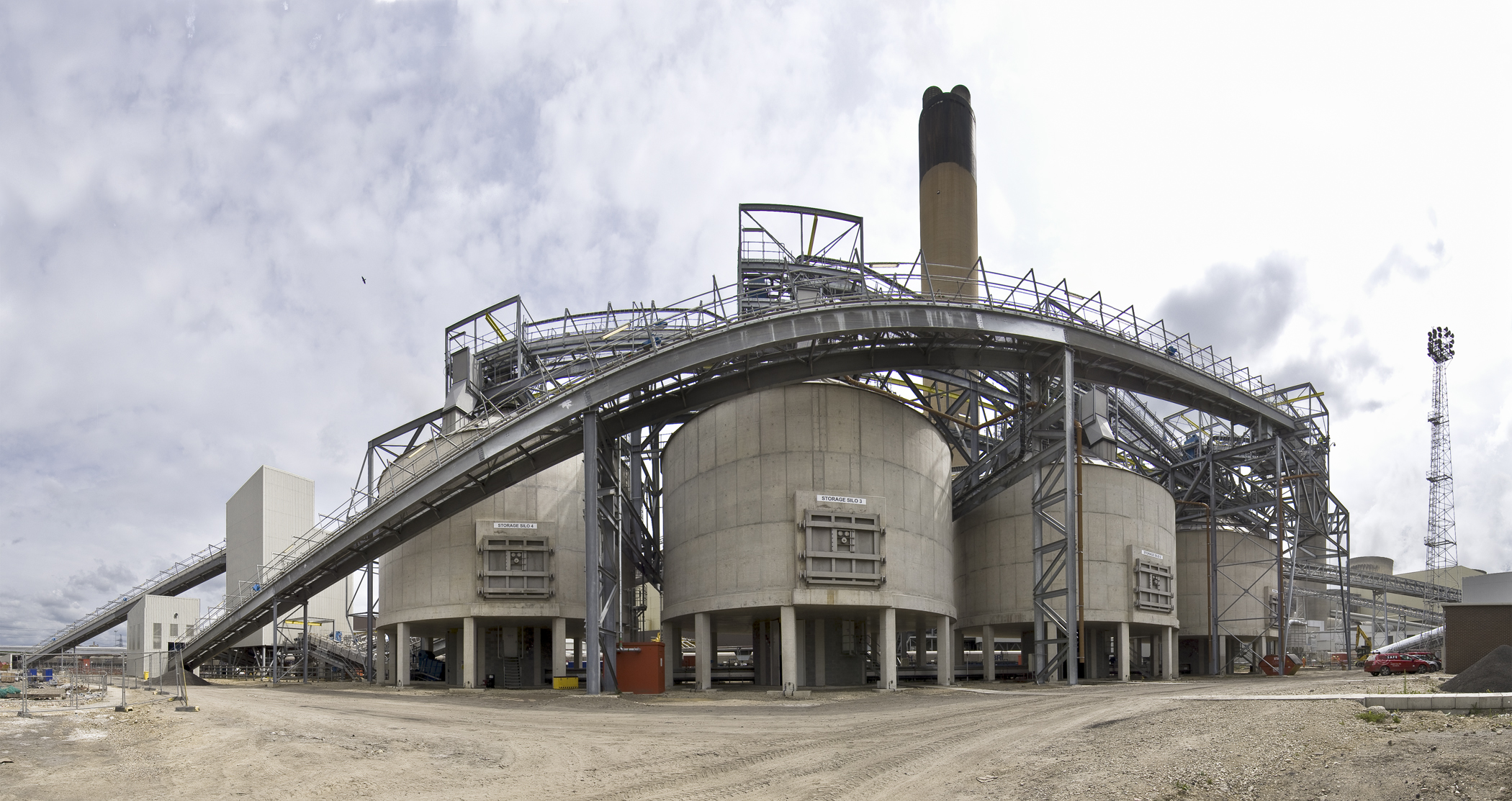
Drax, UK's biggest power producer, takes into consideration the conversion of its remaining coal-fired power units to gas, instead of biomass power. Continue reading "Drax considers switching to gas instead of wood pellets for its remaining coal units"
Article archive
Chilean forestry group Arauco places bid for Brazilian pulpmaker Eldorado
Chilean forestry group Arauco, one of the world's largest pulp producers, confirmed on the 16th of June that it had signed a non-disclosure agreement with Brazilian pulpmaker Eldorado Brasil Celulose SA, for exploring a possible investment. Continue reading "Chilean forestry group Arauco places bid for Brazilian pulpmaker Eldorado"
Downward trend in EU imports of tropical logs
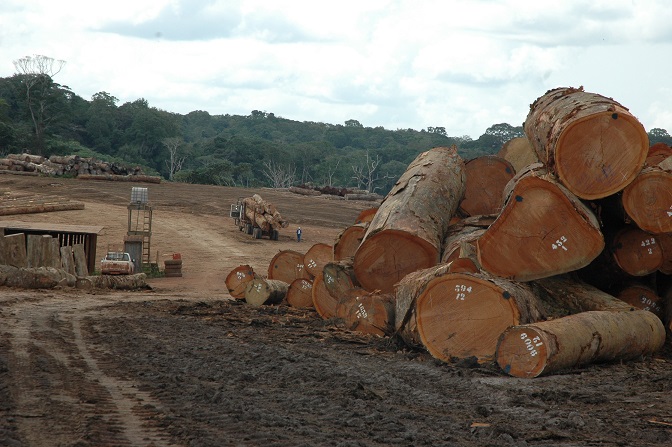
After a brief recovery in 2015 and stasis in 2016, the downward trend in EU imports of tropical logs resumed in the first quarter of 2017.
Imports were only 24,700 MT, 35% less than the same period in 2016.
EU imports of tropical logs decreased from all the leading suppliers including Congo (down 43% to 6,200 MT), DRC (down 50% to 4,750 MT), Cameroon (down 44% to 3,900 MT) and CAR (down 40% to 3,200 MT).
Imports from Equatorial Guinea were level during the period at 2,400 MT and imports from Angola increased from negligible levels to 2,000 MT.
Most of the decline in EU imports of tropical logs in the first quarter of 2017 was concentrated in France, Belgium and Italy. Imports of tropical logs into Portugal were stable during the period.
Södra, Derome and Nordströms Group sign supply agreement
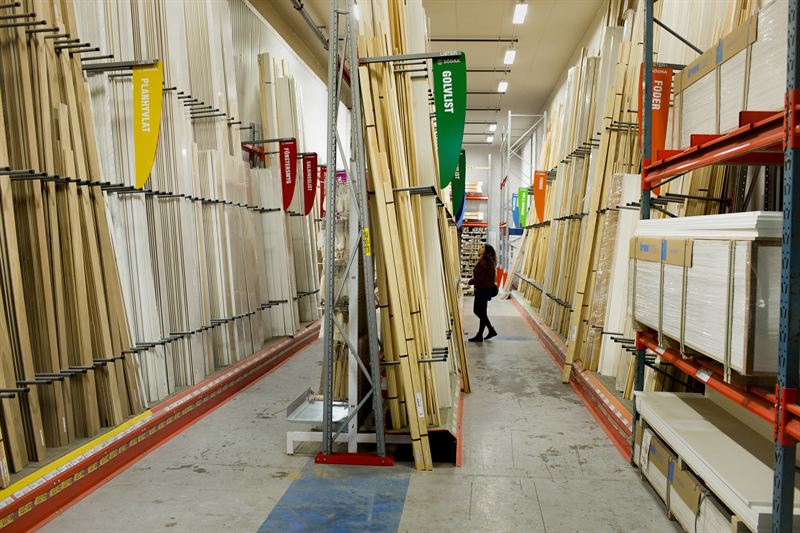
Last week, Södra, Derome and Nordströms Group signed a multi-year agreement for interior wood products. The agreement means Södra will become the main supplier of products such as panelling, moulding and glue boards to the expanding building trade companies.
“We have worked with Derome and Nordströms for several years and see a major benefit from working with customers who focus on long-term relationships, just like Södra. This enables joint initiatives that are beneficial to both parties. One example is that Derome was the first retailer to install Södra’s new store concept for mouldings, which offers a much better overview of this assortment for the end consumer,” said Urban Blomster, Sales Director at Södra Interiör.
Derome is in a highly expansive phase and recently extended its market presence with 12 new stores across Sweden. Nordströmsgruppen is also investing heavily in its ten facilities, located between Uppsala and Linköping.
“Södra has the strength and logistics to join us in our strong development. It is strategically important to create the prerequisites to continue our progress, and Södra is a good fit in this context,” said Diana Larsson, Product Manager Joinery Products at Derome.
“We are pleased to have reached an agreement with Södra for mouldings and interior wood. We have collaborated for some time and I am positive that we are continuing on this path,” said Johan Perjos, Product Manager at Nordströms.
Lower pellets prices in Germany due to warm season

The price for wood pellets in Germany decreased again during June 2017, due to the rising temperatures. EN plus wood pellets price went down by 0.8%% during June 2017, as compared to May, reaching EUR 231.88/tonne.
As compared to the same period of 2016, the price is 3.1% higher, while the price advantage over natural gas is around 22% and 7% over heating oil, according to the survey of the German Energy Wood and Pellet Association (DEPV).
Regional prices
During June 2017, the price for wood pellets has the following regional differences: in northern Germany the price was the most favorable, set at EUR 229.60/t (for a 6 t purchase). In central Germany, the price is EUR 230.52/t, while in southern Germany the 6 t amount costs EUR 231.82/t.
Larger quantities (26 t) were traded in June in the following conditions: southern Germany: EUR 219.72/t; central: EUR 215.62/t, north and east: EUR 214.24/t. (all including VAT).
Lumber prices in the US edged down last week
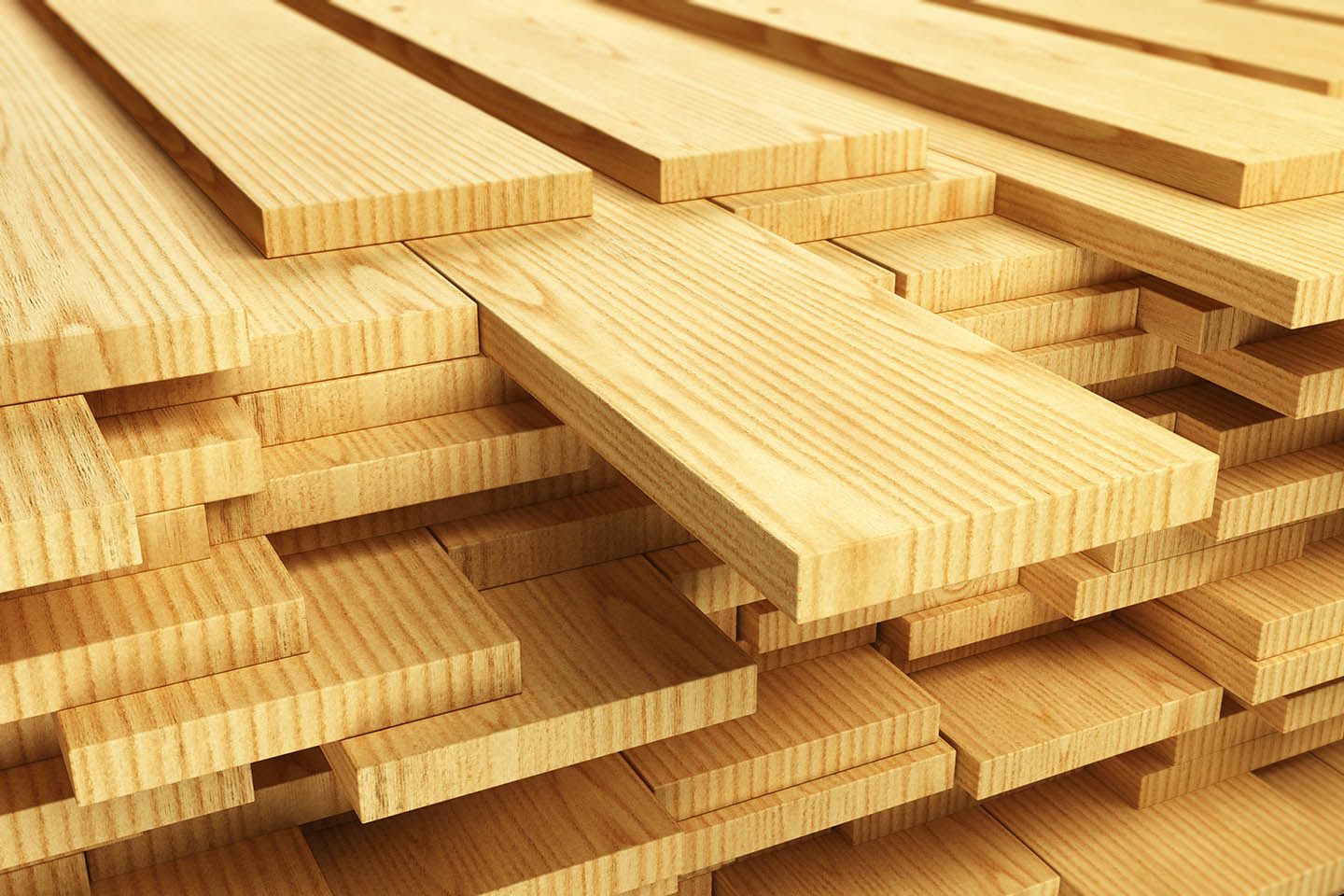
Framing lumber demand has picked up in most species in the US last week, while the the Random Lengths Framing Lumber Composite Price edged down. Continue reading "Lumber prices in the US edged down last week"
12-storey CLT timber tower for Portland

A 12-storey building constructed of cross-laminated timber (CLT) and glulam was approved for construction in Portland, Oregon. The building will be the first all timber tall building in the US. It will include retail space, offices and apartments.
The CLT panels will be supplied by Portland manufacturer D.R. Johnson who was the first company in the US to receive certification according to the APA/ANSI standard for CLT.
The proposed building design was also tested by two universities for seismic, fire and acoustic performance. Building code work is underway in Washington State and Oregon to allow for tall wood buildings, which will simplify the design and permitting process.
Twenty-seven tall wood buildings have been completed to date in Europe and Canada, according to the Council on Tall Buildings and Urban Habitat.
A hybrid timber and concrete building in Vancouver is currently the highest building, but a 24-storey hybrid timber and concrete tower is under construction in Vienna, Austria.
The tallest proposed buildings are a 26-storey hybrid timber and steel tower in Lagos, Nigeria and a 35-storey tower also in timber and steel in Paris, France.
The proposed Abebe Court Tower in Lagos would be the first tall all timber building in Africa and the first to include open-air planted sky-gardens.
120,000 t/yr wood pellet plant inaugurated in Latvia

Estonian wind energy producer Nelja Energia opened its first cogeneration plant and wood pellet factory in the Southern Latvian town of Brocēni on Thursday.
The Estonian company's investment is worth nearly €30 million and the cogeneration plant and wood pellet factory will create 35 jobs.
The modern pellet factory is expected to produce at least 120,000 tons of wood pellets annually. The plant will be supplied with energy by the biofuel-powered cogeneration plant, which has thermal power of 19.4 megawatts, electric power of 3.98 megawatts and an estimated annual electric output of 30,000 megawatt-hours.
Nelja Energia initiated the tet production of pellets at the beginning of the year, which have been successfully passed; the factory's first orders have already been fulfilled.
The bulk of the factory's output will be exported to European markets.
Vietnamese timber companies boosted by VPA-FLEGT

Vietnam will considerably export more wooden products to Europe and other markets once the EU-Vietnam Voluntary Partnership Agreement on Forest Law Enforcement, Governance and Trade (VPA-FLEGT) comes into force. Continue reading "Vietnamese timber companies boosted by VPA-FLEGT"
Slow-down in EU tropical timber imports
The slowdown in EU imports of tropical timber products registered in the second half of 2016 continued into the first quarter of 2017.
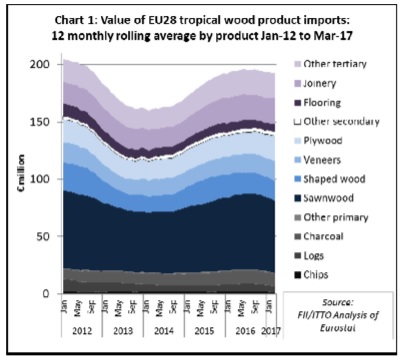 Twelve monthly rolling average imports, which peaked at just below €196 million in June 2016, had slipped to €193 million by March 2017.
Most of the rise and subsequent slowdown in EU tropical imports in the 24 months prior to 2017 was driven by sawn wood. Imports of other product groups remained relatively more stable during this period (Chart 1).
In the first quarter of 2017 compared to the same period in 2016, total EU imports of tropical timber products (all those listed in HS Chapter 44) declined 5% to 553,000 metric 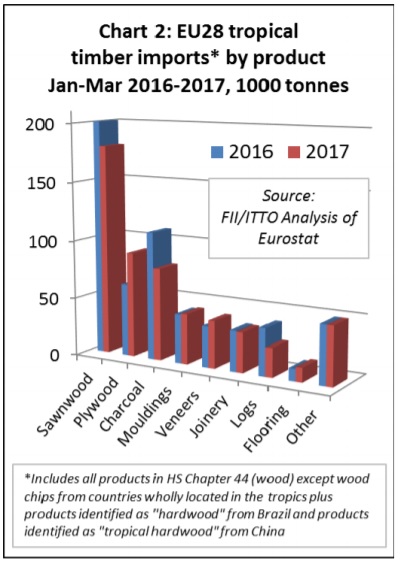 tonnes (MT).
There was a 10% decline in EU imports of tropical sawn to 180,000 MT, a 28% decline in imports of tropical charcoal to 79,000 MT, and a 39% fall in imports of tropical logs to 25,000 MT.
These losses were partially offset by a 45% rise in imports of tropical plywood to 90,000 MT, a 2% rise in imports of tropical mouldings (including decking) to 43,000 MT, a 15% rise in imports of tropical veneers to 40,000 MT, and a 16% rise in imports of tropical flooring to 12,000 MT (Chart 2).
US legislative proposal aimed at encouraging better management of federal forests could help housing market

A draft legislative proposal by Rep. Bruce Westerman (R-Ark.) would encourage better management of the nation’s federal forest natural resources while also ensuring the continued recovery of the housing industry. Continue reading "US legislative proposal aimed at encouraging better management of federal forests could help housing market"
Reduced Canadian lumber exports to the US cause favorable lumber prices, says Weyehaueser’s CEO
The improving housing market, together with a reduction of lumber coming in from Canada, might drive up lumber prices in the short-term and set the stage for increasing lumber prices going forward. Continue reading "Reduced Canadian lumber exports to the US cause favorable lumber prices, says Weyehaueser’s CEO"
Zambia expands ban on timber exports to all species
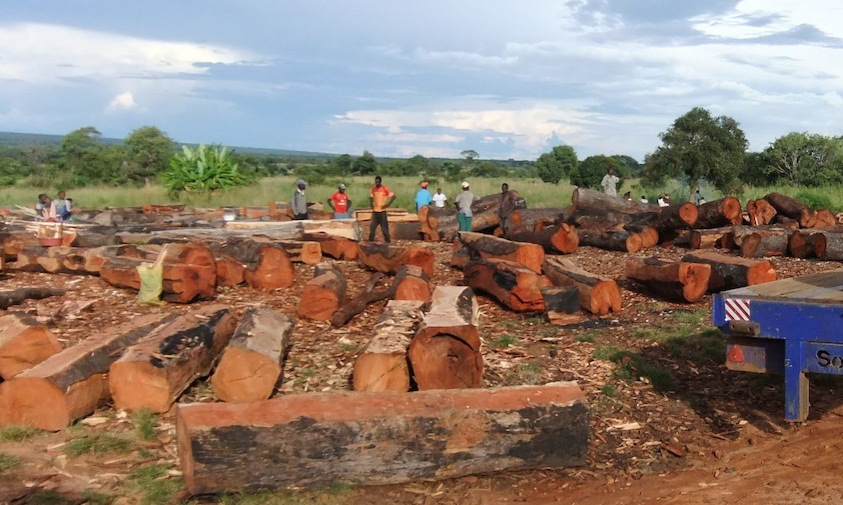
The Zambian government on Tuesday extended its ban on timber exports to all types of timber in the country.
The government has already banned to harvest and export of the Mukula species, an endangered species as well as in-transit of the logs from other countries in the region.
Minister of Lands and Natural Resources Jean Kapata said the government has decided to extend the ban to all timber species in the country.
She told reporters during a press briefing that the ministry will however allow concession licenses to continue operating and supplying timber to the local market.
The measure was aimed at empowering local people and ensure sustainable operations of the industry, she added.
The Zambian minister further said measures put in place to curb illegal harvesting, transportation and trade in timber between February and May this year have yielded positive results.
According to her, authorities impounded 466 trucks laden with timber logs during the period, adding that so far 272 trucks had valid documentation to transit through Zambia.
She said the trucks will soon be released to proceed to respective destinations while the remaining 194 trucks, which have no supporting legal documentation, will be dealt with on a case by case basis.
SCA names new CEO

The distribution of the SCA Group’s hygiene and health company, Essity Aktiebolag (publ), approved by the 2017 Annual General Meeting, has now been completed. The forest products company SCA has a new Executive Management Team effective June 15.
In line with this, the Board of Directors has relieved Magnus Groth of his duties as President and CEO and appointed Ulf Larsson as President and CEO, and relieved Fredrik Rystedt of his duties as Executive Vice President of the forest products company SCA.
Magnus Groth and Fredrik Rystedt will remain in their positions at Essity Aktiebolag (publ) as President and CEO and Executive Vice President and CFO, respectively.
Ulf Larsson has been an employee of the SCA Group 1992. He has served as President of the Forest Products business area since 2008, which following the now completed distribution, comprises the forest products company SCA. He has also been Executive Vice President of the company since August 2016.
Toby Lawton will hold the position of CFO in the new Executive Management of the forest products company SCA. Toby Lawton holds a Master’s Degree and between 2014 and 2017 has held the position of CFO at Vinda International Holding Limited, listed on the Hong Kong Exchange.
The core of SCA’s business is the forest, 2.6 million hectares in northern Sweden. The company offers paper for packaging and print, pulp, wood products, renewable energy, services for forest owners and efficient transport solutions.
Demand for logs, lumber from key offshore markets such as China, US fuels New Zealand forestry exports
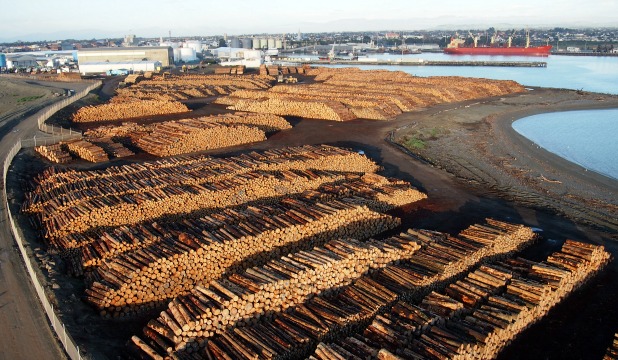
The forestry products market in New Zealand experiences new growth given the strong demand from key markets. Continue reading "Demand for logs, lumber from key offshore markets such as China, US fuels New Zealand forestry exports"
Gradual recovery in EU construction forecast to continue

Recovery of the European economy is boosting construction output, although the overall growth rate is forecast to remain slow in the next 2 years. These are the main conclusions of the 83rd Euroconstruct Conference hosted in Amsterdam on 8-9 June 2017.
Euroconstruct reported that European construction output expanded by 2.5% in 2016, half a percentage point higher than forecast at the previous Euroconstruct Conference held in Barcelona in November 2016.
Euroconstruct now expect the volume of construction output to increase by 2.9% this year and by 2.4% in 2018, both above the previous projections in Barcelona (+2.1% in 2017 and +2.2% in 2018).
The upgraded forecast reflects an economic upswing stronger than expected half a year ago, greatly improved consumer confidence and the continuing loose monetary policy. Overall construction output is expected to increase by 8% in 2016-2018 compared to the 6.5% forecast in Barcelona. Thereafter growth is expected to moderate in 2019 (+2%), slightly below the Barcelona figure (+2.1%).
GDP growth of 1.5% to 2.0% per annum in the period 2017-2019 is projected for the 19 Euroconstruct countries.
According to Euroconstruct, the European economy is set to follow a moderate growth path, stimulated by still relatively low oil prices, the weaker euro exchange rate and the Euopean Central Bank’s stimulus policy (quantitative easing).
In most European countries, domestic consumer demand is increasing, stimulated by declining unemployment.
Investment has started to pick up, particularly since households and companies can still secure inexpensive financing, and foreign demand is developing favourably.
However, the pace of recovery remains relatively moderate due to the sluggish implementation of economic reforms as well as long-standing weak growth trends. In general, the European economic growth potential is lower than it was before the financial crisis, due to the population ageing and declining productivity growth.
Euroconstruct estimate that residential construction in Europe expanded by 5% in 2016. In the coming years growth in this market segment is projected to become less strong, expanding by 3.7% in 2017, 2.3% in 2018 and 1.7% in 2019. At present, output in the sector is boosted by demographic trends, increasing household income and low mortgage rates.
New residential construction expanded by 8.8% in 2016, and growth this year will also remain very strong (+6.8%). However, a significant slowdown in new residential construction is expected in 2018 and 2019. Growth in residential renovation and maintenance has been slower but is expected to remain consistent at about 1.5% per year.
Non-residential construction is forecast to grow only modestly in the coming years; by 2.3% in 2017, 1.8% in 2018 and 1.2% in 2019. Despite the positive impulse from the growth of consumer demand and relatively high corporate profits, expansion in this sector is hindered in many countries by lack of external financing and the poor financial situation of public authorities.
Subsectors where public financing is particularly important – such educational building – is generally lagging other sectors.
Output in civil engineering, after contracting 1.8% in 2016, is forecast to increase by 2% this year and by 3.6% in both 2018 and 2019. Much growth in civil engineering will be concentrated in Eastern Europe, largely due to a new round of EU structural funds.
Construction activity in most European countries is growing consistently at around 2% per year during the 2017-19 period. However, activity is forecast to grow much more rapidly in a few countries, notably Hungary (14.9%), Ireland (7.7%), Poland (5.5%), Czech Republic (4.3%) and Portugal (4.1%).
Rubner Group sold Nordlam and Abbundzentrum Nordlam to Hasslacher Group

The Rubner corporate group has sold Nordlam GmbH and Abbundzentrum Nordlam GmbH (cutting centre) to the Hasslacher group. Approval by the competition authority is anticipated at the end of July.
Stefan Rubner (President, Rubner Holzindustrie AG) and Christoph Kulterer (CEO Hasslacher group) signed the contract for the takeover of all parts of the two firms, Nordlam GmbH and Abbundzentrum Nordlam GmbH, headquartered in Magdeburg, on the 13th of July 2017.
Nordlam GmbH was founded by Rubner in 2000 as a greenfield project and has grown over a period of a few years to become one of the largest glulam producers in Europe. Today the Nordlam brand stands for high-quality glulam in pre-cut standard forms, commissioned products and Express Elements. In the last few years, the site was extended by adding a cutting centre and a second glulam production line. Today around 200,000 m³ of glulam are produced in Magdeburg and sold all over the world.
“With Hasslacher group we have found a dependable partner for the responsible, continued management of the Magdeburg site, confident that we are placing our long-serving and worthy staff in good hands, and we look forward to excellent collaboration in the future”, said the managing director, Stefan Rubner. “In the future, Rubner will concentrate more on producing wooden panel material and its core competence of construction using wood”.
Because with the Nordpan brand, Rubner is a leading manufacturer of single and solid wood panels made of spruce, pine and larch. Going forward, the intent is to extend market leadership in this area, which is why Rubner has decided to concentrate 100% on this area. To this end, forward-looking investments and decisions have already been made.
“As a company with many years’ experience in the production of high-quality laminated timber, Nordlam is very close to us, not only in terms of its product portfolio but also it high technological standards”, said CEO Christoph Kulterer. “The acquisition of Nordlam enables further growth for us on international markets, so that we can cater for increasing demand. We look forward to collaboration across this location with all 250 Nordlam staff.”
Hasslacher group plans to increase production at the Magdeburg site with the existing staff and to enlarge the product portfolio in the medium term.
Rubner group is one of the most important timber construction firms in Europe. The company is active in the five business areas of timber industry, timber structural engineering, building construction, timber-frame house construction and wooden doors. At sites in Italy, Austria, Germany and France, RUBNER employs more than 1500 staff. Annual turnover is around 375 million euros.
Hasslacher group has an annual turnover of around 300 million euros and employs more than 1200 staff. With its seven production sites in Austria, Germany, Slovenia and Russia, it is one of the largest, leading timber industry enterprises in Europe and operates worldwide in more than 40 countries as an innovative manufacturer of solid timber materials, timber constructions and as a supplier of modern architectural timber structural engineering.
Italy’s wood and furniture sector continued to recover during Q1/2017

The Italian wood and furniture sector has flourished during 2017, when more than 79,000 companies spread out across the whole country, providing work for 320,000 people. Continue reading "Italy’s wood and furniture sector continued to recover during Q1/2017"
Canada doubled mahogany imports in March
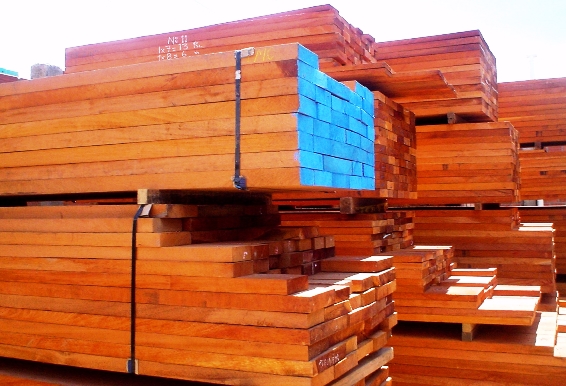
Canadian imports of tropical sawnwood increased slightly in March to US$1.95 million (all import values in US dollars). The value of year-to-date imports was up 6% from March 2016. Imports of mahogany sawnwood doubled in March to US$138,948.
Compared to March 2016 year-to-date imports of mahogany quadrupled. The growth was in mahogany imports from Bolivia which shipped US$77,167 worth of sawnwood, according to Statistics Canada.
Cameroon also expanded mahogany exports to Canada in March, while sapelli imports from Cameroon declined to US$188,431. Canada’s overall sapelli imports fell to US$294,636 in March, down one third year-to-date compared to March 2016.
Sawnwood imports from Brazil more than doubled in March to US$414,194. The bulk of the imports from Brazil are classified “nes” (not elsewhere specified).
Balsa imports from Ecuador were up in March (US$419,422). Canadian hardwood imports from Myanmar and Peru rose in March, while imports from Gabon, Malaysia and Thailand declined.
Södra divests UAB SIWood to Soernsen Group

Södra is divesting UAB SIWood in Lithuania to the German company Soernsen Group. The transfer will take place on 1 July.
SIWood is a subsidiary of the Södra Group that produces MDF products for walls and ceilings, architrave, window sills and window reveals. The company has annual production of 1 million m2 and its largest markets are the building materials trade in Sweden and Norway.
“On January 1st this year, we transferred Södra Wood Grimslöv to Soernsen Group and have since deepened our cooperation with the company. Today, Soernsen Group is one of our main suppliers, and its acquisition of SIWood will further strengthen our collaboration. With the takeover of SIWood, Soernsen will gain a competitive production model, resulting in greater delivery reliability and improved flexibility for us as a customer,” said Jörgen Lindquist, Business Area President of Södra Wood.
“The Soernsen Group is facing a strong increase in business activity this year. SIWood focuses on producing MDF mouldings and panels for the Scandinavian markets and has some spare capacity. Soernsen has a strong demand for MDF skirtings for Central Europe. SIWood, which will stand for Soernsen International Wood in the future, will soon present an expanded range of MDF products. In addition, pine products will be launched in the second half of 2017,” said Robert Soernsen, CEO of Soernsen Group.
The buyer is Soernsen Group, which was founded in 1945 and has several production sites in northern Germany, Estonia and Sweden. The company produces a broad range of mouldings; its standard assortment contains more than 3,000 items in various wood species and it delivers to countries worldwide.

