Article archive

Canfor to boost production at Urbana sawmill by 30%

Canfor Southern Pine, the operating company for Canfor’s operations in the United States, has made an investment of $8.8 million for upgrades at its sawmill in Urbana (Union County).

We are installing a third continuous dry kiln so we can increase lumber production substantially and add a second shift early in 2018,” said Derek Ratchford, Canfor Southern Pine’s regional manager for Arkansas.

It will lead potentially to 36 new jobs at the mill, an increased demand on local harvesting operations, and help us meet the growing demand for quality southern yellow pine lumber in the U.S.

The Urbana sawmill is in an area with abundant and high quality fiber supply, and produces premium southern pine lumber. It currently has a workforce of nearly 140, and an operational capacity of 145 million board feet (mmbf) per year, which will increase by 45 mmbf (or 31%).

The new kiln will have drying capacity up to 90 mmbf of dimensional lumber annually – 60 percent more capacity, which will allow maintenance to be scheduled in a more efficient manner,” said Ratchford. “We’ve already started training employees for the rollout, and expect to be operating by spring.”

Ratchford joined Anthony Forest Products in 2003, which was later acquired by Canfor, so he knows how important the mill is to the region.

When Canfor acquired Anthony Forest Products Company in 2015, it was clearly a great match. Both companies have long histories, and both started small as family-owned businesses, growing on reputations as producers of quality forest products with excellent customer support.”

Since the acquisition in 2015, Canfor has invested $7 million at Urbana with plans for an addition $13 million to be spent from now through 2020.
US to invest $7 million in efforts to expand wood markets

The U.S. Department of Agriculture’s Forest Service is taking grant applications for projects that expand wood products and wood energy markets, especially in areas with high wildfire risk. Applications may be submitted through Jan. 22, 2018. Grants provided through the agency’s Wood Innovations program not only help reduce hazardous fuels and improve forest health, but also create jobs to promote economic vitality in our communities.

In 2018, the program will invest up to $7 million in projects designed to have a long-term impact on lands managed by the agency and other forest lands by leveraging the market for low-value wood.

Funding is available to support a diverse range of activities, from completing engineering designs, cost analyses, permitting, or other requirements for the final stages of commercial construction projects using wood as a primary building material as well as developing a cluster of wood energy projects in a specific geographic area.

Funding may also support business planning and efforts to accelerate the manufacturing, market adoption, and demonstration of innovative wood products, such as cross-laminated timber.

Since 2005, almost 280 grants have been awarded to small businesses, non-profits, institutions of higher education, tribes, states, and local governments to improve forest health while creating jobs, renewable energy and healthy communities.

Since 2013, this funding has also helped establish 22 Statewide Wood Energy Teams and eight Statewide Wood Utilization Teams that collectively expand and support wood energy and wood products markets.

This week is National Forest Products Week (Oct. 15-21), when we celebrate the value of America’s forests and the products they provide while recommitting to sustainably manage these splendid natural resources to meet our nation’s needs now and in the future.

October 19, is National Bioenergy Day, a day to unite organizations across the country that support bioenergy to demonstrate the many benefits that bioenergy provides at the local level.

A diversified wood products industry enhances resiliency of our ecosystems, sequesters carbon, and creates jobs in rural communities.

The deadline for submitting grant applications is Jan. 22, 2018. Information on how to apply is available on the Wood Innovations Grants website or the Wood Education and Resource Center website.

The mission of the U.S. Forest Service, an agency of the U.S. Department of Agriculture, is to sustain the health, diversity and productivity of the nation’s forests and grasslands to meet the needs of present and future generations.

The agency manages 193 million acres of public land, provides assistance to state and private landowners, and maintains world-renowned forestry research and wildland fire management organizations. National forests and grasslands contribute more than $30 billion to the American economy annually and support nearly 360,000 jobs.

These lands also provide 30 percent of the nation’s surface drinking water to cities and rural communities; approximately 60 million Americans rely on drinking water that originated from the National Forest System.

Russia chooses strategic partnership with China in wooden housing sector

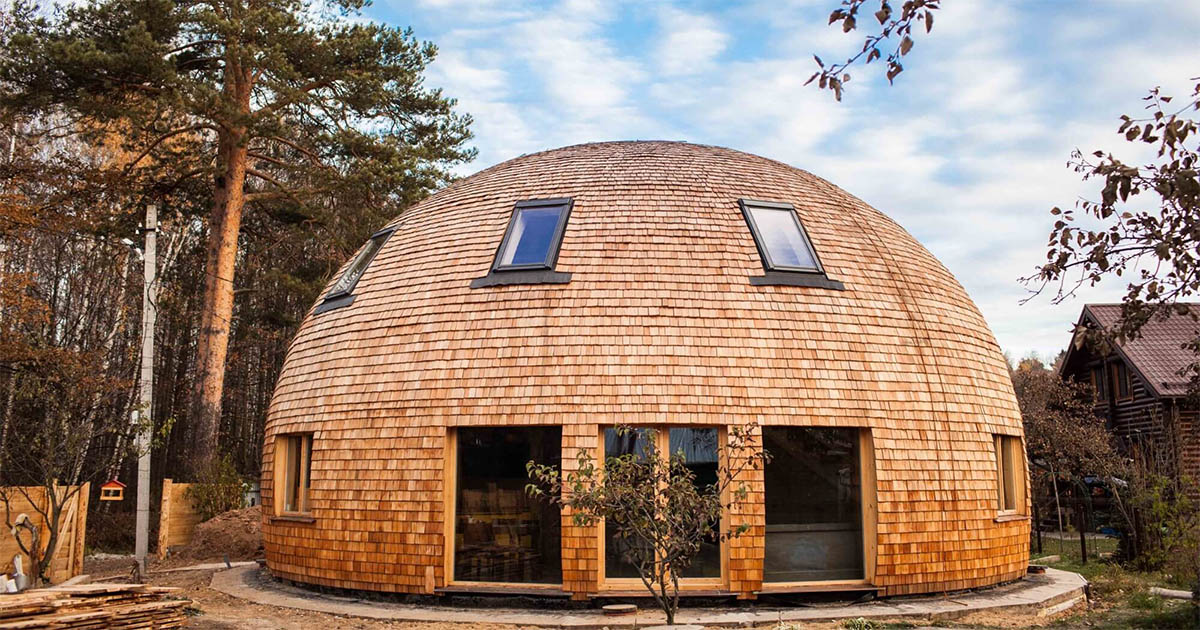
Russia and China have recently discussed about a cooperation plan on wooden housing.
Representatives of the Chinese government agencies showed their interest in the Russian's experience in wooden housing.
"Wooden housing is a subject of interest to both Russia and China. We are united in our desire to provide our citizens with houses made with quality and sustainable materials. This cooperation can also provide more confident growth to the Far East timber industry," says Viktor Evtukhov, State Secretary, Deputy Minister of Industry and Trade of Russian Federation.
China is one of Russia's key markets in terms of timber industry products' export potential. At the moment, the Russian-Chinese Program of Cooperation on forest resources development and usage is being carried out.
At the Beijing exhibition, the Russian delegation presented technological solutions in the sphere of wooden housing, and development of the country's wood processing industry. Nine Russian companies were represented at the Russian Timber Industry collaborative booth, including STOD LLC, SVEZA-les, DOK Kalevala, AO Turanles, and others. The companies exhibited various construction materials, such as sawn timber, glulam, board products, etc.
The participation at the CIEHI 2017 was aimed at promoting the Russian wood construction materials on the global market.
China International Exposition of Housing Industry & Products and Equipments of Building Industrialization 2017 presented 400 exhibitors from 6 countries, within a total area of 50 000 m2.
The exhibitors took part in the meetings on housing, energy efficient construction technologies, integrated systems of the future, within the framework of the event.

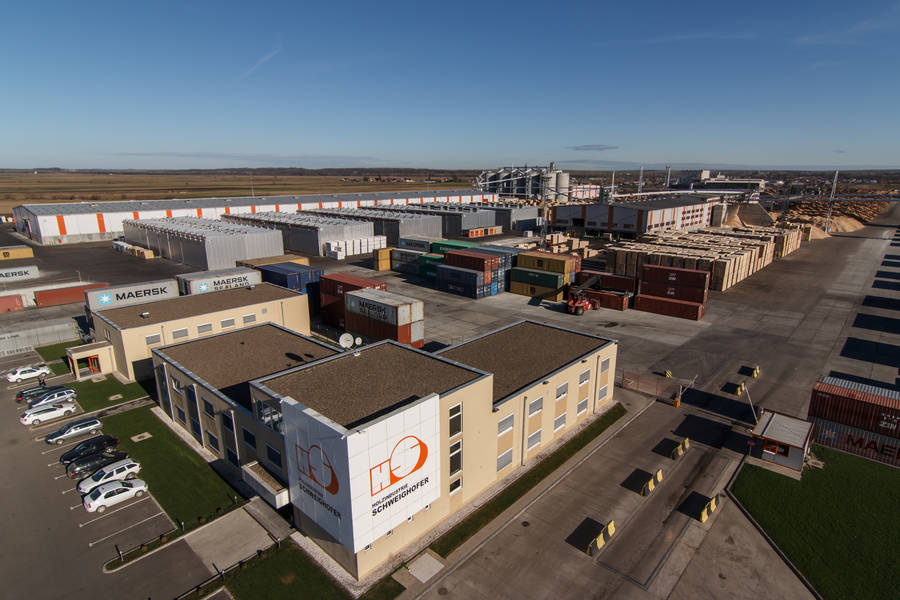
Holzindustrie Schweighofer plans to boost capacity at Kodersdorf sawmill; EUR 30 million investment

The Austrian  Group has bought the Kodersdorf sawmill in Saxony from the Klausner Group in 2015. Since then, the company has been working on the expansion of production capacities.

Today, sawn and planed products are produced at the sawmill, in particular for the markets in Japan and the USA. The plant has a cutting capacity of 1 million cubic meters of roundwood and a planing capacity of 360,000 cubic meters. Schweighofer employs at Kodersdorf around 430 people.

In total, about 30 million euros will be invested in wood processing, including wood drying plants, over the next two years. In the future, investments will also be used to produce not only sawn and planed products, but also glue products, which are particularly used in Asian house construction - especially in Japan.

The expansion is intended to create not only a significant increase in added value, but also around 100 additional jobs will be added by the beginning of 2019.

Lumber prices in the US slipped during last week

The framing lumber sales in the US have quieted over last week, while a mix of trends developed across framing lumber species.
Weakness was widely apparent in Southern Pine, especially on the westside. This contrasted with further gains in prices of dry western species and Western S-P-F, some of which reached new record highs.
There was a mix of trends among random dimension and studs, as well, with key stud prices softening. Drops in SYP random dimension, green Fir Std&Btr 2x4, and S-P-F 2x4 8-foot studs resulted in a $2 decrease in the Random Lengths Framing Lumber Composite Price.

Week
Oct 20
Week
Oct 13
Year Ago
2016
Random Lengths Framing Lumber Composite Price* $438 $440 $356
KD Western S-P-F #2&Btr 2x4 R/L Mill Price 449 443 318
KD Eastern S-P-F #1&2 2x4 R/L, delivered Great Lakes 553 550 409
Green Douglas Fir Std&Btr 2x4 R/L (Portland) 467 470 330
Southern Pine (Westside) #2 2x4 R/L 420 427 434
KD Coast Hem-Fir #2&Btr 2x4 R/L 470 467 330
Ponderosa Pine (Inland) #2&Btr 1x12 R/L 710 700 655
* Weighted average of 15 key items

Random Lengths Panel Market Report
Structural panel sales and price trends were mixed. Strength of order file or lack thereof were the key factors in OSB price trends.
In producing regions where mills had order files into November, prices held firm even though sales dwindled. However, discounts cropped up where loads were available for shipment in October.
Southern Pine plywood traders reported prices of rated sheathing on either side of previously reported levels. Western Fir plywood sales slowed at the mills, but picked up at the secondary level. Prompt shipments were vital to securing sales.

(f.o.b. mill prices) Week
Oct 20
Week
Oct 13
Year Ago
2016
Random Lengths Structural Panel Composite Price* $535 $538 $376
Southern (west-east) 15/32-inch 3-ply rated sheathing plywood 505-528 507-528 367-385
Southern (west-east) 15/32-inch 4-ply rated sheathing plywood 510-530 512-530 373-400
Western 1/2-inch 4-ply rated sheathing plywood 513 525 365
North Central 7/16-inch Oriented Strand Board 455 455 287
*Weighted average of 11 key items


U.S. sawmills rise lumber production

U.S. sawmills produced 19.709 billion board ft. (bbf) of softwood lumber in the first seven months of 2017, a gain of 2.9% from 19.159 bbf in the same period of 2016. 

According to the Western Wood Products Assn. of Portland, Oregon, Western U.S. sawmills contributed 8.137 bbf to the seven-month total, an increase of 1.8% from 7.993 bbf a year earlier, while sawmills in the southern U.S. accounted for 10.644 bbf – up 3.7% from 10.264 bbf a year earlier.

Production in July alone was 2.732 bbf, a year-over-year increase of 4.3% from 2.619 bbf, but down 8.1% from 2.973 bbf in June 2017.

Sawmills in the West accounted for 1.122 bbf of July’s output – up 6.5% from 1.054 bbf last year, but down 10.7% from 1.257 bbf in June 2017. Sawmills in the South produced 1.481 bbf, which was 2.8% above the previous year’s volume of 1.441 bbf, but down from June 2017’s output of 1.576 bbf by 6.0%.

Apparent U.S. softwood lumber consumption in the seven-month period was 27,979 bbf, up by just 0.1% from 27.965 bbf in the first seven months of 2016. Consumption in July was 3.796 bbf – down 10.5% year-over-year from 4.241 bbf, and down 5.2% from 4.003 bbf in the previous month.

Canadian softwood lumber production/consumption

Softwood lumber production by Canadian sawmills in the first seven months of 2017 was 16.724 bbf – up 1.3% from 16.508 bbf in the same period of last year. Sawmills in British Columbia contributed 7.727 bbf, down 3.3% year-over-year from 7.993 bbf, while sawmills east of the Rockies produced 8.998 bbf – up 5.7% from 8.515 bbf a year earlier.

In July, Canada’s softwood production was 2.164 bbf, down 1.6% from last year’s 2.200 bbf, and 9.0% lower than June 2017’s production volume of 2.378 bbf.

Production by sawmills in British Columbia accounted for 1.022 bbf of July’s total, a year-over-year drop of 6.9% from 1.098 bbf, and down 6.5% from 1.093 bbf in June 2017. Sawmills east of the Rockies produced 1.142 bbf, up 3.6% from 1.102 bbf in July last year, but down 11.1% from output in the month before of 1.285 bbf.

Apparent Canadian softwood lumber consumption in the seven-month period was 5.775 bbf – up 5.7% from 5.463 bbf last year, while consumption in July was 875 million board ft. (mmbf) – up 12.2% year-over-year from 780 mmbf, but down 9.4% from June’s consumption of 965 mmbf.

U.S. and Canada utilization/inventories

U.S. production as a percentage of practical capacity averaged 86% in the first seven months of 2017, level with the average in the same period last year, while the percentage in Canada dropped to 89% from 91%.

U.S. inventories slipped 0.4% to 2.862 bbf in July from 2.873 bbf in the same month of 2016. Canadian inventories increased to 3.045 bbf – up 4.8% from 2.904 bbf in July 2016.

Spanish trade association legality risk assessment of Brazil

According to the European Timber Trade Federation (ETTF), the Spanish Timber Trade Association AEIM has produced a preliminary risk assessment report on sourcing from Brazil to support member’s implementation of the EU Timber Regulation (EUTR).

The risk assessment, which was presented to the association’s latest board of directors meeting, was commissioned from a ‘committee of experts’. It lists and analyses official documentation that must accompany Brazilian sawn timber products to satisfy AEIM’s compulsory EUTR-aligned due diligence system.

The report breaks Brazil into three areas; Pará, Matto Grosso and ‘other states’. Legality risk assessment documentation is covered along the supply chain, from forest to export.

Brazil is rated ‘very high risk’ on AEIM’s illegality risk assessment website www.maderalegal.info and the report is therefore seen as a key trading tool.

Brazil is Spain’s second biggest tropical timber supplier after Cameroon, on which AEIM commissioned a similar risk assessment and due diligence report last year. In 2016, Spain imported 10,312 m3 of Brazilian sawn lumber, worth €6.1m.

While addressing illegality risk, the AEIM report also highlights efforts being made by the Brazilian Environment Institute (IBAMA) to tackle illegal trade, and the development of Brazil’s National Control System for Forest Products Origin (SINAFLOR), its timber supply chain tracking database. The final AEIM report will be available soon.

In a separate report, AEIM note that a recent survey of members revealed that only 4% of all tropical timber imported into Spain is certified. AEIM is committed to raising this percentage to 12% by 2020.

Roseburg announces operations curtailment at Dillard sawmill

Roseburg Forest Products is to curtail production at its sawmill in Dillard, Oregon effective Oct. 21.

The company said the curtailment was an effort to allow log deliveries to restore inventories to more efficient levels.

The sawmill is due to restart operations from mid- to late next week, and the dry kilns, planer, and shipping will continue to operate.

Roseburg Forest Products Company, Inc. manufactures and markets various wood products for customers throughout North America. The company offers decorative products, including thermally fused laminate panels, hardwood plywood, ultra-finish panels, and shelving; and construction products, such as engineered wood, lumber and timbers, real wood sidings, softwood plywood, concrete forming plywood, particleboards, and other products.

It also offers industrial products, including medium density fiberboard, industrial and sanded plywood, particleboards, and other products; specialty products, such as landscape timbers and western softwood chips; wood pellet fuel; and various green products.

Wood pellets price in Germany picks up during October

The price of wood pellets in Germany has increased by 1.7% during October 2017, as compared to the previous month.
According to data from the German Energy Wood and Pellet Association e. V. (DEPV), the price amounted to 236.64 EUR / t (for 6-tonne purchases).
As compared to October 2016, the price has increased by 4.5%. One kilogram of pellets in October 2017 costs 23.66 cents and one kilowatt hour (kWh) heat from pellets 4.73 cents. The price advantage for fuel oil is 15% and to natural gas, of  about 20%.
Regional rates (decrease 6t): Southern Germany: EUR 234.15 / t, Central Germany: EUR 236.56 per tonne, North / East Germany: EUR 237.40 / t. Larger quantities (26 t) can be bought for the following prices: South: 219.15 EUR / t, Middle: 221.11 EUR / t, North / East: 216.96 EUR / t (all incl. VAT).

ULK Group claims new Arkhangelsk sawmill complex will be Russia’s largest wood processing facility

Hiab, part of Cargotec, has secured an order for close to 40 LOGLIFT F96ST forestry cranes from Russia.

The customer is ULK, a group of Russian companies specialized in logging, deep wood processing and disposal of waste lumber. The value of the order exceeds EUR 1 million and it has been booked into Cargotec's third-quarter order intake.

"We will build a new wood processing plant next to the existing plant. As a result, this complex will be Russia's largest woodprocessing factory. In order to provide the plants with a stable and uninterrupted supply of timber, we decided to order LOGLIFT cranes because we trust their quality and durability," says Vasiliy Vasilievich Kuznetsov, Technical Director, ULK.

The deliveries of the forestry cranes start in November and will be finalised by the end of 2017.

"We are very happy to receive this order from ULK and our wish is that this delivery is a good start in our cooperation. This order is also a great success for our ambition to grow the Hiab business in the important and recovering Russian market," says Hans Ekman,  Vice President, Forestry Cranes, Hiab.

Hiab is a provider of on-road load handling equipment, intelligent services and digitally connected solutions.

8.1 million tonnes of wood pellets certified in 2016; ENplus leads the way

The European Pellet Council (EPC) in charge of ENplus management, announced a record year for the wood pellet quality scheme.

With over 8,1 million tonnes certified worldwide in 2016 and 9,2 million tonnes anticipated by the end of 2017, ENplus confirms its leading role in the global harmonisation of high quality wood pellets.

Initially developed and launched in Germany in 2010 in order to ensure wood pellet quality all along the supply chain, ENplus has experienced a sustained growth over the years, expanding beyond European borders. In 2016, ENplus certified 366 pellet producers and 324 traders over 41 countries, with a positive trend confirmed by the projections for 2017 showing as many as 411 certified producers (+12%) and 359 traders (+11%). Producers from Australia and New Zealand have also applied for the first time.

Germany maintained its leading position with 1,7 million tonnes of ENplus pellets produced, followed by Austria, France and Romania. Russian demand for ENplus certification is also remarkable. In 2016, the federation was the first non-EU28 country in terms of production, ranking in the top five worldwide. This trend was confirmed in 2017, with one of the most substantial increases in certified volume.

According to Gilles Gauthier, General Manager of the scheme “Market players’ interest in ENplus will allow us to continue investing serenely in consolidating the scheme, its implementation and the coordination with ENplus partners. Maintaining high and harmonised standards will be key for the long-term establishment of the pellet sector.”

Regarding quality classes, over 90% of all certified production is sealed ENplus® A1, the scheme’s highest grade. ENplus A2 represents around nine per cent, while ENplus B pellet production remains limited with less than one per cent of the certified volume. This distribution clearly indicates that the European heating sector remains a market driven by premium quality pellets.

The rapid growth of the certification also implies a specific attention to both quality controls and brand protection: besides the yearly inspections, any quality complaint is closely followed by the ENplus team, potentially leading to extraordinary inspections. This allows for a constant quality control throughout the year. Trademark fraud is also closely monitored by ENplus management, as attested by the 478 infringements identified and positively solved over the past two years.

Eric Vial, President of the European Pellet Council confirmed “The ENplus scheme reached a whole new level, it is now essential to protect and develop its reputation. Among other strategic orientations, we have therefore decided to work in 2018 on improving public awareness about pellet quality and the ENplus brand.”

Average prices for standing timber in Belgium, autumn-winter 2017

List of prices for standing timber set by National Federation of Forestry Experts A.S.B.L.

 Preliminary remarks.
The arrows next to each price range indicate the price evolution against the prices set in the previous period of time. Continue reading "Average prices for standing timber in Belgium, autumn-winter 2017"

Russia’s sawn timber exports up by 27% in January-August 2017

In the first eight months of 2017, Russia increased its sawn timber exports again, both in value and in volume terms, as the statistics published by the Russian Federal Customs Office show.

Thus, during the first eight months of the current year Russia exported 12.156 million tonnes of sawn timber. That is 11.9% more than during the respective period of the last year.

The total value of the exported Russian sawn timber increased as well. In January-August 2017 it came up to $2.58 billion having gone up by 26.86%.

In their turn, Russian log exports went a bit down in volume terms. In January-August 2017, Russian log exports went down to 12.854 million m3 while during the respective months of the last year the figure equalled 13.275 million m3. Thus, Russian log exports decreased by 3.17% y-o-y.

The total value of the Russian logs exported in January-August 2017 came up to $970.1 million, that is 8.19% more than during the respective period of 2016.

India- A growing market for American softwoods

American Softwoods (AMSO), the promotional partnership formed by three major U.S. softwood trade associations has recently declared that the total exports of U.S. softwood lumber to India reached a value of USD 8.882 million in the first half of 2017.

The announcement was made today at the opening of MumbaiWood, which is due to run until October 14, 2017 at the Bombay Convention and Exhibition Center in Mumbai, India.

The statistics, which have been compiled from the latest data released from the United States Department of Agriculture (USDA), reveal an overall increase in value of 102 percent over the same period in 2016.

In terms of species, Southern Yellow Pine dominated exports with over 79 percent of all softwood lumber exports to India. Other species that were also imported in smaller quantities included Douglas-Fir, Ponderosa Pine, White/red Pine, and Lodgepole Pine.

According to market reports, India is an emerging market for softwood lumber. Traditionally, the market has preferred hardwoods for furniture, door and window manufacturing but as regulations on the harvesting of their preferred species (such as teak) has increased, so has the demand for substitutes.

“India is growing in importance for producers of American softwoods and we have been pleased with how well the market has accepted our species and products. Recognizing the need to support local manufacturers, the Indian government has been providing them with support for outsourcing supplies from other countries, allowing them to import raw materials and remanufacture them locally. Our hope is that by participating at events like MumbaiWood, we can establish a direct connection between our members and the different elements of the ‘timber chain’ in India. In doing so, we aim to ensure that they have as much information as they need to design and build with American softwoods and a direct line of supply,” concluded Charles Trevor, Consultant to American Softwoods.

8,000 companies present at this year’s SICAM

The 9th edition of SICAM, the International Exhibition of Components, Accessories, and Semi-Finished Products for the Furniture Industry, ended with numbers growing further. The sector’s leading professionals from all over the globe were in attendance at Pordenone for four days.

There were almost 8,000 enterprises visiting the trade fair to create business for the 583 companies that brought technological and design products to exhibit at the highest international level, occupying the entire trade fair area with over 15,000 square metres of stands. The international rate of the event was very high once more. Over 28% of the companies exhibiting at the trade fair were comprised of foreign companies and, once again, there were over one hundred countries – in addition to Italy – represented by the visiting professionals and buyers registered.

Therefore, SICAM continues to record gradual and constant growth over the years in terms of attendance, and also with regard to the quality and extensiveness of the range of accessories, components, and materials presented. This growth is mainly due to the fact that the sector’s international manufacturers recognise in an increasingly clear-cut manner the role of SICAM in the global trade scene.

“The very enterprises on both the offer and demand sides that come to Pordenone are the true leading players of this success,” according to Carlo Giobbi, the organiser of SICAM. “These companies, the international community of the furniture industry, confirmed once more this year how the event is more and more every year the true occasion when all the players of the furnishing industry come together. It is thanks to their numerous and high-profile participation that we can recognise the success of the event”.

The companies of the components and accessories segment assess their results at the trade fair in terms of business attained and relationships created. The indicator that most certifies the measure in which the industry recognises SICAM’s effectiveness in this direction is the rate of return of exhibiting companies from all over the world. Once more this year, approximately 90% reconfirmed their attendance from the previous edition. This statistic also explains the high rate of international attendance with regard to the visitors.

Certified wood accounts for most of Dutch timber imports

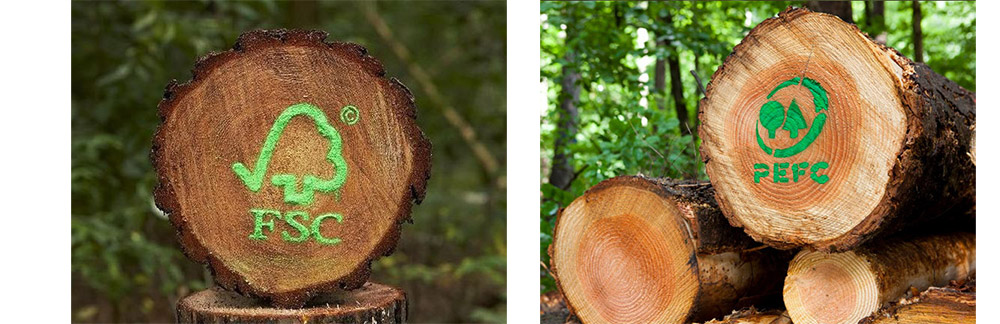
The headline statistic in the ’Sustainably produced wood on the Dutch market’ study from sustainability, forestry and forest products institute Probos, is that the market share of FSC and PEFC certified timber increased from just 13.3% in 2005 to 83.3% in 2015.

This is the fifth analysis of the sector undertaken by Probos, covering the primary wood products and paper and cardboard markets in the Netherlands. It also breaks down market share figures for sawnwood, temperate and tropical hardwoods, sheet materials, packaging paper, cardboard, graphic paper, newsprint and sanitary paper.

The report indicates that share of certified wood on the Dutch market increased across all product groups, although the rate of increase has slowed in recent years.

Share of softwood increased from 76% in 2009 to 96% in 2012 before rising to 98% in 2016.

The share of panel products increased from 61% in 2009, to 89% in 2014 before rising to 92% in 2016. Share of hardwoods increased from 24% in 2009 to 55% in 2013 and 61% in 2016.

The share of certified in tropical sawn hardwood supply to the Netherlands increased from 56.5% in 2013 to 63.2% in 2015. Almost half of the certified tropical sawn supply is under the Malaysian Timber Certification Scheme (MTCS) which is PEFC-recognised and was endorsed as fully compliant with the sustainability criteria of the Dutch government from January this year. The rest of the volume is mainly FSC certified from Cameroon, Gabon, and Indonesia.

The report notes that the most rapid rate of proportional increase in certified supply in recent years is in temperate sawn hardwood, from 20.7% in 2013 to 33.7% in 2015, but this is against the background of a sharp decline in Dutch imports of temperate hardwood.

Probos suggest that temperate hardwoods are lagging other product groups because much is lower grade used in the packaging industry in the Netherlands, very little of which is certified.

Probos do not mention an alternative explanation, which is that a relatively high proportion of temperate hardwood derives from small non-industrial owners in both Europe and North America, which are less likely be certified than the large state and industry-owned forests that supply a majority of softwood and panel products.

The share of total Dutch consumption of timber and woodbased panels taken by timber certified under the schemes was 40.9% for FSC and 33.1% for PEFC in 2015. The relative share of FSC and PEFC on the market was little changed from 2013.

Greenpeace activists block SCA’s Östrand pulp mill

Greenpeace Nordic activists have blocked the entrances to a major Swedish pulp mill that supplies Essity, the world’s second-largest tissue producer. Forty activists from seven countries placed a shipping container at the entrance road to the mill, where trucks deliver timber.

Train tracks leading to the mill have also been blocked, as well as the road used for transporting pulp out from the mill. Activists have hung a 15 x 20 metres banner on the mill with a message to Essity: ‘Stop wiping away forests’.

According to Greenpeace, the SCA Östrand pulp mill in Timrå sources its wood from logging companies that are destroying the last critical forest landscapes in northern Sweden. These areas have been identified by the Swedish authorities as having ‘particularly high ecological preservation values’.

The protest, with Greenpeace Nordic activists, follows the release of a Greenpeace International report, Wiping Away the Boreal, which argues that Essity is driving the destruction of critical parts of Europe’s Great Northern Forest, in Sweden, Finland and Russia.

Greenpeace Nordic Great Northern Forest project leader, Erika Bjureby said:

“It is insane that Essity is allowing these beautiful and critical areas of forests to be destroyed to make toilet tissue brands. The company needs to stop its pulp suppliers wiping critical forests off the face of the earth or stop doing business with them. We need to stop chopping trees here now, before the Great Northern Forest is logged into pieces.”

Greenpeace has launched an online petition calling on Essity to clean up its supply chain and stop wiping away the forests.

Roundwood prices in Estonia mostly up during August

Roundwood prices in Estonia have mostly increased during August 2018, as compared both to the same period last year, but also compared with the previous month.
The prices for sawlogs saw bigger increases as compared to the same period last year, than compared to July 2017. Thus, pine sawlogs could be bought for EUR 66.18/m3 in August, 5.70% more than in August 2016 and 1.48% more than in July.
As for spruce, its price went up by 5.35% as compared to August 2016 and only by 1.07% up as compared to July.
Birch veneer could be bought for EUR 110.98/m3 during August 2017. This represents a 7.12% increase over August 2016 and 7.64% more than in July.
Among the pulpwood assortments, pine could be bought for EUR 27.12/m3 in August, a 13.18% increase over August last year, while the price for spruce and birch went up by 9.29% and 2.49%, respectively.

  August 2016 €/m3 July 2017 €/m3 August 2017 €/m3 Change% August  2016-August  2017 Change% July/August  2017
Pine sawlogs

62.61

65.21

66.18

5.70%

1.48%

Pine sawlogs d<18cm

50.66

51.53

50.91

0.49%

-1.20%

Spruce sawlogs

61.62

65.12

65.82

5.35%

1.07%

Spruce sawlogs d<18cm

48.75

51.72

50.91

4.43%

-1.56%

Birch plywood

57.19

58.67

59.16

3.44%

0.83%

Birch veneer

103.60

103.10

110.98

7.12%

7.64%

Pulpwood          
Pine pulpwood

23.96

26.91

27.12

13.18%

0.78%

Spruce pulpwood

23.46

26.19

25.64

9.29%

-2.1%

Birch pulpwood

23.62

24.14

24.21

2.49%

.0.28%

Aspen pulpwood

18.50

19.87

19.71

6.54%

-0.80%

Firewood

19.58

19.22

20.12

2.75%

4.68%

Arauco invests $151 million in Valdivia sawmill upgrade

Arauco officially announced it presented an Environmental Impact Statement for the extension and modernization of the Valdivia sawmill, which involves a $151 million investment to modernize the current facility and increase annual production capacity from 487,000 cubic metres to about 1 million cubic metres.

The new production unit –which is estimated to undergo construction during 18 months once the EIS is approved and the mandatory permits are procured—will require an average workforce of about 430 people during construction, with a peak of 880 collaborators. During its operation the new saw mill line will employ an additional 390 people.
We are very proud of this important initiative, because we know that the timber industry is a production development pole that holds great potential; and we’re certain that this project is consistent with our goal of becoming a sound strategic pillar for the local economy,” said Charles Kimber, Arauco’s Senior Vice-President Commercial & Corporate Affairs.
The project includes equipment that operates with state of the art technology to maximize production processes. This line comprises, for example, the installation of a new steam boiler for the sawmill’s self-supply.

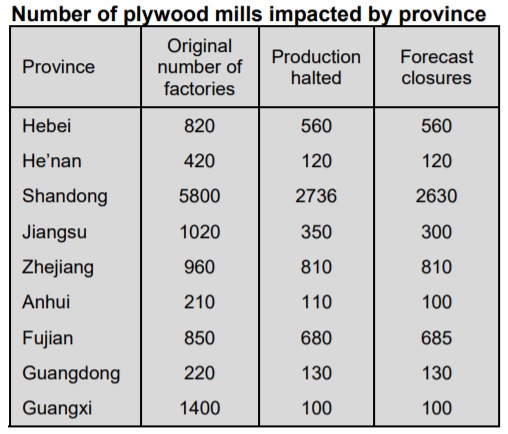
China: Thousands of plywood mills have been required to cease production

China has been accelerating transformation of wood-based panel industry and elimination of outdated production capacity.

According to the China National Forest Products Industry Association (CNFPIA) thousands of plywood mills have been required to cease production of which around half are under-going modernisation.

It has been reported that enterprises in the main woodbased panel production bases such as Shandong Linyi and Heze cities, Jiangsu Pizhou cities which can satisfy environmental regulations and have an important role in maintaining jobs will be allowed to resume production.

Linyi city is home to the largest wood-based panel production plants and annual output exceeded 45 million cubic metres in 2016 accounting for over 50% of the national wood-based panel output. Some 40% of the production from this area is exported.

Analysts report there are issue to be addressed such as upgrading technologies, improving management and development of corporate social responsibility. Recently, significant success has been seen in volatile organic compound control in the enterprises in Linyi city.

Newsletter

Subscribe to our digital newsletter for your daily digest of essential news, views and analysis from the international wood industry delivered directly to your inbox.


0