Article archive

Astec Industries to limit wood pellets business due to financial improfitability

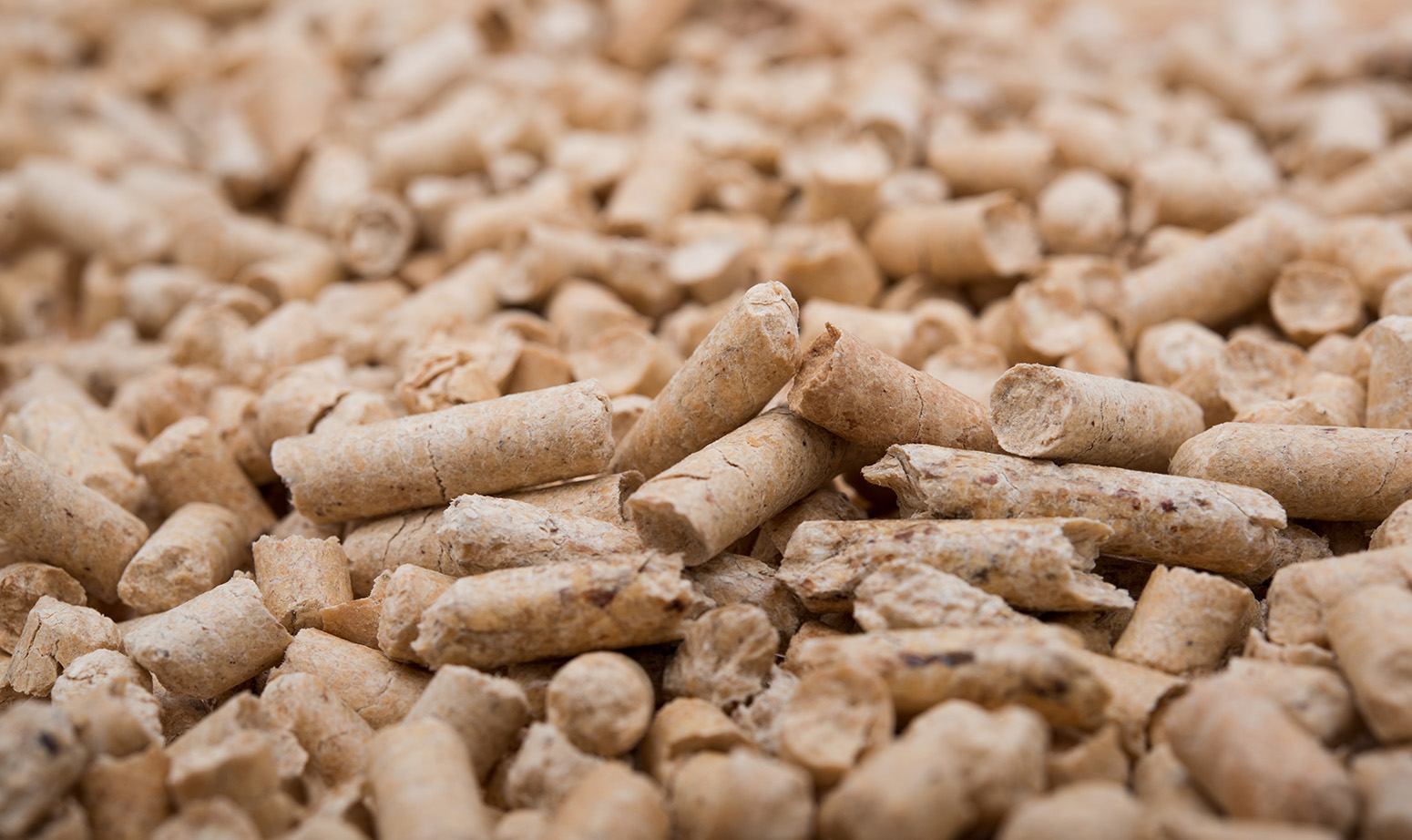
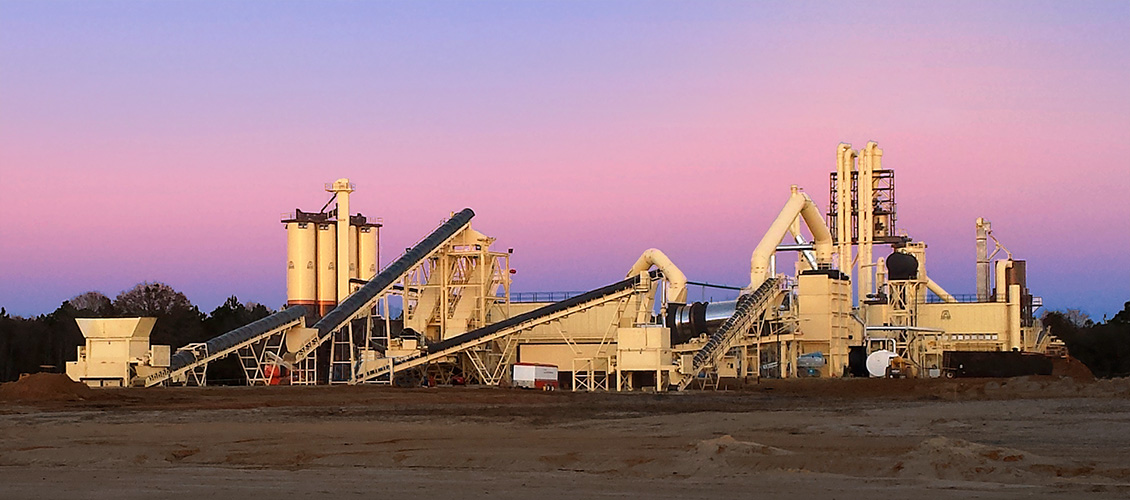
Nearly a decade after entering the business of developing new wood pellet production machines, Astec Industries, Inc. said today it is giving up on its plans to engineer and develop a wood pellet plant in Arkansas and limiting its participation developing other new pellet plants.

The Chattanooga-based heavy equipment manufacturer reported today better-than-expected profits from its core business, but Astec reported a net loss of $40.7 million in the second quarter because of losses in its wood pellet operations.

Astec said it has agreed to pay $68 million in cash and forgive $7 million in receivables related to its incomplete wood pellet plant being built in Arkansas.

Astec said it is exiting its contract with Highland in Arkansas and redefining its strategy to limit its participation in the wood pellet plant market to offering only proven technology for sale as an equipment supplier, not as an engineer, procure, construct (EPC) organization or a participating lender on wood pellet plant projects. Astec said it will continue to sell after-market parts and service support for wood pellet plants.

"In order to further capitalize on the strengths of our core businesses, we have exited our contractual obligations with regard to the Highland wood pellet plant and have redefined our wood pellet plant business.," Astec CEO Ben Brock said in today's earnings announcement. "At the same time, we are engaging in a strategic sourcing review to streamline our procurement process. As we optimize our cost structure, our board is also considering capital allocation options. All of these actions are designed to position the company well for 2019 and beyond."

In the second quarter, Astec said it lost $40.7 million, or $1.76 per share, on net sales of $272.5 million. In the same period a year earlier, Astec reported net income of $14.4 million, or 62 cents per share, on sales of $301.9 million.


Mixed price developments for softwood lumber in Austria

In June, softwood lumber prices in Austria have registered some mixed developments. Compared with May, edged boards and squared timber are on a slight positive trend.
Prices for stock timber and boards in standard length (4-6 m) are declining. All other products show no price change compared to the previous month. 
On a yearly basis, a similar mixed picture can be noticed with a slightly negative tendency. Squared timber and 3-6 m boards have become more expensive over May 2017.
The price for rough boards is stable, while all the other assortments are cheaper over last year.

Softwood Lumber Spruce/Fir

Jun. '17

May '18

Jun '18

Change Jun. '17 to '18
€ / cbm EXW

Edged Boards, 0-IIIa, 23 mm +

243-255

242-251

242-252

-1/-3

Rough boards in fixed dimensions, 18-22 mm

240-250

240-250

240-250

-/-

Squared timber, standard dimensions, I/II, 4-6 m

221-226

222-228

224-228

+3/+2

Stock squared timber, II/III

166-172

165-172

163-171

-3/-1

Boards, III-IV, 8-16 cm, 4-6 m

157-163

156-163

154-162

-3/-1

Boards, III-IV, 8-16 cm, just 4 m

159-166

158-165

158-165

-1/-1

Boards, III/IV, 23 mm, 4-6 m

160-166

158-165

158-165

-2/-1

Boards, III/IV, 28 mm +, 3-6 m

166-175

168-176

168-175

+2/-

Overview of the EU wood door and window market

Eurostat PRODCOM data reveals that the total value of wood doors supplied to the EU increased by 5% to €7.12 billion in 2017. Despite the increase, the value of wood doors supplied to the EU in 2017 was still more than 25% down on the level prevailing before the global financial crises.

Most new wood door installations in the EU comprise domestically manufactured products. The EU’s domestic production increased 4.9% to €6.78 billion in 2017. There was significant variation in the performance of the wood door sector in EU countries in 2017.

Production in Germany, the largest wood door manufacturing country, was stable at €1.30 billion during the year while production in the UK continued to slide, by 2% to €840 million.

However, production increased sharply in Italy (rising 12% to €910 million), France (rising 5% to €640 million), Spain (rising 14% to €540 million), Poland (rising 10% to €510 million) and the Netherlands (rising 30% to €250 million).

Wood door imports into the EU increased by just 0.3% to €341 million in 2017. Imports accounted for 4.8% of the total euro value of wood door supply to the EU in 2017, down from 5.0% the previous year.

Most of the gains in EU door imports in 2017 were from other temperate countries including Norway (+7% to €16 million), South Africa (+16% to €12 million), Bosnia (+29% to €7 million) and Ukraine (+50% to €7 million). Continue reading "Overview of the EU wood door and window market"

Strong rise in earnings for Stora Enso’s Wood Products division

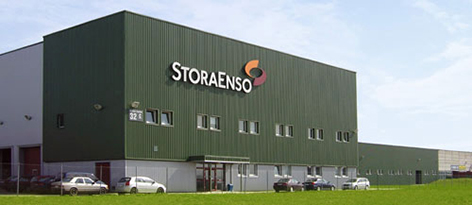
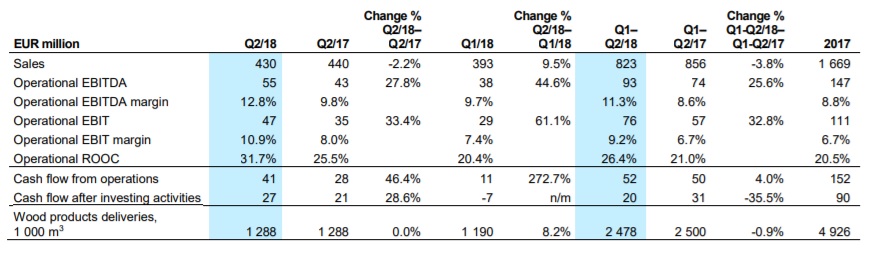
Sales in Stora Enso's Wood products division increased 7.2%, or EUR 29 million to EUR 430 million. This was mainly due to improved prices and active mix management, the company stated.

Operational EBIT increased EUR 12 million, to a record high Q2 level of EUR 47 million, the highest since 2007. According to Stora Enso, this was driven by improved prices and mix, as well as growth from strategic investments, Murów sawmill in Poland and Varkaus laminated veneer lumber (LVL) line in Finland.

Stora Enso's Wood Products division financial results

The ramp-up of the LVL production at Varkaus Mill was completed during the quarter. The investment to a new cross laminated timber (CLT) unit at the Gruvön sawmill in Sweden is proceeding as planned. The production is scheduled to begin during the first quarter of 2019.

Stora Enso will invest approximately EUR 13 million to increase the sawmilling and planing capacity at Launkalne sawmill in Latvia. The start-up is expected to take place in phases during Q2–Q3/2019.

Also the company was selected as the provider of wooden material to several new building projects around the world. CLT will be supplied to 25 King Street in Brisbane, Australia, the largest wooden commercial office building in the world. The total floor area is 14 921 square metres covering 10 floors. Other massive wood projects, where Stora Enso is the chosen supplier include:

  • The Arts Centre at Sherborne Girls School, Dorset England, the final project in the school’s Growing for the Future development programme driven by multiple needs and aspirations,
  • Grand CARRE-Auchan, Lille France, 5 office buildings linked together including a first-floor carpark,
  • Sternäckerweg, Graz Austria, the second of a three-phase building project each phase including 100 new apartments,
  • Vestsiden Komplex, Kongsberg Norway, including a school, a sport hall and student homes,
  • Lapinmäki kindergarten in Helsinki, Finland.

About Stora Enso Wood Products division

Stora Enso's Wood Products division provides wood-based solutions for building and housing. The product range covers all areas of construction, including massive wood elements, wood components and sawn goods. Stora Enso also offer pellets for sustainable heating. The company's customers are mainly merchants and retailers, industrial integrators and construction companies.

Rougier to sell its forest and industrial activities in Cameroon and the Central African Republic

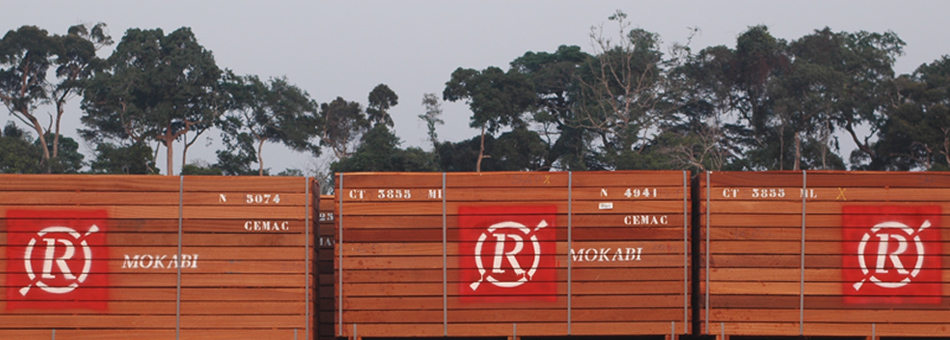
The Rougier Group sells its forest and industrial activities in Cameroon and the Central African Republic.

In connection with Rougier Afrique International’s court-ordered receivership proceedings, Poitiers Commercial Court authorized, during its hearing on 13 July, the entire process for the sale of Société Forestière et Industrielle de la Doumé (SFID), Cambois and Sud Participation in Cameroon and Rougier Sangha-Mbaéré (RSM) in the Central African Republic.

The companies SFID, Cambois, Sud Participation and RSM have been acquired by Sodinaf (Société de distribution nouvelle d’Afrique) following the definitive agreements signed on 16 July in Douala.

The group’s other French and African companies are not concerned, and the French import subsidiary Rougier Sylvaco Panneaux is notably economically and financially independent.

Following the hearing on 13 July 2018, Poitiers Commercial Court has taken into consideration the restructuring operations carried out and the progress made by both Rougier SA and Rougier Afrique International. The Court has authorized a continued observation period for the two companies in order to allow them to finalize the proposed plan and submit it to their creditors.

Founded in 1923, the Rougier Group is a market leader for certified African tropical timber.

Top global softwood lumber producers

The top global lumber companies showed further gains in production in 2017 as compared to 2016 output. Three companies recorded output declines despite robust U.S. – as well as export – market demand (this was due mainly to timber supply issues in the B.C. Interior, the U.S. West and Chile). The largest North American firms increased their output, mainly because of mill capex programs or shifting at existing operations.
There was only one major sawmill company acquisition in 2017: West Fraser’s purchase of Gilman. The average rise in production was only 2.3% for the 13 companies on the list — a slower pace than in the last three years. The list is based on companies with reported softwood lumber production exceeding one billion board feet (bf) on a nominal basis (or, for mills outside North America, more than ~2.3 million m3). Continue reading "Top global softwood lumber producers"

Austria: Wood pellets prices increase in July

In July, consumer prices for ENplus A1 wood pellets in Austria increased slightly. 
The average price (6t purchases) is 23.39 cents / kg. This is 0.5% more than in June and 2.9% more than in July 2017. The pellet price index PPI06 stands at 130.94 points.
The most expensive are pellets in western Austria with 24.29 cents / kg. In the rest of the country, the varies by 23.05-23.52 cents / kg.
Pellets in bags cost an average of € 3.93 per 15 kg bag (when ordering by pallet) or 26.22 cents / kg.
• Year-on-year change: + 1.7% 
• Monthly change: -0.7%
Pellets for industrial customers  ( at purchase quantity of 17 tons) and without VAT cost 201,22 € / t
• Year-on-year change: + 2.6%
• Monthly change: + 0.6%

Sharp drop in US housing starts linked to lumber tariffs

National Association of Home Builders (NAHB) officials recently commented on new data released by the US Department of Housing and Urban Development and the Commerce Department, linking the June decline in housing starts to the increased implementation of tariffs this year.

The data showed total housing starts fell 12.3 percent in June to a seasonally adjusted annual rate of 1.17 million units. Within the overall number, single-family starts fell 9.1 percent to 858,000 units. The multifamily sector, which includes apartment buildings and condos, dropped 19.8 percent to 315,000.

“We have been warning the administration for months that the ongoing increases in lumber prices stemming from both the tariffs and profiteering this year are having a strong impact on builders’ ability to meet growing consumer demand,” Randy Noel, NAHB chairman and a custom home builder from LaPlace, Louisiana, said. “This is why we continue to urge senior officials to take leadership and resolve this issue.”

Combined single and multifamily housing starts fell in all regions of the country, per officials, noting starts fell 3 percent in the West, 9.1 percent in the South, 35.8 percent in the Midwest and 40 percent in the Northeast.

“The concern over material costs, especially lumber, is making it more difficult to build homes at competitive price points, particularly for newcomers entering the housing market,” Michael Neal, NAHB senior economist, said. “Moreover, the soft permit report does not suggest a significant increase in housing production in the near term. However, consumer demand for single-family housing continues to increase as the overall economy and labor market strengthens.”

US imposes additional 25% tariffs on imports of Chinese woodworking machinery

As of July 6 machinery and related tools for wood processing as well as presses for the production of wooden panels made in China began collecting additional 25 percent tariffs when imported into the United States. These products were included in the list issued by the United States trade authorities.

The tariffs, meant to dampen demand for technology, are part of the U.S. response to what the White House calls “China’s unfair trade practices related to the forced transfer of American technology and intellectual property.”

The list of products covers 1,102 separate U.S. tariff lines valued at approximately USD 50 billion in 2018 trade values. This list generally focuses on products from industrial sectors that contribute to or benefit from the “Made in China 2025” industrial policy, which include industries such as aerospace, information and communications technology, robotics, industrial machinery, new materials, and automobiles. The list does not include goods commonly purchased by American consumers such as cellular telephones or televisions.

This list of products consists of two sets of U.S tariff lines. The first set contains 818 lines and these lines cover approximately USD 34 billion worth of imports from China. The Office of the United States Trade Representative (USTR) has determined to impose an additional duty of 25 percent on these 818 product lines after having sought and received views from the public and advice from the appropriate trade advisory committees. Customs and Border Protection began collecting the additional duties on July 6, 2018.

The second set contains 284 proposed tariff lines identified by the interagency Section 301 Committee as benefiting from Chinese industrial policies, including the “Made in China 2025” industrial policy. These 284 lines, which cover approximately USD 16 billion worth of imports from China, will undergo further review in a public notice and comment process, including a public hearing. After completion of this process, USTR will issue a final determination on the products from this list that would be subject to the additional duties.

Spanish Garnica to build another plywood plant in France

Garnica, the recognized Spanish manufacturer of plywood from sustainable wood, announced that it is finalizing the details for the start-up, in the second half of 2020, of the project for a new factory located in the French region of Grand-Est, a region of northeastern France with an abundance of poplar wood.

This would be Garnica’s second plant in France and the seventh of the Group; the other five are located in Spain.

“We have carried out studies in order to ensure the viability and success of the project,” said Christian Michel, CEO of the group, adding that among the decision-making factors for the selection of the final location “the availability of materials in the area, the employability capacity, in addition to others, such as territorial connections or the dynamism of public services” have been assessed.

Garnica is the world leader in the production of poplar plywood from plantations and sustainable forests. With more than seven decades of experience in the industry, the company exports 93% of its production to more than 45 countries on all continents, with its main markets being Western Europe and the United States. It has six production centers and more than 1,050 employees. Its production model promotes plantations and sustainable forests as a source of raw material for its products.

Forest fires ravage Sweden’s forests

A European-wide fire-fighting force has helped Sweden to battle an unprecedented level of forest fires this summer. So far, seven fire-fighting planes, seven helicopters, 60 vehicles and over 340 personnel have been offered through the EU's civil protection mechanism, thanks to Italy, France, Germany, Lithuania, Denmark, Portugal, Poland and Austria.

Commissioner for Humanitarian Aid and Crisis Management Christos Stylianides said: "We have been working 24/7 to help Sweden. This is our duty in a Europe that protects and is close to citizens.

"Over the past week and weekend, a record level of EU support has been mobilised." “The fires in Sweden show that climate change is real and that no country is immune to natural disasters. This is why the Commission has proposed to strengthen EU civil protection response through rescEU – so that when multiple disasters hit member states, they are better prepared to confront them," he added.

Some 27 fires are currently blazing across Sweden, that’s down from 49 the day before. Italy, France and Portugal have also sent water-bombing aircraft, while Norway, Germany and Lithuania have provided helicopters.

Sweden’s Civil Contingencies Agency warned on Monday that the situation remains very serious, with the risk for fire at extreme levels, especially in southern Sweden and around Stockholm, according to TT. Temperatures are expected to remain near 30 degrees Celsius (86 Fahrenheit) all week, but some rain is forecast for the weekend.

The summer has so far been exceptionally hot, with temperatures in large swathes of the country hovering around 30 degrees. Precipitation has also been unusually low, with parts of southern Sweden experiencing their driest summer on record. The Kvikkjokk-Arrenjarka weather station in the far north, on the same latitude as southern Greenland and northern Alaska, broke its record with a reading of 32.5 degrees.

While the fires have destroyed vast tracts of forest and forced forestry companies to halt logging for fear of sparking fires, the heatwave is also causing huge problems for the farming industry. Harvests have been hurt by the lack of rain, and many farmers are now running low on animal feed. Water levels in Sweden’s hydro-power dams, which produce half the country’s electricity, have also fallen drastically, pushing up energy prices.

The fires have raised questions about the impact of climate change and whether the extreme heat is the new normal. That’s raised concerns about Sweden’s ability to tackle such crises. The fires, and the government’s reliance on outside help, may even become a topic in the Sept. 9 general election. Politicians, including Prime Minister Stefan Lofven, have visited the hardest-hit areas.

Forty-four fire engines from Poland were met with applause when they arrived, with Swedes waving Polish flags as the vehicles drove north before arriving in Sveg in Harjedalen county in central Sweden on Sunday evening, according to local media. "Dziekuje to all Polish firefighters" was the headline in the Expressen newspaper, thanking them in their own language.

Sweden’s Forest Agency estimates that some 600 million kronor ($68 million) worth of forest has burned or been damaged by the fires, as of July 19.

Global wood-based panels market to grow sharply by 2025

The global wood-based panel market size is expected to reach USD 174.55 billion by 2025, registering a 7.7 percent compound annual growth rate (CAGR) during the forecast period, according to a new report by Grand View Research of San Francisco, California.

High demand as an insulating material for wall cladding, ceiling, roofing, and flooring applications is expected to boost market growth over the coming years, said the report “Wood-Based Panel Market Size, Share & Trends Analysis Report By Product (Plywood, MDF, Particleboard, Softboard, Hardboard), By Application (Furniture, Construction, Packaging), And Segment Forecasts, 2018 – 2025”.

Investments, divestments, and regional expansions are key strategies adopted by players to strengthen their presence in the market, the report shows. On the down side, increasing raw material prices and lack of technological innovation are expected to be a key concern for industry players.

Innovations in the traditional woodworking industry to produce more sustainable products, such as MDF, particleboard, OSB, and HDF, which can be employed in specific application areas, are expected to boost market growth over the forecast period. Companies are investing in R&D activities to come up with environmentally friendly manufacturing wood-based panels.

Growing population, and rapid industrialization across the globe are major factors that have resulted in deforestation, which, in turn, has led to low availability of raw materials. Increasing raw material prices and high competition among industry players are expected to shrink profit margins of industry players over the forecast period.

Also stringent regulations imposed on manufacturing of wood based panels are expected to be a key threat to market players. Moreover, high initial investments and operational costs associated with the machinery are expected to trigger entry barriers, thereby lowering the threat of new entrants over the forecast period, added the report.

Arauco expands presence in US with the acquisition of Panolam

Arauco announced the purchase of Panolam’s industrial assets located in Albany, Oregon. The acquisition continues the expansion of the company’s presence in the North American market.

The Panolam complex, which will be called Albany Treating and Lamination (ATL), is situated approximately 10 miles from Arauco’s existing particleboard and TFL operations in Albany. The site includes two thermally fused lamination lines with an annual installed capacity of 212,000m3, as well as two impregnation lines and warehouse capacity.

“With this acquisition, we are executing on our strategic plan to strengthen our footprint within the decorative laminate market in North America and expand capabilities to service present and anticipated growing demand,” said Kelly Shotbolt, President, Arauco North America.

“These assets provide the perfect platform to increase lamination production, while adding a second impregnation site, complementing our existing impregnated paper site on the east coast,” he added.

“We are very pleased with the many advantages of this investment,” said Jake Elston, Arauco VP of Operations. “It not only helps us serve a growing marketplace, but also brings new team members and manufacturing capabilities to our group that will strengthen our western region business model.”

Along with the acquisition, Arauco and Panolam have signed a commercial agreement whereby Arauco will manufacture Panolam branded TFL to support west and southern United States customers.

Germany: Wood pellets cheaper in July

Wood pellets price in Germany slightly fell during July 2018. Thus, the average price for ENplus A1 pellets reached EUR 236,36/t, which is 0.6% less than in June and 2.2% more than in July 2017.
During the mentioned period, one kilogram of wood pellets costs 23.36 cents and one kilowatt hour (kWh) of heat from pellets costs 4.73 cents. Pellets currently have a price advantage of about 28% over heating oil and about 20% for natural gas, as reported by the German Energy Wood and Pellet Association e.V. (DEPV).
"Since pellets are usually the cheapest in the summer, customers should now refill their storages," recommends DEPV Managing Director Martin Bentele. "Pellets have been significantly cheaper than oil and gas in recent years. In the summer months, the price drops again, making heating with pellets economically even more attractive."
Regional prices (for 6 tonnes purchases) in July 2018: Southern Germany: EUR 235.39/t, Northern and Eastern Germany: EUR 237.79 per tonne, Central Germany: EUR 235.39/ t.
Larger quantities (26 t) could be bought for the following prices: South: 222.65 EUR / t, Central: 218.62 EUR / t, North / East: 222.76 EUR / t (all incl. VAT).

Swedish softwood lumber exports up by 26% in the first five months

Sawmills in Sweden have exported 6,9 million m3 of sawn and planed lumber during the first five months of 2018, which is 26% more than in the same period last year.

All of the softwood lumber exports from Sweden increased, with the European countries receiving most of the shipments (3,6 million m3, 22% more than January-May 2017). Also, North Africa and the Asian countries imported 43% and 30%, respectively, more softwood lumber from Sweden.

1.000 m3 Jan-May 2017 Jan-May 2018 % Change-Yearly
Europa 2,977,687 3,626,671 22%
North Africa 784,855 1,124,009 43%
Middle East 212,230 270,110 27%
Other Asian countries 901,136 1,167,676 30%
North America 156,009 148,719 -5%
Oceania 20,991 59,413 183%
Total 5,512,448 6,948,331 26%

Deliveries to the Middle East amounted to 270,110 m3, 27% more than in the same period last year, while Oceania received 183% more softwood lumber, amounting to 59,413 m3.

TOP 10 Destinations

Softwood Timber exported from Sweden to... (in cbm )

1.000 m3 Jan-May 2017 Jan-May 2018 % Change - Yearly
UK 1,129,091 1,322,671 17%
Netherlands 414,952 538,231 29%
China 411,925 532,757 30%
Egypt 442,904 497,985 12%
Norway 405,492 480,186 10%
Germany 397,416 438,999 18%
Denmark 355,795 441,024 28%
Japan 345,528 417,338 12%
Algeria 139,078 320,550 130%
Morocco 152,256 222,763 46%

The UK is the main buyer for Swedish softwood lumber, as the country raised the volumes by 17%, amounting to 1,322,671 m3. The second top destination for Swedish softwood lumber was the Netherlans, where the exports increased by 29%, to 538,231 m3.

Stora Enso invests EUR 25 million at Maxau mill in Germany

Stora Enso has decided to install a new steam turbine with a closed-loop cooling system and additional biomass storage at its mill in Maxau, Germany. The investment cost is approximately EUR 25 million and implementation of the project is scheduled to start during the third quarter of 2018 with completion in 2020.

Stora Enso wants to secure the long-term profitable energy production in Maxau Mill by increased electricity generation and higher efficiency. The new 57 MW extraction-condensing turbine complements the existing Combined Heat and Power (CHP) plant which started up in 2010. The investment will reduce the energy cost and secure long term cost competitiveness of the paper mill. Once installed, the payback time will be around four years.

The investment contributes to Stora Enso’s carbon neutral roadmap and science-based targets through higher share of biomass and higher efficiency ( >50 000t CO2 savings per year). The closed loop cooling system will relieve the Rhine River significantly by less thermal output and considerably lower river water extraction.

Maxau Mill

Located on the Rhine River near Karlsruhe in southwest Germany, Maxau Mill is the key pillar in the Uncoated Magazine Paper (SC) product segment.

The two paper machines produce approx. 530 000 tonnes of uncoated magazine papers per year. Paper for Recycling (PfR) serves as the main raw material for the paper production.


Sarawak will no longer issue new timber licences

The Sarawak government will stop issuing new timber licences, due to the fact that vast tracts of forests had already been logged and it was difficult to restore them.

As Chief Minister Datuk Patinggi Abang Johari Tun Openg, said, "worse still is the stripping of the forests of all their vegetation by plywood factories operating deep in the forests, ostensibly to clear the land for the planting of oil palm. As such, there will be no more new palm oil plantation licences except for Native Customary Rights (NCR) land."

Abang Johari stressed that the state government would continue to fight illegal logging.

"Not only are they just stealing timber in areas which are not licensed to them, they are also intruding into the forest reserve areas. "If unchecked, we may have no more forest reserves of any kind, fully protected or otherwise. We must protect the forests if we want to retain any of our indigenous virgin jungle," he said.

Lumber market in the US under pressure by downside prices

Framing lumber market in the US was mostly affected by the downside price pressure during last week.
Deep double-digit cuts not seen in more than a year developed, while failing to draw in much buying. Buyers widely sensed additional downside risk, and limited purchases to must-have items.
The failure to jump-start mill sales after the Fourth of July, the sharp discount in futures compared to cash, and a weak June housing starts report were all cited as factors promoting fear and caution.

Week
Jul 20
Week
Jul 13
Year Ago
2017
Random Lengths Framing Lumber Composite Price* $515 $532 $422
KD Western S-P-F #2&Btr 2x4 R/L Mill Price 555 587 414
KD Eastern S-P-F #1&2 2x4 R/L, delivered Great Lakes 640 660 501
Green Douglas Fir Std&Btr 2x4 R/L (Portland) 540 555 465
Southern Pine (Westside) #2 2x4 R/L 483 504 380
KD Coast Hem-Fir #2&Btr 2x4 R/L 570 585 425
Ponderosa Pine (Inland) #2&Btr 1x12 R/L 775 775 690
* Weighted average of 15 key items

Random Lengths Panel Market Report
The price arrow continued to point downward in structural panels, although discounts in OSB were much sharper than those seen in plywood.
OSB producers in the South took the most aggressive approach to sales, and reported prices finished $30 lower across that region. In Southern Pine plywood, an increase in sales tapered negative perceptions, but prices of rated sheathing slipped further.
Western Fir plywood prices slipped, but continued to show more stability compared to Pine plywood and OSB.

(f.o.b. mill prices) Week
Jul 20
Week
Jul 13
Year Ago
2017
Random Lengths Structural Panel Composite Price* $502 $520 $448
Southern (west-east) 15/32-inch 3-ply rated sheathing plywood 455-495 475-515 377-402
Southern (west-east) 15/32-inch 4-ply rated sheathing plywood 460-500 480-520 382-407
Western 1/2-inch 4-ply rated sheathing plywood 515 522 500
North Central 7/16-inch Oriented Strand Board 395 415 395
*Weighted average of 11 key items

Plywood prices in China slide

Plywood prices in the Chinese domestic market have been falling recently. When questioned dealers said that prices have been heavily affected by the ‘off-season market’ this year and that the number of orders was far less than in the first half of the year.
As a result of the decline in prices many businesses launched promotional campaigns to generate cash flow.
Industry analysts say the current ‘off-season’ downturn is more obvious this year and has been exacerbated by the continued pressure on construction companies by environmental protection departments and that this has dampened demand.
At present the wholesale price for plywood in the Guangdong market is RMB60 to RMB65 per piece for panels of 1220 × 2440 × 12mm.

EU imports of wood furniture on the road to recovery

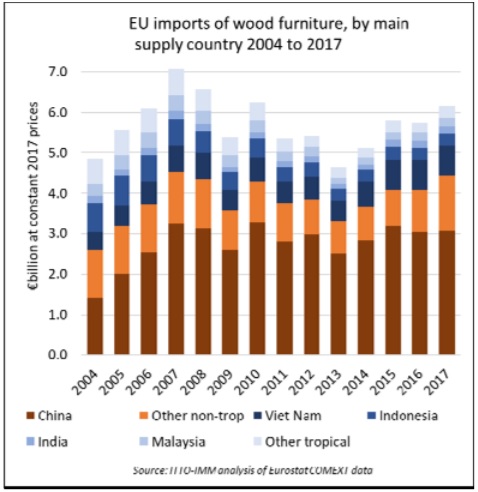
After flat lining in 2016, the value of EU imports of wood furniture from non-EU countries increased 7% to €6.16 billion in 2017. Imports from China, by far the largest external supplier fell 4% in 2016 but recovered 0.7% to 3.08 billion in 2017.

In recent years China’s competitiveness in the EU wood furniture market has been impeded as prices have risen on the back of growing domestic demand and new laws for pollution control pollution in China.

EU furniture importers also continue to question the variable quality of product imported from China and some have struggled to obtain the legality assurances required for EUTR conformance when dealing with complex wood supply chains in China.

The main beneficiaries of rising EU wood furniture imports in 2017 were other European countries including Ukraine, up 67.7% to €133 million, Bosnia, up 14.9% to €218 million, and Serbia, up 13.7% to €127 million.

Rising trend in tropical furniture imports

EU imports of wood furniture from tropical countries increased 3.5% to €1.72 billion in 2017, reversing a 2.5% decline the previous year.

Vietnam is the dominant supplier of furniture to the EU, although imports were flat in 2016 and 2017 after rising 40% in the previous two years. Imports from Vietnam declined 0.7% in 2016 and then increased just 0.5% to €724 million in 2017.

EU imports of wood furniture from Indonesia increased 2% to €309 million in 2017, following a 6% decline the previous year. Imports from Malaysia increased 11% to €180 million, EU imports from Malaysia recovered by 10.7% to reach €203 million last year. Imports from Thailand fell 3.4% to €61 million.

Direct competition between furniture suppliers in the various South East Asian countries is limited by market differentiation.

With the rapid decline of availability of natural forest teak from Myanmar, Indonesia is now best placed to supply a wide range of outdoor furniture products, particularly due to relatively abundant plantation teak supplies.

Indonesia's long woodworking tradition has also meant it has gained a reputation for supply of good quality specialist hand-made furniture, a niche market in the EU where it competes most directly with India.

Vietnamese furniture becoming popular in Europe

By contrast, the Vietnamese furniture sector has gained a reputation for supply of large volume mid-range products, both for exteriors and, increasingly, for interior use, and is importing a wide range of wood from around the world to feed this production.

The Vietnamese furniture industry is regarded by EU importers as technically more evolved than most other Asian producer countries and increasingly able to supply products to high European quality standards.

Malaysia also supplies high quality products but offers a much smaller range than Vietnam with a heavy focus on rubberwood and other plantation species.

While these various external suppliers now play an important role in specific sections of the EU furniture market, the domestic industry remains very dominant. The share of domestic manufacturers in total EU furniture supply declined only slightly between 2013 and 2017.

In 2017, domestic manufacturers accounted for 86.7% of the total value of wood furniture supplied into the EU market, down from 87.5% in 2016 and 88.6% five years before.

Newsletter

Subscribe to our digital newsletter for your daily digest of essential news, views and analysis from the international wood industry delivered directly to your inbox.


0