Article archive

South Korean wood pellet imports reach all-time high

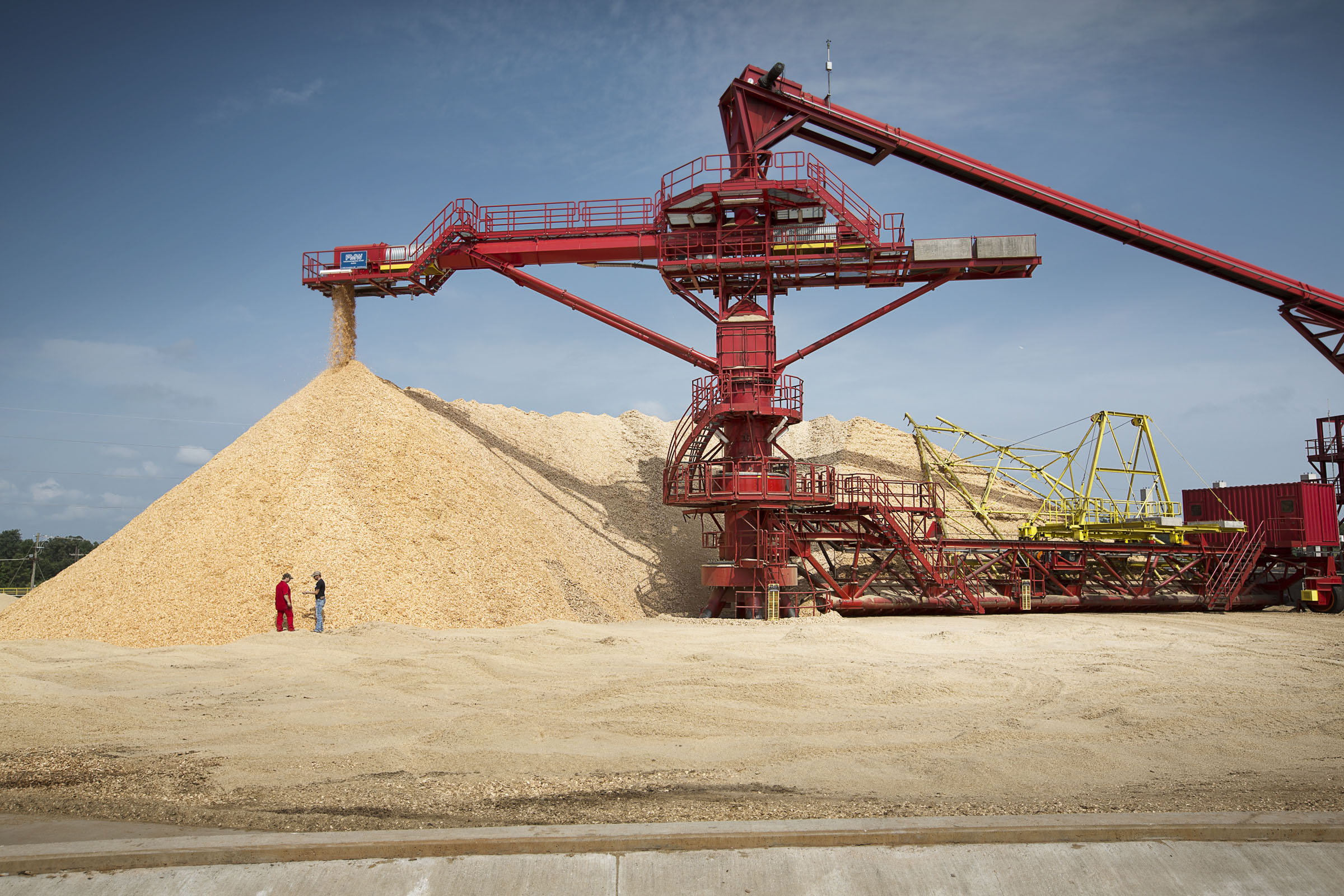
South Korean wood pellet imports reached an all-time high in November, as more cargoes reached Busan and Pohang ports compared with last month.

South Korea imported 358,867t of wood pellets in November, up by 69.2pc from 212,150t in November last year. This was also 7.8pc higher than t October when imports reached what was then the historic high of 333,002t for any month.

Imports through Gwangyang and Gunsan, the main ports for bringing wood pellets into South Korea, were stable in November. Pellet imports through Busan and Pohang ports increased compared with the previous month, a South Korean trader said.

Busan and Pohang ports are used for delivering wood pellets to utility Koen's 125MW Yeongdong No.1 unit, according to market participants. The unit consumes 550,000 t/yr of wood pellets at capacity.

Koen is expected to burn even more wood pellets in 2020 as the conversion of Yeongdong No.2 from coal to biomass is scheduled to be completed by June 2020. The 200MW No.2 unit is expected to consume an additional 900,000 t/yr at capacity, taking the company's requirement to 1.45mn t/yr and making Yeongdong the largest dedicated biomass-fired plant in South Korea with a combined capacity of 325MW.

If Koen had not planned to convert Yeongdong No.2 to biomass, the unit would have been shut by 2025 because it was one of the 10 older coal plants that the government ordered retired ahead of schedule under a plan to phase out coal use for power generation.

Wood pellets from Vietnam still dominated South Korea's imports in November, accounting for a 61pc share. South Korea received 219,035t of Vietnamese pellets in November, up by 79.3pc from a year earlier and up by 6.4pc from October.

Malaysia, Indonesia and Thailand were South Korea's second-, third- and fourth-largest suppliers in October, accounting for 20.1pc, 7.6pc and 6.6pc of deliveries respectively. These three countries supplied a total volume of 123,099t to South Korea, up by 66.1pc from a year earlier.

Logs supply shortage in Malaysia and Indonesia forces many plywood mills to halt production

Log supply shortage is serious in both Malaysia and Indonesia, and this has forced some plywood mills to halt production.
“Log shortage in Malaysia and Indonesia is grave and plywood mills struggle to keep their operations.
“High log cost and low sales prices (of plywood products) put all the plywood mills in Malaysia and Indonesia in life or death situation,” according to the Japan Lumber Report (JLR).
In Sabah, the report said Sinora Sdn Bhd has stopped plywood manufacturing because of log supply shortage. “Sinora has been supplying about 4,000 cubic metres of 12mm structural and concrete forming plywood a month for the Japan market,” added the bi-monthly trade journal on the Japanese market.
In Indonesia, JLR said Korindo group had shut down one of its two plywood mills because of log supply shortage.
“Korindo is the only manufacturer of coated concrete forming panel for Japan and has been supplying about 7,000 cu m a month from two plants. It stopped the operation of KAS plant so the supply volume will be down by half.
“Korindo plywood mill is in tough shape with operational loss for three consecutive terms. It stopped the operation of KAS plant on Oct 23,” added JLR.
Korindo has been supplying about 10,000 cubic metres of concrete forming panel a month for Japan.
According to the report, Korindo has been buying small low grade logs for manufacturing concrete forming panel but availability of low cost low grade logs is getting tight. This is because the Indonesian government restricts clear logging to develop palm farm and selective harvest makes it hard to buy logs under 60cm in diameter. Korindo was reported to have accepted too much orders before log prices soared.
JLR said Korindo was dealt with another blow as the sales of its products to the Middle East market had dropped.
Figures revealed that Japan’s plywood imports from Malaysia fell to 68,600 cubic metres in September from 100,500 cubic metres in January this year while that from Indonesia dropped to 62,600 cubic metres from 80,000 cubic metres during the same period.
JLR said tight log supply was caused by tighter restriction of illegal harvest of timber and weather factor.
In Sarawak, leading timber group Jaya Tiasa Holdings Bhd has scaled down its plywood and veneer production, also blaming log shortage as the reason.
In the 12 months to June 30, 2018, the group’s plywood mills utilisation rate had fallen to 39% of installed capacity of 180,000 cubic metres per annum from 46% a year ago. This had resulted in the mills’ production to drop to 69,320 cubic metres from 82,685 cubic metres year-on-year.
According to JLR, Malaysian and Indonesian plywood suppliers have proposed higher export prices of their products with reduced volume due to declining log supply as rainy season approaches.
“In the past, plywood mills in producing regions build up log inventories before arrival of the rainy season but this year is different. With tight supply of logs even in summer months, mills are not able to build up inventories, so the offered volume is much less than normal.
“Also plywood mills sell some portion of logs for export to generate profits even when mills rely on log supply from its own timberland,” it added.
The report said ample log supply was expected for plywood mills after Sabah banned log exports six months ago but this was not the case, as in reality, log harvest was stagnant by investigation by the central government for illegal harvest and the situation is the same in Sarawak.
The Sarawak authorities launched a major crackdown on illegal logging activities and corrupt practices in the timber trade about five years ago and the campaign is still ongoing.
Malaysian plywood suppliers have proposed to raise the export prices of their products – about US$690 per cubic metres C&F (cost & freight) on JAS 3x6 coated concrete forming panel and about US$590 on JAS 3x6 uncoated concrete forming panel. The prices are both an increase of US$10 per cubic metres from September.

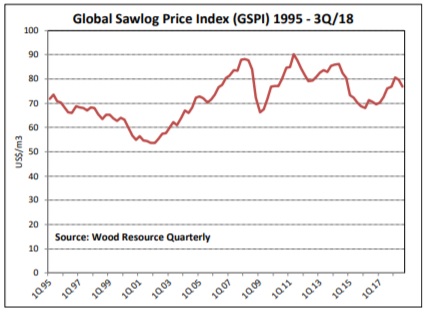
Sawlog prices declining around the world in the 3Q/2018

Softwood sawlog prices declined throughout the world in the 3Q/18. Consequently, the Global Sawlog Price Index (GSPI) fell 3.7% from the 2Q/18 to the 3Q/18, the second consecutive q-o-q decline.
The European Sawlog Price Index (ESPI-€) has fallen for two consecutive quarters to €83.58/m3 in the 3Q/18.
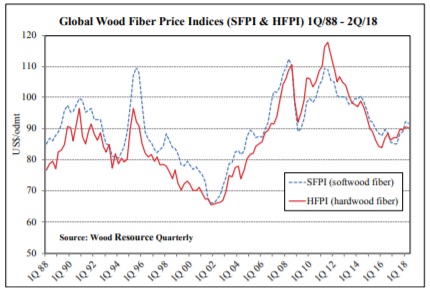
Global pulpwood prices
The Global Softwood Fiber Price Index (SFPI) was practically unchanged from the 2Q/18 to the 3Q/18. However, there were price adjustments of softwood chips and pulplogs around the world with q-o-q increases of over five percent in Norway, Sweden and New Zealand, and price declines of more than four percent in Brazil, Chile, Russia and Western Canada.
Hardwood fiber prices were generally lower in the 3Q in the key markets around the world, which led to the Global Hardwood Fiber Price Index (HFPI) falling 2.0% q-o-q in the 3Q/18.
Global pulp markets
Global trade of wood pulp has gone up every year since 2013, and 2018 is on pace to be another year with a year-over-year increase. Brazil and Finland have increased their exports the most this year. As in previous years, China is the key destination for the expanded pulp volumes being shipped in 2018.
During the fall, prices for NBSK pulp in Europe continued their rapid increase that began in early 2017. Back in January of 2017, NBSK prices in Europe averaged about $810/ton, and just over a year and a half later, prices have reached $1300/ton.
Prices for BHKP initially followed the same trend as NBSK but levelled off in early 2018 and have remained practically unchanged at $1050/ton from March through October this year.
Global lumber markets
Global trade of softwood lumber in 2018 was down an estimated 2.5% from January through September as compared to the same period in 2017. China, Japan, the United Kingdom and the MENA region reduced their imports the most.
The Canadian share of US lumber imports has fallen from 95% of total imports in 2016 to 91% in 2018.
Lumber prices in the US plummeted during the summer and fall, with common grades falling almost 40% from June to November.
A gloomier outlook by Chinese consumers and a shortage of credits for many provincial governments and state-run firms have contributed to reduced demand for forest products in 2018.
Softwood lumber imports to China slowed in 2018, with volumes in the first nine months falling 11% as compared to the same period in 2017.
Global biomass markets
Global trade of pellets has continued to expand in 2018 with total shipments for the year estimated to reach about 20 million tons, up from 18 million tons in 2017.
In the US, the Pellet Feedstock Price Index (PFPI-US) continued to fall in the 3Q/18, reaching US$62.91/odmt. This is the second lowest price seen in the past six years.

UPM to invest EUR 2 billion in new giant pulp mill in Uruguay

UPM plans to invest Euro 2 billion in a new mill to be located near the city of Paso de los Toros in Uruguay. The new mill would have capacity to produce about 2 million tonnes of eucalyptus pulp annually.

A year ago UPM and the government of Uruguay signed an investment agreement which outlines the local prerequisites for a potential pulp mill. The agreement details the roles, commitments and timeline for both parties as well as the relevant items to be agreed prior to the final investment decision. Currently UPM is carrying out technical studies and applying for the necessary permits.

“A pulp mill investment of this scale requires efficient logistics to enable secure wood supply and pulp deliveries from the inland mill to the port of Montevideo. This will require the construction of a modern railway to the port and a modern pulp terminal as well as development of the road network,” says Petri Hakanen, Senior Vice President of the UPM Uruguay Development Project.

The new railway would provide transport opportunities not only for forestry but also for other businesses like grain and wooden products, while also increasing Uruguay’s export competitiveness worldwide.

The new pulp mill would have various positive impacts on Uruguay, providing the community with jobs, training and improved infrastructure. The mill’s location is in the least developed area of the country, potentially providing a major spur for rapid regional development similar to the earlier example of Fray Bentos.

The new pulp mill is estimated to increase GDP by 2%. It would boost the local economy and fuel the growth of hundreds of small and medium sized companies throughout the entire value chain. It would also generate a significant number of permanent jobs in industry, plantations, harvesting, port operations and related services.

Domotex comes to USA in 2019

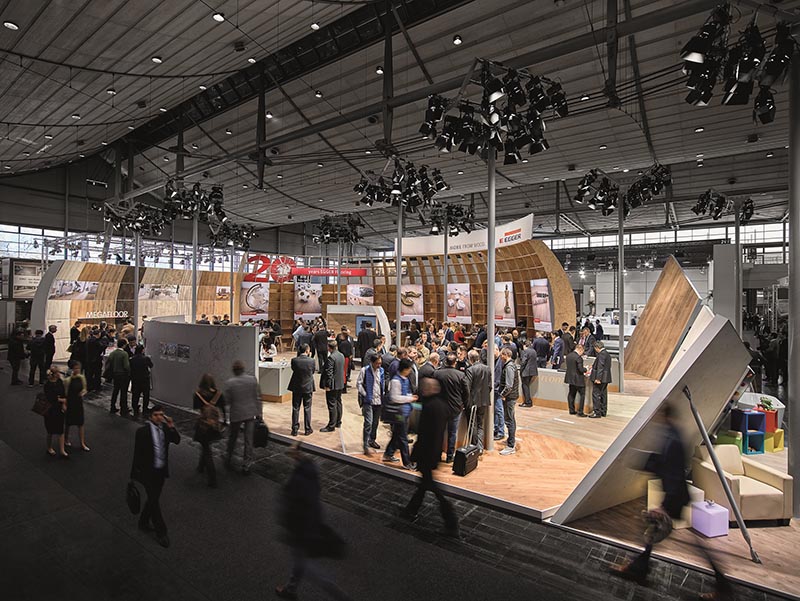
Hannover Fairs USA announced today that it will debut Domotex USA focused on the American residential floor covering industry in Atlanta, Georgia from February 28-March 2nd, 2019 at the Georgia World Congress Center in Atlanta.

Launched in 1988 in Hannover, Germany by Deutsche Messe, one of the world’s top trade show organizers, Domotex is the world’s foremost showcase for floor coverings innovation. Domotex USA will consist of exhibition space, conferences and education, featuring flooring and flooring innovations in one easy three-day trade show in America’s flooring capital, Atlanta.

Exhibitors will display the latest machine-made carpets, wall-to-wall carpeting, textile floor coverings, handmade rugs, resilient floor coverings, design flooring /luxury vinyl tile (LVT) and laminate flooring, parquet and wood flooring, as well as application and installation technologies designed for the residential flooring marketplace.

“Many industry representatives have been asking us for years to launch the Domotex brand in the North American market, as there has not been a flooring trade fair in the Eastern U.S. that demonstrates the quality and breadth of the world’s leading carpet and flooring show, the Domotex Hannover,” said Dr. Andreas Gruchow, Member of the Management Board, Deutsche Messe AG, Hanover. “In addition, given the strong economy in the U.S., much is being invested in commercial real estate such as offices, hotels and shops. The number of residential properties is also growing considerably. These are good conditions for the sale of floor coverings in the United States.”

Domotex USA will target North American-based professionals, including wholesalers and retailers of Carpets, Floor Coverings, Wood Flooring, LVT and other innovative flooring products for Flooring Retailers, Home Builders, Developers, Floor Installers and Home Improvement & Buying Groups. Domotex USA will be organized and managed by Hannover Fairs USA, the U.S. subsidiary of Deutsche Messe.

“Launching Domotex USA in Atlanta makes perfect sense because we can offer industry players across the Midwest, Northeast and Southeast the chance to both visit exhibitors on the show floor and to tour the area’s manufacturing facilities,” said Raymond Bianchi, Vice President, Events & Business Development at Hannover Fairs USA.

Domotex USA is an extension of Deutsche Messe’s worldwide portfolio of flooring events. With its premiere in February 2019, Domotex USA is complementing the floor covering shows in Hannover, Shanghai and Turkey.

Holzwerke Weinzierl to upgrade mill in Germany

Holzwerke Weinzierl installs a new chain-less step feeder at its mill in Germany. The commissioning of the system is planned for the beginning of January 2019 – at this time the existing log sorting plant will also be shut down.

At the beginning of November the installation of the most important system components at Holzwerke Weinzierl could be completed as scheduled.

With a wood capacity of about 650,000 solid m³ Holzwerke Weinzierl is currently one of the most efficient softwood sawmills in Germany..

In 2017 HOLTEC already received the order to deliver a completely new sorting line for short logs.

Holtec designed a special turning unit which transfer the short logs at a 90 degree angle to a second sorting line.

The commissioning of the system is planned for the beginning of January 2019 – at this time the existing log sorting plant will also be shut down.

Current trends in the Chinese plywood market

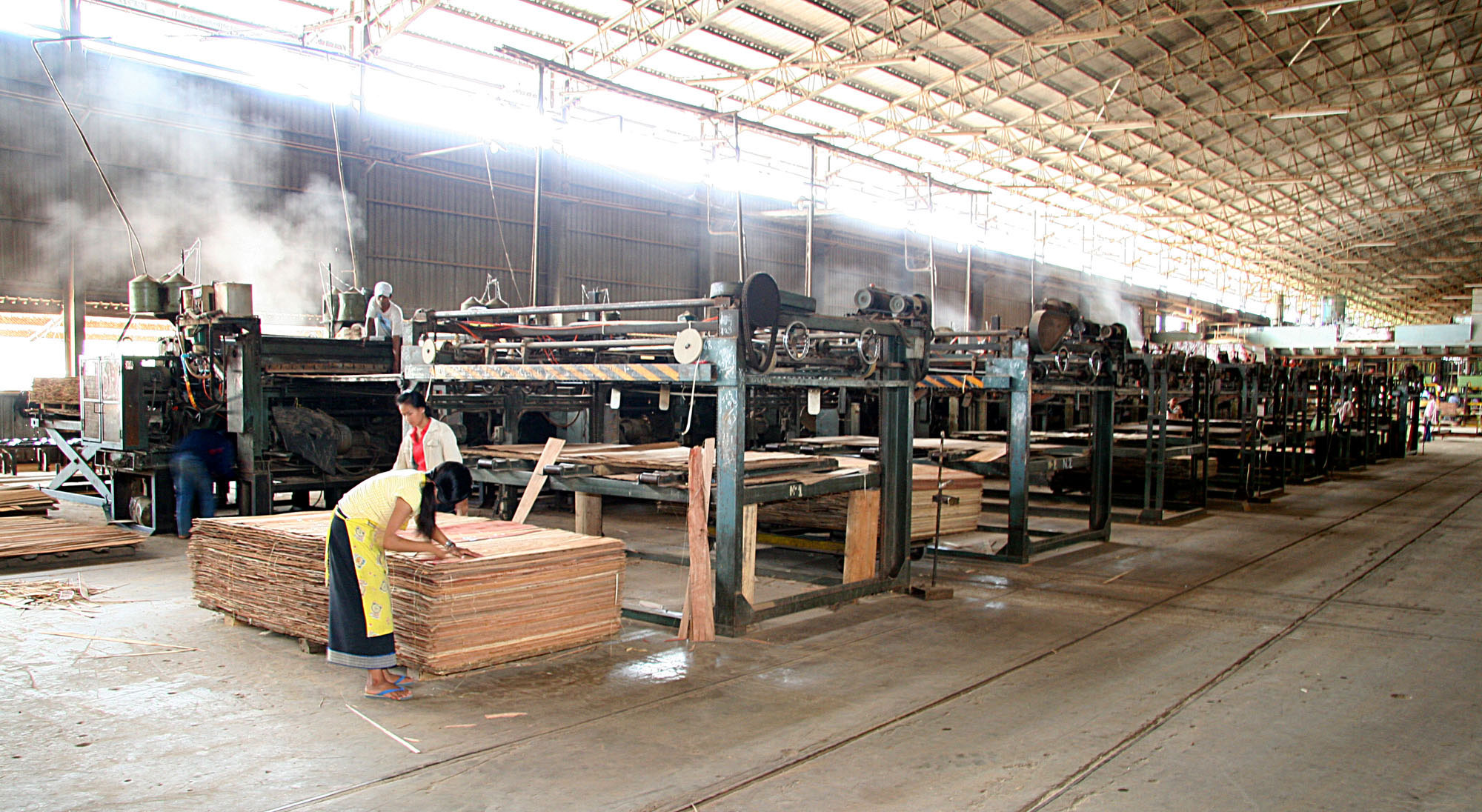
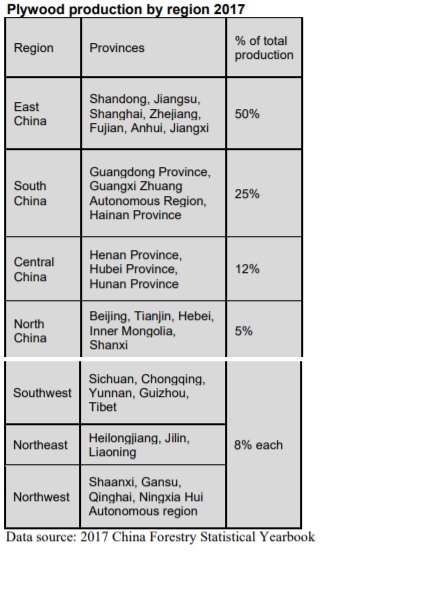
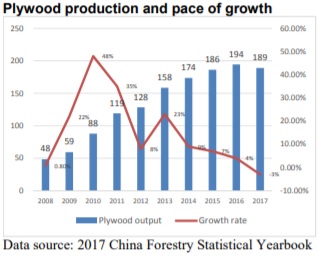
There are around 5,500 major enterprises manufacturing plywood in China. The total production capacity of plywood by these enterprises in 2017 was 189 million cubic metres and production is distributed in 27 provinces, autonomous regions or municipalities.

The output of China’s plywood in 2017 was valued at RMB438 billion, a year on year decline of 3%, the first decline in ten years. Plywood accounted for 64% of all wood-based panel output in 2017. Of the total, production of wood plywood was 157 million cubic metres, bamboo plywood 5.7 million cubic metres, blockboard 17 million cubic metres and other panels 9.3 million cubic metres.

3000 plywood enterprises closed

A massive restructuring effort to eliminate outdated and polluting wood processing mills, many of them being plymills had, by the end of 2017, resulted in around 3,000 plymills across the country being closed.

A total of 621 fibreboard production lines were dismantled or shut down eliminating over 20 million cubic metres of production capacity. However, within a year fibreboard output had recovered.

In addition, more than 900 particleboard production lines were either relocated or closed reducing the installed production capacity by around 17 million cubic metres.

Overall in 2017 there was a 15% decline in the number of woodbased panel enterprises.

These changes affected mainly the smaller companies such that by the end of 2017 production capacity had consolidated in fewer but large and medium-sized enterprises. This restructuring has resulted in an increase in cross-industry mergers and acquisitions within the industry.

By the end of 2017 there were 117 continuous flat pressure fibreboard production lines throughout the country with an annual production capacity of 19.4 million cubic metres accounting for 41% of the national total production capacity of fibreboard. There were also 40 continuous flat pressure particleboard production lines in operation.

Russia: Lumber exports keep on growing, while logs exports fall

In January-October 2018, Russia increased its lumber exports, both in value and in volume terms, indicate the statistics published by the Russian Federal Customs Office.

Thus, during the first ten months of the current year Russia exported 16.14 million m3 of lumber. That is 6% more than during the respective period of the last year.

The total value of the exported Russian lumber increased as well. In January-October 2018 it came up to $3.794 billion having gone up by 15.7%.

In their turn, Russian logs exports went down in volume terms, but increased in value terms. In January-October 2018, the Russian logs exports came up to 15.119 million m3, having gone down by 4.9% year-on-year.

The total value of the Russian logs exported in January-October 2018 came up to $1.212 billion, that is 1.1% more than during the respective period of 2017.

In January-October 2018, Russia increased its plywood exports, both in value and in volume terms, indicate the statistics published by the Russian Federal Customs Office.

Thus, according to the latest data, in January-October Russian plywood export volume came up to 2.239 million m3.
That is 8.5% more than during the respective months of 2017.

The total value of the Russian plywood exported in January-October 2018 came up to $1.139 billion and grew by 24.7% year-on-year.

Thus, the Russian plywood average export price came up to about $509/m3.

Holzindustrie Schweighofer plans to build a biomass plant in Germany

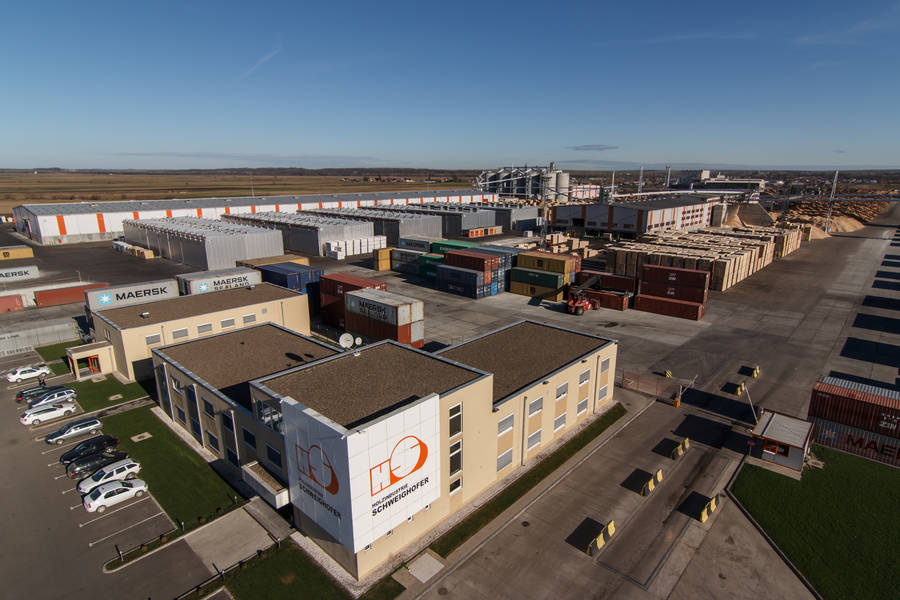
Holzindustrie Schweighofer plans to construct a biomass cogeneration plant at its site in Kodersdorf, Germany. The plant is expected to be operational by 2020.

According to the announcement, with EUR 24 million investment the company plans to build one of Germany’s most modern plants for the production of green energy.

Kodersdorf sawmill is specialized in processing coniferous timber and has a cutting capacity of 1.2 million m3 of timber per year. The energy-efficient kiln drying is supplied with heat from its own heating plant (20 MW). The mills’ planing capacity is about 360,000 m³ annually. Its kiln drying capability is 560,000 m³. Around 430 employees are currently working in this mill. Holzindustrie Schweighofer acquired the mill in 2015 from Klausner.

About Holzindustrie Schweighofer:

The company is a part of the Schweighofer Group. The group is active in the areas of wood industry, viscose pulp production, bio-energy production, forestry and real estate. Headquatered in Austria, Holzindustrie Schweighofer started operating the first sawmill in Romania in 2003 and since that time became a leading company in the European wood processing industry. It employs around 3,100 employees at six locations in Austria and Romania.

US softwood lumber prices fall at the beginning of December

Demand for framing lumber was light last week. Buyers held back amid seasonal slowness, weather, and concerns about the broader U.S. economy. Order files supported mills in holding to established quotes, but budding softness was evident in most producing regions.
Traders weighed these issues against announced production cutbacks, both permanent and temporary, but failed to react with any immediate urgency. Declines in a few key items resulted in a $3 drop in the Random Lengths Framing Lumber Composite Price.

This Week
Dec 7
Last Week
Nov 30
Year Ago
2017
Random Lengths Framing Lumber Composite Price* $340 $343 $434
KD Western S-P-F #2&Btr 2x4 R/L Mill Price 324 346 462
KD Eastern S-P-F #1&2 2x4 R/L, delivered Great Lakes 409 413 535
Green Douglas Fir Std&Btr 2x4 R/L (Portland) 270 280 465
Southern Pine (Westside) #2 2x4 R/L 396 394 457
KD Coast Hem-Fir #2&Btr 2x4 R/L 340 340 490
Ponderosa Pine (Inland) #2&Btr 1x12 R/L 790 785 730
* Weighted average of 15 key items

Random Lengths Panel Market Report

Structural panel buyers lacked urgency, and prices declined amid ample to abundant mill offerings. OSB trading was sparse across North America. Buyers sought a sometimes-tenuous balance between paring inventories for year-end but keeping enough stock on hand to supply customers. Southern Pine plywood traders navigated a stagnant market that revealed little to no urgency throughout the week. Lackadaisical demand persisted in western Fir plywood markets. A few producers reported more interest in sheathing.

(f.o.b. mill prices) This Week
Dec 7
Last Week
Nov 30
Year Ago
2017
Random Lengths Structural Panel Composite Price* $370 $377 $427
Southern (west-east) 15/32-inch 3-ply rated sheathing plywood 360-390 360-390 410-470
Southern (west-east) 15/32-inch 4-ply rated sheathing plywood 365-395 365-395 415-475
Western 1/2-inch 4-ply rated sheathing plywood 351 354 442
North Central 7/16-inch Oriented Strand Board 220 230 300
*Weighted average of 11 key items


Kronospan to expand its business in Russia

Kronospan announced plans to build a furniture materials plant in the Moscow region. This was announced by David Brenner, Commercial Director of Kronospan GmbH in Germany, during the presentation of the investment potential of the Moscow Region held in Vienna on November 22, 2018. 

''We are going to increase the capacity of our enterprise in Elektrogorsk occupying an area of about 60 hectares, and we also consider other 128 hectares to start cooperation with furniture companies at the existing enterprise in Elektrogorsk. We are going to expand our business in the next two years, '' said David Brenner, Commercial Director of Kronospan GmbH in Germany.

Back in the summer of this year, Kronospan announced that it will increase its OSB manufacturing capacity for the Russian market.

According to the announcement, the investment in the extension of the Ufa OSB plant will nearly double its production capacity and meet the growing demand for OSB in the building and construction markets across Volga, Siberia, Ural, Central Asia, China, Korea, Japan and South America.

The plant will have an annual capacity of 1 000 000 m3 and will produce OSB boards in 4 different formats.

Kronospan’s plant in Ufa was opened in 2013. It is one of the largest factories for particleboards with a capacity of over 1 million m3 per year. The company owns the largest continuous press for OSB in the world, with the impressive length of 65 meters. The new production line will foster the export of OSB material and reduce the cost of the material for the end users.

Finland: Strong lumber production this year; pulp industry booming

Sawmill lumber production volumes in Finland rose to 2.7 million cubic meters in July-September, up by 3.8 percent on the corresponding period last year. In the three actual quarters of the year, the production volume is 8.8 million cubic meters, an increase of about 1.4% from last year.

The total Finnish paper production volume in January-September was 5.1 million tonnes. In July-September, the volume of production declined slightly compared to last year's corresponding period, to 1.7 million tonnes. The production of specialty papers and tissue paper production grew in July and September, while the production of printing and writing papers grew.

Plywood production in July-September accounts for a 2.9% drop compared to last year. The cumulative production volume for January-September was still higher than the previous year at 0.9 million cubic meters.

Finnish pulp industry on a rising trend

The pulp industry in the forest industry generated 2.1 million tons in July-September. The volume was strong 9.2 percent more than in the corresponding period last year.

At the beginning of the year, total cumulative pulp production rose to 6.0 million tonnes at the end of September. It is about 6.2 percent higher than the volume of production in January-September last year. An annual pulp production record can be found in the pre-financial crisis, as in 2006 the number of pulp mills rose to almost 8.0 million.

''Thanks to investments made in recent years, the forest industry is able to meet the tough international demand. The sale of bio-based products from renewable raw material looks good even in the long run. For the future it is very important that the use of wood can be sustainably increased,'' says Timo Jaatinen, Managing Director of the Finnish Forest Industries Federation .

A new market segment for Swedish sawmills in China

China does not have a well-developed quality system with third-party controls like the Nordic quality system NTR, which assures the quality of treated exterior wood. This creates opportunities for Swedish Wood to work with the Swedish sawmills to support the development of a quality assurance system for treated exterior wood in China.

A common quality assurance system for treated exterior wood would allow the collaboration with China to be further enhanced and made more efficient. The Swedish sawmills have many years’ experience in global exports and can offer Chinese manufacturers a stable supply of raw material, explains Björn Nordin, Director of Interior & Design at Swedish Wood.

24–26 November saw one of the most important events in treated exterior wood in China: the 3rd China Green Wood Industry Conference & the 11th China Wood Protection Industry Conference. The name describes one conference, which took place in the city of Zhangping in the Fujian province of China. The conference was organised by the China Wood Protection Industry Association (CWPIA), a national organisation that focuses on protective treatments for exterior wood.

Swedish Wood attended, along with representatives from Swedish sawmills, and invited Niels Morsing from the Nordic Wood Preservation Council (NTR) to speak at the conference. The main purpose of Swedish Wood’s participation was to broker new, and strengthen existing, contacts between Swedish sawmills and Chinese manufacturers of treated exterior wood.

During the conference, Swedish Wood held a matchmaking event where 20 selected Chinese companies who are members of the CWPIA met Swedish Wood members in the sawmill industry. The event produced excellent results, with many new contacts and potential customers for the Swedish sawmills.

Niels Morsing gave a talk on quality assurance systems at the conference, focusing on third-party controls. In addition to his work at NTR, Niels is also Director of Wood and Biomaterials at the Danish Technological Institute (DTI) in Denmark. DTI is Denmark’s largest repository of knowledge about construction materials and works to ensure that wood used in outdoor environments meets the market’s expectations. According to Niels Morsing, the Nordic countries have a strong partnership when it comes to research, development and production of exterior wood.

- NTR is a quality system that has been operating in the Nordic region for almost 50 years. We ensure that the market’s expectations are met, both in terms of environmental impact and the quality of the wood. It has always been necessary to find innovative solutions, due to the restrictive nature of European legislation on chemicals, says Niels Morsing.

- At the conference, the Chinese delegates showed considerable interest in the new, environmentally sustainable products that are used in Scandinavia today. China is switching from the previous preferred choice of pressure treatment agents (CCA) to more eco-friendly alternatives that we already use in Scandinavia, continues Niels.

Björn Nordin is pleased with the outcome of the conference and its confirmation of China’s interest in exterior wood.

- China is an important market for Swedish sawmills, and we can report that the Chinese companies are very positive about using Swedish pine and spruce as the raw material for treated exterior wood, he concludes.

China – a high-priority market for Swedish sawmills

China is an extremely interesting growth market for Swedish sawn wood products, and Swedish Wood has been working actively since 2013 to support Swedish sawmill companies in the Chinese market. 2013 saw Sweden export 400,000 cubic metres of sawn wood products to China, three times more than in the previous year. In 2017, a new record was set for exports from Sweden to China of around 920,000 cubic metres, or SEK 1.7 billion (USD 190 million). For a few years now, China has been a priority market and one of the biggest Swedish export markets for sawn wood products.

9% rise in EU imports of tropical sawnwood

Despite a slow start to the year, EU imports of tropical sawnwood were 539,000 MT in the first nine of 2018, 9% more than the same period in 2017. Import value also increased, by 10% to €545 million.

A significant amount of tropical sawnwood arrived into the EU from Cameroon in the third quarter of 2018, taking the total import from that country in the first nine months to 186,500 MT, almost exactly equivalent to the same period in 2017.

Meanwhile tropical sawnwood imports from nearly all other leading suppliers were stronger in the first 9 months of 2018 compared to the same period last year, including from Malaysia (+14% to 81,600 MT), Brazil (+20% to 73,700 MT), Gabon (+19% to 70,800 MT), Congo (+6% to 34,800 MT), Indonesia (+82% to 12,700 MT), Ghana (+8% to 11,000 MT), DRC (+7% to 9,700 MT) and Myanmar (+64% to 6,900 MT). These gains offset declining imports from Côte d'Ivoire (-9% to 21,000 MT) and Suriname (-20% to 4,100 MT).

The rise in imports from Indonesia, which only allows exports of S4S lumber, may be partly due to alterations in the HS codes used to record imports from Indonesia following introduction of FLEGT licensing. The rise in EU imports of sawnwood from Indonesia is offset by a similar decline in imports of mouldings from the country.

In the first nine months of 2018, tropical sawn hardwood imports increased 8% to 185,000 MT in Belgium, bolstered by strong growth in the third quarter of the year, and also increased in the Netherlands (+14% to 81,600 MT), France (+20% to 73,700 MT), Italy (+19% to 70,800 MT), and Germany (+6% to 22,100 MT). These gains offset a 20% decline to 38,300 MT in the UK, a 15% fall to 25,800 MT in Spain and a 9% decline to 16,300 MT in Portugal.

Norske Skog to double wood pellets capacity at facility in New Zealand

The Norske Skog group has decided to invest about A$ 7 million ($5 million) to upgrade the Nature’s Flame wood pellets facility in New Zealand to more than double its annual production capacity to 85,000 tonnes. The increased production capacity will be commissioned in the 4Q 2019.

The approval of the 85,000 tonne capacity upgrade is also a building block for potential further expansion of Norske Skog’s pellet operations in New Zealand.

Eric Luck, Regional President Norske Skog Australasia, comments: “The investment supports Norske Skog Australasia’s ongoing strategy to “Build Our Future from Fibre and Energy”. The additional production capacity is aimed at producing premium industrial grade pellet fuels for both the domestic New Zealand commercial and industrial market, as well as for the rapidly growing Japanese and Korean green energy generation markets.”

Nature’s Flame’s state of the art plant at Taupo was acquired by Norske Skog in 2015, and is well positioned in the centre of the north island where the bulk of New Zealand’s forest based industry is located. Wood pellets produced by Nature's Flame are a premium heating fuel made from wood residues from nearby timber processing facilities.

Austria: Softwood lumber prices on a downward trend in November

In November, most softwood lumber assortments in Austria are on a declining price trend. The only exception is the price for edge boards which has increased both as compared to the previous month, as well as over November 2017. 
Rough and square boards show at least over the previous year a slight upward trend. Compared to the previous month, the price for rough boards is stable, while squares are slightly cheaper.
All other assortments have become significantly cheaper compared to both time references. The most pronounced declines were recorded for stock timber squares and boards in standard thicknesses.

Softwood Lumber Spruce/Fir Nov. 2017 Oct. 2018 Nov. 2018 Change. Nov. '17 to '18
€ / cbm EXW
Edge Boards, 0-IIIa, 23 mm + 242 - 252 242 - 253 243-254 +1/+2
Rough boards in fixed dimensions, 18-22 mm 239 - 250 240 - 250 240-250 +1/-
Square timber, standard dimensions, I/II, 4-6 m 220 - 226 221 - 227 220-227 -/+1
Stock square timber, II/III 166-172 164 - 171 162-169 -4/-3
Boards, standard thickness, III-IV, 8-16 cm, 4-6 m 158-165 155 - 162 154-161 -4/-4
Boards, standard thickness, III-IV, 8-16 cm, just 4 m 159-166 157 - 163 156-162 -3/-4
Boards, wide, III/IV, 23 mm, 4-6 m 159-166 157 - 164 157-164 -2/-2
Boards, wide, III/IV, 28 mm +, 3-6 m 168-176 168 - 176 167-176 -1/-

Lumber exports from Belarus continue booming trend in Q3

In the third quarter of this year, Belarusian exporters sold 859,000 m³ of lumber worth US $ 93.7 million abroad. In terms of volume and value, this represents an increase of 44% or 71%.

As a result, the increase in export volume was slightly lower than in the first (+ 78%) and second quarter (+ 51%).

According to the Belarusian statistical authority Belstat, deliveries to EU countries increased by 49% to 753,000 m³ or by three percentage points to a share of 88%.

Exports to Latvia (+64% to 176,000 m³), ​​Poland (+94% to 62,000 m³) and the Netherlands (+83% to 55,000 m³) have increased at an above-average rate. Deliveries to Germany (+23% to 161,000 m³), ​​Lithuania (+41% to 162,000 m³) and Belgium (+38% to 58,000 m³) have underperformed.

Cumulatively over the first nine months, 2.520 million m³ exceeded the previous year's figure by 56%. Deliveries to the EU have increased almost to the same extent to 2.144 million m³. Exports to CIS countries have doubled to 329,000 m³.

Central/West Africa: Downward pressure on FOB tropical logs prices

Central/ West African producers report a slight easing of sawnwood and log FOB prices (Euro basis) being offered by buyers in the Middle East and China. Sharp discounted prices are being demanded for belli and while Chinese buyers are honouring existing contract prices there are clear downward pressures on FOB prices. Middle Eastern prices are under pressure say producers due to high volume shipments from Cameroon and Gabon.
Demand for okoume peeler logs remains low as okoume cannot compete with lower cost alternatives in the interior plywood segment of the market. Also, prices being offered by buyers for the Chinese market for sawn okoume are falling and kiln dry okoume sawnwood is being sold at around US$320 per cubic metre FOB.
In contrast demand for okoume sawnwood in the Philippines remains stable say producers. Analysts point to US tariffs on imports as a major factor behind the weakening prices.
Buyers turn to chartering because of container shortages
A shortage of containers is causing importers to turn to chartering conventional capacity, mainly cement ships with no return cargo. This is a big relief for exporters who have been suffering shipping problems for the past year.
Port Pointe Noire the only sea port in the Republic of the Congo is beginning to experience congestion and reports say shippers can expect delays of up to a week. Shipments from Owendo Port are recovering but reports suggest further dredging will be required before large vessel can dock.
Kavazingo stock survey
Analysts report that there are large stocks of Kavazingo logs and sawnwood throughout Gabon. The government is undertaking stocktaking to be able to set a limit on exports if a decision is taken to temporarily lift the export ban.
A multi-stakeholder group will meet and discuss how the stocks can or should be treated and exported. A report will have to be presented to Gabon’s Prime Minister by the Minister of the Forest.
Anticipating approval for exports GIZ and the NGO, Traffic, will be training parties how to elaborate a Non Detriment Finding CITES report.
Certification debate progresses in Gabon
Discussions continue in Gabon on the plan which would require all concession holders to be FSC certified.
A recent forum in Gabon chaired by the Minister of Water and Forests who is responsible for Environment and Sustainable Development, Jacques Denis Tsanga, discussed proposals for the implementation of an action plan to prepare the way towards certification in the forestwood sector in Gabon.
ATIBT has reported that six recommendations were made including, to quote ATIBT, “Forestry companies (in Gabon) have to decide what certification they prefer to adopt”.
Industry sources say currently there are only three companies with FSC certification Rougier, Precious Wood and CBG (Compagnie des bois du Gabon) whose combined concession area extends to around 3 million hectares. In addition another 5 companies are said to be under audit for certification.
There are over 160 sawmills registered in Gabon of which 135 are reportedly operating. Most of the mills are operated by Asian companies followed by European and local enterprises.
Log Export Prices

West Africa logs, FOB € per m³
Asian market
LM
B
BC/C
Acajou/ Khaya/N’Gollon
265
265
175
Ayous/Obéché/Wawa
250
250
225
Azobe & Ekki
275
275
175
Belli
350
350
Bibolo/Dibétou
215
215
Bilinga
275
275
-
Iroko 330
310
270
Okoume (60% CI, 40% CE, 20% CS) (China only) 220 220 200
Moabi 365 365 -
Movingui 210
210
-
Niove
160
160
Okan
220
220
Padouk
350
300
245
Sapele 320 320 265
Sipo/Utile
325
300
265
Tali 370 370


EU imports of tropical logs pick up pace in third quarter

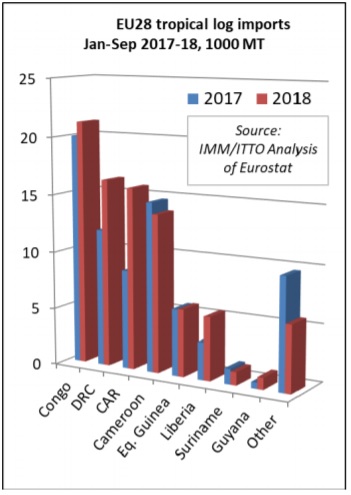
After a downturn in 2017, the quantity of EU imports of tropical logs recovered ground in the first nine months of 2018. Imports of 86,400 MT during the first months this year were 14% greater than the same period in 2017.

The value of tropical logs imported by the EU also increased, by 8% to €43.4 million. As with sawnwood, EU imports of tropical logs picked up in the third quarter of 2018 after a relatively slow start to the year.

EU imports of tropical logs increased from Congo, the leading supplier, rising 6% to 21,200 MT in the first nine months of 2018. There was also a significant increase in EU log imports from DRC (+37% to 16,300 MT), CAR (+83% to 15,800 MT), Liberia (+69% to 5,500 MT), and Guyana (+90% to 1,200 MT).

These gains offset declining imports from Angola, from around 5,000 MT in the first nine months of 2018 to negligible levels this year. Imports from Equatorial Guinea (5,900 MT) and Suriname (1,200 MT) were at a similar level to last year.

Most of the gain in EU imports of tropical logs in the first nine months of 2018 was concentrated in France (+24% to 31,200 MT) and Belgium (+33% to 23,200 MT).

Imports of tropical logs were slow in Portugal in the first half of 2018 but increased in the third quarter. In total, in the first nine months of 2018, Portugal imported 14,900 MT of tropical logs, 4% more than the same period last year.

Newsletter

Subscribe to our digital newsletter for your daily digest of essential news, views and analysis from the international wood industry delivered directly to your inbox.


0