
Article archive

Wood products prices stagnate in Germany during February

In February, the German producer price index for wood products has registered a high degree of stagnation as compared to January. However, compared to February 2013, most of the prices rose sharply.
Spruce lumber, roof battens and raw particle boards are significantly more expensive over January. All other wood products have registered stable prices or even recorded declines. The latter applies also for timber and pellets.
Compared with the same month last year almost all prices increased. The exceptions are beech blocks and HDF panels which are below last year's level. Energy wood assortments, roof battens and boards (width over 16 cm) and KVH have registered the highest increases. With 104 points, KVH, however, is priced much worse off than softwood lumber products that range between 110 and 120.

Germany's Producer Price Index Commercial Products
(2000=100)
Feb.
2013
Jan.
2014
Feb.
2014
Change
Feb. '13
to Feb.'14
Spruce and Fir lumber (Picea abies Karst.) 108.0 113.3 114.1 5,65%
Lumber according to DIN 4074/S10 112.4 117.3 116.8 3,91%
Finger-jointed squares and beams (KVH) 98.2 104.4 104.4 6,31%
Boards, width over 16 cm 112.5 119.2 119.7 6,40%
Boards, width from 8 to 16 cm, size from 15 to 24 mm 109.8 111.1 111.1 1,18%
Roof battens according to DIN 4074/S10 108.1 114.4 116.6 7,86%
Reserve squared timber, A/B, 10X10 - 12X12 109.0 113.8 113.8 4,40%
Softwood, size>6mm, planed, sanded, finger-jointed 108.1 112.6 112.5 4,07%
Wood chips from softwood 108.0 115.7 115.7 7,13%
Pellets and Briquets, compressed 123.2 137.8 135.6 10,06%
Hardwood lumber 105.7 107.0 107.0 1,23%
Beech blocks, A/B, size 50-60 mm, length 3m, damped 104.8 102.3 102.3 -2,39%
Beech frames, size 26-32 mm, length  3m, undamped 105.8 107.5 107.5 1,61%
Particle boards, raw or sanded 106.4 106.6 108.4 1,88%
Particle boards, laminated with decor 114.4 114.8 114.8 0,35%
HDF panels, size > 800 kg/m³, raw/sanded 112.1 110.7 110.6 -1,34%
Laminate floorings, density > 800 kg/m³ 109.5 109.9 109.7 0,18%

Softwoods dominate the log imports in China

China‘s log imports totalled 45.16 million cu.m valued at US$9.317 billion in 2013, up 19 percent and 28 percent respectively over 2013. The average landed price for imported logs was US$206 per cubic metre.

Of the total, coniferous log imports amounted to 32.93 million cu.m, or 73 percent of all log imports, a year on year increase of 23%. Last year New Zealand replaced Russia as the main log supplier to China.

Hardwood log imports totalled 12.23 million cu.m, a year on year increase of 9% in volume. Tropical log imports rose 7 percent to about 9.33 million cubic metres, accounting for 21 percent of all hardwood log imports. The value of tropical log imports grew 22 percent to US$3.571 billion.

China‘s imports from Russia fell 8 percent but imports from Ukraine, Myanmar, US, Australia, France and New Zealand increased sharply as can be seen in the table below.

Top 10 log suppliers to China

Import volume (million cu.m) % of total imports Average price (US$/cu.m)
Total China 45.16 100 206
New Zealand 11.5 25 147
Russia 10.26 23 137
US 5.61 12 222
PNG 2.75 6.09 227
Canada 2.72 6.02 197
Solomon Is. 2.04 4.51 198
Australia 1.74 3.86 127
Ukraine 1.39 3.08 131
Myanmar 0.97 2.15 552
France 0.68 1.5 190
Top ten 39.66 87.21


Tropical logs imports in Europe drop 20%

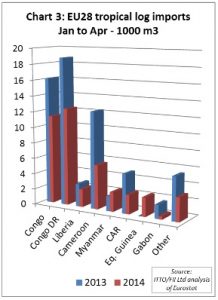
EUtropicallogimports

EU imports of tropical hardwood logs were 186,000 m3 in 2013, down 20% compared to the previous year. Imports of this commodity into France, the main destination, were down 20% at 86,350 cu.m. Imports from all the leading supply countries declined, including Congo (Kinshasa), Congo (Brazzaville), Cameroon, Central African Republic, and Liberia.

The decline is due to the combined effects of weak European demand, supply constraints, and regulatory uncertainty. The European okoume plywood manufacturing sector, formerly a major buyer of logs, has struggled to compete during the recession and capacity is now small, with a significant share of production having relocated to Gabon.

Due to supply problems and rising log prices, more central European mills that formerly imported tropical hardwood logs for sawing and slicing have switched to temperate hardwoods this year. On the supply side, political unrest restricted log availability from Central African Republic in 2013. The Liberian government placed a freeze on all logging activities in January 2013, including on the exportation of logs from the country.

Meanwhile, encouraged by the EUTR, environmental groups have focused heavily on finding discrepancies in the legal documentation for log exports from the Congo basin. This has added to the already high level of uncertainty in the EU tropical hardwood log trade.

The only significant upward trend in EU tropical log imports was of teak from Myanmar. This has followed the end of trade sanctions and has also been encouraged by Myanmar‘s announcement of a ban on log e xports fro m April 2014. The main European end users in the boat - building sector have been building stocks in advance of the measure.

Price for sawmills in Germany rises sharply

The turnover of the German sawmills increased strongly in January, both as compared to December and as well as compared to the same month last year. Over January 2013, the total turnover has increased by almost 10%. With a 14.6% rise, foreign sales have this time surpassed the increase in domestic revenue. And after a long time, the sales of the euro zone are back on a strong growth. Compared to the same month last year they've increased by 17%. Domestic sales grew by 7.7%

Values increase even more when compared to December. Total revenue increased by just over 27%, foreign sales by 24% and sales to the euro zone by almost 35%. Domestic sales rose over December up to 28.5%.

Revenue

(.000 EUR)
January 2013 December 2013 January 2014 Change
Jan. '13
to '14
Sales 283.101 244.646 311.015 9,86%
Domestic sales 193.839 162.366 208.700 7,67%
Foreign sales 89.261 82.281 102.315 14,62%
Foreign sales with Eurozone 66.578 57.846 77.988 17,14%
Foreign sales with the rest 22.683 24.434 24.327 7,25%

Latest wood products prices in Brazil

This report contains price information of logs, sawnwood, veneer, plywood and other wood products from Brazil. (Source: ITTO)

Brazilian logs, mill yard, domestic US$ per m3
Ipê 158
Jatoba 105
Guariuba 84
Mescla (white virola) 88

Export Sawnwood Prices

Sawnwood, Belem/Paranagua Ports, FOB US$ per m3
Jatoba Green (dressed) 1,278
Cambara KD 770
Asian Market (green) Guariuba 394
Angelim pedra
920
     Mandioqueira
302
Pine (AD) 220

Domestic Sawnwood Prices

Brazil sawnwood, domestic (Green) US$ per m3
Northern Mills (ex-mill) Ipe 803
                                 Jatoba 568
Southern Mills (ex-mill) Eucalyptus (AD) 232
                                 Pine (KD) 1st grade 204

Export Veneer Prices

Veneer, Export  (Belem/Paranagua Ports) FOB US$ per m3
White  Virola  Face  2.5  mm 341
Pine Veneer (C/D) 240
Rotary cut Veneer, domestic US$ per m3
(ex-mill Northern Mill)      Face    Core
White Virola      247   202

Export Plywood Prices

Plywood Export, FOB US$ per m3
White  Virola  (US Market)
5.2 mm OV2 (MR)
498
15 mm BB/CC (MR)
483
White Virola (Caribbean Market)
4mm BB/CC (MR)
675
12mm BB/CC
493
Pine Plywood EU market, FOB US$ per m3
9mm C/CC (WBP) 368
15mm C/CC (WBP) 341
18mm C/CC (WBP) 337
Plywood Prices, domestic (ex-mill Southern mill) US$ per m3
Grade MR (B/BB)  White Virola 4mm 776
 White Virola 15mm
540
Domestic prices include taxes and may be sbject to discounts.

Prices for Other Panel Products

Belem/Paranagua Ports, FOB US$ per m3
Blackboard Pine  18mm  5 ply (B/C) 422
Domestic Prices, Ex-mill, Southern Region
Blackboard White Virola faced 15mm 506
Particleboard 15mm 331

Export Prices For Added Value Products

FOB Belem/Paranagua Ports US$ per m3
Decking Boards   Cambara 1,045
  Ipê
2,570

Japanese construction stagnates in February

Japan's housing starts growth slowed down more than expected in February, Rtt News reported quoting official data released today by the Japanese Ministry of Land, Infrastructure, Transport and Tourism. Moreover, construction orders also grew at a slower pace than in January.
Housing starts increased only 1% as compared to February 2013, after economists were expecting a 6,1% rise after the 12,3% one registered in January. Housing starts at an annualized rate fell to 919,000 from 987,000 in January.
Construction orders received by 50 big contractors climbed at a pace of 12.3 percent, weaker than the 15.2 percent increase posted in January.

Kingfisher sells its shares in Hornbach

The family of entrepreneurs Hornbach has buyed back the minority interest that the British retail group Kingfisher plc owned in Hornbach Holding AG.
The British retailer sold the 25 percent plus 2 shares in Hornbach's unlisted ordinary shares it owns to the Hornbach family for approximately EUR 100 million. Separately, Kingfisher sold its 17.4 percent stake in Hornbach's preference shares to an international circle of institutional investors for EUR 135 million. 
Some of the reasons for the withdrawal of Kingfisher in Hornbach are, on the one hand, the lack of opportunity to take a more dominant position in Hornbach. Moreover, a continuation of the alliance with the strategic decisions on the part of the minority shareholder in the last year was no longer compatible. With the acquisition of 15 Bricostore DIY stores in Romania in May 2013 and the preparations for the planned summer 2014 market entry in Germany with the small-scale retail format 'Screwfix' puts Kingfisher for the first time in direct competition with its German partner, Albrecht Hornbach. Now there are clear relationships without conflicts of interest.

Global wood pellets market forecast to double by 2020

As the Biomass Magazine BM reports, the global wood pellets market will reach US$ 9 billion from a current US$ 4 billion, in the next seven years. The statement was made by Michele Rebiere (Viridis Energy Inc.) at the summit that preceded the International Biomass Conference, held March 24-27 in Orlando, US.

Ms Rebiere, quoted by Biomass Magazine, added that by far the European pellet market is the largest in the world and expected to register the highest growth. The EU pellet consumption is forecast to increase from 20 million metric tons (mmt) in 2013, up to 28 mmt in 2015, and 42 mmt by 2020. In Europe, the rising demand is both covered by large power plants, but also a significant upsurge was recorded in the heating sector. For example, in Italy, where pellets are mostly used in heating, demand has doubled in one year.

The North American market is at a current 4 mmt, and forecast to be at 5 mmt in 2015. In this respect, Ms. Rebiere said: 'I think the forecasts in North America will increase substantially, as the interest in cofiring with coal is likely to increase'.

In Asia, the wood pellets market is projected to increase 7 times by 2020: from 1mmt in 2013, to 3 mmt in 2015, up to 7 mmt in 2020.

At the same meeting, Seth Ginther, executive director of the U.S. Industrial Pellet Association, offered estimates that range between 25 mmt to 70 mmt by 2020. “I think that 2013 was the year we’re beginning to see where the market is going to shake out. It’s going to be more like the 25 mmt level, but that still is going to be significant,” said Mr. Ginther, quoted by BM.

The price of Austrian wood pellets drops in March

In March the price of wood pellets in Austria dropped for the first time since April 2014. Though modest, the price growth was constant from the spring of last year until February 2015.
This month Austrian Enplus A1 pellets cost -0,7% less than in the previous month and are -5.3% cheaper compared to March 2014. The price survey conducted by proPellets Austria resulted in an average price of € 247.1 per tonne.
In March, wood pellets in bags cost an average of €4,04 per 15 kg sack (when ordered by the pallet). This represents a -1.4% decrease over February 2015, and -5.6% as compared to March 2014.

Housing starts in US remain below 1 million mark

Construction started on 923,400 new homes in 2013. This is 18% higher than the number of starts in 2012, but construction activity is still significantly lower than before the 2008 financial crisis. Before the recession, housing starts ranged between 1 and 2 million units every year.
In December, the number of housing starts declined by 10%. Construction started on 999,000 new homes in December at a seasonally adjusted annual rate. Multi-family home construction fell more than singlefamily housing starts in December. However, demand for rental apartments remains high.
A significant share of new home construction will be multi-family until 2015, according to the National
Association of Home Builders. The number of building permits decreased to 991,000 units in December (seasonally adjusted annual rate). The number of building permits issued is an indicator of future building activity.
Sales of existing homes increased by 1% from November to December according to the National Association of Realtors. Home sales remain slightly lower than at the same time last year.

New wood processing plant in the UK for SCA

On Tuesday 18th March, Ulf Larsson, President of SCA Forest Products, inaugurated SCA Timber Supply’s new plant at Melton on Humberside, in the company of guests and senior management from SCA Timber AB and SCA Timber Supply UK, the company announced in a press release.
SCA’s Melton wood processing plant receives its timber from SCA’s importing hub on the King George Dock at Hull, which the company opened in 2005. Approximately 50,000 m3 of wood will be processed annually through SCA Melton, going into the supply chains of the company’s builders’ merchant and joinery production customers.
SCA Melton is one of three UK locations operated by SCA Timber Supply UK, the others being its Welshpool, Powys, plant, which also services the builders’ merchant sector and its headquarters in Stoke-on-Trent, from which it services the DIY sector with wood products.

Indonesia wood exports to EU may rise up to 10%, following VPA

On 27 February the European parliament ratified the EUIndonesia Forest Law Enforcement, Governance and Trade (FLEGT) Voluntary Partnership Agreement (VPA), ITTO reported.
This agreement acknowledges that Indonesian timber and wood products are being certified through the domestic timber legality verification system (SVLK) as legally harvested and processed, thus complying with the EU Timber Regulation, which became effective in March last year.
With this ratification by the EU, Indonesian timber producers and exporters have gained a competitive edge in the EU market said Bayu Krisnamurti, Indonesia's Deputy Trade Minister. Indonesia is one of the world's biggest timber producers and is set to be the first country to have a VPA ratified by the European Parliament.
The ratification of the VPA means Indonesian timber and wood products exported the EU member states are exempt from the mandatory due diligence requirements applied to exports from countries which have not yet concluded VPA negotiations.
Analysts suggest there will likely be a significant jump in Indonesian wood product exports to the EU and Bayu Krisnamurthi has said Indonesia expects to increase timber and wood product shipments to the EU by 5-10 percent this year.
Indonesia and EU hold first review of VPA implementation plans
The FLEGT Newsletter has reported that representatives of Indonesia, the EU Delegation to Indonesia and the EU FLEGT Facility met in Jakarta at the end of January to assess progress on VPA implementation.
Indonesia's representatives included officials from the ministries of Forestry, Trade and Foreign Affairs and leaders from civil society and the private sector. Participants reviewed the joint Indonesia–EU action plan on VPA implementation, an outcome of the 2013 joint assessment of Indonesia‟s timber legality assurance system, SVLK.
Indonesian officials reported progress on the critical issue and released two new regulations on the SVLK and a third on imports. Acknowledging the complexity of the remaining issues in the action plan and the work needed to maintain stakeholder participation, the two parties extended the timeframes outlined in the action plan.
Indonesia and the EU also discussed the next joint SVLK assessment, which they agreed to begin in the second half of 2014, after the first meeting of the joint implementation committee. After the meeting, the Ministry of Forestry organised two regional multi-stakeholder consultation workshops in Makassar and Yogyakarta in February on the draft regulations. A national consultation workshop is planned for 19 March.”

Finland: Log prices stable in February

In February 2014, roundwood prices in Finland are largely stable as compare to January, with only few minor changes. Pine logs price has registered a slight increase of EUR 0,55/ per cubic metre, while spruce and birch logs are cheaper over the previous month by EUR 0,29/cbm and EUR 0,21/cbm respectively.
Year-over-year, in February there are some discordant results. Birch and spruce logs slightly gained some price increase. At the same time, all other assortments have become cheaper by between -0,53% to -2,91% for pulpwood spruce.

Roadside prices of roundwood in Finland EUR/m³ over bark

 February 2013 January 2014 February 2014 Change
Feb./2013
to Feb./2014
LOGS  
Pine 57.30 57.16 57.71 0.71%
Spruce 56.97 57.52 57.23 0.45%
Birch 46.94 46.48 46.69 -0.53%
PULPWOOD  
Pine 29.57 29.34 29.03 -1,82%
Spruce 31.55 30.41 30.63 -2,91%
Birch 30.59 30.05 30.01 -1,89%

The above prices are collected from metla.fi

Austria: Price of wood pellets up by 5%

In March 2014, the price survey conducted by proPellets Austria resulted in an average price of € 26.01 €-Cent per kg of wood pellets (for a 6 tonnes purchase) or 5.31 Cent per kWh. As compared to the same month of last year, wood pellets are more expensive by 4.9 percent. Compared to February 2014, the price has decreased by -1,3%.
In March, wood pellets in bags cost an average of 4.28 € per 15 kg sack (when ordered by the pallet). This represents a 6.4% increase over March 2013 and a -0.8% decline over February 2014.

Global log prices inching up

Global sawlog prices rose in the 4Q/13 resulting in the GSPI reaching its third highest level since 1995; the highest price increases were seen in Western North America, Northern Europe and the Baltic States. Higher demand for lumber and increased global trade of logs pushed sawlog prices upward in many markets during 2013, according to the Wood Resource Quarterly. As a consequence, the GSPI price index has move upward to reach its highest level in eight years. Log prices in Western North America, Sweden, Finland, Latvia and Japan have increased the most over the past 12 months.
Sawlog prices trended upward throughout the world in the 4Q/13 and the Global Sawlog Price Index (GSPI) rose to US$88.78/m3. This was the highest level in over two years and the third highest price on record since the inception of the Index in 1995.
In the 4Q/13, the GSPI was 5.4% higher year-over-year and 14% higher than the ten-year average.  Many of the price increases around the world during 2013 were the result of improved lumber prices in a number of key markets in the second half of the year and a substantially higher trade of logs worldwide.
Global shipments of softwood logs were up by as much as 17% from 2012, totaling more than 80 million m3, based on estimats by Wood Resources International. This was the highest shipment of logs since 2007 when global trade reached an estimated 86 million m3. Of the ten largest log-importing countries, China, Germany, Sweden, Finland and Canada increased import volumes the most year-over-year. It was only South Korea that reduced importation from 2012 to 2013.
On a regional basis, sawlog prices in the 4Q/13 did go up the most in North America and Europe year-over-year because of tighter log supply, while log prices retracted somewhat in Latin America and Oceania (in US dollar terms). In local currencies, upward price movements the past year have been the highest in the Western US, Western Canada, Japan, Latvia and Sweden, with 4Q/13 prices being between 8-18% higher than in the 4Q/12.
Most of the listed countries are major lumber exporters, and with improved consumption of lumber around the world in late 2013, demand for sawlogs did increase so sawmills have been forced to pay more for logs to be able to obtain sufficient supplies to feed their mills. This trend is likely to continue in 2014 with lumber markets improving in North America and Europe.

CLT comes to America

A super-strong engineered wood product popular in Europe, known as cross-laminated timber (CLT), is coming to America under a joint venture involving a Coeur d’Alene-based lumber producer, spokesman.com reported.
The Austrian Johann Offner Group and Idaho Forest Group, which operates five mills in North Idaho, US, will sign a partnership to produce cross-laminated timber (CLT) to be distributed in the American market.

'The family-owned companies together will market and distribute CLT building systems in the U.S. as soon as this year', said Marc Brinkmeyer, chairman of Idaho Forest Group. 'Idaho Forest Group, which distributes lumber all over the U.S. and also exports to Asia, will be the first company to sell CLT in this country', Brinkmeyer added.

Mr. Brinkmeyer, quoted by spokesman.com, also says that he has monitored the development of engineered wood for five years now and has seen 'very cost-effective, attractive buildings' made from CLT components. The US company will firstly import CLT, hoping that in 24-36 months will start producing it.
CLT was invented in 1996 by the Austrian company KLH, which now is a subsidiary of Johan Offner Group. CLT is presented as an alternative to traditional building components, such as concrete, masonry and steel. CLT consists of layers of lumber oriented at right angles to one another and glued together to form rigid panels with exceptional strength and stability. Those panels then are made into building components such as walls and floors.

European imports of Chinese plywood stable

According to the latest figures provided by Eurostat, European imports of plywood from China slightly declined in value by -1% in 2013, down to EUR 352,8 million, as compared to 2012 (EUR 355,5 million).
The UK remains the largest EU importing country of Chinese plywood with an overall share of almost 50% and a 3% rise in imports registered in 2013. The UK is followed by Belgium with a share of 14% and a significant decline in imports (-11%).
Germany was the third EU largest importer in 2013, with EUR 36 million worth of Chinese plywood and a 1% increase over 2012.

TOP Importing Countries

EU: Plywood imported from China by... (in EUR )

2012 2013 Change in %
EUROPEAN Union Total
355,542,350 352,852,201 -1 %
United Kingdom
171,017,370 176,087,000 3 %
Belgium
58,617,161 52,438,180 -11 %
Germany
35,624,550 36,087,490 1 %
France
26,529,100 27,122,130 2 %
Poland
13,228,020 12,792,610 -3 %
Others
50,526,150 48,324,790 -4 %
The statistics are based on the numbers published by Eurostat. The product Plywood consists of following HS Codes: 44123.

EU imports of wood pellets booming

The European Commission recently presented the 2030 policy framework for climate and energy, where expectations are that by 2030, the share of renewable energy will be of at least 27%. In this respect, the recent years European policies on biomass have driven consumption of wood pellets up to new records every year.
For example, consumption of pellets in the European Union increased almost 4 times from 2006 to 2013 (from 4,6 million tonnes, up to 16 million in 2013). Based on the targets set by the European authorities, some forecasts, like the one of the European Biomass Association (AEBIOM), predict that by 2020 consumption of wood pellets in the EU will reach 50-80 million tonnes.
In Europe, there are two main drivers that support this spectacular forecast. First there are the conversion plans from coal to biomass of large power plants, especially in the UK. And second, the efforts of many European countries to increase the share of renewable energy in their heating sectors.
On these two facts, demand is quite divided in the EU: the UK, the Netherlands and Belgium have opted to meet part of their renewable energy obligations by the use of biomass for the generation of electricity. Therefore, these three countries are mainly using pellets for power plants. Conversely, in Germany, Austria, Italy, France and Sweden, wood pellets are mainly used in small-scale private residential and industrial boilers for heating. In Denmark, which is the second European wood pellets consumer (after the UK), pellets are used both in small boilers in private homes or medium-sized district heating plants, but also in large combined heating and power (CHP) plants.
One thing is clear: with the new renewable energy targets set by the European authorities, some of the EU countries will become dependent on imports, as production has slowed down since 2010 and is now around an estimated (2013) 10 million tonnes (9,2 million t in 2010).
Thus, imports boomed again in 2013 and grew in volume by 32% as compared to the previous year, passing the 10 million tonnes mark, and reaching 11,05 mil. tonnes. In value, the increase is of 32% (EUR 1,66 billion).
In 2013, imports from the domestic market (intra-EU trade) picked up by 26% (up to 4,8 million tonnes. Latvia covered 20,6% of all imports and is the main European source of imports, followed by Estonia (12,15% share), Portugal (11,13%) and Germany (8,95%).
Imports from outside the European Union (extra-EU trade) came mostly from North America. As in recent years, the upward trend of imports from Canada and the United States continued with a 51% rise in volume (4,6 million tonnes) and 45% in value (EUR 669,6 million). In volume, purchases from the US grew by 57% (2,76 million tonnes), while those from Canada by 43% (1,9 million tonnes).
US is by far the largest source of pellets for the European market with a 25% share of the overall imports. Canada is second with 17% and Latvia comes in third with a 9,13% share.

Wood pellets imported by EU from... (in tons )
TOP Origins
2012 2013 Change in %
EUROPEAN Union
3,863,134 4,879,062 26 %
Latvia
769,570 1,009,553 31 %
Estonia
401,928 592,836 47 %
Portugal
371,544 543,435 46 %
Germany
514,562 437,016 -15 %
Austria
354,530 395,114 11 %
Others
1,451,000 1,901,108 31 %
OTHER European Countries
1,250,613 1,426,833 14 %
Russia
642,054 701,758 9 %
Bosnia - Herzegovina
67,815 170,389 151 %
Ukraine
217,428 164,644 -24 %
Croatia
136,197 146,967 8 %
Belarus
112,055 115,650 3 %
Others 75,062 127,426 70 %
NORTH America
3,110,630 4,687,310 51 %
USA
1,764,394 2,766,223 57 %
Canada
1,346,237 1,921,087 43 %
TOTAL 8,362,932 11,055,483 32 %

Source: Eurostat. HS Codes: 440131,44013020

Södra increases production at planing sawmill

Södra's sawmill in Ramkvilla will expand with a night shift at the planing line, meaning that the annual, planed production increases by 30 000 cubic meters. The sawmill saws construction timber from softwood lumber. Main markets are Denmark, Germany and the UK.
Planing capacity at Ramkvilla will grow from 95,000 to 125,000 cubic meters, which means that another six people are needed in production.
In an interview back in January 2014, Södra's CEO, Lars Idermark, announced the company's plans for 2014 to expand production at several sawmills: 'This year, we are expecting to achieve total production of approximately 1.8-1.9 million cubic metres. The new sawmill in Värö has been operating at full capacity since last autumn. Three-shift production is now placing us in a position from which to achieve profitability. We are aiming to produce 500,000 cubic metres of sawn timber in 2014 and 600,000 cubic metres in 2015,' the CEO said.

Germany: Drop in wood pellets price

At the beginning of the spring, in March, the cost of wood pellets in Germany has decreased by EUR 10/tonne on average, the German Energy Wood and Pellet Association (DEPV) reported. A tonne of pellets (for a 6t purchase) currently costs EUR 273.69, which represents a 3.5% decline over February.
'Due to a short warm winter, the traders' stocks of pellets are well filled. Therefore, many pellet dealers have taken spring actions,' Martin Bentele, the executive chairman of DEPV, explained.
In Germany, the prices in March 2014 have registered the following regional differences: as in recent months, the cheapest pellets can be found in northern and eastern Germany, where they currently cost EUR 271.86/t (for a 6t purchase quantity). In central Germany, pellet customers pay on average EUR 275.19 per tonne, while in southern Germany they pay slightly less (EUR 273,52/t).
Larger quantities (26t) were traded in March 2014, at the following rates: North/East- EUR 252.00/t; Centre- EUR 257.81/t; South- EUR 261.31/t (all including VAT).

Newsletter

Subscribe to our digital newsletter for your daily digest of essential news, views and analysis from the international wood industry delivered directly to your inbox.


0