
Article archive

Chinese redwood imports crash by more than 50%

There are about 11,000 ‘redwood’ processing enterprises in China with 4,000 being in Fujian province, 2,000 in Zhejiang province, 1,900 in Jiangsu province, 1,300 in Guangdong province, 1,000 enterprises in Beijing and 800 enterprises in Hebei province, ITTO reported.

Although prices for ‘redwoods’ are high there is little interest in commercial platations as growth rates are very slow and rotations very long. The vast majority of China’s ‘redwood’ is imported but the trade in ‘redwoods’ has declined in recent years.

According to the Chinese ‘Redwood’ Committee, China’s ‘redwood’ log imports were 628,300 cubic metres valued at US$705 million from January to September 2015, a year on year decline of 57% in volume and 64% in value compared to a year earlier. The average price for imported ‘redwood’ logs dropped 15% in the same period.

China’s sawn ‘redwood’ imports totalled 89,000 cubic metres in the first nine months of last year and were valued at US$161 million, a year on year drop of 51% in volume and 51% in value. However, the average price for imported sawnwood fell only slightly.

The main sources of China’s ‘redwoods’ were Africa and Southeast Asia. In the first nine months of last year 62% or 395,400 cubic metres was imported from African countries and were worth US$D289 million, down 3% in volume and 1% in value.

The balance of 339,200 cubic metres of ‘redwoods’ were imported from Southeast Asian countries at a value of US$557 million, up 4% in volume and 3% in value from the same period of 2014.

EPLF: Laminate flooring sales grow again in 2015

In 2015, worldwide sales of 452 million m² of European-produced laminate flooring (467 million in 2014) were reported by the 20 Ordinary Members of the EPLF (i.e. the manufacturers of laminate flooring). The resulting minus of 3.1 % is relativized in view of a Turkish member having left the EPLF at the end of 2014. Once again, growth rates varied between regions during 2015 ‒ Western Europe (including Turkey) was somewhat weaker, whereas Eastern Europe saw a slight upturn. Figures rose positively as well in Asia, and the biggest gains were recorded in North America. EPLF laminate flooring sales in South America for 2015 also showed an upward trend.

With one Turkish member having left the EPLF, the Western European sales of the laminate flooring industry (including Turkey) fell from 282 million m² in 2014 down to 254 million m² in real figures in 2015, i.e. a plunge by 10 %. In Germany – the largest single regional market in Central Europe – the substitution trend continued: The EPLF believes that a shift in favour of what is known “LVT flooring” is the reason for the decline on the German market down to around 66 million m² (prev. year 69 million m²), showing a minus of 4.6 %. However, from the EPLF’s point of view, the German flooring market will continue to dominate in the future by a wide margin – not only as a sales market but more than ever as the country of origin with an estimated more than 230 million m2 production volume.


Also included in the EPLF sales statistics for Western Europe is Turkey, where laminate sales for the Association experienced another significant drop during 2015, showing a decline of approx. 44 % down to 32 million m² (prev. year 57 million m²). The reasons behind this are complex: a major Turkish member having left the EPLF at the end of 2014, and the anti-dumping proceedings brought forward by the Turkish Ministry of Economy against some German flooring manufacturers, which ran until summer 2015, have both contributed to the decline. Another factor to be considered, according to the EPLF, is the general weakening of the Turkish economy. Despite worsening figures, Turkey remains the third-largest target market for EPLF members.

France has shown a slight downturn with 37 million m² (prev. year 39 million m²) and in 2015 now occupies second place in Europe. The United Kingdom, despite a booming construction market, did not continue its positive upward trend for the EPLF members, showing slight losses of 3 % with a sales figure for 2015 of 31 million m² (prev. year 32 million m²), which puts the country in a strong fourth place right after Turkey. The Netherlands market grew in 2015 with + 8 %, and at 19 million m² (prev. year 18 million m²), still managed to retain fifth place. With sales of 15.3 million m² (prev. year 14.6 million m²) and roughly + 5 %, Spain holds on to sixth place.

Despite a difficult situation in Eastern Europe during 2015, EPLF laminate sales were able to keep up in this region. Indeed, at 111 million m² (prev. year 110 million m²), European laminate flooring producers achieved a slight increase in that region of 1 %. In Russia, 29 million m² were sold (prev. year 28 million m²), which resulted in a growth rate of 2 %. Meanwhile the association learned that, due to different reasons, about 20 million m2 out of the EPLF members’ Russian production are not included in the statistics. At any rate, the 2015 outcome once again puts Russia ahead of Poland in the sales ranking – Poland saw an improvement of 7 % (prev. year 6%) up to 28 million m² (prev. year 26 million m²). The subsequent places in the ranking are occupied by Rumania with 11 million m² (prev. year 11 million m²), Hungary with 6 million m² (prev. year 6 million m²), Bulgaria with 5 million m² (prev. year 4 million m²) and the Ukraine with a good result after all of nearly 5 million m² (prev. year 8 million m²).

The EPLF sales curve for North America has been rising steeply since 2013 and that trend has continued in 2015, with +32 % up to 39 million m² (prev. year 29 million m²). At 25 million m² (prev. year 18 million m²), the USA saw gains in 2015 of 37 %, Canada achieved a good increase of 24 % in 2015 with 14 million m² (prev. year 11 million m²).

Total sales in 2015 of European-produced laminate in Asia Pacific stand at around 17 million m² (prev. year 15 million m²), which means an increase of 14 % (following +20 % the prev. year). Again, the biggest growth was registered in the Chinese market, which includes Hong Kong. Exports from high-end products made in Europe are increasingly well received here – 2015 saw sales of 5.6 million m² (prev. year 5 million m²), which equates to an increase of 10 % over the previous year. Israel has improved slightly at 2.5 million m² (prev. year 2.2 million m²) and Saudi Arabia has registered good growth with 3 million m² (prev. year 2 million m²). The markets in India and Australia, with their traditionally low turnover level, have also shown comparatively pleasing growth in 2015.

South America showed an overall positive trend in 2015 with 17 million m² (prev. year 16 million m²) and + 9 %. Sales in Mexico reached around 4.5 million m² (prev. year 3.9 million m²), also Argentina showed better results with 1.8 million m² (prev. year 1.4 million m²). Compared with the previous year, the Chilean market remained stable with sales of 7 million m² (prev. year 7 million m²).

Wood manufacturing sector in Europe stagnates

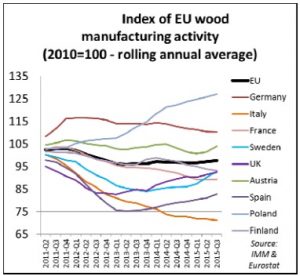
Wood_manufacturing_activityDemand for wood products has benefitted only a little from Europe’s slow economic recovery in the last three years. This is evident from the Eurostat index of EU wood manufacturing activity which covers the sawmilling, veneer, panels and joinery sectors but excludes wood furniture. European wood manufacturing activity remained stalled at around 97% of the 2010 level between the start of 2014 and second quarter of 2015.

The stasis in European wood manufacturing activity is a reflection of the slow growth in the European construction sector. It also suggests that wood has yet to make significant inroads into market share of alternative materials.

Competition between suppliers of different wood products – such as between panels and sawn wood and between temperate and tropical hardwood - also remains intense.

While total European demand for wood products has remained flat, there are on-going significant shifts in the source of demand. Markets for sawn wood and woodbased panels have been particularly hard hit by the economic downturn and stagnation of the building and furniture sectors.

The wood veneer sector has suffered profoundly from the contraction of the southern European joinery manufacturing industry and has come under intense pressure from substitute materials and new finishing techniques across the European continent.

However new opportunities are arising for value-added engineered and other forms of modified wood products, particularly in structural applications. The combination of strong technical performance and reduced overall costs of construction are the main drivers for uptake of these modern wood products.

The carbon and sustainability message is a welcome bonus for those specifiers and contractors keen to burnish their green credentials. The relatively positive outcome of the recent Climate Change conference in Paris gives some confidence that this latter issue may become a more prominent driver in the future.

Russian exports of wood products up in volume but fall in value

Statistics from January-November 2015 show a change in terms of the Russian wood products’ export volumes. This is due to the fluctuations of the Russian ruble in 2015. The first 11 months of 2015 brought a 17.3 million m3 of unprocessed wood sale in Russia, according to the Russian Federal Customs Service. This represented a 7.56% fall from 2014. Also, exports in value terms fell from 2014, by 25.11%.
Even if Russia exported more sawnwood in the first 11 months of 2015, the total value declined and exports came up to 13.04 million m3, which represented a 10.29% increase from 2014. Sawnwood exports decreased to $2.82 billion, with a 18.39% decrease from 2014, when the value terms reached $3.45 billion.
Also, the plywood exports suffered some changes during January-November 2015. In the course of the mentioned period, Russia exported approximately 2 million m3 of plywood. Comparing to 2014 (1.79 million m3), this represented a 11.32% growth. The exports’ value rose up to $911 million, which was 15.55% less than in 2014, when the gains reached $1.078 billion.
A positive outcome came from the Russian pulp. During the first 11 months of 2015, Russia exported 1.87 million of pulp for a total value of $971.5 million, raising the exports by 3.16% in value terms and by 10.84 in volume terms.
[gravityform id="1" title="false" description="true"]

Sweden: Smaller forest machines deflate the market

The Swedish market for forest machines is shrinking. That’s the conclusion of a review of the past six years’ registrations of forwarders. The average reduction is 16 percent.
According to Elmia, the manufacturers can see several reasons and the trend also applies to harvesters.
The same decrease applies to harvesters too.

Rolf Andersson, CEO of Rottne, explains that “the machines are becoming more efficient, with a higher utilisation rate and longer lifespan. Because the felling volumes stay relatively constant from year to year, fewer machines are required.”

The after market is also affected by the decrease because stronger constructions mean that welding repairs on frames and centre pivots are rarely done, whatever the brand of machine.
Other factors are also at work. Peter Hasselryd, CEO of Komatsu Forest, says the proportion of final felling done has been unusually high.

“We’ve sold fewer but larger machines. The forestry companies may have temporarily reduced their thinning operations in order to save their thinner stock until the new mills come on line.”

Higher demands from the banks
The banks are making greater demands for financing forest machines and contractors are therefore delaying replacing their machines. The number of registrations for forwarders fell by 5% in 2015, from 301 to 287 machines.
John Deere retook first place with 127 registered forwarders, a market share of 44.3 percent.

“We were right in the middle of changing our product range in 2014 and had eight months’ delivery time for some models. Now the new models are in place and the statistics are showing that," explains Dieter Reinisch of John Deere.

Komatsu Forest was the top selling brand in Sweden in 2014, but the company fell from 101 to 85 forwarders sold. Peter Hasselryd says that “2014 was a good year with successful launches of new models. Over time we’ve had a 30-percent market share and that’s where we are now.”
Gremo was the one who lost the most, as only 4 forwarders were registered in 2015. The company says it sold seven machines but even that is nearly a 50-percent reduction compared with 2014’s sale of 12 machines.
Big growth for small machines
Small machines appear to be the reason for the decreasing market. These are not registered with the Swedish Transport Agency. But the manufacturers say this competition has a marginal effect.
During 2013 - 2015 an average of 282 forwarders were registered per year. The average for the previous three-year period was 335, meaning that the market has decreased by 16 percent or 54 forwarders.

Number of registered forwarders in Sweden in 2015 by manufacturer

Year

2015

2014

Manufacturer

Number

%

Number

%

John Deere

127

44.3

94

31.2

Komatsu

85

29.6

101

33.6

Rottne

29

10.1

34

11.3

Ponsse

26

9.1

41

13.6

EcoLog

14

4.9

11

3.7

Gremo

5

1.7

12

4.0

Logset

1

0.3

1

0.3

Tigercat

0

0.0

7

2.3

Total

287

301


Source: the Swedish Transport Agency. Compiled by Elmia AB


Number of registered forwarders in Sweden by year

Year

Number

2015

287

2014

301

2013

257

2012

335

2011

358

2010

313

2009

258

2008

353

2007

382

2006

299

2005

353

Source: the Swedish Transport Agency. Compiled by Elmia AB 
 
[gravityform id="1" title="false" description="true"]

Latvia: Forestry industry exports up 3.1%

Latvia exported 1.883 billion worth of forestry industry products during the first 11 months of 2015. This represented a 3.1% growth from the same period of 2014, according to LETA, referring to the Latvian Agriculture Ministry. Regarding the timber and timber products, Latvia exported a worth of 1.607 billion, representing a 2.4% growth from the first 11 months of 2014.
Forestry industry exports reached a high level in 2014, when Latvia exported 2.015 billion euros worth of forestry products. Thus, the forestry industry import value rose to 688.74 million euros.
Latvia exported 18.7% of its forestry products to the UK during January-November 2015, while 10.6% went to Germany and 8.6% to Sweden. The exports to the UK brought Latvia 352 million euros. Another 199 million euros came from Germany and 161 million euros from the exports to Sweden. During the same period, Latvia imported forestry products worth 650 million euros. This amount represented a 4.8% increase from the same period of 2014.
The largest supplier for Latvia was Lithuania, who imported 113 million euros worth forestry products in January-November 2015, making for the 17.4% from the total imports. Estonia supplied another 82.6 million euros (12.7%) and Poland imported 82.8 million euros worth products (12.7%).
[gravityform id="1" title="false" description="true"]

China's economic crash to affect the Swedish forest industry

After China’s economy registered growth rates of 10-15% for 15 years before the financial crisis, the country is now facing a decrease. Still, its economy is growing by about 7% annually, according to official data. The decrease is reason enough to worry, as some analysts believe that this growth is actually about 3-4% and the slowdown will continue in the coming years.
The lower growth is a result from shifting focus from industrial, heavy infrastructure investment and exports to domestic consumption in the form of services and trade, as Skogs Industrierna states. Moreover, a change in interests would be dangerous at the moment.
In China, huge capacities build up in parts of the industry during the hot years as to accommodate a double-digit domestic growth and strong world economy. A rapid decline in production is now due to the big demand, both internally and externally, which brought many sectors to suffer from overcapacity.
China’s authorities decided to stimulate the domestic economy through interest rate cuts, in the form of stronger domestic demand. Still, this economic move is but not enough to compensate for the slowdown in industrial production and exports. While exports have slowed down from 20-40% growth, the industrial production decreased from 15-20% to about 5%.
Implications for the Swedish industry
Sweden has a high proportion of exports to GDP ratio, compared to most countries. The proportion of Sweden's exports to China as the final destination is relatively limited, both in total and for the forest industry. The proportion of total exports to China, however, has increased in recent years, from about 3% in 2012 to about 4%.

In addition, China’s share of timber exports increased considerably during the years 2012-2015. The share of exports of pulp and paper, rose in connection with the financial crisis, but has remained more or less stable since then. This means that China isn’t Sweden’s main trading partner, but its importance has grown considerably in recent decades.

Thus, the direct negative consequences of a possible major Chinese slowdown are generally unlikely to be devastating for the Swedish industry.
Still, China’s global power on the economy has to be taken seriously, as its share of the world economy has rose to 13% in 2014. If China’s economy slows down, it affects the whole economy, as there are few real economic powers in the world at the moment. From this point of view, not only Sweden would be affected, but the entire world economy.
[gravityform id="1" title="true" description="true"]

China’s economic crash to affect the Swedish forest industry

After China’s economy registered growth rates of 10-15% for 15 years before the financial crisis, the country is now facing a decrease. Still, its economy is growing by about 7% annually, according to official data. The decrease is reason enough to worry, as some analysts believe that this growth is actually about 3-4% and the slowdown will continue in the coming years.

The lower growth is a result from shifting focus from industrial, heavy infrastructure investment and exports to domestic consumption in the form of services and trade, as Skogs Industrierna states. Moreover, a change in interests would be dangerous at the moment.

In China, huge capacities build up in parts of the industry during the hot years as to accommodate a double-digit domestic growth and strong world economy. A rapid decline in production is now due to the big demand, both internally and externally, which brought many sectors to suffer from overcapacity.

China’s authorities decided to stimulate the domestic economy through interest rate cuts, in the form of stronger domestic demand. Still, this economic move is but not enough to compensate for the slowdown in industrial production and exports. While exports have slowed down from 20-40% growth, the industrial production decreased from 15-20% to about 5%.

Implications for the Swedish industry

Sweden has a high proportion of exports to GDP ratio, compared to most countries. The proportion of Sweden's exports to China as the final destination is relatively limited, both in total and for the forest industry. The proportion of total exports to China, however, has increased in recent years, from about 3% in 2012 to about 4%.

In addition, China’s share of timber exports increased considerably during the years 2012-2015. The share of exports of pulp and paper, rose in connection with the financial crisis, but has remained more or less stable since then. This means that China isn’t Sweden’s main trading partner, but its importance has grown considerably in recent decades.

Thus, the direct negative consequences of a possible major Chinese slowdown are generally unlikely to be devastating for the Swedish industry.

Still, China’s global power on the economy has to be taken seriously, as its share of the world economy has rose to 13% in 2014. If China’s economy slows down, it affects the whole economy, as there are few real economic powers in the world at the moment. From this point of view, not only Sweden would be affected, but the entire world economy.

[gravityform id="1" title="true" description="true"]

Forestry crisis in Romania due to huge rise in timber prices

Romanian timber producers consider that the highest timber prices in Europe are in Romania. These prices have increased a lot over the past years, according to industry representatives at a press conference organized by the Romanian Association of Furniture Producers (APMAR). Romsilva, the Romanian Forestry Agency  has issued a regulation that allowed an increase in starting prices.
The regulation was discussed at the auctions from December 2015 and, as Aurica Sereny, president of the Romanian Association of Furniture Producers, stated, it will lead to an important forestry crisis because the high prices will represent a start “to a competitiveness crisis of the entire wood processing industry, including the furniture industry”, according to information from the press conference.
RNP Romsilva organized the main auctions for roundwood for the 2016 production year between 17 – 24 December 2015. They offered a 4.31 million m3 total volume, but only 5% of it was sold. Thus, they rescheduled the auctions for 12-25 January 2016. The sales still didn’t increase, as nothing got sold in Botosani and only 20% got sold in Alba and Vrancea counties, according to Apopei.

“This is an industry dependent on a natural resource made available by Romsilva. The furniture industry can absorb a 2-3 percent increase in the price of timber, but in the current environment where the price of timber entering a factory for manufacturing is doubled, or tripled in certain cases, this increase means 30-40 percent over the current prices contracted on the internal markets”, detailed Mihai Apopei, vice-president of the Romanian Commerce and Industry Chamber.

Following the entrance into force of HG 924/11.11.2015 regarding the capitalizing on the wooden mass that makes up the public property of the state, RNP Romsilva decided not to take it into consideration.

“The exaggerated starting prices at auctions have lead, largely, to economic agents being unable to make offers, this further exacerbated by the fact that the wood bark is calculated at the same price, even though, as reference value, it is over 100 times cheaper (1-2 RON/m3),” said Nicolae Tucunel, president of ASFOR.

Thus, the increased starting prices are not justified, as the prices for raw materials on the global market have gone down, from the price of oil, gas, wood, metals, etc. To adapt to the conditions of the local and international market, RNP Romsilva cancelled the decision and a new one is to be taken.
[gravityform id="1" title="false" description="true"]

Välinge partners with Armstrong World Industries

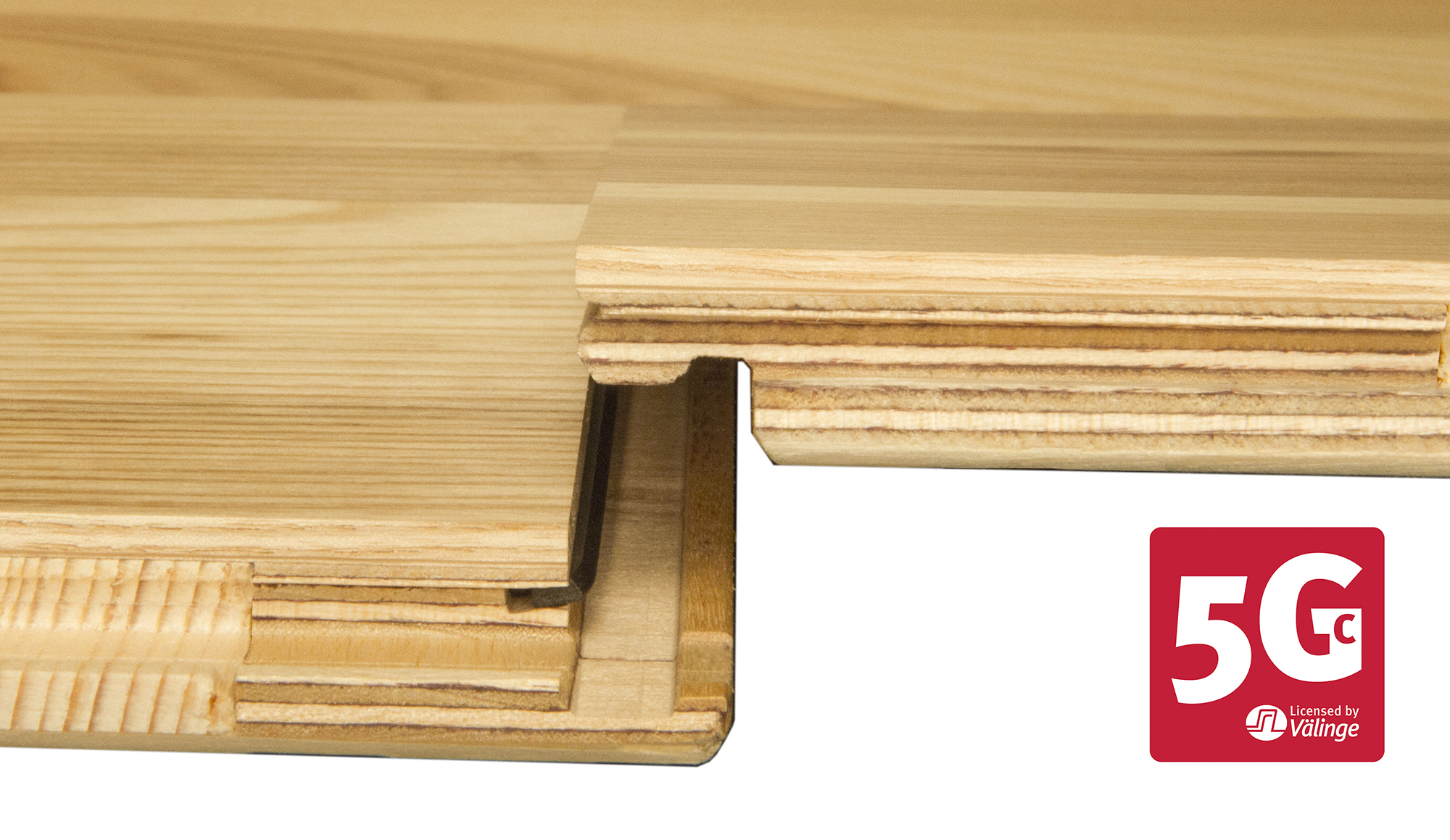
Välinge announced that Armstrong World Industries will launch their latest product innovation Vivero™ luxury flooring integrated with Välinge’s 5G technology.

Mr. Per Josefsson, Välinge’s Director New Materials Technology, commented:

“We are excited to expand the cooperation with Armstrong and also about the new luxury flooring product launch at Surfaces. Armstrong will now become the first licensee to produce and sell luxury flooring products with the 5G® Fold Down locking system in a product made in the US.”

According to Välinge’s  information, the new product line will be launched at The International Surface Event (Surfaces), held in Las Vegas, January 19-22, 2016.
The new luxury flooring line is manufactured in Armstrong’s newly opened production facility, located in Lancaster, Pennsylvania in the U.S.
Armstrong World Industries is a global leader in the design and manufacture of floors and ceiling systems. According to the company’s information, as of March 31, 2015, it operated 32 plants in nine countries and had approximately 7,500 employees worldwide.
The company is the first LVT manufacturing partner of Välinge for the 5G technology in North America.
Earlier Välinge and USFloors reached a cross-license agreement for wood-plastic composite products.
About Välinge:
The company is a world leading R&D and IP company in the flooring industry based in Sweden. Välinge International has about 80 employees who are mainly involved in R&D and customer support.
[gravityform id="1" title="true" description="true"]

Norbord gets license suspended for Val-d'Or OSB mill

Norbord Inc. announced that the Quebec Minister of Forests, Wildlife and Parks has terminated the wood license associated with its curtailed Val-d'Or, Quebec OSB mill. Production at the Val-d'Or mill was indefinitely suspended in 2012 following persistently weak North American housing market conditions and lower demand for OSB. This development is not expected to have any impact on the company's financial results.

"This is disappointing news, but in the bigger picture, we firmly believe that our Val-d'Or mill is the best alternative for the aspen pulpwood in that region," said Peter Wijnbergen, Norbord's President and CEO. "Unfortunately, market conditions do not yet justify a restart at Val-d'Or , but we are exploring options for the mill and are committed to a restart once market conditions are supportive. The Ministry has confirmed we can reapply for a wood license when we are ready to restart the mill."

Norbord is the world's largest OSB producer and continues to operate in the Abitibi region at its La Sarre, Quebec OSB mill. Since 2012, the company has invested and committed capital in excess of US$35 million to optimize that mill's capacity and ensure its long-term competitiveness.

About Norbord

Norbord Inc. is a leading global manufacturer of wood-based panels and the world's largest producer of oriented strand board (OSB). In addition to OSB, Norbord manufactures particleboard, medium density fibreboard and related value-added products. Norbord has assets of approximately $1.8 billion and employs approximately 2,600 people at 17 plant locations in the United States , Canada and Europe.

[gravityform id="1" title="true" description="true"]

Norbord gets license suspended for Val-d’Or OSB mill

Norbord Inc. announced that the Quebec Minister of Forests, Wildlife and Parks has terminated the wood license associated with its curtailed Val-d'Or, Quebec OSB mill. Production at the Val-d'Or mill was indefinitely suspended in 2012 following persistently weak North American housing market conditions and lower demand for OSB. This development is not expected to have any impact on the company's financial results.

"This is disappointing news, but in the bigger picture, we firmly believe that our Val-d'Or mill is the best alternative for the aspen pulpwood in that region," said Peter Wijnbergen, Norbord's President and CEO. "Unfortunately, market conditions do not yet justify a restart at Val-d'Or , but we are exploring options for the mill and are committed to a restart once market conditions are supportive. The Ministry has confirmed we can reapply for a wood license when we are ready to restart the mill."

Norbord is the world's largest OSB producer and continues to operate in the Abitibi region at its La Sarre, Quebec OSB mill. Since 2012, the company has invested and committed capital in excess of US$35 million to optimize that mill's capacity and ensure its long-term competitiveness.

About Norbord

Norbord Inc. is a leading global manufacturer of wood-based panels and the world's largest producer of oriented strand board (OSB). In addition to OSB, Norbord manufactures particleboard, medium density fibreboard and related value-added products. Norbord has assets of approximately $1.8 billion and employs approximately 2,600 people at 17 plant locations in the United States , Canada and Europe.

[gravityform id="1" title="true" description="true"]

FSC ends disassociation with Dalhoff Larsen and Horneman

The Board of Directors of the Forest Stewardship Council (FSC) has decided to end FSC’s disassociation from Dalhoff Larsen and Horneman (DLH) on a probationary basis.
This means that FSC can once again enter into trademark license agreements with DLH. The decision was taken after an analysis showed that DLH had made satisfactory progress towards the fulfillment of the conditions DLH had to meet in order to end the disassociation.
FSC disassociated from DLH in February 2015 when an impartial complaints panel concluded that DLH had been involved in illegal timber trade activities in Liberia. FSC gave DLH a set of conditions which, if satisfactorily fulfilled, would end the disassociation with the company. These included compensation for affected communities and a third-party verification of DLH’s due diligence systems.
In October 2015, DLH presented FSC with an action plan describing its activities to compensate the affected communities for the lost income they incurred as a consequence of illegal logging. These activities were agreed with the communities through the free, prior, and informed consent process conducted on the ground by the Sustainable Development Institute (SDI), a well-known, credible, and trusted local development organization. The action plan was approved by the FSC Board of Directors in November 2015.
In December 2015, DLH submitted further documentation showing the progress made in the fulfillment of all of FSC’s conditions. FSC concluded that the progress was satisfactory, and the FSC Board of Directors decided to end the disassociation from DLH on a probationary basis.

German wood pellets at stable prices

The price for wood pellets in Germany remains constant at the beginning of 2016, with a current price of 241.70 EUR per tonne, according to the German Energy Wood and Pellet Association (DEPV). The price has gone up only 0.6% since December 2015, but the price has lowered with 5.5%.
The price advantage of wood pellets over natural gas is 25%. Meanwhile, with the recent crash in oil prices, wood pellets offer no price advantage over heating oil. On contrast, oil has a price advantage over pellets of 27%.

Martin Bentele, Managing Director of the trade association DEPV, says that winter can have a bad influence on the pellets price.

“The supply of trade in wood pellets nationwide is outstanding and the cold is welcome to continue for some time,” he adds.
No timber harvesting is taken place now, but the pellet producers and retailers have enough resources as to quickly supply the pellets tanks, Mr. Bentele concluded.
Regional prices
The lowest price for pellets is in southern Germany, with 239.98 EUR per tonne for the 6t purchase quantity, as the results for January 2016 show. In Central Germany, the price is 241.21 EUR per tonne and in the North and East it reaches 246.87 EUR per tonne.
Larger quantities (26t) were traded in January on the following terms: Southern and Central Germany: 224.04 EUR per tonne, while in the South and East the price was 227.83 EUR per tonne.
Infographic: 

Price of wood pellets in Germany
Create your own infographics
[gravityform id="1" title="true" description="true"]

Dieffenbacher delivers particleboard plant in China

Dieffenbacher was given an order for a straw-based particleboard plant from Chinese chemical company Wanhua back in December 2015. This plant is projected to deliver a 110,000 m³ of straw-based particleboard annual output and Wanhua may use it to manufacture panels constructed from wood, a blend of wood and straw, and entirely from straw.

Wanhua-kl
In the front Christian Dieffenbacher and Zhao Zhimei, CEO Wanhua, during the signing ceremony.

The project must include everything from the forming station to the finishing line, while the forming station is equipped with two windformers for the surface layer and a forming head for the core layer. The core element of the plant is the continuous press CPS type 280 – 23.5 and this 8.5 ft press produces boards that are up to 2440 mm wide and between 8 mm and 35 mm thick. Moreover, the components supplied in the finishing line area include a diagonal saw and a distribution and trimming saw.

Dieffenbacher has adjusted 11 major orders for complete plants, while 5 further orders have already been signed. The company has been working on plant concepts for a long time, especially ones with alternative raw materials such as fast-growing woods, annual crops (e.g. sugar cane, straw) and recycled wood in response to the rising demand for machine technology designed to work with these specific raw materials.

The main reason for rising price of wood is the partial or complete replacement of wood in the manufacture of boards, but the environmental policy requirements have also driven this development. Thousands of tons of straw are burned each year in the field in China and this has a major influence of the environment. Thus, these large quantities must be used in other ways and the Wanhua project has been designed to improve this issue.

The Wanhua Industrial Group is a Chinese chemical company with headquarters in Yantai, Shandong Province and it is the world's largest manufacturer of MDI glue ahead of Covestro and a leading TDI manufacturer.

[gravityform id="1" title="true" description="true"]


Pan Pac Forest Products doubles production capacity at Milburn sawmill

Japanese-owned Pan Pac Forest Products will pour NZ$23million into doubling capacity and creating jobs at its Milburn sawmilling plant just South of Dunedin. The company bought part of the former Southern Cross Forest Products company out of receivership 14 months ago, Otago Daily Times reported.
Pan Pac, a subsidiary of Japanese company Oji Group Holdings, plans to double processing of mainly export grade radiata pine to 100,000 cum per year, boost jobs at Milburn, just north of Milton, from 29 to 35, and create site capacity for further expansion.
Pan Pac general manager Michael Reaburn said the company would initially continue to operate from both the existing Milton and Milburn sites during construction, but the aim was for a single 'state-of-the-art production facility' at Milburn, doubling existing capacity.
"The plan involves building a new kiln and installing a new boiler at the Milburn mill. Construction will take just over a year and is due for completion in April 2017," Mr Reaburn said. Work was due to start next month, using local contractors and suppliers, but Mr Reaburn said some specialist equipment would need to be imported from Europe and North America.
"The Otago operation is an important part of our growth plan and helping meet the expanding demand for lumber in the Asian market," Mr Reaburn concluded.
Pan Pac was established in New Zealand 43 years ago, with a sawmill and pulp mill north of Napier in Hawkes Bay, owning 35,000ha of forests, employing 370 staff and 450 contractors from around the region. Pan Pac has a turnover of more than $350million annually, exporting to China, Japan and the US, plus some domestic sales.
[gravityform id="1" title="true" description="true"]

Brazilian furniture exports expected to rise in 2016

According to the Brazilian High-end Furniture Manufacturers Association (ABIMAD) the expectation is that Brazil's furniture exports in 2016 will expand nearly 6% over 2015 levels. Although not a startling growth a growth, this should help enterprises in the sector to maintain profit levels through trade in high-end furniture, ITTO says.

According to ABIMAD exports to Argentina are likely to increase as the new government there tackles the economy. Argentina is an important destination for Brazilian furniture and an improvement in exports will greatly benefit Brazilian manufacturers who suffered because the economy in Argentina was weak.

In addition, recovery in the housing market in the United States is good news for Brazilian manufacturers. The US is historically a major buyer of Brazilian furniture. European countries are also on radar of furniture manufacturers and the expectation is that exports to the EU will grow in 2016.

[gravityform id="1" title="true" description="true"]

COP 21: Implications of Paris Agreement for the forest industry

The UN climate summit in Paris that ended on December 12th did not deliver on all fronts, providing no guarantee that the world will avoid the worst impacts of climate change. However it did produce the most promising international climate agreement in years, ITTO reported.

Critically, the agreement built on initial commitments of over 180 countries to reduce their carbon emissions and includes a review clause to encourage countries to increase their pledges in the near future. As the only the economic sector to be referenced explicitly, the Paris agreement also raised the political profile of forestry and signalled that cutting emissions from deforestation and promoting sustainable forestry is now recognised globally as one the most efficient ways to address climate change.

To make Paris a lasting success, it’s now important that the key agreements on issues such as financial support, the increase of emission-reduction pledges, and Reduced Emissions from Deforestation and Forest Degradation (REDD) are further developed and implemented in the months and years ahead.

The agreement is built on the commitment of signatories to deliver against “Intended Nationally Determined Contributions” (INDC) to reduce greenhouse gas emissions. By allowing countries to voluntarily declare their own commitments, discussions in Paris side-stepped the serious political conflict created in earlier negotiations which sought to allocate specific targets for emissions reductions to individual countries.

The downside of this approach is that, in aggregate, the commitments made fall well short of what the scientific community argues is needed to limit the global temperature rise to 2 degrees Celsius above pre-industrial levels, the widely recognised threshold for major economic and environmental disruption. The upside is that the agreement achieved unprecedented levels of political support. Close to 150 world leaders were in Paris to mark the start of the talks and negotiators from 195 countries signed off on the agreement when the talks ended.

Paris was also significant for the high and positive levels of business engagement, a testament to the growing momentum behind global climate policy. While the INDC’s in aggregate fall short of what is required, some national commitments are ambitious and together they signal that measures to reduce carbon emissions will be an increasing factor in political and economic decision-making worldwide in the future.

For example the EU committed to reduce GHG emissions to 40% below 1990 levels by 2030. China indicated that it will reduce carbon intensity to 60-65% of 2005 level by 2030, increase the non-fossil fuel in national energy supply to 20%, and continue to expand forest area. The United States stated that it would reduce GHG emissions to 26-28% below 2005 level by 2025. Many developing countries included action against deforestation in their INDCs.

For example Brazil committed to “strengthening policies and measures with a view to achieve, in the Brazilian Amazonia, zero illegal deforestation by 2030 and compensating for greenhouse gas emissions from legal suppression of vegetation by 2030.”

Forestry related measures were also prominent in the text of the agreement. Article 5 encourages countries to “take action to implement and support, including through results-based payments” REDD+ activities.

It also explicitly recognises “the role of conservation, sustainable management of forests and enhancement of forest carbon stocks in developing countries.”

The overarching “decision” that Annexes the Paris Agreement recognised “the importance of adequate and predictable” finance for REDD+ activities. Although the ‘rules of the game’ for REDD+ were already agreed – thus legitimising and ‘regulating’ REDD+ activities – the political signal of Article 5 is very important. It shows forest nations that this is a long-term game.

This in turn should give added confidence to continue with REDD+ strategy and readiness activities. Several groups of nations used the opportunity offered by the Paris Conference to launch new forestry-related initiatives. African nations, with support from NGOs and the German government, launched AFR100 at the Global Landscapes Forum during the Paris meeting.

AFR100 is an initiative to restore 100 million hectares of degraded forest lands before 2030. It is led by ten African countries: the Democratic Republic of Congo, Ethiopia, Kenya, Liberia, Madagascar, Malawi, Niger, Rwanda, Togo and Uganda.

There was also a “Leaders’ Statement on Forests and Climate Change” issued jointly by the governments of Australia, Brazil, Canada, Colombia, Democratic Republic of Congo, Ethiopia, France, Gabon, Germany, Indonesia, Japan, Liberia, Mexico, Norway, Peru, United Kingdom and the United States.

The Statement included a commitment to intensifying efforts to protect forests, to significantly restore degraded forest, peat and agricultural lands, and to promote low carbon rural development. It also included commitment to large-scale implementation of national REDD+ and sustainable land-use and climate change programs and, importantly, to generate and reward verified results.

Leaders from developing and developed countries also launched specific partnerships to help reduce deforestation. For instance, Brazil and Norway extended to 2020 their partnership to reduce deforestation in the Amazon Forest and Norway committed new financial support.

Norway, Germany and the UK also pledged to provide US$5 billion from 2015 to 2020 for REDD+ programs. Some private sector representatives of the private sector were also keen to lend their support. The co-chairs of the Consumer Goods Forum – M&S and Unilever – issued a statement that they will preferentially buy agricommodities from areas that have “designed and are implementing jurisdictional forest and climate initiatives”.

Building on their commitment to “deforestation-free” sourcing policies through the New York Declaration on Forests, the two companies said in future they will preferentially source from jurisdictions that demonstrate commitment and progress towards an ambitious national INDC which includes a strategy for reducing emissions from forests and other lands whilst increasing agricultural productivity and improving livelihoods.

But perhaps more significant for forest policy than these statements of intent, was a pivotal reference in the Paris Agreement to the importance of “removals by sinks of greenhouse gas emissions in the second half of the century” to rapidly reduce global emissions after they peak “as soon as possible.”

There was combined with a transparency clause which makes clear that removals by sinks must be included in national emissions inventories. The implication is that forests – a vast sink which can be increased through active management – are acknowledged to be central to the solution of global climate change.

Countries worldwide are also under an obligation to account accurately and regularly for all the carbon stored in the vegetation and soils in forests, as well as in agricultural land and protected areas and in the products of these lands (such as wood, crops, and biomass).

As this data is collected and analysed, new market opportunities should arise for sustainable timber products as it becomes increasingly clear that increased use of such products is a particularly efficient way to reduce carbon emissions.

[gravityform id="1" title="true" description="true"]

VIDEO: The European Pellet Conference coming up next month

The World Sustainable Energy Days, 23 – 26 of February, including the European Pellet Conference Feb 24-25, are organised by the OÖ Energiesparverband, the energy agency of Upper Austria with the mission of promoting energy efficiency and renewable energy sources.
Independently in parallell 24 – 28 February is the big Energisparmesse – Expoenergy – organised by the Welser Messe. The first two days of the exhibition is dedicated for business people. In total around 68 000 m2 exhibition space.

European Pellet Conference 2016

Date:

24 – 25 February 2016

Venue: 

Wels, Austria
Stadthalle, Pollheimerstrasse 1,
4600 Wels/Upper Austria

Conference fees:

•  290 Euro for the European Pellet Conference with Site
Visits (includes the Young Researchers
Conference: Biomass), (23 – 25 Feb. 2016)

•  200 Euro for the European Pellet Conference
(includes the Young Researchers
Conference: Biomass), (24 – 25 Feb. 2016)
All fees include an entrance ticket to the tradeshow and conference documentation. All fees plus 10 % VAT

Conference languages:

English, German

Organisation and conference office:

OÖ Energiesparverband
Landstrasse 45, 4020 Linz, Austria
Tel. +43/732/7720-14386
office@esv.or.at

With more than 600 participants every year, the European Pellet Conference held in Wels is the largest annual pellet event in the world.

Includes

  • World Pellet Business & Technology Forum
  • Pellet Market News Worldwide
  • Pellet Technology Outlook
  • Pellet Business Cooperation Platform
  • Technical Site Visits: Pellets & Wood Chips
  • Poster Presentation

PROGRAMME

Tuesday, 23 February 2016

08.30 – 18.00: Site Visit “Pellets & Wood Chips
A full-day trip by bus including technical Site Visits on the production of fuels & equipment and innovative applications for heating and electricity production


Wednesday, 24 February 2016

09.00 Pellet policies and markets

  • Opening & welcome
    Michael Strugl, Regional Minister for Energy, Upper Austria
    Gerhard Dell, OÖ Energiesparverband, Austria
  • The role of bioenergy in the Energy Union
    Giulio Volpi, European Commission, DG Energy
  • EU bioenergy – market trends and policies
    Fanny-Pomme Langue, AEBIOM
  • Ecodesign requirements and labelling for biomass heating
    Alexander Weissinger, Bioenergy 2020+, Austria

The role of bioenergy in the bioeconomy

  • Global potentials and developments
    Hubert Röder, Wissenschaftszentrum Straubing, Germany
  • From innovation to market – biomass in Upper Austria
    Christiane Egger, OÖ Energiesparverband, Austria
  • An effective strategy for regional economic development
    Adam Sherman, Biomass Energy Resource Center, USA

Lunch break


Panel discussion:
Pellets – facts vs. fiction

  • Chairperson: Tim Portz, BBI International
  • Gordon Murray, Wood Pellet Association, Canada
  • Hans Martin Behr, Deutsches Pelletinstitut, Germany
  • Stefan Ortner, ÖkoFEN, Austria
  • Francisco Puente, ESCAN, Spain

Successful business models

  • How to improve the profitability of a pellet business
    Henrik Arfwidsson, Agroenergi Neova Pellets, Sweden
  • Financing and operating pellet facilities in Europe and the US
    José Ignacio Pedrajas, Prodesa North America, USA
  • Risk management with wood pellet future contracts
    Ulrich von Fürstenberg, Euronext, France

World Pellet Technology Forum

  • Technology outlook: pellet heating of the future
    Ingwald Obernberger, Bios Bioenergiesysteme, Austria
  • Comparison of soft and hard wood pellet production
    Peter Lange, CPM Europe, NL
  • “New” pellet fibers require new technologies
    Gregor Rinke, Rinke Engineering, Germany
  • Reducing ash content in pellet production
    Ivan Lipovec, PAL, Italy

19.00 Evening programme


Thursday, 25 February 2016

09.30 Session: Pellet Technology Outlook – a research update (in English only)

09.30 Session: Pellet Market News Worldwide (in English only)


09.30 Pellet Technology Outlook – a research update (in English only)

  • Optimisation of cereal straw torrefaction and pelletisation
    Javier Gil Barnó, CENER, Spain
  • BRISK: combustion characteristics of “HTC pellets” and “vineyard pruning pellets”
    Stefan Retschitzegger, Bioenergy 2020+, Austria
  • BeReal: a test method for pellet stoves reflecting real life operation
    Hans Hartmann, TFZ Bayern, Germany
  • EMPYRO: energy and materials from pyrolysis
    Gerhard Muggen, BTG-BTL, NL
  • ENERCOM: polygenerating energy, fuels and fertiliser
    Thorsten Kläs, Soil-Concept, Luxembourg
  • LogisTEC: innovation in biomass supply chains
    Michiel C. Carbo, ECN, NL
  • SECTOR: final results and torrefaction outlook
    Kay Schaubach, DBFZ, Germany


12.30 End of the session


————

09.30 Pellet Market News Worldwide (in English only)

  • Chairperson: Gordon Murray, Wood Pellet Association of Canada
  • Opening
    Gilles Gauthier, European Pellet Council
  • Price differences and international trade with household pellets
    Lukas Kranzl, Energy Economics Group, Vienna University of Technology, Austria
  • Canada: wood pellet industry update
    Michele Rebiere, Viridis Energy
  • US: old challenges, new opportunities
    Ben Bell-Walker, Biomass Thermal Energy Council
  • India: increasing opportunities in emerging markets
    Suhas Patel, Saurashtra Agro Briquettes
  • Germany: responding to weak markets
    Martin Bentele, DEPV
  • UK: boom and bust – the pellet boiler market
    Neil Harrison, re:heat
  • Spain: campaign “Biomass in your home”
    Pablo Rodero Masdemont, AVEBIOM
  • Romania: potentials for pellets and briquettes
    Dorin Sfaca, Romanian Pellets and Briquettes Association
  • Namibia: biomass opportunities
    Dr. Bruce Brewer, CCF Bush

12.30 End of the session

Sawmill up for sale in Austria

The business at the former RZ sawmill in Bad St. Leonhard in the Lavant Valley (Lavanttal) is now up for sale, after it reached insolvency back in June 2015. The sawmill is now free from encumbrances and it includes the real estate and all machinery, fixtures and fittings.
Recovery specialists Karner & Dechow have begun the process for the sale of the sawmill, on the the instructions of the insolvency administrator, Dr Egbert Frimmel, according to Yahoo Finance. The Carinthian traditional business covers an area of 123,000 sqm and accommodating several production halls and warehouses as well as office premises with a floor space of around 13,000 sqm.
The maximum capacity of the sawmill reaches some 400,000 solid cubic metres per annum at a top diameter of 24-40cm and is designed for timber diameters of up to 55cm. The complete machinery also includes sorting systems, drying rooms and a tool sharpening shop.
Moreover, the entire handling-equipment with numerous stacker trucks with lifting capacities of up to 16 tonnes, wheel loaders and the vehicle fleet are included in the company's capital assets.
[gravityform id="1" title="false" description="true"]

Newsletter

Subscribe to our digital newsletter for your daily digest of essential news, views and analysis from the international wood industry delivered directly to your inbox.


0