

There is a growing coalition of companies and other organisations in the EU committed to making the case for a long-term trade in tropical hardwoods in the EU – although with the important qualification that all tropical wood promoted for use in the EU should be either third party certified or, at minimum, subject to independent legality verification. That of course raises questions, still not satisfactorily addressed, about equitable market access, particularly for community and other non-industrial forest operators.
The FLEGT Action Plan and associated work through Voluntary Partnership Agreements (VPAs) with most of the leading tropical wood suppliers to the EU is beginning to encourage the development of more enlightened policy environment and positive image for tropical wood products in the EU.
Meanwhile there are signs that the European Sustainable Tropical Timber Coalition (STTC), which started in 2013, is gaining momentum. The STTC brings together companies in timber sector, retail, and end-use industries, with government officials and NGOs in the interests of promoting increased use of certified tropical timber in the EU. STTC has established a target to increase EU sales of certified tropical timber by 50% over 2013 levels by 2020.
In March STTC launched a new phase of development involving a closer strategic partnership with the European Timber Trade Federation (ETTF), re-energised communications and membership drives and, critically, a funding initiative to back private and public sector Action Plans and projects.
Timber businesses can now receive match-funding for activities in the framework of an STTC Action Plan for up to 30% of the cost, or Euro15,000. Federations are eligible for grants of up to Euro30,000 for developing sustainable sourcing policies. In addition, STTC partners and participants can submit project proposals with a requested STTC contribution up to Euro50,000 if it contributes to STTC objectives.
A new website (www.europeansttc.com) lays out STTC goals and the all-round case for using sustainable tropical timber. It provides technical data, tropical timber application case studies, lists STTC partners and members and explains how to join and apply for funding.
ATIBT, PEFC and STTC link up to promote tropical timber
Also in March, STTC acquired two influential new partners with potentially important implications for the future scope, direction and level of support for STTC activities. One new STTC partner is the International Tropical Timber Technical Association (ATIBT), which supports development of international trade in tropical timber, both as a viable business, and a means of helping maintain the tropical forest and the habitats and biodiversity it supports.
On announcing the partnership, ATIBT President Robert Hunink emphasised the important role of STTC to encourage introduction and promotion of so-called ‘lesser used species’, noting that “successful promotion of these species is especially crucial for the economic viability of operators in the Congo Basin and to maintain a balanced species composition in the forest.”
PEFC is the other new STTC member and is already in discussion with STTC about a project which aims to increase European imports of certified tropical timber from Asia, now one of PEFC’s principal focus areas. The specific objective of the joint project is to create improved linkages between growing certified Asian timber output and the EU market and to address critical bottlenecks in supply of certified wood products from the region.
Article archive
Finland: Sawn softwood production and export expected to rise in 2016
Growth in the value of Finnish forest industry exports this year is driven by pulp and paperboard exports. Weak price trend is suppressing sawn timber exports. Next year new investments and increasing demand are expected to raise Finnish forest industry production. Weak outlook for paper demand will continue and exports are forecast to decline both this and next year, according to a new research by the Finnish Pellervo Economic Research (PTT).
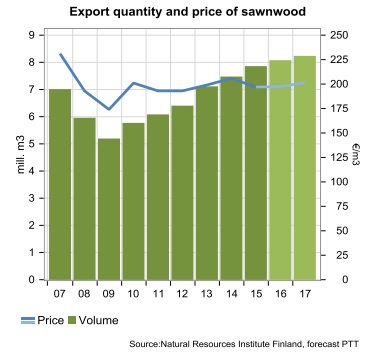 Intense competition in sawn softwood markets
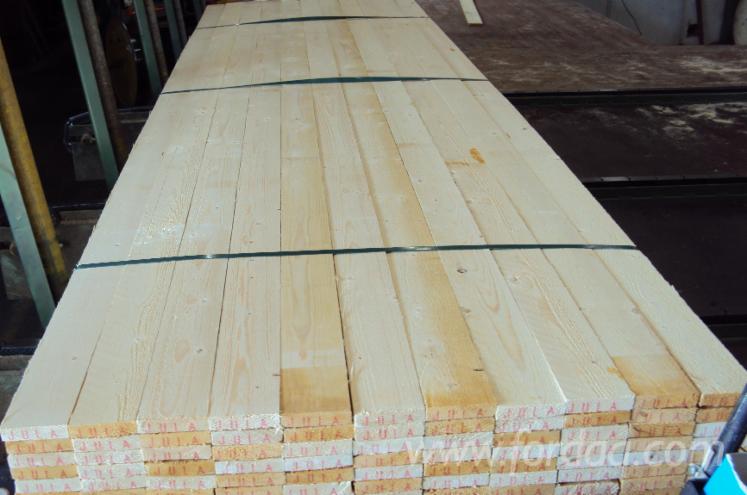
The Finnish sawn industry has a difficult year behind and the beginning of the year hasn’t brought any relief. However, the beginning of the construction season is expected to bring new light to the wood industry as construction is forecast to rise in Finland and main export markets in Europe.
Also the demand of spruce sawn softwood in Asia is expected to grow, led by China.
Difficulties in the North African market is reflected negatively to the outlook for pine sawn softwood. Sawn production will rise a couple of per cent in 2016. Production of plywood will increase as Stora Enso starts its LVL-production in Varkaus. Intense competition will keep sawn products’ export price development moderate. Economic growth and increasing construction activity in main markets will raise the demand and price of wood products next year.
Paper production down, paperboard exports increase
The production and export of paper in Finland will reduce by 3–4 per cent this year and 2–3 per cent 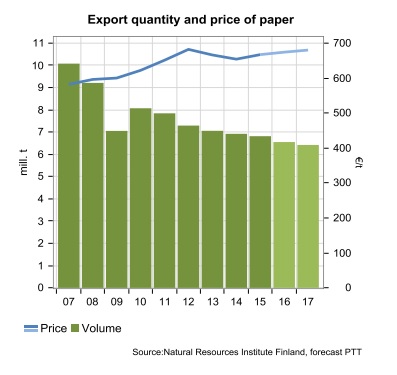 next year. This is explained by announced or already realized capacity closures and the downward trend in demand. The average export price will rise slightly but a more significant increase would still require more closure of machines in Europe. Despite of declining production, paper products still account for about 40 percent of Finnish forest industry's export earnings.
Paperboard production in Finland increases significantly this year and next year owing to growing production capacity. The increasing supply of paperboard in Europe will decrease average export price of paperboard from Finland.
Increasing supply will decrease pulp’s export price
This year and next year a number of large, mainly eucalyptus pulp-producing, new factories will see daylight. Pulp exports from Finland will also continue in a positive trend this year and next year because of increasing production capacity. Softwood pulps global supply increase is expected to be moderate. The increased supply of hardwood pulp will however decrease the price of softwood pulp as well and therefore decrease Finland’s average export price of pulp. Metsä Group’s bioproduct factory will start in autumn 2017 and will not affect the price development of pulp for the forecast period.
Key forecast variables for the Finnish forestry in 2016–2017
|
2016f |
2017f |
|||
|
Volume |
Price |
Volume |
Price |
|
| Export markets | ||||
|
Paper |
-4/-3 |
0/+1 |
-3/-2 |
0/+2 |
|
Pulp |
+3/+4 |
-6/-4 |
+4/+6 |
-4/-3 |
|
Paperboard |
+7/+9 |
-4/-2 |
+5/+7 |
-3/-1 |
|
Sawn softwood |
+2/+4 |
0/+1 |
+1/+3 |
+1/+3 |
|
Plywood |
+2/+3 |
+1/+2 |
+3/+5 |
+1/+2 |
f PTT’s forecast
West Fraser announces higher earnings from lumber operations

West Fraser Timber Co. Ltd. has reported Q1/2016 net earnings of C$42 million, down from the C$49 million in the same 2015 quarter.
The integrated company whose products include lumber, plywood, pulp and newsprint among others, reported that the revenues on sales advanced to C$1.077 billion from C$1.014 million in the Q1/2015.
West Fraser's lumber operations generated operating earnings of C$63 million, up from C$17 in the Q4 of 2015, as a result of the higher prices and shipments combined with a weaker Canadian dollar. Also, the lumber markets improved slightly as generally milder weather conditions produced above normal home building activity in many parts of the U.S.
West Fraser's panel segment, which includes plywood, LVL and MDF, generated operating earnings of C$12 million, down from C$16 million in the Q4/2015, mostly reflecting weakening plywood and MDF prices.
Meanwhile, pulp and paper operations generated operating earnings of C$5 million compared with operating earnings of C$8 million in the previous quarter. Pulp results benefitted from a weaker Canadian dollar as the U.S. dollar-denominated pulp prices, which were relatively stable in the quarter. This benefit was offset by increased maintenance costs at the Hinton pulp mill, the result of a minor maintenance shutdown during the period.
"We have made significant investments in growth, capital and innovation, and we are starting to see the benefits of the most comprehensive five- year capital plan in our history. We are geographically diversified and have a modern and efficient group of assets which positions us well in addressing any trade sanctions arising from the dispute,” stated Ted Seraphim, President and CEO of West Fraser.
[gravityform id="2" title="true" description="true"]
Canada: FSC puts in force new forest management standards

The Forest Stewardship Council (FSC) will implement a new forest management standard in Canada, only after considerable stakeholder engagement ensures this new standard reflects the opinions of all stakeholders, as far as possible.
This is according to Kim Carstensen, Director General of FSC, who was responding to concerns from environmental, social and economic groups that their needs would be superseded by others in the development of the new standard. Stakeholders were also concerned about the implementation of Motion 65, passed at FSC’s last international members’ meeting, which called for the protection of the world’s remaining untouched forests.
The FSC International secretariat has warned the Board of Directors that the current deadline to implement Motion 65 into national forest management standards, set for the end of 2016, is creating significant levels of anxiety in Canada and threatens to disrupt ongoing processes to find national, chamber-balanced solutions to protect IFLs in Canada. The Board of Directors shared this concern and agreed to receive and vote on a proposal to prolong the current deadline at their next meeting in July. A postponement would give the Canadian stakeholders appropriate time to agree how protection of intact forest landscapes should be included in the national standard. Carstensen reconfirmed that FSC would consider all opinions and ensure that consensus is reached among the four chambers so that a compromise that is acceptable to all can be implemented.
“FSC is an international membership organization with a governance structure based on participation, democracy, equity and transparency and we are committed to using this quality to ensure that Motion 65 gets implemented as part of a Canadian standard that provides innovative solutions in line with 21st century issues,” according to the council’s international Director General, Kim Carstensen.
“The FSC International Board of Directors will vote on a proposal for Motion 65 that ensures that inclusive, chamber-balanced input is listened to, particularly regarding the integration of Indigenous concerns related to Free, Prior and Informed Consent and Indigenous Cultural landscapes.”
While FSC international members voted for Motion 65, forest management standards are developed at a national level. FSC Canada recognizes a relevant and feasible new standard requires analysis and consensus and it will take into consideration the needs of all members to ensure that the National Forest Management Standard is an accurate reflection of all Canadian stakeholders. The new standard will cover issues particular to the country, such as the Free, Prior, and Informed Consent of First Nations and the protection of the habitat of the woodland caribou.
“Canada is a key supplier of FSC certified products internationally bringing a clear competitive advantage to the Canadian forest sector worldwide,” according to François Dufresne, president of the Canadian chapter. “FSC Canada is part of the solution to ensure domestic and international market access for forest products from responsible sources considering that 80% of all Canadian forest products are exported, mainly to the United States.”
FSC International is committed to provide additional resources to ensure a smooth transition towards the implementation of the new National Forest Management standard in Canada, FSC says. These resources will be deployed into more robust field-testing and stakeholder engagements. FSC Canada’s forest management standard is set to be completed in early 2017. To reach this objective, FSC Canada will have to merge its four standards (B-C, National Boreal, Maritimes, Great Lakes/St. Lawrence) into a national standard.
[gravityform id="2" title="true" description="true"]
Valutec to deliver two kilns for Austrian Hasslacher

Austrian company Hasslacher, has recently invested in Swedish company Valutec’s two progressive kilns, for its laminated wood plant in Sachsenburg, Kärnten, Austria, as reported by Wood Business.
“We need to increase the drying capacity and drying quality in terms of precision in the moisture content and reduced cracking. Valutec offered the best complete solution,” said Michael Fercher, the technical manager at Hasslacher.
The kilns from Valutec will be used to dry center cut timber as to reach a 12% final moisture content. The progressive kilns built by Hasslacher combine the high capacity with the quality that the company needs to dry the big packages that they own. They will be made out of stainless steel and will be equipped with pressure frames for minimal deformation of the top timber layer.
“Hasslacher focuses extensively on quality and our consistent quality thinking in everything from building material to drying control was one of the main reasons that they chose us,” says Robert Larsson, CEO of Valutec.
The new kilns will be ready for delivery by the spring and summer of 2016 and will be ready to work during September.
[gravityform id="2" title="true" description="true"]
Nippon Paper plans to start production of wood pellets
Nippon Paper Industries, Tokyo, plans to produce heavy efficient-burning wood pellets as to use them as biomass fuel for electricity generation. The company will begin the tests on their new project in spring 2017 and plans to start the operation in fiscal 2018, as reported by Nikkei Asian Review.
The wood that Nikkon Paper plans to use is called torrefied wood and its process, torrefaction. This implies roasting it, by heating the wood at low temperatures for an hour. During this time, the wood releases a substance capable to burn by doubling the heat volume of the wood chips. Thus, the power generation efficiency also doubles.
As Nikkei Asian Review reported, the company will import eucalyptus and other tree materials harvested in Thailand by a division of SCG Packaging, a leading papermaker there in which it holds a 22% stake. The wood will be shipped to Nippon Paper's Kushiro mill in Hokkaido, where it will be mixed with coal and heated to produce torrefied wood pellets.
As for the tests starting 2017, the Japanese company is working on a system capable to operate with an output capacity for 8,000 tons of fuel pellets a year. Part of the tests will also consist of surveys taken all around Asia, with the help of the trading house Mitsui & Co.
If the studies will show that the project would bring profit, Nippon Paper will enhance its production capacity tenfold in fiscal 2018.
[gravityform id="2" title="true" description="true"]
German Pellets has several prospective buyers

The insolvent wood pellet manufacturer German Pellets GmbH may well continue its operations, according to the German media, as there are several serious prospective buyers.
The insolvency administrator of the company, Bettina Schmudde, stated that there are several takeover bids from German and foreign investors, without revealing any names. Further on, negotiations will continue with the most promising bidders, as to pass German Pellets to a new owner. First for sale is the core business with three locations in Germany.
According to a report by the Handelsblatt, the German wood processor Rettenmeier is the favorite prospective buyer. The second candidate is the papermaker pulp Rosenthal, owned by the private equity firm Mercer International.
The sale will bring a low double-digit millions number. Schmudde will open the insolvency proceedings on May 1st.
The company of Wismar filed for bankruptcy in February after the rescheduling of a bond due April 1, which had failed. It is one of the largest bankruptcies in Germany this year, which affected a five-digit number of investors.
The price of pellets has been under pressure because the oil price crashed and two warm winters also caused the demand to decrease.
[gravityform id="2" title="true" description="true"]
Unilin signs licensing agreements with Chinese companies
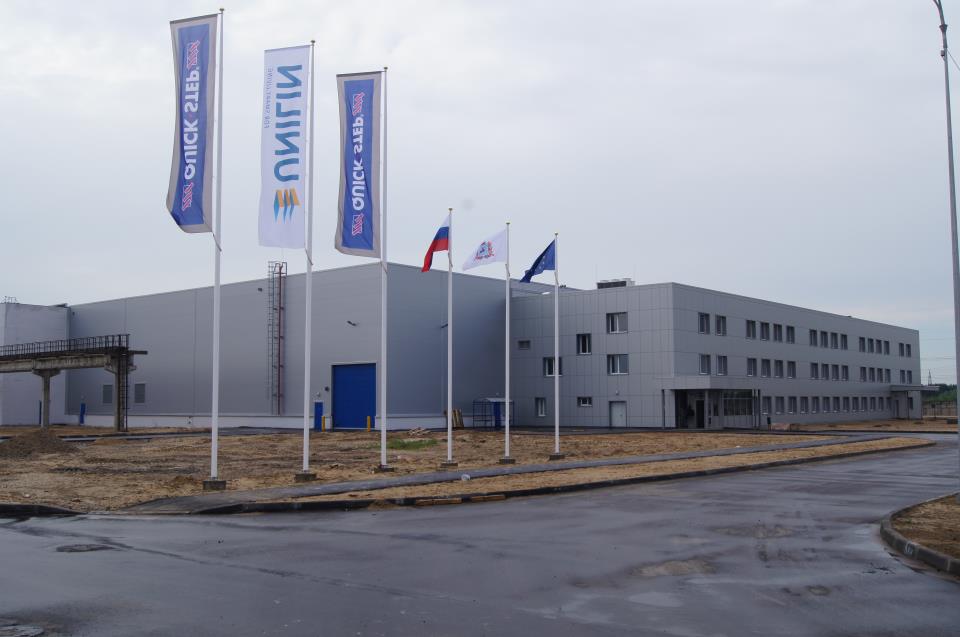
Unilin's IP division has extended the license agreements of the following Chinese WPC manufacturers, giving these companies additional protection on the US Floors Coretec® patents for their respective WPC product lines:
- Jiangsu Zhengyoung,
- Anhui Hanhua,
- SS Floor,
- Changzhou Sennuo,
- Changzhou Jinuo,
- Nanjing MGM,
- Shanghai Jinka,
- Huzhou Beiyakesi,
- Nan Sing Plastics, and
- Jiangsu Tongsheng
Earlier this year, a similar agreement was reached by Unilin with Novalis.
In addition to these agreements, Unilin's IP division also reached settlements with the Chinese manufacturers, Zheijiang Kingdom and Changzhou Lingdian, to reinstate their licenses after being terminated for serious breaches of their license agreements. Both companies accepted liability and penalties for past unlicensed sales and other breaches.
Says Bart Van der Stockt of Unilin's IP division regarding the reinstatements: "These settlements are important for our licensing business as they show our firm commitment to protect our licensed customers who rely on Unilin as the licensor to prevent infringement of its intellectual property. With the increasing popularity of LVT and WPC, Unilin will step up its efforts to detect fraud and underreporting in these categories of products in order to maintain fair and equal competition".
Flooring products which are not reported as licensed product to Unilin, will expose manufacturers, importers and retailers to patent infringement claims since the license agreements with manufacturers exclude such non-reported volumes from patent protection.
Opinion: A new Softwood Lumber Agreement would be more restrictive
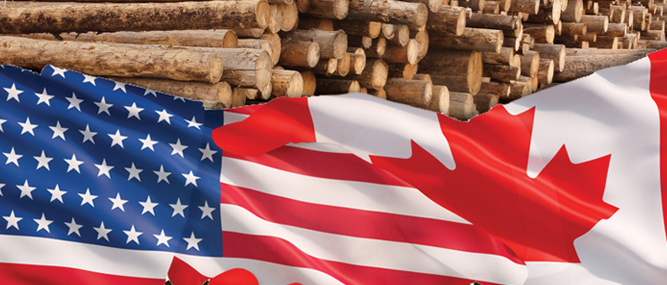
The next Softwood Lumber Agreement won’t be happening this year, as Carl Grenier, lecturer at Canada's National School of Public Administration (ENAP) and Université Laval told participants at the Montreal Wood Convention, according to Wood Business.
As Grenier added, the new agreement will limit the trade options even more. Moreover, he thinks that the SLA signed in 2006 was a bad choice from Canada’s side.
"The direct costs of this agreement totalled $4.7 billion for the industry. Of that amount, one billion was paid to U.S. industry by the Canadian government,” he added.
As it happened back in 2014, the lumber prices were very low and free trade between Canada and the US was prevailed 23% of the time. As different forecasts consider this free trade, it should prevail at least half the time when lumber prices are quite high, Wood Business reported.
One glimmer of hope, however, is for Quebec, which finds itself in a better position than New Brunswick 30 years ago to ask to be excluded from this agreement.
"The new forest regime gives 25 per cent of wood available for auction and the price of 75 per cent of the remaining wood is determined by the price of wood sold at the auction," Grenier said.
Grenier blamed the political will, which would get Canada much better deals. For example, in the last 10 years, there has been very little interest in to preparing the ground for a new agreement. He also added that he thinks that the next agreement would be more restrictive especially because of the lack of political will.
[gravityform id="2" title="true" description="true"]
US: Demand for decorative laminates forecast to go up by 2.5%
Demand for decorative laminates in the US is forecast to increase 2.5 percent per year to 11.6 billion square feet in 2020, valued at $6.8 billion. Growth in the production of building components (e.g., cabinets and wall panels), as well as in related products (e.g., furniture), and the continued use of engineered wood in the manufacture of many of these items will pose opportunities for decorative laminates. Advances in building construction activity and greater credit availability are driving demand for building components and related products, while low domestic energy costs and increasing wages in traditionally low wage countries are allowing US-manufactured goods to be more cost-competitive with imports, says a new Freedonia study.
Low-pressure laminates to generate most rapid gains
Cabinets and furniture were the two largest markets for laminates in 2015, together accounting for nearly half of demand. Of these, the cabinet market is projected to post the more rapid gains. Increases in the number of new homes built through 2020 will provide opportunities, since many of these new homes will include stock cabinets, which are often made using saturated paper and other low-pressure laminates on an engineered wood substrate. The much smaller flooring market will also achieve above average annual gains. Domestic manufacturing of laminate flooring is experiencing a boost after certain imported products received negative press in early 2015 regarding alleged product safety.
Further gains will be limited by the growing popularity of luxury vinyl tile, which is providing strong competition for laminate. Demand for low-pressure laminates, which account for more than 80 percent of the market, is forecast to generate the fastest average annual gains through 2020, benefiting from strong growth in the manufacture of certain end use products such as cabinets. Advances will be driven by the significant use of low pressure laminates in the large cabinet and store fixture markets, where the cost advantages of these products outweigh the durability benefits of higher priced high-pressure laminates. In addition, low-pressure laminates are gaining use due to favorable performance characteristics. Vinyl films, in particular, can be more easily applied to substrates with raised panels (as in cabinet doors) and curved edges (as in store fixtures and furniture). In another example, saturated paper can provide a high gloss appearance, which is on trend in cabinets and other market categories. Performance improvements in all types of low pressure laminates are continuing to fuel their adoption as a low cost decorative surfacing material. Sales of high pressure laminates will continue to depend on their advanced performance characteristics such as long-term durability and greater resistance to scratches. Yet they will face increased competition from low-pressure laminates in key markets, limiting further gains.
Durability, low cost to be key factors to growth
Gains in decorative laminates demand will be attributable to their competitive edge over surfacing materials such as wood veneers and coatings. Laminates are valued for their ability to provide good durability in surface protection at a relatively low cost. However, laminates will face increased competitive pressures from relatively new products in certain applications. In cabinets, for example, laminates are facing increased competition from acrylic veneers in high value, high gloss applications. In addition, intra-competition will continue to increase, as saturated papers and vinyl films gain use to some extent at the expense of low-basis weight papers and high-pressure laminates.
[gravityform id="2" title="true" description="true"]
Germany: Producer prices for wood products stable in March

Producer prices for wood products in Germany show only small movements in March. According to data provided by the German Federal Statistical Office (Destatis), no change was recorded for seven of the seventeen index values when compared to the previous month. And even where prices show some change, they are usually below 1%. The most significant change was for narrow boards. The index value increased by 1.7% as compared to February.
A little more dynamic and mixed are the developments over the same month of last year, which show a slight downward trend. The softwood lumber assortments registered a minor price fall. The strongest decrease was registered for square stock timber, particleboard and KVH. The highest increase was recorded for roof battens (+1,36%).
By far, the sharpest downtrend from the previous year can be noticed for pellets and briquettes. The index is lower by more than 8% as compared to March 2015. On contrast, a slight upward movement was recorded for hardwood assortments, especially for roof battens
| German producer Price Index Commercial Products (2000=100) |
March 2015 | February 2016 |
March 2016 | Change March 2015/2016 |
| Nadelh.,Dicke>6mm,gehob.,geschliff.,keilverz. (m3) | 111.1 | 110 | 110 | -0,99% |
| Spruce and Fir lumber (Picea abies Karst.) | 112.8 | 112.9 | 112.7 | -0,08% |
| Lumber according to DIN 4074/S10 | 116.3 | 116.3 | 116.9 | 0,52% |
| Boards, width over 16 cm | 120.9 | 120.6 | 120.6 | 0,25% |
| Boards, width from 8 to 16 cm, size from 15 to 24 mm | 109.8 | 106.4 | 108.2 | -1,45% |
| Roof battens according to DIN 4074/S10 | 115.3 | 118 | 116.9 | 1,36% |
| Square stock timber, A/B, 10X10 - 12X12 | 116 | 111.1 | 111.6 | -3,79% |
| Finger-jointed squares and beams (KVH) | 99.6 | 97.9 | 97.5 | -2,10% |
| Hardwood lumber | 110.5 | 111.9 | 111.9 | 1,26% |
| Beech blocks, A/B, size 50-60 mm, length 3m, damped | 106.5 | 106.9 | 106.9 | 0,38% |
| Beech frames, size 26-32 mm, length 3m, undamped | 110.9 | 112.4 | 112.4 | 1,35% |
| Wood chips from softwood | 101.3 | 99.8 | 99.5 | -1,77% |
| Particle boards, raw or sanded | 116.3 | 110.1 | 109.1 | -4,47% |
| Particle boards, laminated with decor | 115.2 | 115.2 | 115.2 | 0,00% |
| HDF panels, size > 800 kg/m³, raw/sanded | 114.6 | 113.7 | 113.7 | -0,78% |
| Laminate floorings, density > 800 kg/m³ | 109.4 | 110.1 | 110.3 | 0,82% |
| Pellets and Briquets, compressed | 118.9 | 109.7 | 109 | -8,32% |
UPM Plywood reports lower profits and sales in Q1/2016
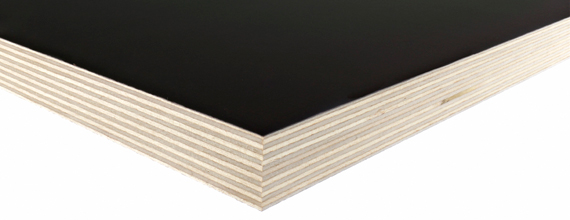
UPM Plywood division reported 20% drop in EBITDA for the first quarter of 2016. EBITDA for Q1/2016 was €20million, against €25 million in Q1/2015. UPM's Plywood delivery volumes were lower than the high level last year and sales prices decreased slightly.
UPM Plywood's adjusted operating profit also dropped by €5 million from the same quarter last year, down to €14 million. Sales reached €110 million in Q1/2016 (Q1/2015: €119 million). Plywood deliveries were 189,000 cubic metres (Q1 2015: 199,000 m3).
In the quarter, UPM's Otepää mill expansion proceeded according to schedule with the first installations already taken into use. Also, Finnish birch mill competitiveness improvement programme proceeded according to plan, while production adjustments were carried out in Pellos spruce plywood mills to mitigate negative impact of low-priced imports.
For the weaker results in this quarter, UPM says that the plywood market balance was impacted by low-priced imports, particularly in the beginning of the quarter in some product segments. Also, UPM notices that the market environment improved gradually during the quarter in Europe and demand is estimated to have increased slightly from last year. Plywood demand grew in both industrial applications and construction related end-use segments.
For the overall results of the Group here
Finland: Forest industry is the country's largest exporter

The forest industry is once again Finland's largest export sector. According to official statistics released in March, wood and paper industry accounted for 21,7 per cent of Finland's total exports. Exports were boosted, in particular, by demand for pulp and paperboard. The last time this happened was in 2010.
The second-largest sector of Finland's exports was machine and automotive industry, whose share was 21 per cent. The third largest export sector in 2015 was chemical industry, which accounted for 18,8 per cent of the country's exports.
Investments in the Finnish forest industry have also picked up. However, Finland still needs to improve its competitiveness.
"Finnish manufacturers are suffering from high labour costs and the labour markets remain rigid. Additionally, we need to secure industrial peace through an urgent reform. Illegal strikes and sympathy strikes are not a problem in other exporting countries," says Timo Jaatinen, Director General of the Finnish Forest Industries Federation.
Over the next ten years, a quarter of the employees in the forest industry will be retiring. Managing an ageing workforce is therefore a significant challenge for the Finnish companies.
"The Government must ensure that enough new professionals are educated. At same time, demand for wood is growing. Our goal of strengthening supply calls for ambitious decisions," says Jaatinen.
The total value of forest industry exports grew last year by 2.9 per cent to 11,6 billion euros. This amount includes products of the carpentry industry.
Ninety per cent of the exports are shipped by sea.
"Finland should not accept any unequally targeted maritime, environment or other regulations that would harm the competitiveness of the Finnish industry," Jaatinen concludes.
Finland: Forest industry is the country’s largest exporter
The forest industry is once again Finland's largest export sector. According to official statistics released in March, wood and paper industry accounted for 21,7 per cent of Finland's total exports. Exports were boosted, in particular, by demand for pulp and paperboard. The last time this happened was in 2010.
The second-largest sector of Finland's exports was machine and automotive industry, whose share was 21 per cent. The third largest export sector in 2015 was chemical industry, which accounted for 18,8 per cent of the country's exports.
Investments in the Finnish forest industry have also picked up. However, Finland still needs to improve its competitiveness.
"Finnish manufacturers are suffering from high labour costs and the labour markets remain rigid. Additionally, we need to secure industrial peace through an urgent reform. Illegal strikes and sympathy strikes are not a problem in other exporting countries," says Timo Jaatinen, Director General of the Finnish Forest Industries Federation.
Over the next ten years, a quarter of the employees in the forest industry will be retiring. Managing an ageing workforce is therefore a significant challenge for the Finnish companies.
"The Government must ensure that enough new professionals are educated. At same time, demand for wood is growing. Our goal of strengthening supply calls for ambitious decisions," says Jaatinen.
The total value of forest industry exports grew last year by 2.9 per cent to 11,6 billion euros. This amount includes products of the carpentry industry.
Ninety per cent of the exports are shipped by sea.
"Finland should not accept any unequally targeted maritime, environment or other regulations that would harm the competitiveness of the Finnish industry," Jaatinen concludes.
The tallest skyscraper in Stockholm to be build out of CLT

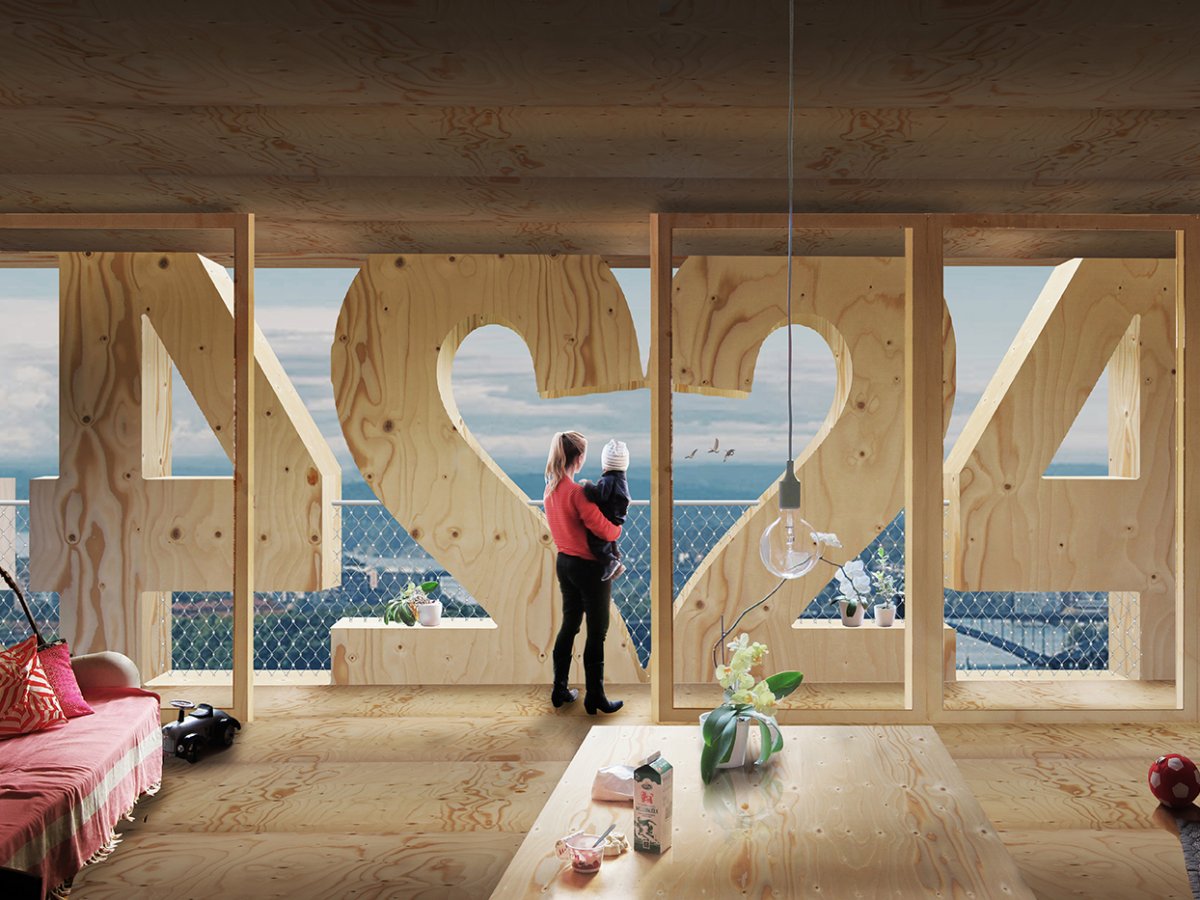
Stockholm, Sweden, will be home to its tallest skyscraper made entirely out of wood. More specifically, the building will be built out of cross-laminated timber (CLT). The "Trätoppen“ 40-floor building is designed by Anders Berensson Architects and will be built inside of a park car, according to Tech Insider.
"If we want to reduce the amount of cars in the city center of Stockholm and at the same time make space for more housing without building on green areas, then replacing car parks with housing, shops and restaurants feels obvious," said Anders Berensson.
The car park is a very famous place because it has the number of each floor displayed on its façade. The "Trätoppen“ will reach 436 meters high and will have its own apartments, shopping, restaurants, and private terraces. Each apartment is designed to be around 850 square feet.
The price for the construction hasn’t been established yet, but the building will be constructed with full energy efficiency. Also, the facade of the building will reduce greenhouse gas emissions from the city below because of the wood's ability to store carbon in its walls, as reported by Tech Insider.


[gravityform id="2" title="true" description="true"]
Over 372,000 visitors at Salone del Mobile Milano 2016

With an unprecedented 372,151 total attendees, up 4% since the 2014 edition – when the biennial Kitchen and Bathroom exhibitions last took place – the 55th edition of the Salone del Mobile Milano has drawn to a close. 41,372 people visited on the Saturday and Sunday, when the fair was open to the public.
“With 67% of attendees from abroad, most of them high profile and with robust spending power, according to comments from exhibitors, this edition has yet again confirmed the strong international vocation and importance of exports as a crucial segment of the sector today”, said Roberto Snaidero, President of the Salone del Mobile.Milano.
The relevance of the Salone – which has evolved over time from simple trade fair into “must-see” event – and of the importance of the sector was confirmed by the presence of a large number of institutional figures from all sides of the political spectrum, and especially by Prime Minister Matteo Renzi’s visit to the fair, presiding over the 7th SaloneSatellite Design Award ceremony on Wednesday 13th April.
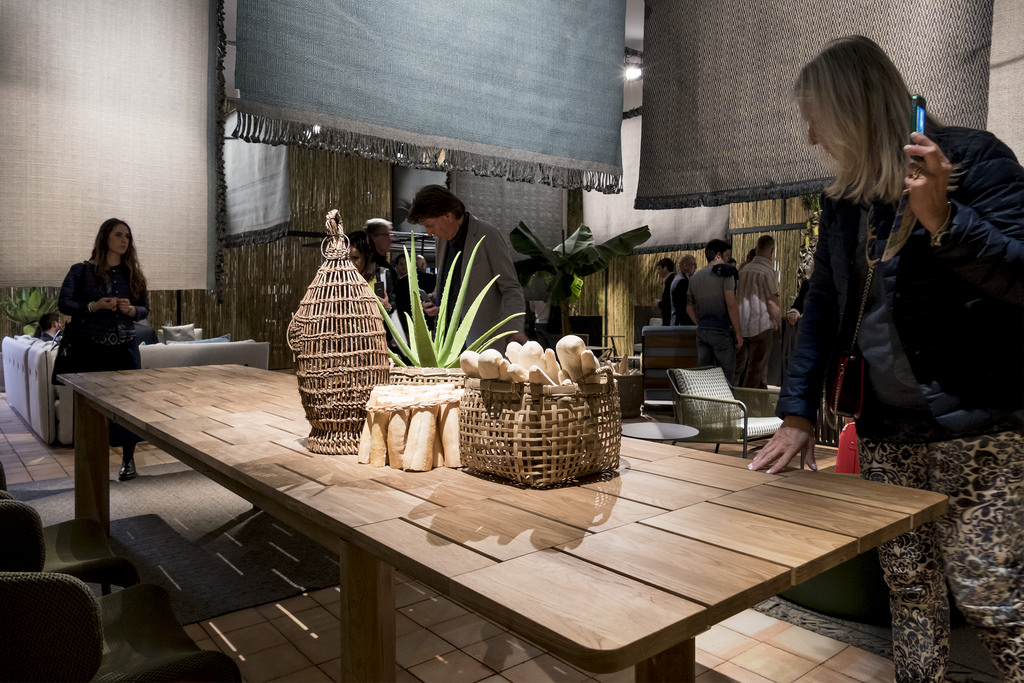
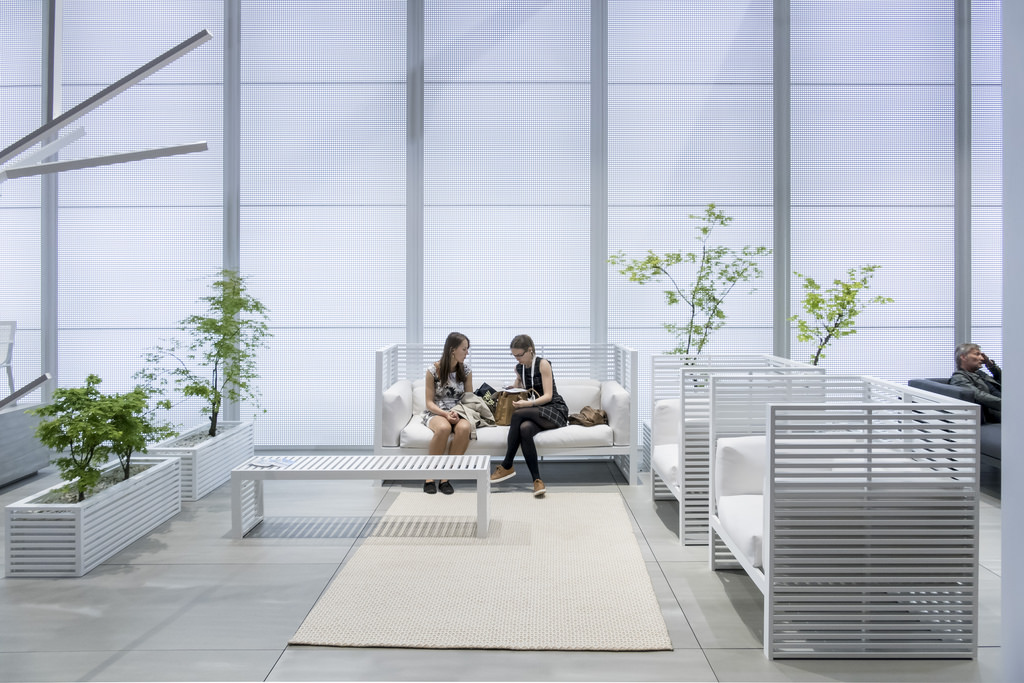

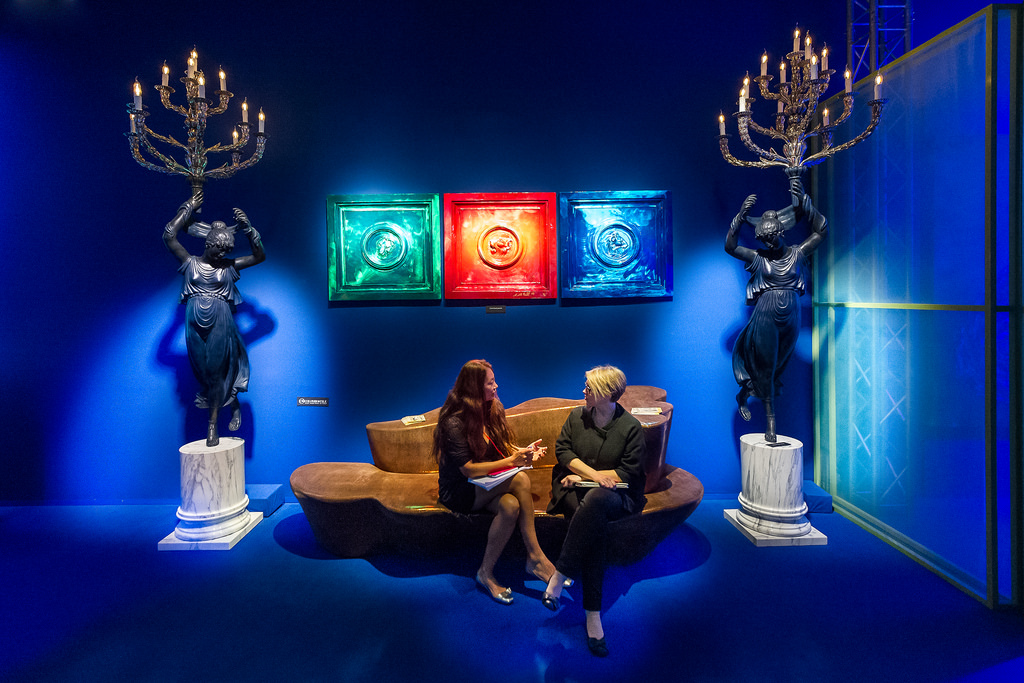
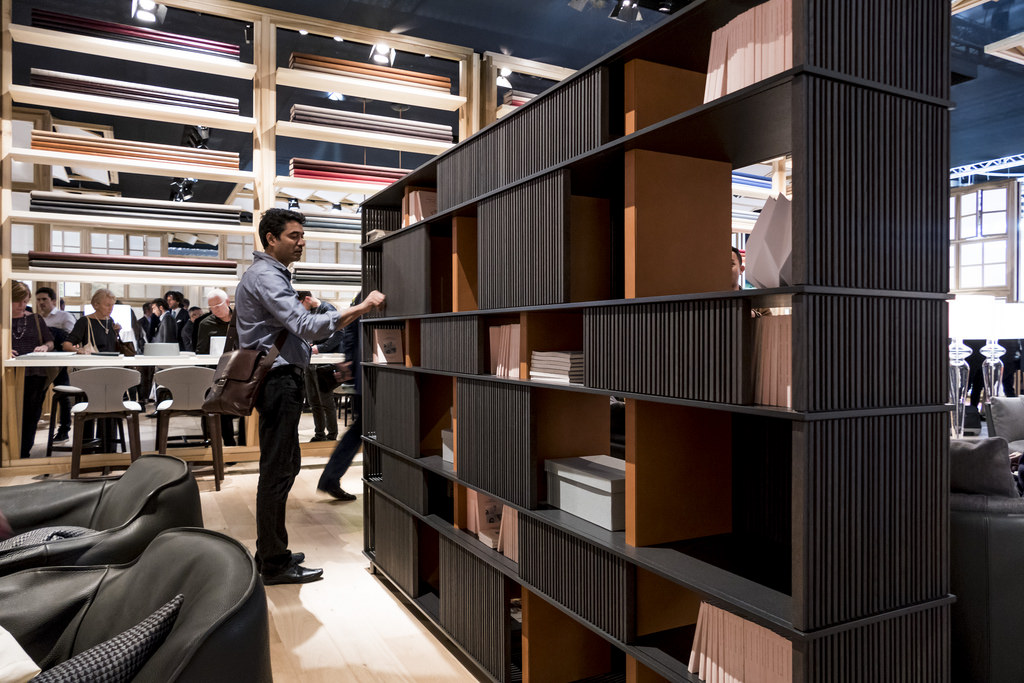
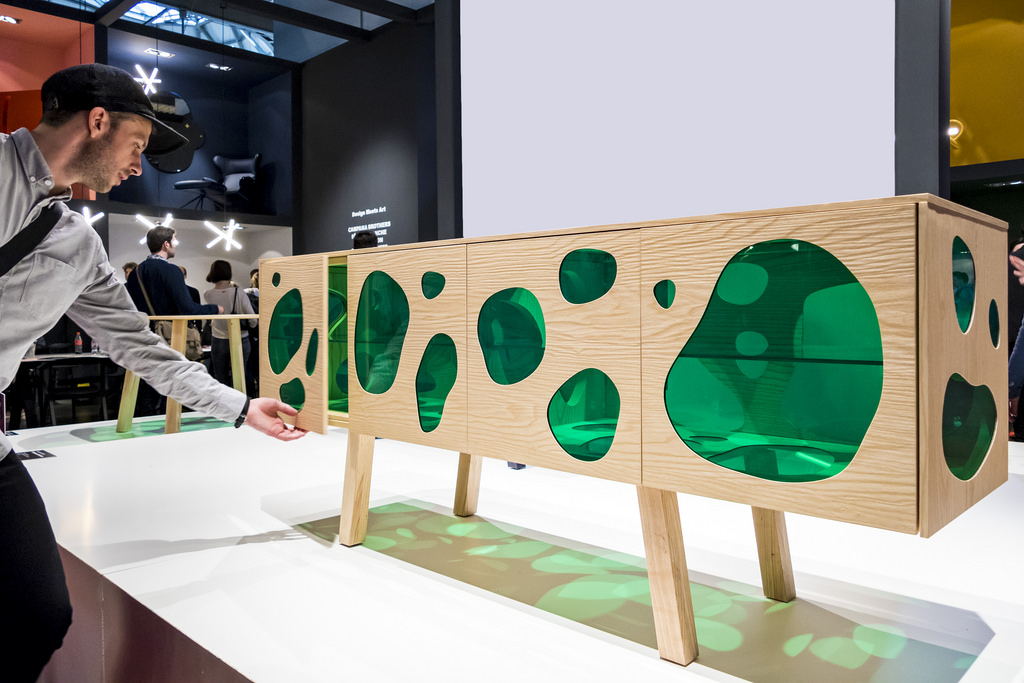
Visitors also flocked to the 19th edition of SaloneSatellite, devoted to the theme “New Materials>New Design”, showcasing the work of 650 young designers under 35.
The events in the fairgrounds and in the city were also very well received. Among them ”Before Design: Classic” that put a contemporary spin on classic furnishing, with artistic direction by Ciarmoli Queda Studio and a video by filmmaker Matteo Garrone. As also the “space&interiors” event, devoted to architectural finishings by Migliore+Servetto Architects at the The Mall, Porta Nuova.
Lastly, ROOMS. Novel Living Concepts – the state of the art of interior architecture – curated by Beppe Finessi, runs until 12th September at the Triennale di Milano, as part of the XXI Triennale International Exhibition.
Bergs Timber to acquire Norvik's Jarl Timber

Bergs Timber AB signed a letter of intent to acquire all of Jarl Timber’s shares, a subsidiary of Norvik Industries. The transaction will be made on a debt free basis and the payment will be made in newly issued shares of Bergs Timber (SEK 2.30/share). The issue price is a premium to Monday's closing price of 16.2% and Norvik expects to have a 29% stake in Bergs Timber AB after the completion of the transaction.
Yet, the final purchase price is determined based on the working capital of the company, which will be settled by 30th of April 2016. The acquisition is subject to completion of contract negotiations, implementation of the "due diligence", necessary regulatory approvals, the approval of the Extraordinary General Meeting of Bergs Timber and other customary closing conditions.
Jarl Timber conducts sawmill operations in Broakulla, Sweden. The geographical proximity of the Bergs Timber's plants in Gransjö, Orrefors and Nybro contribute positively to the industrial logic of the transaction. Moreover, Bergs Timber states that the acquisition brings the potential for synergies in production and marketing cooperation with Norvik.
As reported earlier by GWMI, Jarl timber was supposed to increase capacity and efficiency by 20-25%.
It seems that the agreement is expected to be signed in June and Bergs Timber's Extraordinary General Meeting will take place shortly after the agreement is signed.
About
Jarl Timber, founded in 1946, is located in the region of Småland, which is at the very heart of Sweden's timber country. The sawmill processes and distributes about 110 000 m3 of sawn and planed timber. Around 85% of the production is sold for exports to Europe, North Africa, Middle East and Far East.
Bergs Timber makes sawn and processed timber products at their three Swedish sawmill plants in Mörlunda, Orrefors and Gransjö, as well as at the timber preservation company Bitus, located in Nybro. The group’s sawmills are equipped with planing mills for processing, and all plants are situated within range of 100 kilometres. Total sawmill capacity is approximately 390,000 m³ of sawn timber, of which more than half is processed. Over the financial year, sawmill production totalled 283,000 (293,000) m³. Bitus produces around 155,000 m³ of preserved timber per year. Of the Company’s timber products, more than 70 percent is exported, mainly to the UK, USA, Scandinavia and the Middle East/North Africa.
By-products from manufacture are mostly sold to the pulp and particleboard industries. Timber raw materials are obtained primarily from the areas surrounding the group’s sawmills. The group offers a full range of silvicultural services, ranging from advising forest owners, to clear felling.
Bergs Timber to acquire Norvik’s Jarl Timber

Bergs Timber AB signed a letter of intent to acquire all of Jarl Timber’s shares, a subsidiary of Norvik Industries. The transaction will be made on a debt free basis and the payment will be made in newly issued shares of Bergs Timber (SEK 2.30/share). The issue price is a premium to Monday's closing price of 16.2% and Norvik expects to have a 29% stake in Bergs Timber AB after the completion of the transaction.
Yet, the final purchase price is determined based on the working capital of the company, which will be settled by 30th of April 2016. The acquisition is subject to completion of contract negotiations, implementation of the "due diligence", necessary regulatory approvals, the approval of the Extraordinary General Meeting of Bergs Timber and other customary closing conditions.
Jarl Timber conducts sawmill operations in Broakulla, Sweden. The geographical proximity of the Bergs Timber's plants in Gransjö, Orrefors and Nybro contribute positively to the industrial logic of the transaction. Moreover, Bergs Timber states that the acquisition brings the potential for synergies in production and marketing cooperation with Norvik.
As reported earlier by GWMI, Jarl timber was supposed to increase capacity and efficiency by 20-25%.
It seems that the agreement is expected to be signed in June and Bergs Timber's Extraordinary General Meeting will take place shortly after the agreement is signed.
About
Jarl Timber, founded in 1946, is located in the region of Småland, which is at the very heart of Sweden's timber country. The sawmill processes and distributes about 110 000 m3 of sawn and planed timber. Around 85% of the production is sold for exports to Europe, North Africa, Middle East and Far East.
Bergs Timber makes sawn and processed timber products at their three Swedish sawmill plants in Mörlunda, Orrefors and Gransjö, as well as at the timber preservation company Bitus, located in Nybro. The group’s sawmills are equipped with planing mills for processing, and all plants are situated within range of 100 kilometres. Total sawmill capacity is approximately 390,000 m³ of sawn timber, of which more than half is processed. Over the financial year, sawmill production totalled 283,000 (293,000) m³. Bitus produces around 155,000 m³ of preserved timber per year. Of the Company’s timber products, more than 70 percent is exported, mainly to the UK, USA, Scandinavia and the Middle East/North Africa.
By-products from manufacture are mostly sold to the pulp and particleboard industries. Timber raw materials are obtained primarily from the areas surrounding the group’s sawmills. The group offers a full range of silvicultural services, ranging from advising forest owners, to clear felling.
Still many challenges for the European hardwood industry

While imports have been rising and some key sectors of the European economy, such as construction, furniture and flooring, are now growing slowly, these remain challenging times for the European hardwood industry.
Use of all hardwood in traditional applications in Europe, but particularly for mass-produced goods like doors and flooring, continues to come under pressure. Many consumers are still cash-strapped and, while they want the look of hardwood, they often won’t pay the price for what is perceived to be a luxury product.
Share continues to be lost to alternative materials perceived to be cheaper and easier to maintain. Alternatives include panel products like MDF, softwood – sometimes chemically or thermally modified or engineered - as well as laminates and plastics.
Challenges are particularly pronounced for tropical hardwood. There is a persistent “image problem”, while the EU Timber Regulation together with uncertainty over the legality of product seems to be limiting EU procurement of tropical timber to a narrower range of companies, both on the importing and exporting side.
Importers also continue to mention lack of supply continuity, transport problems and long lead times as factors impeding increased use of tropical timber in the EU.
Tropical wood life cycle analysis performance beats other materials
Sustainably sourced tropical timber species out-performed competitor materials in a demanding life cycle analysis project backed by the European STTC.
Eric de Munck of Netherlands–based timber research body Centrum Hout led the trials, which pitted tropical timbers against key market rivals in the manufacture of marine application pile planking and window frames.
The pile planking life cycle analysis (LCA) project was proposed to the STTC by the Netherlands Timber Trade Association (NTTA) and other industry players due to the fact that tropical timber faces increasingly strong competition in this market from steel, PVC, plus other varieties of wood.
The research team also said that existing environmental data for the species used in this application was out-dated and unreliable. The study, undertaken in association with the FSC Netherlands, has already generated impressive figures in favour of tropical timber in terms of cradle to grave environmental cost per square metre.
The species used were sustainably sourced African azobé and okan and South American angelim vermelho. They were evaluated against two types of PVC planking – one comprising all virgin raw material, the other recycled – and steel. The researchers chose a popular form of pile planking and applied equivalent LCA methods to all materials types.
Preliminary results showed that, over a 30-year lifespan, the environmental performance of tropical timber planking is 24 times better than virgin-material PVC and 21 times better than recycled. Compared to steel it’s 133 times better.
The final LCA data from the research will be added to the Dutch Environmental Database and international data resources Ecoinvent and ILCD (the International Reference Life Cycle database). The results will also be publicised via the trade media, presentations to industry events and direct to tropical timber end users and specifiers.
The window frame LCA, which is being undertaken in association with the Netherlands Woodworking Industry Association, is using sustainably sourced African, Asian and South American reference wood species.
The competitor materials in this case are softwood, modified softwood and PVC and initial results are expected by the end of next March. Both studies will be completed and implemented by the end of next June, with the outcomes widely publicized.
[gravityform id="2" title="true" description="true"]

