
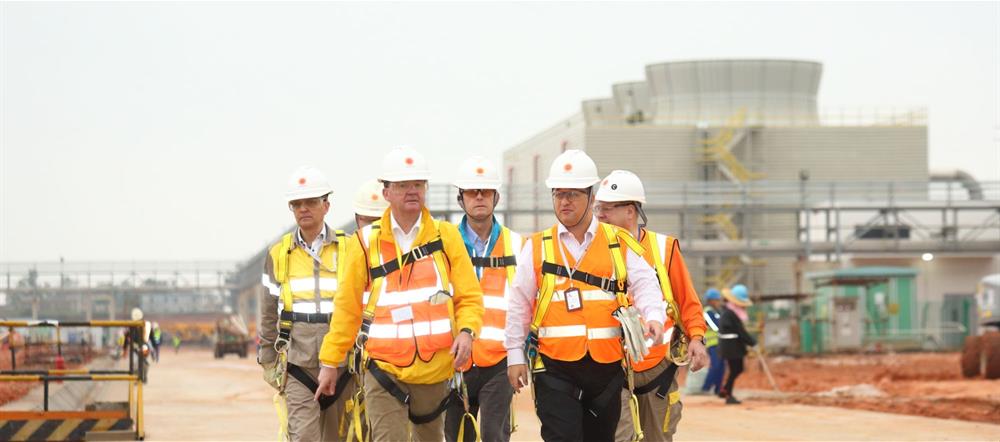
Stora Enso inaugurates its new consumer board mill in Beihai, China. The mill started up in May and it is expected to reach full production within 18 to 24 months. With an investment of EUR 800 million, this is the largest Nordic direct investment in China, and a significant investment in the history of Stora Enso.
The Beihai consumer board mill has an annual capacity of 450,000 tonnes of high-grade carton board products. One of the key end products is Liquid Packaging Board, of which more than 80 per cent today is imported to China. Stora Enso is the world-leading producer of this product.
“We are delighted to announce the official opening of the Stora Enso consumer board mill in China. This is a very important milestone for us”, says Stora Enso’s CEO Karl-Henrik Sundström. “China is a market with high potential and the start-up of our consumer board mill is crucial to meet the growing demand for high-quality and safe fiber-based food packaging in China and the Asia Pacific region.”
The consumer board mill is located in the Tieshangang industrial zone of the Guangxi region, 40 miles outside of Beihai city. Stora Enso’s operations in the Guangxi region also consist of tree plantations with around 85,000 hectares of land leased since 2012. The plantations have been certified to the Forest Stewardship Council (FSC®) and the China Forest Certification Council (CFCC).
Article archive
Production of EPAL euro pallets continues upward trend
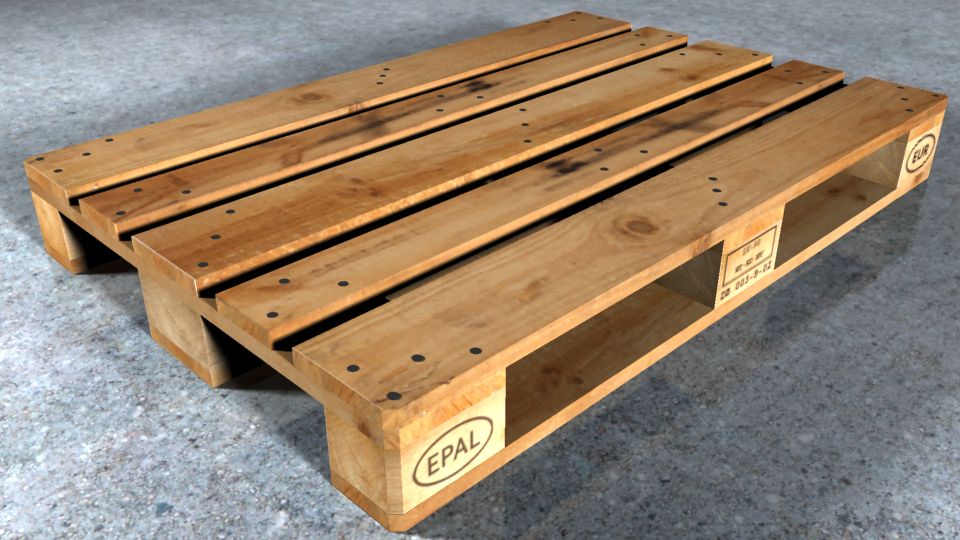
After the excellent annual result in 2015 with an increase of 10.9% and in total over 100m EPAL pallets, 73.6m of which were newly produced EPAL Euro pallets, the upward trend is continuing in the first quarter of 2016.
In Q1/2016, 18.3m EPAL Euro pallets were produced worldwide: an increase of 5.1% compared to the previous-year period. Repairs figures increased slightly on the previous year with 6.1m EPAL pallets repaired.
Martin Leibrandt, CEO of the European Pallet Association e.V. (EPAL): “This excellent result for the first quarter of 2016 shows the high efficiency of the EPAL Euro pallet in logistics and the high acceptance rate of the EPAL system, the largest open exchange pool worldwide. In addition to this, is the outstanding work of the National Committees, our success in fighting against EPAL-pallet counterfeiting and support for users through effective tools such as the PalletCheck Express App, the quality classification and the EPAL Academy. All of this together makes the EPAL Euro pallet so successful and sustainable.”
DONG Energy Avedøre Power Station getting ready to use wood pellets as fuel

Unit 1 at Avedøre Power Station is one step closer to using wood pellets instead of coal. The largest single component in the conversion has just been installed. It is a 34-tonne heavy cooler which is to be installed in the boiler house at a height of 20 meters.
Morten Reinhold, Senior Project Manager in DONG Energy and project manager of the conversion, said: Continue reading "DONG Energy Avedøre Power Station getting ready to use wood pellets as fuel"
Angola: 57 million m3 exploitable timber potential

Angola has an exploitable timber potential estimated at 57 million m3, out of which 340,000 m3 are in natural forests and 850,000 m3 in planted forests.
The available timber volume for annual exploitation is approximated at 1.9 million m3 to 1.2 million m3, as the minister of Agriculture, Afonso Pedro Canga, stated.
According to All Africa, Anola produced 125,000 m3 of timber in 2015 and might grow even more considering the investments that are underway in the public and private sectors. In the public sector, the Ministry of Agriculture is already developing a program to empower the field of forestry services as to maintain supervision and control the illegal exploitation.
"Forest exploitation implies a set of conditions, equipment, roads, technical personnel and also entrepreneurs who have such technical and financial capacity and strict monitoring of the activity," said Pedro Canga.
In the 1980’s there was a planted areas potential of 150,000 acres of forest nurseries, which are now smaller. At the moment, as to recover the potential of those areas, there are program for plantation and reforestation for environmental, energetic and timber production purposes, as All Africa reported.
"We have all potential to grow. We have a planted forest potential, the nurseries, mainly in the central highlands, that is receiving a new organization and treatment, both concerning their protection and sustainable exploitation, and expansion of the planted area," he stressed.
Moreover, the Forest Development Institute (IDF) has some insufficiencies regarding the controlling services capacity because of lack of personnel, as minister Canga explained. Yet, the Ministry of Environment manages to control the forest conservation areas very well.
Canada: Largest forest products companies show improved yoy revenues in Q1/2016

The largest Western Canadian and Eastern Canadian based forest products companies reported overall higher net earnings in the first quarter of 2016 compared to both the first and fourth quarters of 2015. Commodity prices remained mixed for the first quarter, with lumber prices, specifically Western SPF 2x4 improving while panel and pulp prices declined.
The average price of Western SPF 2x4s in Q1 was USD $271 per thousand board feet, higher than the Q4 2015 average price of USD $263, but lower than the Q1 2015 average price of USD $307, Continue reading "Canada: Largest forest products companies show improved yoy revenues in Q1/2016"
Lithuania: Roundwood prices in 2016 much lower than last year

During March 2016, roundwood prices in Lithuania kept on decreasing compared to 2015. Except for spruce pulpwood, which remained stable, all the other pulpwood and sawlog prices registered a sharp decline.
On a yearly basis, small-sized softwood decreased by -18.9%, registering the highest decrease, followed by pine sawlog, which went down by -12.5%. Also, alder, spruce and birch are cheaper by -5.5%, -4.83% and -2.81% respectively. Continue reading "Lithuania: Roundwood prices in 2016 much lower than last year"
Switzerland: Wood pellets' price increases sharply in June
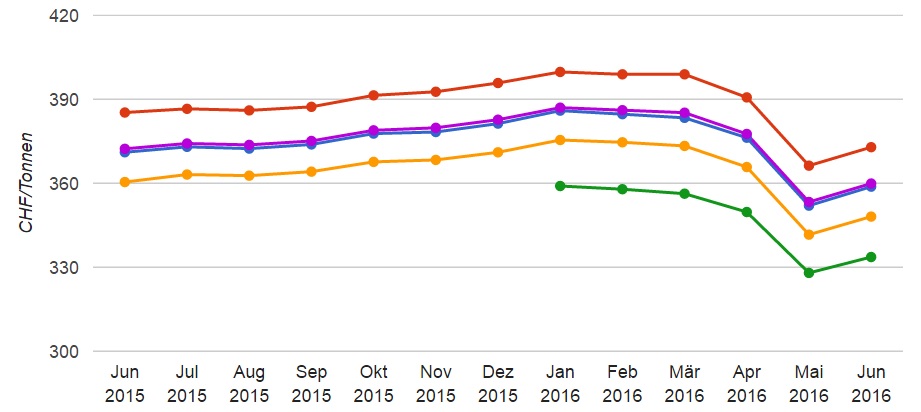
After several months of declining trend, the price of wood pellets in Switzerland has increased sharply in June. The average price for wood pellets quality ENplus A1 is 359.9 CHF per tonne, the equivalent of 332.58 EUR.
Continue reading "Switzerland: Wood pellets' price increases sharply in June"
Switzerland: Wood pellets’ price increases sharply in June
After several months of declining trend, the price of wood pellets in Switzerland has increased sharply in June. The average price for wood pellets quality ENplus A1 is 359.9 CHF per tonne, the equivalent of 332.58 EUR.
Continue reading "Switzerland: Wood pellets’ price increases sharply in June"
Drax claims to fully switch to wood pellets in the next 3 years
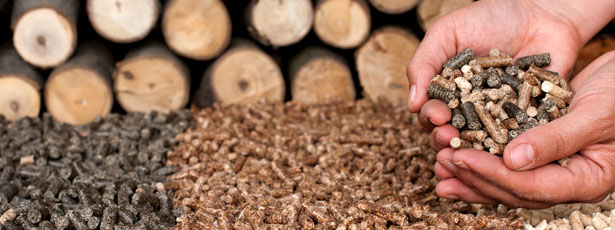
Drax group might eliminate coal power earlier than the 2025 deadline, which the UK ministers have previously set in November 2015. As the chief executive of the company, Dorothy Thompson, stated, Drax will start to use wood pellets instead of coal at its boilers from its North Yorkshire power plant, Continue reading "Drax claims to fully switch to wood pellets in the next 3 years"
Scandinavian sawmills exported more than 1 mil. m3 of softwood lumber to China in 2015

Despite China's overall negative economic context in 2015, and the slowdown in the Chinese housing market, the European sawmills managed to increase softwood lumber exports to the country.
According to the latest Eurostat figures, in the twelve months of 2015, EU's softwood lumber exports to China increased by 29% over 2014. Finland has the lead, with a share of 29,7% of all European exports (and a 73% increase yoy), followed closely by the Netherlands (29,5% share) and Sweden (23,2%).
All in all, Scandinavian sawmills managed to surpass a volume of 1,1 million cubic meters in exports to China. In value, exports of the two Scandinavian countries reached EUR 234 million.
|
74,638,290 | 131,894,560 | 77 % | |
| Sweden | 84,282,270 | 102,533,050 | 22 % |
Overall, in January-December 2015, the value of EU exports to China reached EUR 282 million, higher by 15% as compared to January-December 2015.
| EU- Softwood lumber exports to China in cubic meters | Jan.-December 2014 | Jan.-December 2015 | Change in % |
| EU Total | 1,659,547 | 2,138,855 | 29% |
| Finland | 368,317 | 635,679 | 73% |
| Netherlands | 354,200 | 631,867 | 78% |
| Sweden | 426,857 | 496,661 | 16% |
| Germany | 282,927 | 130,475 | -54% |
| Czech Republic | 54,977 | 106,500 | 3% |
| EU-Others | 168,858 | 137,673 | -18% |
Source: Eurostat (HS 440710)
Rising EU imports of lower value Eastern European hardwood
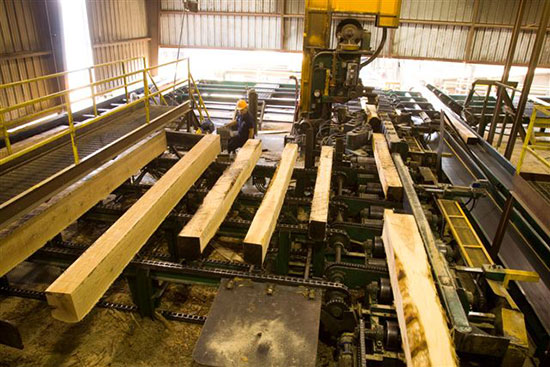
A key trend in the EU sawn hardwood trade in recent years has been increased dependence on imports of lower value product from Eastern Europe, notably Ukraine, Belarus, Russia, Bosnia and Serbia.
In 2015 there were higher deliveries from the Ukraine (+37% to 350,000cu.m), Belarus (+63% to 128,000cu.m), Russia (+117% to 125,000cu.m), Bosnia (+17% to 112,000 cu.m) and Serbia (+3% to 77,000 cu.m).
Growth in import volumes was significantly higher in each case than the rise in euro-based import value, as all three countries’ currencies fell dramatically against the euro in 2015. This is likely to have a decisive factor for the sharp rise in volumes from this region last year. Continue reading "Rising EU imports of lower value Eastern European hardwood"
FLEGT licensing in Ghana and Indonesia close to operational

In May, the European Commission (EC) published a comprehensive independent evaluation of theEU FLEGT Action Plan. The Plan encompasses the wide range of EU policy measures introduced over the last decade to support good forest governance and remove illegal wood from trade, ITTO reported.
The report suggests there is general recognition that VPA negotiation and implementation, strongly supported by EFI, the EC and EU Member States, have helped to sharpen the legality definition, and this has been valuable, even if no functioning TLAS has been produced.
The VPA Survey revealed that three VPA implementing countries acknowledge the positive effect of the legality definition process on the development of the TLAS. And despite the challenges, two countries – Ghana and Indonesia – now have systems very close to operational.
Another observation is that the Action Plan’s contribution to the objective of sustainable forest management is unclear and needs to be made more explicit. According to the report, available data suggest that the TLAS under development are not necessarily enhancing more sustainable forest management (SFM) or SFM certification, and that this is not envisaged by many stakeholders in VPA countries.
There’s also a concern that FLEGT needs to focus more on domestic timber markets and support for the actors operating in them. This is seen as critical to the broader FLEGT objective of contributing to poverty reduction.
Slow EUTR implementation weakens incentives
Considering the EU demand side, the report echoes many of the conclusions of the EU review of the EU Timber Regulation published earlier this year. The report suggests there is a widespread perception that EUTR has been implemented slowly and unevenly and that this is decreasing incentives for VPA countries to commit to finalising FLEGT licensing systems.
The report notes that “while advances have been made [on EUTR implementation], there have been major differences between front-runner [EU] countries and slow followers.
This has resulted in unfair competition between Member States, inconsistent market requirements for the private sector in producer countries and a risk that VPAs would lose their value and the EC some of its credibility”.
The report goes on to suggest that the capacity of most EUTR authorities is considered rather limited, in terms of staff numbers, budgets and training. In important timberimporting countries, such as the Netherlands and Belgium, only three and half a full-time equivalent staff, respectively, has been assigned to EUTR enforcement.
It’s noted that while big EU companies started developing due diligence (DD) systems at an early stage - which had sometimes resulted in a significant reduction in their number of suppliers - and were ready to exercise DD when the EUTR came into force, the vast majority of companies across the EU applied a “wait and see” mentality.
Unless there is effective implementation, control and prosecution on the one hand, and sufficient and clear guidance on the other, especially the SMEs seem unlikely to change their practice.
German Pellets continues to live under new ownership
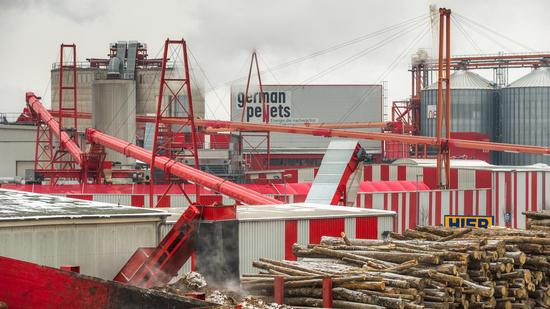
The insolvency administrator of German Pellets Group, attorney Bettina Schmudde, signed earlier this week notarized contracts, which provide for the sale of the assets necessary for the operation of the plant of German Pellets GmbH Sachsen. Thus, German Pellets Group’s last remaining plant has been sold and will continue under the direction of the new owners.
PLT Pellet Lohnfertigung Torgau GmbH will take over the operation of the plant of German Pellets Sachsen GmbH, which will immediately restart the production of pellets.
Bettina Schmudde comments: "We are very relieved that our continuation efforts have been successful with the sale of German Pellets Group’s last remaining plant. The most part of the jobs in German Pellets’ plants has been maintained."
The German Pellets Group was a major participant in the wood pellet and animal hygiene industry and produced with the help ofaround 650 employees in Germany, Austria and the USA wood pellets and animal bedding products based on wood from renewable resources.
The insolvency proceedings for German Pellets GmbH started on the 1st of May in Hamburg, with insolvency administrator Bettina Schmudde ahead of the issue. The bankrupt company was divided to small investors as to guarantee its continuation.
The German Pellets plant in Wismar was bought by Metropolitan Equity Partners, LLC, New York (MEP) and operates now as a newly founded company under the name Wismar Pellets GmbH.
The mills in Ettenheim (128,000 t/yr of wood pellets) and Herbrechtingen ( 256,000 t/r) in southeastern Germany were acquired by J. Rettenmaier & Söhne GmbH + Co KG (JRS).
While $550 million were invested in the German Pellets companies in the US, the mills in Texas and Louisiana are still under Chapter 11 insolvency proceedings and there are lawyers and investors who work to find a solution as to restructure and continue the operations.
There is also the coal-fired powerplant Langerlo in Belgium, whose sale is still under negotiations. The Belgian government is also helping the company find a new investor and continue its operations.
Price of Finnish spruce logs on the rise

In April, the Finnish roundwood prices have slightly grew compared to the previous month and the same month of 2015. Compared to March 2016, the pine sawlogs price went down by 0.85%, while the spruce sawlogs and birch sawlogs increased minorly by 0.1% and 0.7%, respectively. The pulpwood assortments prices follow the same ascending trend. The pine pulpwood price is 1.1% higher than in March 2016, while the spruce and birch pulpwood prices increased by 0.8% and 0.7%, respectively.
Year-on-year, the pine sawlogs registered a small decrease of 1.22%, Continue reading "Price of Finnish spruce logs on the rise"
Weyerhaeuser to sell liquid packaging board business to Nippon Paper
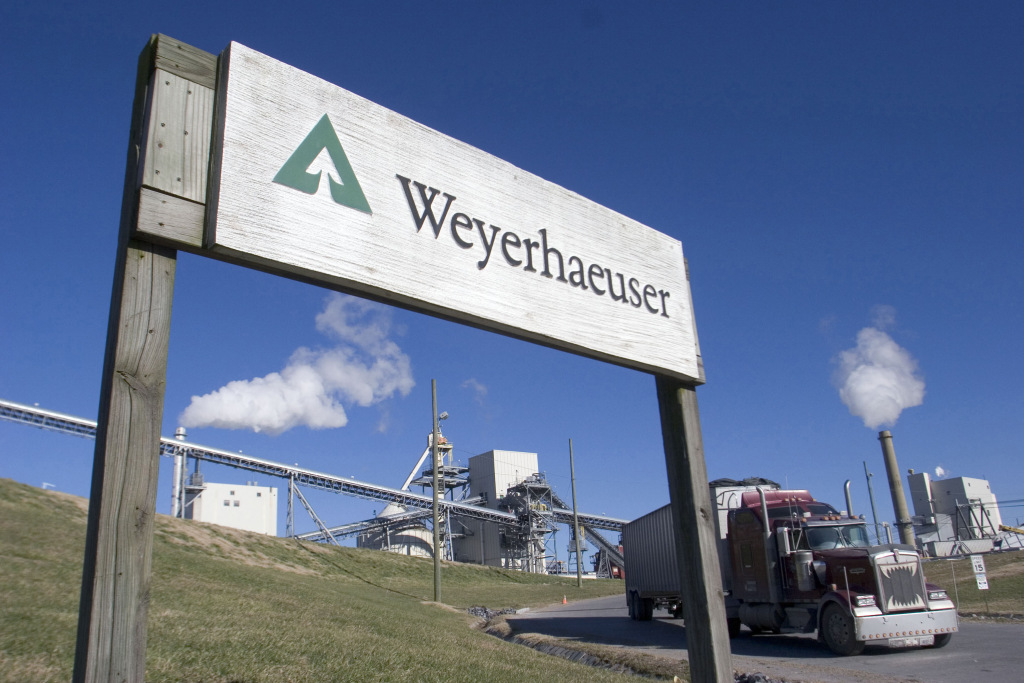
Weyerhaeuser Company announced an agreement to sell its liquid packaging board business to Nippon Paper Industries Co., Ltd. for $285 million in cash.
The transaction includes one mill located in Longview, Wash., with an annual capacity of 280,000 tons.
This announcement concludes a portion of the strategic review of the Weyerhaeuser's Cellulose Fibers business, which was initiated in November 2015. Weyerhaeuser announced the planned sale of its pulp mills in May 2016. The company's review of its printing papers joint venture is ongoing.
"This transaction creates significant value for Weyerhaeuser shareholders and enhances the focus of our portfolio as we work to be the world's premier timber, land, and forest products company," said Doyle R. Simons, president and chief executive officer.
The transaction is subject to customary closing conditions, including regulatory review, and is expected to close in the third quarter 2016. The Weyerhaeuser liquid packaging board mill and Nippon Paper Industries will continue to operate separately until the transaction closes.
Metsä to sell Thermowood business

Metsä Wood, the wood products segment of Metsä Group, has divested its thermowood business to Lunawood Ltd. The thermowood production facility is located in Kaskinen, Finland.
Personnel of the thermowood business will in its entirety transfer to the new owner’s payroll.
Metsä Wood and Lunawood have made a contract for cooperation in thermowood raw material deliveries for several years. “We enter into partnerships with growing customers according to Metsä Wood’s strategy,” says Henrik Söderström, Sales Director, Metsä Wood.
Metsä's thermowood is produced by heat treating Finnish grown pine and spruce to temperatures in excess of 200 degrees centigrade. During the heat treatment, chemical and structural changes occur within the timber, which alter and improve some of its basic characteristics. The resulting product is an altogether more durable and stable timber, a cladding material for use in exposed areas such as external walls.
“We are able to provide our customers with an even more comprehensive range of high quality thermowood products. We will also improve the level of customer service thanks to the growth in our capacity. In accordance with our company strategy we will continue to develop and grow the business by investing in Kaskinen, where we plan to double the production capacity in the next five years,” says Lunawood Chief Executive Officer Arto Halonen.
As a result of this business purchase, the annual capacity of thermowood production for Lunawood will increase from 81 000 m³ to 105 000 m³. The combined annual turnover of Oy Lunawood Ltd and the Metsä Wood ThermoWood business will be around 40 million euros in 2016, and the company will employ a total of 83 people.
Strong housing in the US improves revenues of the Canadian wood industry

Pre-tax profits in Canada's wood manufacturing industry are expected to grow from $1.1 billion in 2015 to just under $1.5 billion this year thanks to strong demand from the U.S.
"With the weakness in the Canadian housing market weighing on the industry, the resurgence in the U.S. housing market is expected to remain the key driver for improving demand for Canadian wood products over the next couple of years," said Michael Burt, Director, Industrial Economic Trends, The Conference of Canada.
Continue reading "Strong housing in the US improves revenues of the Canadian wood industry"
Chinese high-rise timber construction inspired by Europe

In 2015 China decided to promote timber as a viable alternative to conventional steel and concrete construction of high-rise buildings. This decision will not only have a positive impact on the climate, with timber being the only renewable building material, but also on European exports of timber products. Since the 1st of June a Chinese delegation has been visiting Europe in order to learn from European modern timber construction experts. By the end of the year China will have established norms and standards enabling the construction of high-rise timber buildings of up to 18 stories.
The Chinese delegation consisted of representatives from the Ministry of Housing and Urban - Rural Development, MOHURD, as well as leading Chinese scientists and experts. The visit was part of a Chinese initiative aimed at increasing timber construction through the introduction of modern construction techniques. Hosting the visit was European Wood, a joint European venture aimed at promoting modern construction in wood, with Swedish Wood as a prime mover.
“For a long time now the European wood industry has been working closely with Chinese building authorities in order to pass on knowledge of norms and standards for modern timber construction,” says Jan Söderlind, chairman of European Wood.
It was at the end of 2015 that China decided to promote timber. The aim is to have approved norms and standards by the end of the year that will make it feasible to construct high-rise timber buildings of up to 18 stories in height.
The Chinese delegation followed an intensive program during its week-long visit. Starting off with a meeting at the Ministry of Enterprise and Innovation in Stockholm, Sweden, this was followed by technical seminars and field visits which explored aspects of both production as well as examples of relevant buildings.
“During these days, we have had both interesting and challenging discussions as regards the European approach to medium and high rise timber buildings. I am very keen on following the development in China, and it will be of special interest to see to what extent new developments will come,” says Professor Erik Serrano of Lund University, technical expert to European Wood.
After three days in Sweden the delegation continued its journey to the European mainland with Munich, Germany, being the first destination. There the difficulties relating to the fire protection of high-rise timber structures were discussed. Although there is a joint building code in position the complexity of the issue is highlighted by the great diversity of national applications. The process of creating European standards was discussed in Vienna while the last day of the delegation’s visit was spent at the Technical University of Graz.
“We are very impressed by this Chinese initiative of a new national construction standard for high-rise timber buildings. The development, in coordination with European and worldwide standards, will primarily support the wider use of the only sustainable building material resource we have available - wood,” says Professor Stefan Winter of the Technical University of Munich.
Rörvik sells Tranemo plant to Vida Group

After selling Tvärskog plant last week, Rörvik announced the selling of another of their sawmills in Tranemo, Sweden, to Vida Group. The change of ownership will take place on September 1, 2016.
Rörvik had previously closed the Tvärskog mill, together with another one in Sandsjöfors, back in January 2016.
“The acquisition of the small log sawline in Continue reading "Rörvik sells Tranemo plant to Vida Group"
BC lumber exports grew once with SLA expiry

The total softwood lumber production in British Columbia reached adjusted 2.65 million dry m3. The production increased by 5.9% compared to last year and grew by 2.2% year over year. It was the highest first-quarter production since 2007.
The international exports increased by 21.5% compared to the Q1/2015, thus reflected in the production growth. The gap between exports and production growth could reflect sales of existing inventories. Shipments to the U.S. jumped 37% while those to China remained largely the same and exports to Japan contracted, Continue reading "BC lumber exports grew once with SLA expiry"

