Article archive

Germany: Wood products prices stable in March

The German wood products price index was largely stable in March as compared to the previous month. All prices fluctuate minorly around the levels of February.
The fluctuations are moving below 1%, however the overall tendency is directed upwards. A more significant change was noticed for beech blocks with an increase of 1.3% compared with February.
When compared with March 2016, the list of products can be divided into two parts. Softwood and wood energy assortments are almost entirely below last year. On contrast, hardwood and wood materials are in almost all cases higher than in March 2014, with laminate flooring being the only exception (-0.54%)
A more pronounced downward price trend was recorded for wood pellets, wood chips and KVH. Raw particleboards and beech blocks registered the highest price increases.

Germany's Producer Price Index Commercial Products
(2000=100)

March 2016

February
2017

March 2017

Change 
March '16
to '17

Spruce and Fir lumber (Picea abies Karst.)

114.9

112.7

112.8

-1,82%

Lumber according to DIN 4074/S10

116.3

115.4

116.3

%

Finger-jointed squares and beams (KVH)

105

100.5

99.6

-5,14%

Boards, width over 16 cm

121

120.4

120.9

+0,08%

Boards, width from 8 to 16 cm, size from 15 to 24 mm

111.9

109.4

109.8

-1,87%

Roof battens according to DIN 4074/S10

117.8

115.3

115.3

-2,12%

Stock squared timber, A/B, 10X10 - 12X12

113.7

115.4

116

+2,02%

Softwood, size>6mm, planed, sanded, finger-jointed

112.2

111.2

111.1

+0,98%

Wood chips from softwood

114.3

101

101.3

-11,37%

Pellets and Briquets, compressed

137.8

119.4

118.9

-13,71%

Hardwood lumber

107

110.3

110.5

+3,27%

Beech blocks, A/B, size 50-60 mm, length 3m, damped

102.3

105.1

106.5

+4,10%

Beech frames, size 26-32 mm, length  3m, undamped

107.5

110.9

110.9

+3,16%

Particle boards, raw or sanded

107.7

116.7

116.3

+7,98%

Particle boards, laminated with decor

114.8

115.2

115.2

+0,34%

HDF panels, size > 800 kg/m³, raw/sanded

111.6

114.5

114.6

+2,68%

Laminate floorings, density > 800 kg/m³

110

109.2

109.4

-0,54%

Furniture exports from the UK decrease, as the imports report growth

The total furniture and floorcoverings imports into the UK rose by 8.1% in March 2017, to £831.8m from £769.2m in February. Yet, the total export value went down by 6.1%, to £286.2m from £304.9m. Continue reading "Furniture exports from the UK decrease, as the imports report growth"

China: Plywood dominates wood-based panel exports

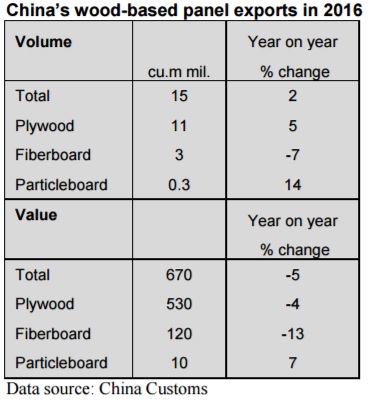
China’s wood-based panel exports in 2016 totaled 15 million cubic meters valued at US$670 million, a year on year increase of 2% in volume but decrease of 5% in value.

Plywood dominated wood-based panel exports in 2016 and accounted for 76.5% of the total wood-based panel exports. Plywood exports totaled 11 million cubic meters in 2016 valued at US$530 million, up 5% in volume but down 4% in value.

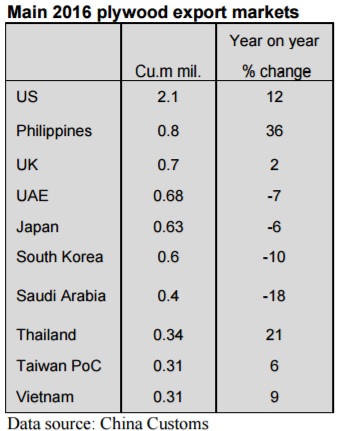
Most of China’s plywood exports were destined for the US market (2.1 million cu.m), a year on year increase of 12%.

Shipments of plywood from China to international markets were mainly through Qingdao (4.47 million cu.m) and Nanjing (4.33 million cu.m), a year on year increase of 16% and 1% respectively. 78% of China’s plywood exports were through the above-mentioned two ports.

German parquet industry reports higher production levels

At this year's Annual General Meeting of the Association of the German Parquet Industry (VDP) in Bad Honnef, the main focus was based on the analysis of the economic situation and also on the technical topics and activities on the market. Continue reading "German parquet industry reports higher production levels"

Over 90% of UK timber imports are certified

The latest summary report of certification content in U.K. timber product imports was published by the Timber Trade Federation (TTF) in April 2017. The analysis, based on data derived from TTF member companies for the year 2015, shows certified, sustainable material at a record high of over 90% of imports by TTF members.

TTF members account for roughly 85% of the total UK market for imported timber (including logs, sawn wood, decking, mouldings, veneer, plywood and other panels).

The report shows year-on-year growth in certified products to an unprecedented level of 90.2% of total volumes.

The report notes that of the remaining, uncertified, 10% there are large volumes of hardwoods purchased from North America and Africa, both areas where traditional certification is less apparent. There are also large volumes of panel purchases coming from China.

Within this 10%, TTF members are conducting supply chain, species and country risk assessments as part of the due diligence process required both for the EUTR and the TTF Responsible Purchasing Policy (RPP). Therefore, risk within the supply chain for uncertified timber is adequately managed.

The report notes that there is a significant and increasing business-to-business demand for certified products in the market. Despite the progress by members, TTF note that "this demand can prove difficult to meet from traditional source countries and regions and at times can prove detrimental to timber being specified as a material".

With this in mind, the TTF indicates that their policy is not to exclude uncertified products and that it is "committed to helping demonstrate the sustainability criteria of wellmanaged, uncertified sources, for instance newly FLEGT licensed Indonesian products and North American timber etc".

The report provides insights into the relative share of different certification frameworks in the UK market.

Softwoods as a product group are fairly evenly split between FSC and PEFC, however FSC dominates tropical hardwood timber purchases. Of the 50% of tropical hardwood purchases that were certified, nearly 97% of that was FSC - the remaining 3% comprising MTCS/PEFC certified timber from Malaysia.

The high levels of certified product traded by UK TTF members is partly a reflection of the products and supply countries involved - dominated by primary and secondary wood products and mainly derived from European countries where there is a high proportion of certified forests.

TTF note that the level of members trade in, and certification proportion, in more complex products such as doors and engineered flooring is also rising, but is still a long way behind sawn wood products. Overall certification of panel products and further processed products remains low.

TTF members also do not include UK importers and retailers of wood furniture - a sector which evidence shows still comprises a large proportion of uncertified supply. This is due both to the lower level of corporate commitment to sustainable timber procurement amongst furniture buyers and to the greater complexity of products and supply chains.

Resolute Forest Products cuts shifts at seven sawmills due to US lumber duties

Forestry workers in Quebec prepare for the layoffs start, as a result of the softwood lumber dispute with the United States. Continue reading "Resolute Forest Products cuts shifts at seven sawmills due to US lumber duties"

Finland: Sawn softwood production up 15% in Q1/2017 as Chinese demand booms

The Finnish forest industry notably increased its production of sawn softwood timber and plywood at the start of 2017, when construction in the main market areas picked up. Paperboard and pulp production also grew strongly, but disparities between product groups in the forestry industry remain high.

The increase in European demand, and especially demand in China, for the industry was visible in the early part of the year. Political risks cast a shadow over growth prospects, however.

“Businesses in the Eurozone have confidence in the future, but increasing protectionism and political risks are a real threat to world trade,” says the Finnish Forest Industries Federation’s Chief Economist Maarit Lindström.

China's economic growth in the early part of the year was due to retail, manufacturing and investment. Demand for forestry products in China comes from the packaging and construction industries, for example.

Finnish production of sawn softwood in the first quarter of 2017 was 3.1 million cubic metres. This is an increase of 15.1 percent over the same period last year. Plywood production grew by 17 percent to 0.3 million cubic metres. Paperboard production was 0.9 million tonnes, or 6.1 percent more than in the same period last year. Pulp production grew by 2.6 percent to 1.9 million tonnes.

Finnish paper production continued to decline, to 1.7 million tonnes. There are a number of reasons for this, such as reduced demand for paper. Paper production was therefore 5 percent below the amount for the first quarter of the previous year.

“Finland’s cost-competitiveness has not recovered from the financial crisis. In the forest industry, differences between product groups highlight the need for improved competitiveness, and for increased flexibility,” Lindström says. “Although the cyclical situation has contributed to raising production volumes, especially in the manufacturing sector, low cost-competitiveness poses a challenge.

Finland's economic growth will be sustainable only when exports are on the road to proper recovery. For this reason, political decision-makers must ensure that the operating environment enables improved investment and greater employment. International companies based in Finland need a level playing field compared to those of competing countries. For example, Germany promotes its industrial competitiveness through a wide range of methods,” continues Lindström.

In addition, the tax reforms planned by the United States put a renewed focus on corporate taxation. Indeed, there are signs of stiffer international tax competition. Finland’s corporate taxation remains competitive for now, but companies want to be sure that the operating environment is also attractive in terms of taxation.

Record high in US wood furniture imports

US wood furniture imports reached a record high in 2016, at US$16.7 billion, up by 3% from 2015.

The value of imports increased from all major suppliers except Indonesia (down by 9%) and Malaysia (down by 5%).

China’s share of total imports decreased again in 2016 (although overall it was up by 2%, to US$7.82 billion), to 46.8%, but Vietnam’s share grew to 19.1% (at US$3.19 billion, up by 6%).

Malaysia’s share of total imports was the same as in 2014, at 3.8%. Canada, Mexico and India recorded the strongest year-on-year growth in wood furniture exports to the US in 2016.

EU review highlights fragility of okoumé plywood sector

The EU renewed anti-dumping duties on imports of okoumé plywood manufactured in China on 7th April.

These duties were originally introduced by the EU in 2004 and would have lapsed after only five years had not an interested party requested the European Commission (EC) to initiate an expiry review.

In 2009, the European Panel Federation (EPF) requested a review which led the EU to extend the duties for another 5 years from January 2011. Near the end of that period, in October 2015, the EPF once again requested that the EC initiate an expiry review.

This new investigation led to the announcement of another 5-year extension from April 2017. The duties renewed on 7th April are unchanged from those originally imposed in November 2004, requiring payment of between 6.5% and 23.5% by four named Chinese manufacturers and 66.7% by all other Chinese manufacturers.

The four manufacturers paying lower duties had cooperated during the original anti-dumping investigation and shown that the “injury-margin” for their products was less than calculated by the EU for other Chinese manufacturers.

The review investigation carried by the EC – which focuses on the years 2012 to 2015 – is interesting for the insight it provides into the current extent and status of the EU okoumé plywood manufacturing sector. It reveals an industry that remains extremely fragile, suffering from very low profit margins, weak demand, and negligible levels of investment.

The EC concluded that although the sector’s financial position has improved slightly over the last 5 years, removal of the anti-dumping duties on equivalent Chinese products would lead to a “recurrence of injury” and threaten its survival.

The product covered by the anti-dumping duties and investigated by the EC is that falling within TARIC code 4412 31 10 10 and defined as “plywood consisting solely of sheets of wood, each ply not exceeding 6 mm thickness, with at least one outer ply of okoumé not coated by a permanent film of other materials”.

This definition captures both "full okoumé" plywood with okoumé throughout and combi plywood with at least one outer face of okoumé, the rest being made of other wood.

The product is used for a variety of end-uses in the EU, notably exterior joinery and carpentry applications for boarding, shutter boards, exterior basements and balustrades and riverside panelling, and more decorative purposes particularly in vehicles and yachts, and for furniture and doors.

The EC investigation involved a review of relevant trade and industry statistics and consultation with interested parties. Invitations to participate were issued to all known exporting producers in China.

However, only one company offered any information and this only to say that no okoumé plywood was manufactured during the review period. The EU also noted that input was requested from the Chinese authorities but no information was received.

As a result, the analysis relied heavily on questionnaire responses from five sampled plywood producers in the EU and from one producer in Morocco. The latter was identified as a suitable "analogue" country (producers in Turkey, another “analogue” country, did not respond to the questionnaire).

China’s interest in Swedish wood confirmed during trade fairs

In March 2017 Swedish Wood participated in the CIFM fair in Guangzhou, China, together with 10 member companies representing the Swedish sawmill industry.

The fair visitors confirmed the increasing interest for Swedish wood in China.

Continue reading "China’s interest in Swedish wood confirmed during trade fairs"

Canfor has appetite for more mergers and acquisitions

Canfor Corp.’s appetite for mergers and acquisition (M&A) opportunities, notably in the U.S. South, continues unabated and the company is open to opportunities in wood products, solid wood, pulp and paper and energy, but is not interested in getting back into the oriented strand board (OSB) or panel products sector.

That was the message from Canfor’s CEO Don Kayne in a financial conference call on April 27.

Kayne was asked by an analyst to “speak to the company's appetite” for larger scale M&As now it has some certainty on at least the countervailing duty portion of the U.S. softwood lumber duties.

Kayne said: “Certainly, we've got an appetite for M&A, of course. We always have, it's just one of several priorities.”

Outlining the company’s approach to capital allocation, Kayne said Canfor had “made some significant progress on improving our balance sheet in the last couple of years and that was our focus and I think we're certainly in that area now that we are glad we are with all the uncertainties that are going on everywhere.”

He said Canfor was going to be “looking at, we believe, some pretty significant opportunities for organic growth within the company and we're targeting ourselves of around C$200 million to now and somewhere in 2018 and even beyond that we see another couple of $100 million potentially that just organically that we see amongst our own operations.”

After organic growth, and also the possibility of share buybacks, there were M&A opportunities. “We want to continue to grow in the South, as we've said many, many times and we still do so we're just evaluating those -- all those opportunities that may come up on an individual basis,” said Kayne.

Asked if Canfor would be open to other areas of the wood products spectrum, such as OSB--which the company has been involved in before, in British Columbia--Kayne said: “Specifically about OSB, I think we'll leave that to others that [have] a lot of expertise in that. There's been lots of consolidation taking place there and so I don't see ourselves getting into OSB again at all, or panels for that matter at all, period. The way we would look at it is where else -- in addition perhaps even to Southern yellow pine that may make sense globally that we might be interested in, but for the most part it will be wood products or forest products oriented between pulp and paper, energy and solid wood.”

US plywood imports from Malaysia triple

US hardwood plywood imports declined in February after two consecutive months of growth. February imports decreased 9% to 313,168 cu.m. worth US$168.7 million.

However, year-to-date US plywood imports were 24% higher than in February 2016. Year-to-date imports from Malaysia almost tripled compared to the same time last year.

The US imported 192,057 cu.m. of hardwood plywood from China in February, followed by Indonesia with 34,598 cu.m. Cambodia has become a significant source of US hardwood plywood imports. In February Cambodia shipped 4,457 cu.m. of plywood to the US.

The unit value of imported plywood was highest in February for plywood from Indonesia and Malaysia, and lowest for imports from Russia.

More hardwood flooring from Indonesia in early 2017

US hardwood flooring imports increased 11% from the previous month and were worth US$4.3 million in February. Imports of assembled flooring panels (including engineered hardwood flooring) were US$9.2 million.

Year-to-date imports of both types of wood flooring were significantly up from February last year.

US hardwood flooring imports from Indonesia grew substantially in February to US$792,066. Year-to-date imports from Indonesia were 30% higher than in February 2016. Hardwood flooring imports from China were US$1.26 million in February, up 43% year-to-date from February 2016.

Imports of assembled flooring panels declined from the previous month to US$9.2 million in February, but yearto-date imports were up from last year. China and Canada accounted together for over 60% of all imports of wood flooring panels.

Year-to-date flooring panel imports from Indonesia were one third higher than at the same time last year. Vietnam surpassed Thailand in flooring panel shipments to the US in 2017 with over US$1 million exported year-to-date.

Stora Enso reports sharp profit rise in its Wood Products division

The wood products division in Stora Enso has recorded a 34 per cent increase in operational earnings before investment, tax, depreciation and amortisation (EBITDA) in 2017 Q1, compared to 2016 Q1.

Deliveries increased by 11.6 per cent to reach 1.21 cbm; and divisional sales saw an 8.9 per cent rise to hit €416 million (US$456 million) compared to the €382 million (US$418 million) in 2016.

Stora Enso credits the growth in operational earnings to the slightly higher sales prices and higher volumes, notably for spruce sawn products, realised.

The boost in sales can also be traced to the investments in the Varkaus laminated veneer lumber (LVL) line, upgrades in the Murów sawmill, and rising demand and prices for cross-laminated timber (CLT).

Stora Enso is also set to invest in a biocomposite granules manufacturing line with a 15,000-tonne yearly production capacity at its production mill in Hylte, Sweden.

Kastamonu acquires Italy’s third largest particleboard producer

Turkish Kastamonu Entegre has acquired Italian Gruppo Trombini in May. This acquisition along with its last investment, places Kastamonu Entegre’s foreign investments to be more than EU800 million.

Gruppo Trombini was founded in 1962 at Ravenna in Northeast Italy. The company has two particleboard facilities - one in Pomposa with a capacity of 480 thousand cubic meters annually and another in Frossasco with a capacity of 320 thousand cubic meters per year – totaling an annual 800 thousand cubic meters. With the addition of the Italian market, Kastamonu Entegre aims to target 20% of the market share in the country and will start running these facilities in 2018.

The negotiations started in the first quarter of 2017 and Kastamonu Entegre’s CEO, Haluk Yildiz, said, “We continue to increase our global scale production capacity. By having purchased the third largest particleboard producer of Italy, we have added Italy to our investments in Romania, Bulgaria, Bosnia- Herzegovina and Russia. Hence, our foreign investments reached a total amount of  EU800 million”.

Yildiz also emphasised that with Italy at the center of fashion and design, it is the fourth big furniture producer of the world. “The size of the Italian furniture market is 20 million,” he said.

Furniture exports amount to about US$10 million. And as one of the biggest producers in the world, Kastamonu Entegre is proud to become a producer in Italy where they have only been exporting, Yildiz explained.

“We wish that this acquisition which will mark a new jumping point for our company, would be beneficial for our sector and our company,” he said.

Newsletter

Subscribe to our digital newsletter for your daily digest of essential news, views and analysis from the international wood industry delivered directly to your inbox.


0