

The total export value of logs and timber products in Sarawak decreased as reported to three years ago period, to RM 5.95 billion, in 2016. Continue reading "Export value of logs and timber products from Sarawak decreased by 10%"
Article archive
US lumber prices lowered, while buyers revived sales

Buyers of framing lumber in the US recovered their businesses after weeks on the sidelines. Producers of various species seeking trading levels over the past several weeks finally hit values that drew in reluctant customers. Continue reading "US lumber prices lowered, while buyers revived sales"
The German wood and furniture industry keeps on increasing in 2017

In 2016, the German timber industry reported a 2.4% increase in its turnover, while the total worth of goods reached EUR 35 billion. The sawmill industry reported a 2.9% increased turnover, followed by manufacturers of parquet with a growth of 4.2%, manufacturers of wood packaging with a plus of 5.1% and the manufacturers of building elements with a plus of 8%.
On the other hand, the wood-based materials industry recorded a slight decline in sales of 0.8%.
The German furniture industry was able to further strengthen its competitive position and achieved growth of 3.2% up to EUR 18 billion in 2016, for the third year in a row. The development was primarily driven by foreign business, which was up by around 4%, while domestic sales only rose by 2.8%.
With a turnover of 7.2% increase, the manufacturers of shop and commercial furniture were particularly well off in 2016, followed by the office furniture industry with a plus of 5.9% and kitchen furniture industry with a plus of 4.4%. Residential furniture and other furniture were up 2.4% year-on-year. The industry currently counts 84,150 employees in 498 companies.
The positive development of the German wood industry continued in the first months of 2017 as well. The wood industry grew faster than the furniture industry. The growth driver in the wood industry was above all the construction sector, which is currently benefiting from the high demand for building construction and public construction.
John Deere reports higher worldwide sales of forestry and construction equipment
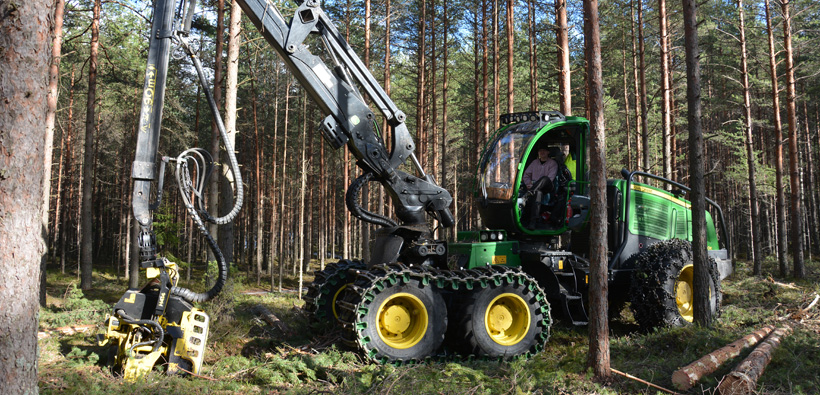
For the second financial quarter ended April 30, worldwide net sales of John Deere increased 5 percent, to $8.287 billion, and increased 4 percent, to $13.912 billion, for six months. Net sales of the equipment operations were $7.260 billion for the quarter and $11.958 billion for the first six months, compared with $7.107 billion and $11.876 billion for the same periods last year.
John Deere's onstruction and forestry sales increased 7 percent for the quarter and 1 percent for six months, mainly as a result of higher shipment volumes and price realization, partially offset by higher warranty costs.
Operating profit was $108 million for the quarter and $143 million for six months, compared with $74 million and $143 million last year. Results for the quarter were assisted by increased shipment volumes and price realization, partially offset by higher warranty costs and a less-favorable sales mix. For the first six months, results were about the same as in the prior period and were affected by the same operating factors as for the quarter, as well as by voluntary employee-separation expenses.
Deere's worldwide sales of construction and forestry equipment are forecast to be up about 13 percent for 2017, with no material currency-translation impact. The forecast reflects moderate economic growth worldwide. In forestry, global industry sales are expected to be down about 5 percent due to soft conditions in North America.
US housing starts predicted to rise 8.4% in 2017

The US National Association of Realtors’ mid-year forecast projects that housing starts will reach 1.27 million this year, an 8.4% bump, and new single-family sales also will climb 8.4% to 620,000. Ongoing challenges continue to suppress single-family starts — which are still below the 50-year average — including shortages of labor and lots, as well as tight lending conditions.
Existing-home sales are on pace to reach 5.64 million for 2017, a 3.5% increase over 2016 and the highest level since 2006, according to the . Median prices for existing homes also are anticipated to climb by about 5%.
Inventory shortages, particularly in the low- and mid-market range, are one of the factors suppressing homeownership rates. NAR Chief Economist Lawrence Yun noted that tight supplies are causing home prices to grow faster than incomes in some markets.
The trend from the past few years of the housing recovery is continuing in 2017: a slow, but steady, climb restrained by lingering challenges, such as labor shortages, tight lending and student loan debt.
This gradual upward movement is reflected in a number of housing indicators, including the Housing Market Index, which this month saw builder confidence reach its second-highest point since the recession.
Housing starts dipped to a seasonally adjusted rate of 1.172 million in April, 2.6% below March but 0.7% higher than April 2016. On the labor front, residential construction added just 900 net jobs in April.
Low inventory continues to be a challenge, particularly for first-time buyers as starter-home inventory fell 8.7% in the first quarter or 2017. Trulia reported that the percentage of monthly income required to buy a starter home rose 2.9 points from 2016, to 38.3%.
This recent NAR report offers a more optimistic view of the existing-home sale market this year, as compared with its forecast released in November 2016. At that time, the association predicted that existing-home sales would climb only 2% this year and see a 4% bump in median price.
Central/West Africa: Improved export demand – logs and sawnwood price prospects looking better
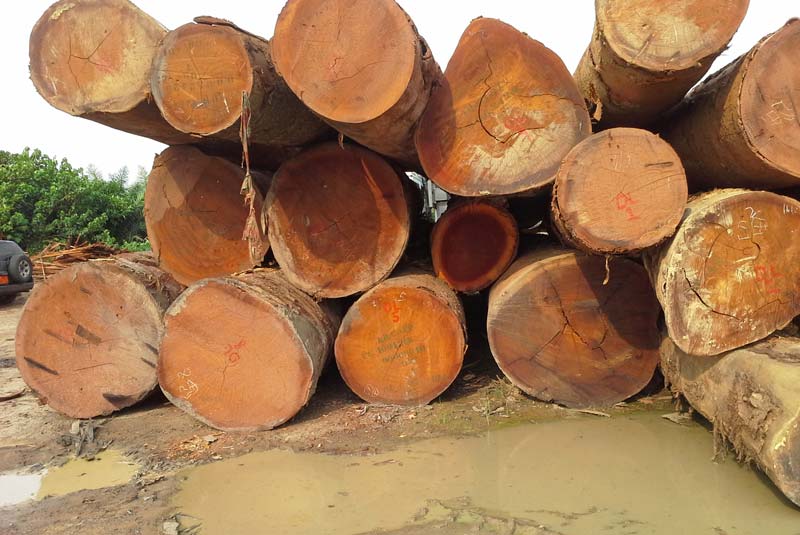
Producers across Central/West Africa continue to be busy taking advantage of improved international demand. There has been some firming of prices but, once again, this is for a few of the more popular timbers.
When asked, producers indicated they are confident that the current firm demand will hold and that prices will remain stable through into the third quarter of the year as European buyers are beginning to return with enquiries.
The only market that is problematic at present is South Africa where short term prospects for exports look grim.
The rand has weakened and there is still no sign of the much anticipated government infrastructure projects being awarded which would help the construction sector and lift demand for timber.
Log Export Prices
| West Africa logs, FOB | € per m³ | ||
| Asian market |
LM
|
B
|
BC/C
|
| Acajou/ Khaya/N’Gollon |
245↑
|
240
|
160 |
| Ayous/Obéché/Wawa |
240
|
240
|
190
|
| Azobe & Ekki |
230
|
230
|
160
|
| Belli |
250
|
250
|
–
|
| Bibolo/Dibétou |
180
|
170
|
|
| Bilinga |
230
|
230
|
- |
| Iroko | 325 |
300
|
265
|
| Okoume (60% CI, 40% CE, 20% CS) (China only) | 245↑ | 240↑ | 185 |
| Moabi | 330 | 300 | 235 |
| Movingui | 210 |
210
|
160
|
| Niove |
175
|
160
|
–
|
| Okan |
230↑
|
205↑ |
–
|
| Padouk |
300
|
280 |
230
|
| Sapele | 290 | 280 | 220 |
| Sipo/Utile |
310
|
290 |
255
|
| Tali | 330 | 320 |
–
|
Sawnwood Export Prices
| West Africa sawnwood, FOB |
€ per m³
|
|
| Ayous | FAS GMS | 430↑ |
| Bilinga | FAS GMS | 530 |
| Okoumé | FAS GMS |
400↑
|
| Merchantable | 300 | |
| Std/Btr GMS | 345↑ | |
| Sipo | FAS GMS |
535
|
| FAS fixed sizes | 555 | |
| FAS scantlings | 560 | |
| Padouk | FAS GMS | 850 |
| FAS scantlings | 980↑ | |
| Strips | 645 | |
| Sapele | FAS Spanish sizes | 505 |
| FAS scantlings | 510 | |
| Iroko | FAS GMS | 625↑ |
| Scantlings | 710 | |
| Strips |
410
|
|
| Khaya | FAS GMS |
450
|
| FAS fixed |
470
|
|
| Maobi | FAS GMS |
620
|
| Scantlings |
630
|
|
| Movingui | FAS GMS |
430
|
Source: ITTO
EU unable to assess China’s okoumé plywood production

The European Commission is unable to accurately assess the level of China’s okoumé plywood production. A rough estimate using information provided by the European Panel Federation (based on the volume of okoumé logs imported into China in 2014), put annual production at somewhere between 290,000 cu.m and 2.9 million cu.m per year.
The large range is because of lack of data on how much imported okoumé is destined for plywood production in China, or is used for full okoumé plywood or combi plywood. Nevertheless, the EC suggested, based on this data, that okoumé production capacity in China is likely to be significantly greater than in the EU.
The EC also noted plywood in China is produced by the same companies and on the same equipment, whatever the wood species used and that okoumé plywood tends to be more profitable than other types of plywood. Therefore, according to the EC, in the absence of anti-dumping measures, “it is likely that Chinese producers will shift their production from other types of plywood towards the more lucrative okoumé plywood”.
The EC also noted that anti-dumping duties on imports of Chinese plywood exist in the Republic of Korea, Morocco and Turkey, while the U.S. issued a preliminary determination of the countervailing measures against Chinese plywood in January 2017.
The EC suggested that “Chinese exporting producers thus will have limited access to these markets and will be limited in exporting their production or re-directing their exports to these markets. This leaves the EU market even more attractive for Chinese plywood imports”.
The EU review concluded: "the significant production capacity available in China, the possibility of Chinese producers to easily increase production volumes available for exports, the possible high dumped prices in other third markets as well as in the Union market and the attractiveness of the Union market, indicate that a repeal of the measures would likely result in Chinese exporting producers re-entering the Union market at dumped prices and in significant quantities.
It is therefore considered that there is a likelihood of recurrence of dumping should the current anti- dumping measures be allowed to lapse."
Austria: Price of wood pellets further drops in May
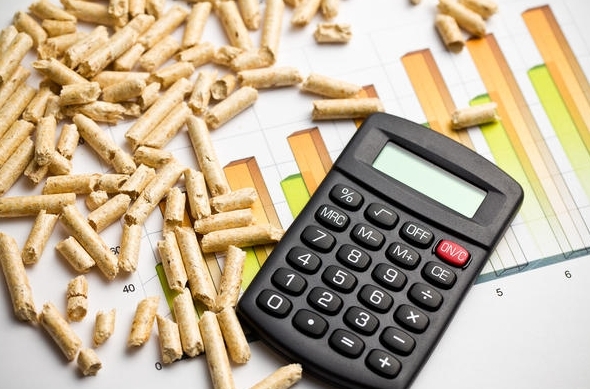
Austria's Enplus A1 wood pellets price amounted to an average of EUR 225.1 per tonne in May 2017.
This represents an -1.9% decrease over the previous month and a 1.3% increase as compared to May 2016.
Austrian wood pellets presently offer a price advantage of 46.7% as opposed to extra light heating oil and 79.4% as opposed to natural gas.
Wood pellets in bags cost an average of EUR 3.90 per 15 kg sack (when ordered by the pallet), a -1.6% decrease as compared to April and a 1.9% increase, as compared the same period last year.
Tembec announced closing of the sale of its Senneterre mill to Resolute Forest Products

Tembec announced that it closed the sale of its sawmill and related forestry assets located in Senneterre, Quebec to Resolute Forest Products.
The sale also included certain working capital items. The company received proceeds of approximately $9 million on closing, subject to potential working capital adjustments. The transaction will not give rise to a gain or loss as the assets were sold at their carrying values.
This transaction included the transfer of all the employees (103 unionized and 21 non-unionized employees). Tembec acquired the mill in 2003 from Nexfor Inc. and Norbord Industries Inc. The Company’s lumber capacity is now 755 million board feet per year, down from 855 million board feet prior to the sale.
Tembec is a manufacturer of forest products – lumber, pulp, paper, and specialty cellulose – and a global leader in sustainable forest management practices. Principal operations are in Canada and France. Tembec has approximately 3,000 employees and annual sales of approximately $1.5 billion. Tembec is listed on the Toronto Stock Exchange (TMB).
The global wood pellets demand forecast shows optimistic scenarios

The industrial wood pellet tonnage demand and spot prices are based on optimistic scenarios in which cofiring or full-firing wood pellets in large pulverized coal (PC) power plants develops in Japan, Korea, the U.S. and Canada. Continue reading "The global wood pellets demand forecast shows optimistic scenarios"
Stable wood pellet price in Northern Europe due to cold spring

The Nordic Pix Pellets price index was kept stable by the cold spring and also by the 0.7% strengthening of the Euro against the Swedish Crown from March to April. Continue reading "Stable wood pellet price in Northern Europe due to cold spring"
Setra to boost sawn timber production by 20% in Malå
Renewables play more important role in the EU energy mix

The European Environment Agency (EEA) has recently published the report on ‘Renewable energy in Europe 2017: recent growth and knock-on effects,’showing that renewables have become a major contributor to the energy transition occurring in many parts of Europe. As reported, growth in renewables continues to bolster climate change mitigation in the EU.
The EU-wide share of renewable energy use increased from 15% in 2013 to 16% in 2014. This upward trend continued also in 2015, as renewable energy accounted for the majority (77%) of new electricity-generating capacity for the eighth year in a row. Recent data from Eurostat showed that the EU-wide renewable energy use finally reached 16.7% in 2015 – which is close to the EEA’s 16.4% preliminary estimate published in December 2016. This steady EU-wide progress in renewables since 2005 enables the EU to stay well on course to reach its target of 20 % by 2020.
At Member State level, the shares of renewable energy use continues to vary widely, ranging from over 30% in Finland, Latvia and Sweden, to 5% or less in Luxembourg and Malta.
Regarding solid biomass. Electricity generation from solid biomass grew from 4.8 Mtoe in 2005 to 9.0 Mtoe in 2014 (9). The growth rate over the 2005-2014 period was 7 % (Figure 2.6). In 2014, Germany's share of the total electricity generated from solid biomass was 17 %. The United Kingdom and Finland had shares of 15 % and 11 %, respectively. In 2015, electricity generation from solid biomass increased again compared with 2014 due to the expansion of biomass cogeneration and the conversion of coal-fired power plants to biomass installations. Again, in the United Kingdom there was a sharp increase in solid biomass electricity generation due to the conversion of a further, third, coal-fired power plant.
Solid biomass remains the most important source of renewable energy for heating. The consumption of renewable heat originating from solid biomass decreased from 76.5 Mtoe in 2013 to 73.5 Mtoe in 2014. This decrease was mainly due to a mild winter in 2014, which reduced the demandfor heating. The compound annual growth rate for heat from solid biomass was 2 % over the period from 2005 to 2014. In 2015, the consumption of solid biomass for renewable heat increased to 75.9 Mtoe, according to an EEA estimate. To realise the expected NREAP levels of solid biomass for 2020, a growth rate of 2 % per year over the remaining period would be sufficient.
Heating and cooling. The share of heating and cooling from renewable sources (RES-H&C) in the EU-28 was 17.7 % in 2014. The gross final consumption of RES-H&C was 87.5 Mtoe in 2014, which corresponds to a decrease of 1.8 Mtoe compared with 2013. In 2014, the largest contributions came from solid biomass (73.5 Mtoe, or 84 % of all RES-H&C), heat pumps (8.2 Mtoe, or 9 % of all RES-H&C) and biogas (2.9 Mtoe, or 3 % of all RES-H&C).
EU okoumé plywood consumption falls 35%

The data gathered by the review investigation carried by the EC – which focuses on the years 2012 to 2015 shows that EU consumption of okoumé plywood ranged from 175,600 cu.m to 189,000 cu.m per year in the period 2012 to 2015, a substantial decline from around 290,000 cu.m during the EU’s previous review in 2008-2009.
The EC comments that the decrease was explained by okoumé plywood being substituted by other tropical wood species and by the fallout from the economic crisis. The share of China in the market during this period when antidumping duties were in place was negligible
EU production of okoumé plywood was 144,000 cu.m in 2012 rising to 148,000 cu.m in 2015. Capacity utilisation was 80% throughout this period. This compares to annual production of around 265,000 cu.m in 2008 and 2009 reported in the previous review.
Production capacity in the EU, which was 577,000 cu.m in the previous review period, fell even more dramatically due to the closures of several EU producers, including Plysorol formerly the largest EU manufacturer, and reduced capacity by those producers still in the business.
EU producers share of the EU market increased from 68.2% in 2012 to 74.9% in 2015, almost all at the expense of producers in Gabon and Morocco. The EU okoumé plywood manufacturing industry employed 543 people in 2012, declining to 492 in 2015. Production per employee increased by 13% from 265 cu.m in 2012 to 300 cu.m in 2015.
Sales prices of okoumé plywood manufactured in the EU averaged 756 EUR/cu.m in 2012 rising to 780 EUR/cu.m in 2015. These prices are considerably lower than levels of around 900 EUR/cu.m recorded in the previous review during 2008-2009.
The prices achieved recently are insufficient to cover the unit costs of production which averaged 783 EUR/cu.m in 2012, fell to 760 EUR/cu.m in 2013 and 2014, before rising to 778 EUR/cu.m in 2015.
The EC notes that during the whole 2012-2015 period, profitability of the EU okoumé plywood was extremely low. It was negative at the beginning of the period and turned only slightly positive in 2014 and 2015.
The level of profitability in 2015 was markedly lower even than in 2009 at the height of the economic crises.
Investment was also extremely low, below that required to compensate for depreciation of fixed assets in 2012 and 2013, and just rising above this level in 2014 and 2015.
While EU manufacturers were gaining share at the expense of manufacturers in Gabon and Morocco in the period 2012 to 2015, the latter were selling product at lower average prices.
Average prices for EU imports of okoumé plywood from Gabon increased from 628 EUR/cu.m to 645 EUR/cu.m between 2012 and 2015, while prices from Morocco increased from 662 EUR/cu.m to 700 EUR/cu.m.
The EC compared sales prices of domestic, Gabon and Moroccan manufacturers in the EU during the review period with commercial prices offered by Chinese manufacturers to non-EU European countries (namely Bosnia and Herzegovina, Switzerland, Turkey, Gulf States and Norway). These prices ranged from 313 EUR/cu.m to 540 EUR/cu.m (CIF).
The EC also noted that the average CIF price of okoumé plywood supplied into the EU from China during a brief period in 2012 when imports from the country increased from negligible levels to over 1000 cu.m was 549 EUR/cu.m.
The EC concluded that prices offered by Chinese manufacturers for okoumé plywood were substantially less than both EU manufacturers and manufacturers in analogue countries.
China imports 1.4 million m3 of wood based panels in 2016, up 31% from 2015

Four timber groups dominated China’s sawn softwood imports in 2016, korean and Scots pine (8.3 million cu.m, 47%), spruce and fir (8.11 million cu.m, 45%), radiata pine (1.19 million cu.m, 7%) and Douglas fir (0.23 million cu.m, 1%).
The volume of korean and scots pine, spruce and fir, douglas fir and radiata pine imports rose 41%, 11%, 9%, and 1% respectively year on year.
Main sawn hardwood imports
The main sawn hardwood species imported into China in 2016 were oak (1,380,000 cu.m, 10%), American ash (508,000 cu.m, 3.54%), beech (503 000 cu.m, 3.51%), cherry (150,000 cu.m, 1.06%) and merbau (130,000 cu.m, 0.93%).
The volumes of cherry, ash, oak and merbau rose 55%, 14%, 11%, and 3% respectively, but, overall, North America hardwoods and beech imports fell 11% and 1% year on year respectively.
 Particleboard dominated wood-based panel imports
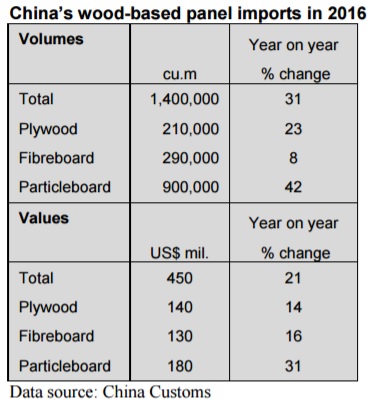
China’s wood-based panel imports in 2016 were 1.4 million cubic metres valued at US$450 million, a year on year increase of 31% in volume and a 21% increase in value. Particleboard dominated China’s wood-based panel imports accounting for 65% of the total wood-based panel imports. Particleboard imports were 900,000 cubic metres valued at US$180 million, up 42% and 31% respectively.
China’s particleboard imports were mainly from Thailand (290,000 cu.m), Malaysia (220,000 cu.m) and Romania (150,000 cu.m), a year on year increase of 115%, 13% and 6% respectively. 72% of China’s particleboard imports were from the above-mentioned three countries.
Particleboard imports to China were shipped mainly through Tianjin (220,000 cu.m), Shanghai (180,000 cu.m), Huangpu (140,000 cu.m) and Shenzhen Customs (120,000 cu.m).
Kronospan’s operations in Bulgaria might be suspended
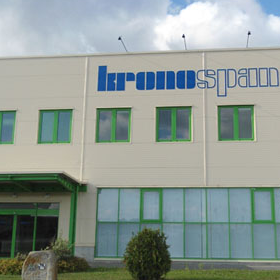
The operations of wood products manufacturer Kronospan Bulgaria, a unit of Austria’s Kronospan, will be suspended if by June 30 it fails to adopt measures to comply with the air quality requirements, the Bulgarian environment ministry said on Thursday.
According to Bulgarian media, the ban will continue until the company complies with the requirements, the environment ministry said in a press release following a meeting between environment minister Neno Dimov and Asen Nikov, CEO of Kronospan Bulgaria.
To meet the requirements, Kronospan Bulgaria plans to build two indoor storage facilities, as well as to cover the conveyor belts used to transport sawdust left as a byproduct of the company’s operations.
In January, the economy ministry said Kronospan Bulgaria will invest 42.6 million levs ($24.2 million/21.8 million euro) in expanding the capacity of its production facilities.
Kronospan is among the leading manufacturer of wood products for the furniture industry on the Bulgarian market.
LIGNA to see high participation from visitors and exhibitors

Against a backdrop of a positive economic environment, LIGNA's organisers are expecting a successful event with a high number of international visitors at the leading exhibition for woodworking taking place in Hannover from May 22 to 26.
New and emerging trends in woodworking technology will also see exhibitors showcasing the latest Industry 4.0 and intelligent production processes.
“LIGNA is globally recognised as the most important place to create and set trends in the woodworking industry. If we are talking about furniture production of the future, visitors can see the ingredients for that in Hannover,” said Eumabois President and CEO of Leitz Juergen Koeppel.
Intelligent machines and intelligent tooling are the drivers of integrated, automated processes. They are designed to be agile, easy to manage and control, low cost and adaptable to unpredictable changes in end user requirements. These will open new possibilities for quality, productivity, flexibility and sustainability.
Small and major players will exhibit alongside one another. Visitors will benefit from a revamped site layout, designed to facilitate their visit.
“The industry needs to be able to respond to consumers who demand solutions, performance, beauty and the right price, without settling for customary standards. Our European system of technological solutions will be part of the offer LIGNA,” Luigi De Vito, Eumabois Vice President and SCM Division Director Machinery, said.
“LIGNA is the best chance to touch and look the latest technological innovations available in the market.”
Biggest shareholder in Canfor acquires large stake in West Fraser Timber
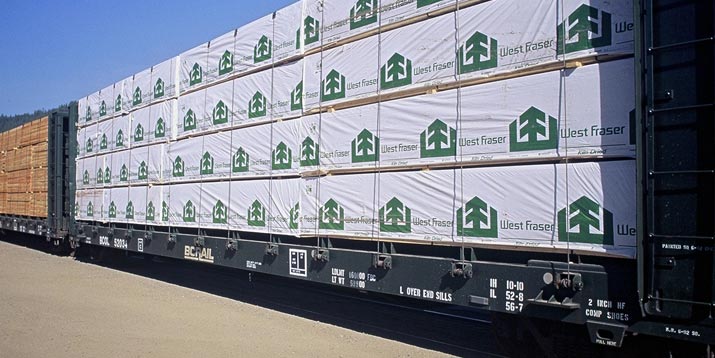
Jim Pattison, a billionaire from British Columbia, has recently acquired a 10.1% stake in West Fraser Timber Co. Ltd., raising speculation about a potential merger with Canfor Corp. Continue reading "Biggest shareholder in Canfor acquires large stake in West Fraser Timber"
Wood pellet prices in Germany at seasonal low levels

The price for wood pellets in Germany went down in May, as usual at this time of the year. EN plus wood pellets now cost EUR 233.73/tonne, 5% less than in April. Continue reading "Wood pellet prices in Germany at seasonal low levels"
US softwood lumber prices reach highest price level since 2004

Softwood lumber prices in the US have reached their highest levels since September 2014. This represents a 13.4% y-o-y raise in April. Continue reading "US softwood lumber prices reach highest price level since 2004"

