Article archive

Estonian Combimill Reopalu OÜ ordered 2-zone Progressive Kiln type HFB from Heinola

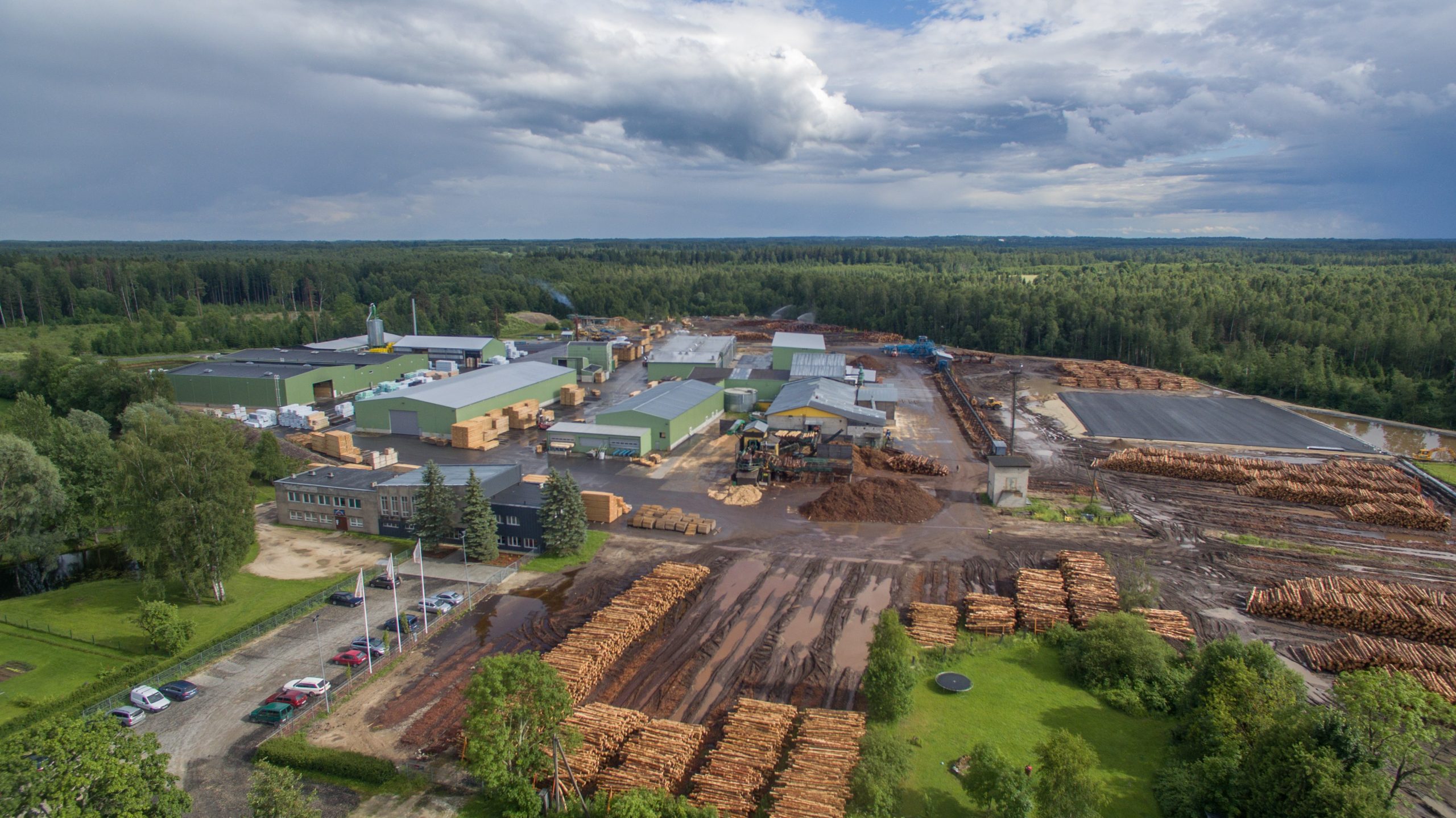
Combimill Reopalu OÜ invested in a new 2-zone Progressive Kiln type HFB  in Estonia. The new HFB-Progressive Kiln will be taken into production in the beginning of year 2019.

According to the announcement, the company placed an order with Heinola Sawmill Machinery for the equipment with annual capacity of ca. 32 000 m3 when drying sideboards to 18 % final moisture content. The kiln building is made of selfsupporting, wide stainless steel elements.

The existing three 2-zone progressive kilns will be also connected to advanced HEINOLA Drying Kiln Control System.

Combimill Reopalu OÜ sawmill is operated by Combi Group. It was founded in 2014. The land owned by the sawmill covers about 8,5 hectars. In 2017, Combimill Reopalu OÜ was employing 55 people. The modern, state-of-the-art technology being used on site allows the two sawmills to cut roughly 260,000 cubic metres of sawn timber a year, in total.

Combi Group is a leading Estonian timber industry group, which owns one forest management company, two sawmills, six wood after treatment plants and one distribution service company.

The Combimill Sakala and Combimill Reopalu OÜ sawmills are operated by Combi Group. The group’s principal activity is the production of sawn timber from roundwood.
Wood fiber costs for pulpmills in the US increased significantly in Q1/2018

During the first quarter of 2018, there were substantial increases in wood costs for pulpmills in Western US and Canada, while wood fiber prices fell to record lows in Eastern Canada.

Price movements for wood fiber throughout North America were mixed in the 1Q/18 with substantial increases seen in the Western US and Western Canada, while prices for softwood chips fell substantially in Eastern Canada, according to the latest issue of the North American Wood Fiber Review (NAWFR).

The only region where wood prices remained practically unchanged was in the US South, where the pulp industry continues to have some of the lowest fiber costs on the continent.

Wood fiber costs for pulpmills in North America were mixed in the 1Q/18, as compared to the 4Q/17. The biggest increases quarter-over-quarter were seen in British Columbia and the Western US, where prices for wood chips, the major fiber source for the two region’s pulpmills, increased by 12% and 15% respectively. Tight fiber supply, low fiber inventories, wildfires in the fall, reduced harvest levels and transportation challenges were all factors that contributed to the upward price pressure on both wood chip and pulplogs during the winter season.

In Eastern Canada, growing lumber production has created ample supplies of residual chips while demand for wood fiber has stagnated. This imbalance, building over the past 18 months, finally resulted in significant price declines when the annual price negotiations of 2018 were concluded. Wood chip prices in the 1Q/18 were at their lowest level in over 30 years and the region’s pulpmills now has the lowest softwood fiber costs in North America.

In the continent’s largest forest industry region, the U.S. South, prices for softwood fiber have stayed quite stable for the past 18 months despite increased harvesting activities and a higher supply of sawmill residuals. Prices for pine pulplogs throughout 2017 and early 2018 have been at their lowest levels in five years in both the Southeastern and South Central sub-regions.

While there were ample supplies of softwood fiber throughout the south in the 1Q/18, the picture was different for hardwood fiber. The supply/demand balance for hardwood pulpwood, particularly in the Gulf states, was tighter than that of softwood because of continued strong demand for hardwood fiber by both pulpmills and chipping facilities, paired with constrained log supply.

The limited supply of both logs and wood chips has resulted in upward prices pressure over the past six months, with average prices in the South Central region reaching their highest levels in almost two years. Following a notable increase in softwood fiber pricing in the US Northwest in the 4Q/17, prices surged in the 1Q/18, according to the NAWFR.

Low pulplog inventories and limited opportunities for obtaining additional fiber volumes left fiber buyers scouring the region for pulplogs and scrambling to secure sufficient supplies of residual chips. The increases in fiber prices for both pulplogs and wood chips resulted in the highest price levels seen in the region for six years.

Belgium: Standing timber average price list for spring – summer 2018

List of prices for standing timber set by National Federation of Forestry Experts A.S.B.L.

Preliminary remarks.

The arrows next to each price range indicate the price evolution against the prices set in the previous period of time.
These prices are suggested:
1. For normal harvesting conditions (flat ground or inclinated slightly, easily accessible, without any harvesting process related complications).

2. For the normal market conditions (payment deadlines, sale charges, caution, harvesting period).

3. For the lots of sufficient volume
Softwood :
- prices are based on the wood volume calculated over bark.
- wood must be of good quality, few knots, straight, with the acceptable degree of tapering, exempt of decay etc
- For fir, the prices are ginve for les prix sont présentés pour des
Thinning for the categories 20-39, 40-59, 60-69, 70-89
add 10% to the prices of wood from final felling areas, for the categories 60-69, 70-89
Final felling, for the categories 90-119, 120-149, 150-179, 180 and +

- For other softwood the prices are preserved for the wood harvested from the thinning areas. For final felling wood add 10 %

- Major lots(> 1000 m³) are respectively sold at a higher prices than smaller volumes

- For the windfall, it is indicated to apply discounts. The amount of discount is quite variable and depends on the circumstances.
Hardwood :
- the prices are given for the entire logs.
- the price intervals are given for a particular lot depending on the percentage of the special quality wood (for example,colour, sawing, peeling, redwood goods, etc...). For the precious/rare species (oak, cherry, walnut...) the prices can be be determined only by means of thorough analysis of each separate butt log.
Firewood
Upper price range limit concerns smaller lots sold to private actors
Important : prices widely vary depending on the regions, conditions (proximity to major agglomerations, accessibility, relief, wild vegetation, forest scattering, ...) and cutting quality (tree crowns – coppice wood - saplings- hardwood proportions).

AVERAGE PRICE FOR STANDING TIMBER (euro/m³) Autumn-Winter 2017

HARDWOOD
Circum. to 1.5m. 100-119 120-149 150-179 180-199 200-219 220-249 250 and +
High-quality oak 50 € / 80 € ⇑ 80 € / 120 € ⇑ 120 € / 150 € ⇑ 150 € / 190 € ⇑ 200 € / 250 € ⇑ 200 € / 250 € ⇑ 200 € / 250 € ⇑
Industrial oak 35 € / 55 € ⇑ 60 € / 80 € ⇑ 80 € / 120 € ⇑ 100 € / 140 € ⇑ 110 € / 150 € ⇑ 110 € / 150 € ⇑ 110 € / 150 € ⇑
American oak 30 € / 40 € ⇑ 60 € / 80 € ⇑ 80 € / 120 € ⇑ 100 € / 140 € ⇑ 110 € / 150 € ⇑ 110 € / 150 € ⇑ 110 € / 150 € ⇑
White beech 25 € / 30 € ⇒ 40 € / 50 € ⇑ 40 € / 60 € ⇑ 60 € / 80 € ⇒ 70 € / 90 € ⇒ 70 € / 90 € ⇒ 70 € / 90 € ⇒
Red beech/industrial beech 25 € / 30 € ⇒ 25 € / 30 € ⇒ 30 € / 35 € ⇒ 40 € / 50 € ⇒ 40 € / 50 € ⇒ 40 € / 50 € ⇒ 40 € / 50 € ⇒
High-quality ash 25 € / 30 € ⇒ 50 € / 70 € ⇑ 60 € / 80 € ⇑ 70 € / 90 € ⇑ 70 € / 90 € ⇑ 70 € / 90 € ⇑ 70 € / 90 € ⇑
Industrial ash 25 € / 30 € ⇒ 30 € / 35 € ⇒ 40 € / 55 € ⇒ 45 € / 55 € ⇓ 45 € / 55 € ⇓ 45 € / 55 € ⇓ 45 € / 55 € ⇒
Shaped poplar 15 € / 20 € ⇒ 25 € / 30 € ⇒ 30 € / 40 € ⇒ 35 € / 45 € ⇒ 35 € / 45 € ⇒ 35 € / 45 € ⇑ 35 € / 45 € ⇒
Non-shaped poplar 15 € / 20 € ⇒ 20 € / 30 € ⇒ 25 € / 30 € ⇒ 25 € / 30 € ⇒ 25 € / 30 € ⇒ 25 € / 30 € ⇒ 25 € / 30 € ⇒
Mapple 25 € / 30 € ⇒ 25 € / 30 € ⇒ 40 € / 60 € ⇒ 60 € / 80 € ⇒ 60 € / 80 € ⇒ 60 € / 80 € ⇒ 60 € / 80 € ⇒
Cherry 25 € / 30 € ⇒ 25 € / 30 € ⇒ 40 € / 60 € ⇒ 60 € / 80 € ⇒ 60 € / 80 € ⇒ 60 € / 80 € ⇒ 60 € / 80 € ⇒
Firewood: 6 to 13 euros/m³ apparent (Wallonne)⇒  7 to 20 euros/m³ apparent (Flamande)⇒Saplings (70 - 100 cm circumference) : 15 to 20 €/m³⇒
Pulpwood (hardwood) : 5 to 8 euros/tonne ⇒
FIR
Circum. to 1.5m. 20-39 40-59 60-69 70-89 90-119 120-149 150-179 180 et +
thinning for final felling : + 10 % Final felling
Fir (Ardenne) 1 € / 5 € ⇒ 15 € / 20 € ⇒ 35 € / 45 € ⇒ 45 € / 55 € ⇒ 60 € / 70 € ⇒ 65 € / 75 € ⇒ 65 € / 75 € ⇒ 65 € / 75 € ⇒
Fir (Moyenne Belgique) 1 € / 5 € ⇒ 12 € / 20 € ⇒ 30 € / 40 € ⇒ 40 € / 50 € ⇒ 50 € / 60 € ⇒ 60 € / 70 € ⇒ 60 € 70 €⇒ 60 € / 70 €⇒
OTHER SOFTWOOD SPECIES - for final felling: + 10 %
Circum. to 1.5m. 20-39 40-59 60-69 70-89 90-119 120-149 150-179 180 et +
Japanese Larch & Abies grandis 0 € 3 € ⇒ 7 € / 12 € ⇒ 15 € / 30 € ⇒ 30 € / 35 € ⇒ 35 € / 45 € ⇒ 50 € / 60 € ⇒ 55 € / 65 € ⇒ 55 € / 65 € ⇒
Scots pine 0 € 3 € ⇒ 7 € / 12 € ⇒ 15 € / 30 € ⇒ 25 € / 30 € ⇒ 30 € / 40 € ⇒ 30 € / 40 € ⇒ 30 € / 40 € ⇒ 30 € / 40 € ⇒
Corsican pine 0 € 3 € ⇒ 7 € / 12 € ⇒ 15 € / 30 € ⇒ 25 € / 30 € ⇒ 30 € / 40 € ⇒ 30 € / 40 € ⇒ 30 € / 40 € ⇒ 30 € / 40 € ⇒
European Douglas & Larch 1 € 5 € ⇒ 9 € / 15 € ⇒ 25 € / 35 €⇒ 40 € / 50 €⇒ 55 € / 65 € ⇒ 60 € / 70 €  ⇒ 65 € / 75 €⇒ 60 € / 70 €⇒

EU imports of tropical logs recover a little ground

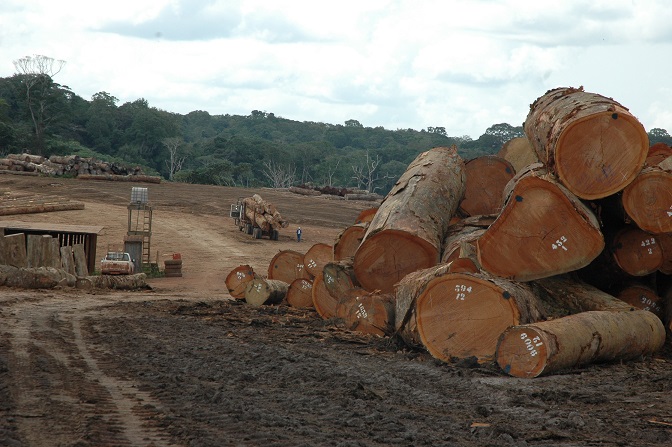
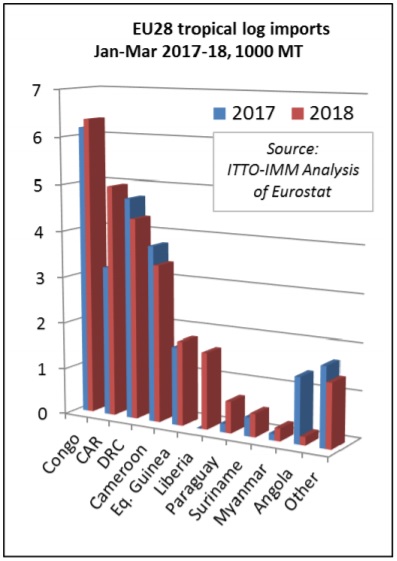
After a downturn in 2017, EU imports of tropical logs recovered a little ground at the start of 2018. Imports of 25,500 MT during the first quarter of the year were 9% greater than the same period in 2017.

EU imports of tropical logs increased from the two leading suppliers, Congo (rising 3% to 6,400 MT) and CAR (rising 54% to 5,000 MT).

EU log imports from Equatorial Guinea also increased during the period, by 8% to 1,800 MT. Imports from Liberia, of which there were none in the first quarter last year, were 1,600 MT in the same period this year.

However, during the first quarter of 2018, EU imports of tropical logs declined 9% from DRC to 4,300 MT and 11% from Cameroon to 3,400 MT. EU log imports from Angola, which increased sharply in 2017, were again at negligible levels in the first quarter of this year.

Most of the gain in EU imports of tropical logs in the first quarter of 2018 was concentrated in France (+43% to 11,400 MT) and Belgium (+15% to 5,800 MT). Imports of tropical logs in Portugal fell 32% to 3,800 MT during the period.

Malaysia: Sabah log export ban expected to revive the timber industry in the country

The export of logs from Sabah, a major timber producing state, has been banned with immediate effect.

The recently elected Chief Minister, Mohd Shafie Apdal, said the move was taken to ensure sufficient timber for mills in the State and secure jobs. The steady decline in availability of natural forest logs is behind this ban, say analysts.

In recent years Sabah exported between 200,000 and 300,000 tonnes of logs to countries such as China, Japan, Philippines and India.

James Hwong You Chuaang, President of Sabah Timber Industries Association (STIA), welcomed the ban saying this long awaited measure will help revive the timber industry in the State where many mills have been forced out of business because of a log shortage.

It is the uncertainty over log supply that has held back investment in downstream manufacturing said Hwong. The members of the STIA hope this ban will be the beginning of a new era in the timber industry in Sabah.

IKEA opens first Indian store in July at the lowest possible prices

IKEA prepares for the opening of its first store in India, in Hyderabad, this July. The biggest change that the Swedish furniture giant will bring on the Indian home furniture and furnishings market is the fact that it will sell 15% of its products for under Rs 200 (EUR 2,5).

We are very confident that we will enter the market with the lowest possible prices. There will be 1,000 products at prices below Rs 200 when we open our store,” Ikea India’s Maharashtra market manager Per Hornell told the daily.

As DNA reported, the company does not seem to be in a tearing hurry to expand its India footprint, with the Mumbai store, its second, expected to be launched only in mid-2019. What’s more interesting is that Ikea, which known for its big blue box stores and not for a serious digital presence, is expected to launch its online store following the Mumbai launch in a bid to take on companies such as Pepper Fry and Urban Ladder.

IKEA may also experiment with new business models such as home furnishing consultancy, wherein customers opting for the Ikea family members’ programme can request home visits for personalized recommendations.

Moreover, the company announced that it will make a tie-up with mobile-based services platform UrbanClap as its furniture assembly service partner for the Hyderabad store. This will allow Ikea to provide services at a low price, said Hornell, adding that these professionals trained by Ikea will reach the location within 90 minutes of booking the services online.

As reported by DNA, in May, UrbanClap, a mobile-based services marketplace said it has been engaged as the furniture assembly service partner for Ikea in Hyderabad. Ikea also said that it is looking for land in Ahmedabad and Surat to open stores, and has also signed a Memorandum of Understanding (MoU) with the Gujarat government for them.

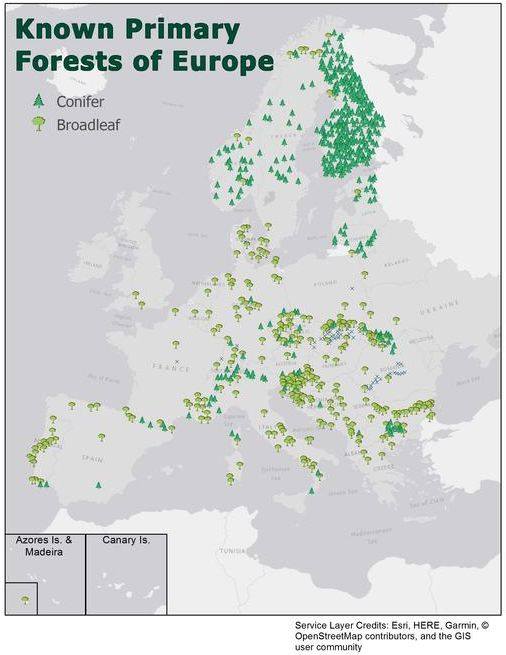
First map of the last primary forests in Europe released in Germany

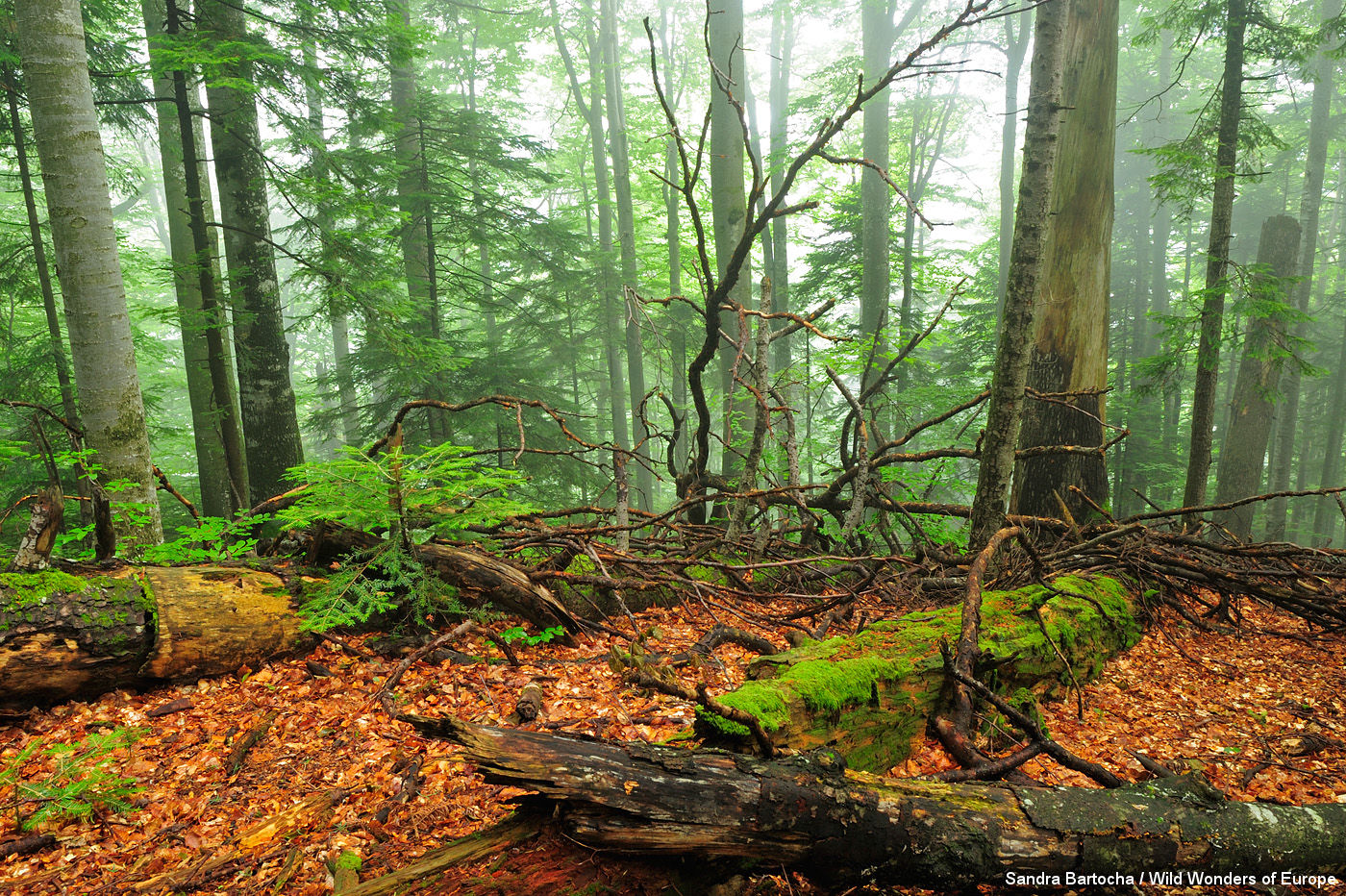
Scientists at the Geography Department of the Humboldt-Universität zu Berlin (HU) have compiled the first map of the remaining primary forests in Europe. The map includes more than 1.4 million hectares of primary forest across 34 countries.

It is not that these forests were never touched by man, this would be hard to believe in Europe”, explains Dr. Francesco Maria Sabatini. He is coordinator of the new study which has now been published in the journal Diversity & Distributions. “Still, these are forests in which there are no clear visible indications of human activities, and in which ecological processes follow natural dynamics.”

Prof. Dr Tobias Kümmerle (HU), co-author, highlights: “Although these forests only make up a very small fraction of the forested area of Europe they have enormous value for conservation. Primary forests are the only places where many species on the verge of extinction are still to be found. These forests are also vital for better understanding how human influences affect the forest ecosystem. Knowing where to find the last remaining primary forests is therefore extremely important. But prior to this study, there was simply no unified map for Europe.

In order to prepare this map, several different datasets needed to be merged and harmonized. Dr. Francesco Maria Sabatini: “The success of the study relied on collaborating with hundreds of forestry specialists, NGO activists, and other experts who shared their knowledge about their countries with us.

Even in Europe, preserving these pristine forests is not a matter of course

Although these forests occupy an area higher than previously expected, the study shows in particular that primary forests in Europe remain generally very rare, are located in remote areas, and are fragmented into small patches. Although 89 percent of Europe's primary forests are located within protected areas, they are still threatened.

Wide patches of primary forest are currently logged in mountain areas, for instance in Romania and Slovakia or in some Balkan countries. A soaring demand for bioenergy coupled with high rates of illegal logging are leading to the destruction of this irreplaceable natural heritage –  often without people even being aware that these forests are primary,” explains Professor Miroslav Svoboda, University of Life Science in Prague and co-author of the study.

The new map can contribute to preserving these forests. In addition, the map provides valuable evidence of where futher undiscovered patches of primary forest might be.

German furniture exports to the US, Canada and China grow strongly in the Q1/2018

The furniture exports from Germany increased by 1%, to approximately EUR 2.7 billion during the first quarter of 2018.

The exports to the US grew, particularly, with an increase of 25.3%, to EUR 127 billion worth of furniture. This increase brought the US to rank No. 7 in the most important export countries, as reported by the Association of the German Furniture Industry e.V. (VDM).

Exports to China grew by 24.2%, to EUR 80 million, while exports to South Korea increased by 40.9%, at EUR 10 million.

According to VDM Managing Director Jan Kurth, there is still hope that the opportunities offered by the global free trade will continue to be used by all players around the world to offer consumers the products of their choice at reasonable prices. After all, furniture imports from the US to Germany also posted a neat increase of 47.6% in the first quarter.

Recent issues of the goods exchange are proven by the example of Great Britain. In the first quarter of 2018, German furniture exports to the UK declined by 10.8% to EUR 166 million, reflecting the uncertainty of British consumers triggered by the Brexit debate and the slight depreciation of the pound against the euro. Also, imports from the island stagnated (+ 0.3%).

First quarter decline in EU imports of tropical sawnwood

EU imports of tropical sawn wood decreased 6% to 166,100 MT in the first quarter of 2018. This was mainly due to a continuing slide in imports from Cameroon, ongoing since the end of 2016.

EU imports of tropical sawn wood from the central African country declined a further 24% to 49,000 MT in the first three months of 2017. Imports also fell from Congo (down 4% to 9,400 MT), and Côte d'Ivoire (down 21% to 6,800 MT)

However, after a decline in 2017, EU imports of tropical sawn wood from Malaysia increased 18% to 29,300 MT in the first quarter of 2018. There was also a rise in imports from Brazil (+3% to 27,600 MT), Gabon (+7% to 22,600 MT), and Ghana (+8% to 3,600 MT) and DRC _+36% to 3,000 MT).

An 86% rise in EU imports of sawn wood from Indonesia (to 5,000 MT), a country which restricts exports in this product group to profiled wood, may be partly due to reclassification of some wood mouldings products from HS4409 to HS4407.

Introduction of the FLEGT licensing system in Indonesia since November 2016 has led to some changes in the HS codes used for Indonesian products by EU customs and operators to ensure consistency between codes identified on the licences issued in Indonesia and the codes entered on to customs forms for entry into the EU.

In the first quarter of 2018, tropical sawn hardwood imports declined 14% to 51,900 MT in Belgium, 9% to 18,600 MT in France, 30% to 10,700 tonnes in the UK, 11% to 6,800 MT in Germany, and 50% to 3,800 MT in Portugal.

These losses were partially offset by a 33% rise to 35,200 MT in the Netherlands, a 22% rise to 17,800 MT in Italy and a 6% rise to 12,600 MT in Spain.

Hardwood exports from the US to China get to record levels in Q1 2018

Amidst the trade dispute between China and the US, the hardwood exports to Sea and Greater China
rallied and exceeded the historic high, as compared to the same period of time in the past few years.

Fueled by the strong performance of Mainland China and Vietnam market, the exports value to
Sea and Greater China markets was over $644 million, rose 12.8% (YoY) and set a new record in Q1 of 2018.

Sea and Greater China markets accounted for over 62% of all global exports. Greater China
market increased at 14.3% (YoY) to $563 million and was the highest value among the same
period of time in the past few years.

Performance in Southeast Asia market mixed but overall exports value to this region was up
3.3% (YoY) to $81 million, in which 76.2% was contributed by Vietnam. Vietnam market rose
8% to $61.7 million (YoY) in which the export value of hardwood lumber up 9% to $49.6
million and veneer soared at 54% to $1.4 million (YoY).

Indonesia and Philippines markets also recorded a positive growth at 5.2% and 12.7% respectively. Other Sea markets dropped at different level, Malaysia down 18.9%; Thailand down 16.5%; Singapore down 25%.

Roundwood prices in Estonia significantly up over last year

Prices for roundwood in Estonia increased significantly in March 2018, as compared to the same month of 2017.
During the mentioned period, the prices for sawlogs increased at an average of 10-20%. Thus, pine sawlogs could be bought for EUR 77.67/m3, which is 18.65% more than in March 2017. At the same time, the price for spruce increased by 20.59%, to EUR 77.46/m3, and birch sawlogs could be bought for EUR 65.78m3 (10.68% more than last year).
At the same time, pulpwood assortments prices went up by an average of 30%, with the price for birch going up the most, by 36.82%, to EUR 33.18/m3. Pine and spruce could be bought for EUR 33.91/m3 and EUR 32.44/m3, respectively.

Roundwood prices EUR/m3 March 2017 February 2018 March 2018 Change % March 2017/March 2018
Sawlogs
Pine 65.46 76.57 77.67 +18.65
Spruce 64.23 77.01 77.46 +20.59
Birch 59.43 63.24 65.78 +10.68
Pulpwood
Pine 25.98 31.15 33.91 +30.52
Spruce 24.91 30.75 32.44 +30.22
Birch 24.25 30.99 33.18 +36.82

IKEA orders two kilns from Heinola for its production plant in Poland

IKEA ordered two large automatic 2-zone Progressive Kilns type HFB from Heinola Sawmill Machinery for its production plant in Stalowa Wola, Poland.

According to the announcement, the kilns have an annual capacity of ca. 55 000 m3 when drying 50 mm pine to 9 % final moisture content.

In 2015, Heinola delivered two similar kilns to the same plant.

IKEA opened Poland's largest sawmill in the south eastern city of Stalowa Wola in September 2014. The lumber produced is mainly used in IKEA factories in Poland and Slovakia and its processing capacity is of 400,000 m3 of logs per year.


Wood demand forecasts for Japan in 2018

Japan's Forestry Agency has recently organized a meeting regarding the future of the wood demand in the country, for the Q2 and Q3/2018.

During the meeting, officials discussed about the general demand for imported wood products that would certainly decline for both logs and lumber, while the domestic demand for lumber and plywood would increase. This would improve self-sufficiency rate but may result in oversupply of domestic logs.

The new housing starts have registered a steep decline, as compared to the same month in 2017, with an average of 953,000 new units, 8,000 units lower than it was previous forecast.

Due to high export prices, the Japanese forestry agency explained that the imports of North American logs and lumber would decrease. Also, the log supply for the second quarter of 2018 would improve, so the imports would increase by 2.4%. Yet, the third quarter imports would decline by 4.5% due to forest fires that happen during the summer months. The demand for these quarters would stay unchanged from 2017.

Supply of North American lumber would decline by 4.7% for the second quarter and the third quarter supply volume would stay the same as last year. Yet, the demand for the second quarter would decline by 8.3% and for the third quarter by 5.1%, because of high export prices, caused by overheated U.S. lumber market.

The supply overcomes the demand, so that the inventories at the end of the third quarter would increase. European lumber, which has increased for two straight years, would keep decreasing all through 2018, as the supply side is more interested in other markets and the prices in Japan have climbed high enough, officials reported.

Supply of both domestic and imported structural laminated lumber for the second quarter would decline by 4.3 % and for the third quarter by 3.8%. Reasons are continuous stagnation of whitewood products and dropping orders for redwood beam, as the demand has peaked on imported products, while domestic production would stay almost the same as last year.

Radiata pine log supply declined, while lumber supply increased in 2017. In 2018, log supply would stay the same as in 2017 and the lumber supply would increase slightly. The higher prices of radiata pine lumber would cause the demand to shift to lower costs for domestic cedar lumber.

As Japanese forestry officials discussed during the meeting, Russian log imports would continue to be  low through the third quarter, due to higher log exports duty. Russian lumber imports increased by 10.4% in the first quarter, but the second quarter supply would be the same as 2017, then drop by 9.1% for the third quarter. Reason is that other markets are more attractive for the Russian suppliers.

Demand for domestic logs would keep increasing through the third quarter. For lumber, the Forestry Agency made a policy as to give subsidy for use of solid wood. Also, the logs exports would increase for all the markets, particularly for China.

Lumber prices in the US set even higher records

The framing lumber market in the US was slow during last week, as to shake off a little bit of discomfort from the long weekend in the U.S.
Prices continued to post gains, but at a more gradual rate compared to earlier weeks in May. Resistance to record prices, credit limits, and fear of downside risk were among many reasons cited for holding back to reassess prospects going into June.
Nonetheless, more modest gains pushed the Random Lengths Framing Lumber Composite Price to a new high of $582.

Week
Jun 1
Week
May 25
Year Ago
2017
Random Lengths Framing Lumber Composite Price* $582 $578 $402
KD Western S-P-F #2&Btr 2x4 R/L Mill Price 655 653 366
KD Eastern S-P-F #1&2 2x4 R/L, delivered Great Lakes 725 722 460
Green Douglas Fir Std&Btr 2x4 R/L (Portland) 605 605 390
Southern Pine (Westside) #2 2x4 R/L 602 600 442
KD Coast Hem-Fir #2&Btr 2x4 R/L 660 655 395
Ponderosa Pine (Inland) #2&Btr 1x12 R/L 770 765 695
* Weighted average of 15 key items

Random Lengths Panel Market Report

Structural panel sales were sluggish, but tight supplies supported moderate price gains. Mills sales of OSB slowed, but prices maintained modest upward momentum on the strength of order files into late June.

Southern Pine plywood trading took on a more measured tone to start the week, but mills nudged quotes higher after extending order files. Activity in western Fir plywood was slow to start the holiday-shortened week Sales picked up late Wednesday.

(f.o.b. mill prices) Week
Jun 1
Week
May 25
Year Ago
2017
Random Lengths Structural Panel Composite Price* $570 $566 $400
Southern (west-east) 15/32-inch 3-ply rated sheathing plywood 547-580 545-575 345-375
Southern (west-east) 15/32-inch 4-ply rated sheathing plywood 552-590 550-585 350-380
Western 1/2-inch 4-ply rated sheathing plywood 563 557 403
North Central 7/16-inch Oriented Strand Board 445 440 320
*Weighted average of 11 key items

China boosts imports of tropical logs & sawnwood

China’s log imports from the USA in the first three months of 2018 totalled 1.41 million cubic metres, a year on year increase of 7% over the same period of 2017. China’s sawnwood imports from the USA in the first three months of 2018 rose 5% to 709,600 cubic metres.

Rise in tropical hardwood log imports

China’s log imports were 14.38 million cubic metres in the first three months of 2018, up 14% over the same period of 2017, hardwood log imports rose 25% to 4.93 million cubic metres.

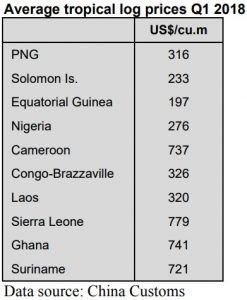
Of total hardwood imports in the first quarter 2018, tropical hardwood log imports totalled 2.65 million cubic metres, up 23% over the same period of 2017 and accounted for 18% of the national total. The value of tropical log imports in the first three months of 2018 was US$837 million reflecting a 28% rise.

The average price for imported tropical logs in the first three months of 2018 rose 5% to US$316 per cubic metre. Before its log export ban Myanmar was a major source of tropical logs for China. Data from China’s Customs shows log imports from Myanmar in the first three months of 2018 were just 2,500 cubic metres valued at US$3.43 million. At an average price of US$1,372 it seems unlikely that these were plantation logs.

China imported tropical logs mainly from Papua New Guinea (32%), Solomon Islands (28%), Equatorial Guinea (11%), Nigeria (5%), Cameroon (5%), Congo Brazzaville (4%). The top 10 suppliers accounted for over 90% of China’s tropical log imports in the first three months of 2018.

Rise in tropical sawnwood imports

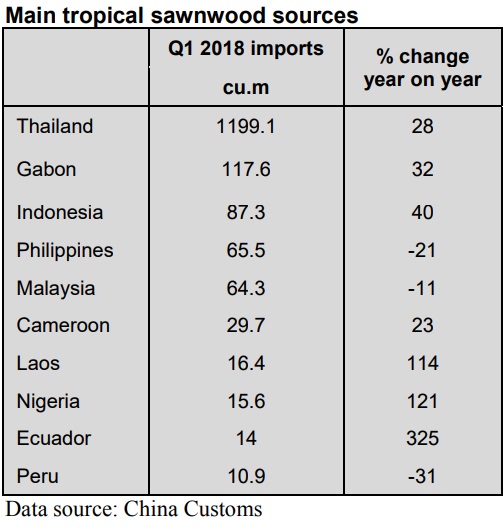
China’s sawnwood imports were 8.29 million cubic metres in the first three months of 2018, up 5% over the same period of 2017. Sawn hardwood imports rose 15% to 2.91 million cubic metres.

Of total sawn hardwood imports, sawnwood imports from tropical coumtries were 1.67 million cubic metres valued at US$662 million, up 25% in volume and 32% in value and accounted for 20% of the national total.

The average price for sawnwood imported from tropical countries was US$395 per cubic metre, down 7% from the the same period of 2017. Six tropical countries supplied just over 90% of China’s ‘tropical’ sawnwood requirements in the first three months of 2018 namely, Thailand (72%), Gabon (7%), Indonesia (5%), Philippines (4%), Malaysia (4%) and Cameroon (2%).

The International Woodworking Fair 2018 is forecast to have double-digit growth

Expectations are running high for this year’s International Woodworking Fair, which will feature over 1 million sq. ft. of exhibit space, around 1,000 exhibitors, and attendees from all over the US and more than 80 other countries.

Taking place at the Georgia World Congress Center in Atlanta, from August 22 to 25, IWF is recognized as one of the largest woodworking trade shows in the world for the furniture manufacturing, architectural woodwork, custom and general woodworking industries, IWF is a biennial event held in even years. The show is owned and sponsored by Woodworking Machinery Manufacturers of America and the Woodworking Machinery Industry Association.

IWF has increased by double digits, show-over-show, in attendance, exhibit space, square feet sold and exhibitors’ growth from 2012 to 2016. IWF 2018 is currently on pace for another double-digit growth across the board, compared to IWF 2016. We expect over 30,000 registrations for IWF 2018,” says Roberto Ghizzoni, show’s chairman and vice president of OMGA Industries.

IWF 2018 will feature an extensive education program with over 70 seminars on manufacturing, business management, marketing, production, design and other topics. New symposiums are in the works to cover 3D printing, powder coating, digital fabrication, lean manufacturing, and business conditions.

Other show highlights include the Design Emphasis student competition, Challenger’s Awards for product innovation, New Product Showcase, Decorative Surfaces Pavilion, and Cabinet & Closets Pavilion.

Our theme is ‘Imagine’ and every attendee will see what they can imagine and have access to many items they likely didn’t know existed. Everyone from the small shop to the large and medium companies will be able to find everything they need during their IWF experience,” says Ghizzoni.

Romanian authorities investigate Holzindustrie Schweighofer in organized illegal logging ring

On Wednesday, the 30th of May 2018, Romanian prosecutors executed 23 search warrants across the country related to a criminal investigation into the Austrian timber giant Holzindustrie Schweighofer.

The police raids, which included the company’s headquarters in Sebes, represent a new stage in the investigation into organized criminal activity that began three years ago.

The alleged organized criminal group includes Holzindustrie Schweighofer, several public institutions, and other companies suspected of engaging in “misappropriation of public auctions, tax evasion, unfair competition, illegal logging and other offenses,” according to a press release from the Romanian Directorate for the Investigation of Organized Crime and Terrorism (DIICOT).

Today’s police action shows that even a company as powerful as Schweighofer is not above law,” says David Gehl, Eurasia Program Coordinator for the Environmental Investigation Agency. “Illegal logging in Europe’s last great forests must have real and meaningful penalties.

Holzindustrie Schweighofer, the largest timber processor in Romania, has been active in the country since 2002, over a period when the Romanian government estimated that a large portion of all logging was illegal. An undercover video released by EIA in 2015 exposed a top Austrian Schweighofer official eager to purchase illegal wood.

A report issued by the Forest Stewardship Council (FSC) in 2016 also found clear and compelling evidence of illegal activity, resulting in Schweighofer losing its FSC certification. In a statement released on the 31st of May, the company reiterated that it has instituted a new tracking system, but EIA has shown that a major portion of their supply comes from third party log yards, which mask the origin of the timber and leave them at high risk for receiving illegally logged wood despite this new system.

Romania harbors Europe’s largest remaining virgin forests, which have become increasingly threatened by aggressive logging, including in National Parks. On May 26th, Romanian activists protested the destruction of Domogled National Park, Romania’s largest protected area, which has been among the most affected by destructive logging in the past ten years.

The forests of Romania are a treasure that should benefit all Romanians today as well as future generations,” says Gehl. “Schweighofer is finally starting to face the consequences for a decade of stealing the forests from the Romanian people.”

EU tropical timber imports flat-line in 2018

The slowdown in EU imports of tropical products, which began in 2016 and continued throughout last year, levelled off in the first quarter of 2018.

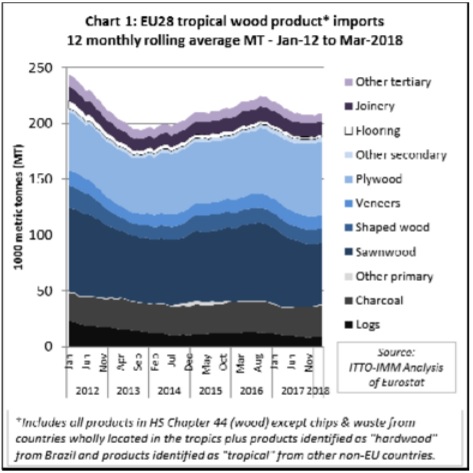
Chart 1 shows twelve monthly rolling average imports (to iron out seasonal fluctuations) into the EU of all tropical wood products listed in HS Chapter 44 (excluding wood waste and chips). It shows that imports peaked at an average of 224,000 metric tonnes (MT) per month in September 2016, slipped to a low of 207,000 MT in January this year and recovered only slightly, to 209,000 MT, by March 2018 (Chart 1).

EU imports of tropical wood products in the first quarter of 2018 were only around 7% more than the all-time low of 195,000 MT per month recorded in the middle of 2013 at the height of the euro-zone crises.

In value terms, EU imports of tropical wood products averaged around euro203 million per month in the first quarter of 2018, 13% more than the all-time low in 2013 but 6% down on the level prevailing in 2016.

Most of the rise and subsequent slowdown in EU tropical imports in the last three years was driven by sawnwood.

The stabilisation of the EU’s tropical wood trade so far in 2018 is mainly due to a slight uptick in imports of plywood and charcoal.

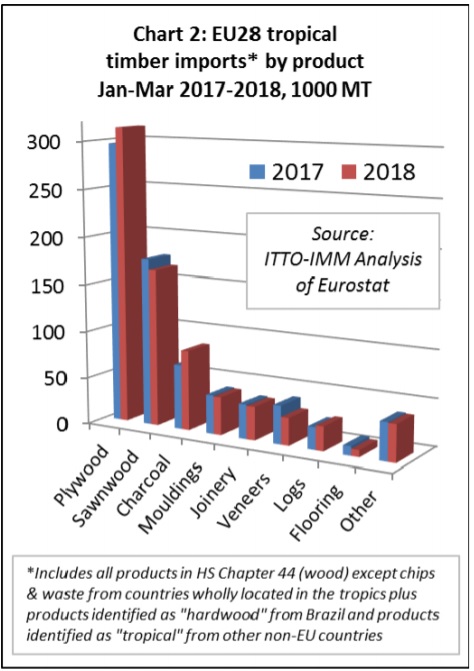
In the first quarter of 2018 compared to the same period in 2017, total EU imports of tropical wood products increased 1% to 740,000 MT. There was a 23% rise in imports of tropical charcoal to 85,000 MT, a 6% rise in imports of tropical plywood to 314,000 MT, and 9% rise in imports of other secondary products (such as fibreboard and sleepers) to 14,000 MT.

However, these gains were largely offset by a 6% decline in EU imports of tropical sawn to 166,000 MT, a 28% decline in imports of tropical veneer to 29,000 MT, a 2% fall in imports of tropical mouldings to 40,000 MT, and a 10% fall in imports of various tertiary products (such as flooring, glulam and other joinery, marquetry, and wooden tools) to 64,000 MT (Chart 2).

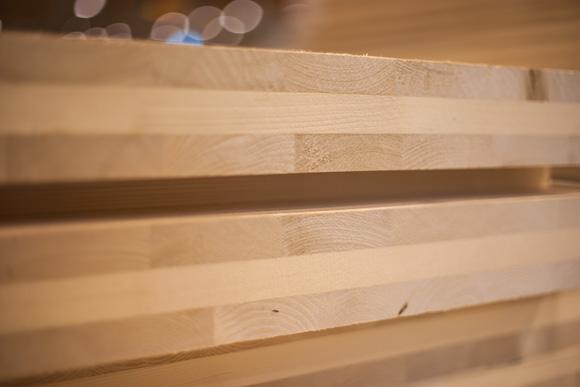
Brazil as source of timber for CLT production

The global market for cross-laminated timber (CLT) is expected to be worth around US$2 billion by 2025 according to a new report published by Grand View Research, Inc. One of the factors driving this will be an increase in the building of wooden homes.

The press release from the research company says rising awareness about the environmental hazards caused by the use of cement concrete in infrastructure construction coupled with rising number of cross laminated timber manufacturers and increasing demand for green homes are factors propelling the market growth.

The shift from concrete-based construction to woodbased construction around the world is positively influencing the market. In addition, the cost effectiveness of CLT and shorter construction time will drive demand.

Europe was the first to investigate cross laminated timber and research. The availability of timber from the forests of central European countries and advanced timber processing industries are the leading cause for market growth in Europe. Countries like Canada, the U.S., New Zealand, Japan and China are also rapidly developing markets for cross laminated timber.

This development could benefit Brazil say analysts because plantations in Brazil mature quickly and are a good source of raw material for CLT production.

Log export ban in Malaysia still active

Until some important issues get solved, the Malaysian government’s decision to temporarily ban the export of round logs will remain active.

According to Bernama Malaysian National News Agency, Chief Minister Datuk Seri Mohd Shafie Apdal said that “what must be done has to be done immediately” and quipped that he would not entertain lobbying from any quarters and the decision to impose the ban on logs was endorsed at the sate Cabinet meeting on Monday.

There are serious decisions to be made concerning the logging industry in Sabah and I have to put my foot down in the best interest of the people.I realise that its a tough decision to make but it has to be done. As a matter of fact, it should have been implemented a long time ago.

The ban could be temporary or it could be long-term, and the matter will be studied thoroughly. I am all for our logs to be processed locally so that legal sawmills can operate and provide sawn timber and other value-added products, which in turn would create more job opportunities,” he said.

The chief minister said the Sabah Forestry Department would be directed to inform all players, concessionaires, as well as, operators of Forest Management Units (FMUs)  to comply with the Cabinet’s decision with immediate effect.

On Monday, the chief minister ordered the Yayasan Sabah Group’s Forestry Division to undertake a comprehensive review of its operations after it was disclosed that ‘exclusive operators’ held a monopoly and took the bulk of the profits.

Mohd Shafie, who is also Sabah Foundation Chairman, expressed disbelief and sadness when told that Rakyat Berjaya (RBJ) Sdn Bhd, the operator of the foundation’s timber resources, had been in the red for four out of five years since 2013.

‘Exclusive operators’ are companies which enjoyed special privileges from the previous government and former Chief Minister. Their deal involved extraction of logs, buying them and then having the privilege of exporting them at the best prices while RBJ only received a fraction of the profits.

RBJ’s operations also seem to indicate that the company can make better profits if logs are processed into sawn timber. It was noted that RBJ could earn better profits if it sold the logs themselves. Mohd Shafie said such a policy must stop as whatever business deals the government or its agencies are involved with must be productive and bring maximum benefit, not for the leaders, but the people, as reported by Bernama Malaysian National News Agency.

“Now it looks like the well-connected ‘exclusive contractors’ are reaping in fat profits out of logging activities while Yayasan Sabah is paid pittance and in some cases even incur debts.

“It is obvious that only a handful of people are benefiting from the logging operations while Yayasan Sabah is forced to downsize as there is very little money for its operations," said Mohd Shafie, adding that there was an urgent need to put matters right.

He promised to pave the way for Yayasan Sabah to regain its glorious days and be able to finance its core activities of providing education and free medical services to the needy.

Newsletter

Subscribe to our digital newsletter for your daily digest of essential news, views and analysis from the international wood industry delivered directly to your inbox.


0