Article archive

China tropical sawnwood imports up 15%; purchase prices fall

Chinese tropical sawnwood imports in 2015 totalled 4.77 million cubic metres, accounting for 18% of the national total and were valued at US$2.1 billion reflecting a 15% rise in volume but a 6% decline in value, ITTO reported.
The average price for imported tropical sawnwood was US$432 per cubic metre, a year on year decline of 19%. Just 10 countries supplied just over 96% of China’s tropical sawnwood requirements in 2015 namely, Thailand (64%), Gabon (7.2%), Philippines (6.6%), Indonesia (5.3%), Malaysia (5.2%), Cameroon (2.6%), Laos (2.2%), Ecuador (1.2%), Peru (1.1%) and Congo Rep. (1.1%).
Tropical sawnwood imports from Cameroon rose sharply (123%) in 2015 and imports from the Philippines fell dramatically (-47% ) over the same period.
The main entry points for tropical sawnwood imports in 2015 was Guangzhou and Shanghai Ports which accounted for 52% and 15% respectively of all tropical sawnwood imports.
Top 10 suppliers of sawn tropical hardwood

 2015 imports in mil. cubic meters Change in % 2014/2015
Thailand  3,050,000 37%
Gabon  340,000 41%
Philippines  320,000 -46%
Indonesia  250,000 -12%
Malaysia  250,000 0
Cameroon  120,000 24%
Laos  110,000 -27%
Ecuador  60,000 123%
Peru  50,000 -8%
Congo Rep.  50,000 20%
Data source: China Customs

Average prices for tropical sawnwood

 2015 US$/cubic meter Change in % 2014/2015
Thailand  338 -26%
Gabon  645 -2%
Philippines  148 -5%
Indonesia  770 -7%
Malaysia  496 -16%
Cameroon  679 6%
Laos  1240 -26%
Ecuador  910 21%
Peru  818 1%
Congo Rep.  651 13%
Data source: China Customs

 
[gravityform id="1" title="true" description="true"]
 
[gravityform id="2" title="true" description="true"]

Södra reports marked increase in bioenergy products exports

Södra's bioenergy production is growing, and more and more agreements are being signed. Exports of energy products are also on the rise. While the Danish market, in particular, is showing strong demand, more markets are beginning to show an interest, as Södra says in a press release.
Södra's main energy product market is Sweden, but the export market is growing. In addition to the Danish market, there is a major interest in Norway and large volumes are being used to replace coal in the UK. In Denmark, Södra's energy products are used by both individual consumers and large thermal power stations. Deliveries mainly comprise pellets and briquettes, but also shavings. The density of pellets and briquettes is higher than sawdust, which makes them more energy efficient. And when fewer vehicles are needed to transport higher volumes, this efficiency is doubled, Södra says.
"We haven't seen the end of this yet," says Gustav Tibblin, Director of Business Development at Södra. "Bioenergy is a future issue for all of society, and Södra's raw material has a very high standing in the market. The raw material from our members' estates comes from responsible and certified forestry, and we utilise every part of the tree.
New energy products
One example of new energy products is the briquettes, or "heat logs," that are made at the company's sawmill in Kinda. They are symmetrical bricks used as firewood in stoves, and are produced from the chips and sawdust at the final stage of the sawing process, after the timber has been dried and planed. The product is therefore derived from a secondary flow, and demand is growing:

"In two years, our annual production has grown from around 100 to 1,500 pallets," says Patrik Wass, Sawmill Manager at Kinda. "The briquettes burn longer and generate more heat compared with conventional logs."

Energy generation plays a natural role in Södra's operations, according to Gustav Tibblin, and Södra produces energy, electricity and fuel as part of all its processes - in the forest, in the mills and in the sawmills.

"The culture of Småland is deeply ingrained in our roots; we don't let anything go to waste," says Gustav Tibblin. "At the same time, society is undergoing a transition, and we have to replace fossil-fuel energy with bioenergy. We can, and want, to participate and contribute. Growing energy is what we do."

Facts: 
Bioenergy is energy derived from biological and renewable materials. Biofuel is fuel derived from biological materials that can be used in district heating plants, industry, vehicles, and so forth. Liquid biofuel is the type of biofuel that is used to power vehicles.

 
[gravityform id="1" title="true" description="true"]
 
[gravityform id="2" title="true" description="true"]

Greenpeace: Illegal timber from Cameroon's rainforests landing in Chinese ports

Greenpeace is conducting an investigation on a log supplier from Cameroon, which, apparently, is illegally cutting wood from the African rainforests and exports it to China.The investigation – operating across three continents – is currently focused on Cameroonian timber trader Compagnie de Commerce et de Transport (CCT), according to Greenpeace.
The investigation also found similar concerns about European imports from the same trader leading to action last week by Dutch regulators.
The presence of wood from the same supplier (CCT) in China may open up the possibility of illegally cut wood re-entering the EU market once it has been processed, says Greenpeace. The timber comes from Cameroon’s rainforest and CCT is buying substantial amounts of logs from firms which Greenpeace investigators found to be involved in illegal logging.
Greenpeace has uncovered huge stockpiles of CCT wood in the Chinese port of Zhangjiagang – where no law prevents the import of illegally-felled wood. The organization also has photos that reveal many logs carrying the logos of companies and cutting titles of operators that Greenpeace field investigations have found to be engaged in illegal logging.
Since 2000 trade has shifted away from sensitive markets.  Although last year Belgium and Italy alone appear to have imported more Cameroonian timber than China, the EU market’s significance as a destination for Cameroonian wood has decreased, while China’s significance has increased.
At the same time, a 2014 report of the Independent Auditor of the Cameroon forestry sector found that not a single logging title in Cameroon can currently be considered legal when the currently agreed – but as yet not established – legality criteria are applied.
Yet, the Cameroonian government has rejected the investigation’s claims as inaccurate and suggested that the timber suppliers providing logs to CCT are operating legally.
 
[gravityform id="1" title="true" description="true"]
 
[gravityform id="2" title="true" description="true"]


Greenpeace: Illegal timber from Cameroon’s rainforests landing in Chinese ports

Greenpeace is conducting an investigation on a log supplier from Cameroon, which, apparently, is illegally cutting wood from the African rainforests and exports it to China.The investigation – operating across three continents – is currently focused on Cameroonian timber trader Compagnie de Commerce et de Transport (CCT), according to Greenpeace.

The investigation also found similar concerns about European imports from the same trader leading to action last week by Dutch regulators.

The presence of wood from the same supplier (CCT) in China may open up the possibility of illegally cut wood re-entering the EU market once it has been processed, says Greenpeace. The timber comes from Cameroon’s rainforest and CCT is buying substantial amounts of logs from firms which Greenpeace investigators found to be involved in illegal logging.

Greenpeace has uncovered huge stockpiles of CCT wood in the Chinese port of Zhangjiagang – where no law prevents the import of illegally-felled wood. The organization also has photos that reveal many logs carrying the logos of companies and cutting titles of operators that Greenpeace field investigations have found to be engaged in illegal logging.

Since 2000 trade has shifted away from sensitive markets.  Although last year Belgium and Italy alone appear to have imported more Cameroonian timber than China, the EU market’s significance as a destination for Cameroonian wood has decreased, while China’s significance has increased.

At the same time, a 2014 report of the Independent Auditor of the Cameroon forestry sector found that not a single logging title in Cameroon can currently be considered legal when the currently agreed – but as yet not established – legality criteria are applied.

Yet, the Cameroonian government has rejected the investigation’s claims as inaccurate and suggested that the timber suppliers providing logs to CCT are operating legally.


[gravityform id="1" title="true" description="true"]


[gravityform id="2" title="true" description="true"]


France: Worries on massive log exports to Asia

The log exports from France gathers 15% of the national forest’s assets. Yet, it provides only 3% added value, according to Fédération Nationale du Bois (FNB). China alone accounts for 1 million m3 log exports and this represents € 800 million loss value and 40 million of tax and social security revenues lost for France, as FNB says.
Another important issue is that exporting the unprocessed logs attracts jobs losses in France. In terms of added value, the ratio is 1 to 10 in favor of the industry. Thus, 10 000 m3 of logs exported create one job, while 10 000 m3 of logs processed in France create 10 jobs.
According to FNB, exports of processed logs would cut terrestrial and maritime pollution in France by 2.3 times. A container of oak logs contains approximately 22 m3 or 26 tonnes (thickness of of 1.2 t / m3 x 22 m3). A container of dried oak sawn timber contains approximately the equivalent of 50 m3 of logs. The bark, ecological fuel of high quality, remains thus in France to feed nationwide boilers.
The case of oak logs is the most striking, FNB emphasizes. Between 2007 and 2014, the volume available for the French sawmills has gone down from 2.45 million m3 in 2007 to 1.25 million m3 in 2014. At the same time, the price paid to forest owners has doubled. 80% of the exported logs are logs that sawyers need to run their sawmills.
Before exporting, the logs are treated with a chemical (cypermethrin), harmful to the forest environment, which is not recognized by the Chinese authorities. And for which the marketing authorization for such use was suspended by ANSES ( France's sanitary agency) because of its lack of efficacy. This treatment is already banned in Belgium and Germany.
France proposes to set up new treatments methods starting April 1, which are already practiced by many countries in the world (USA, Canada, New Zealand), because the ease of implementation is already proven. There are more than 1000 machineries installed in France and the debarking equipment costs for exporters is modest. France must modernize its practices and harmonize them with those of industrialized countries rather than countries which are under developed, FNB commented.
Fédération Nationale du Bois is a leading French professional organization of companies in the forest industry. FNB brings together 80 national, regional or business dedicated to French wood and its use. It thus represents 1750 companies for 5 billion euros in turnover.
 
[gravityform id="1" title="true" description="true"]
 
[gravityform id="2" title="true" description="true"]


Austrian Binderholz expands in Finland

Binderholz Group, one of the largest manufacturers of solid wood products in Europe, has now expanded its production in Northern Europe. The Austrian company bought the Finnish sawmill operator Vapo Timber in January 2016, according to Good News Finland.
The sawmill has two sites in Eastern Finalnd, located in Lieksa and Nurmes, which will be Binderolz’s headquarters in Northern Europe. The two sawmills will work under the name “Binderholz Nordic”, expanding the 60 years operations of the Austrian company.

“[This acquisition] is of great importance for Binderholz. It opens up new dimensions in terms of the quality of our machined products [and] enables us to enter new markets and reach new milestones," stated Hans Binder, company owner.

As GNF reported, woodwork and construction industry in Germany, Benelux, Scandinavia and the UK will be aided by these two sawmills owned by Binderholz. Also, Central Europe will receive timber from the Finnish facilities.
The 147 employees at the sawmills will soon be growing by 40 to 80 more staff in the next years, according to company’s plans. At the moment, Binderholz has 1350 employees at its sites in Austria, Germany and Finland.
Finland also meets Binderholz’s values, especially on sustainable and future-oriented forest management. The company operates on a no-waste principle and all its waste timber is turned into biofuels or green electricity.
Binderholz’s production specifically requests raw materials of spruce and pine, a thing that led them to Finland. The sawmills' capacity will be increased from 1.75 million m3 to 2.55 million m3 per year. Binderholz also wants to invest more in production and processing capabilities in Finland and the company will make further plans to build a center of solid wood production in the country.
 
[gravityform id="1" title="true" description="true"]
 
[gravityform id="2" title="true" description="true"]



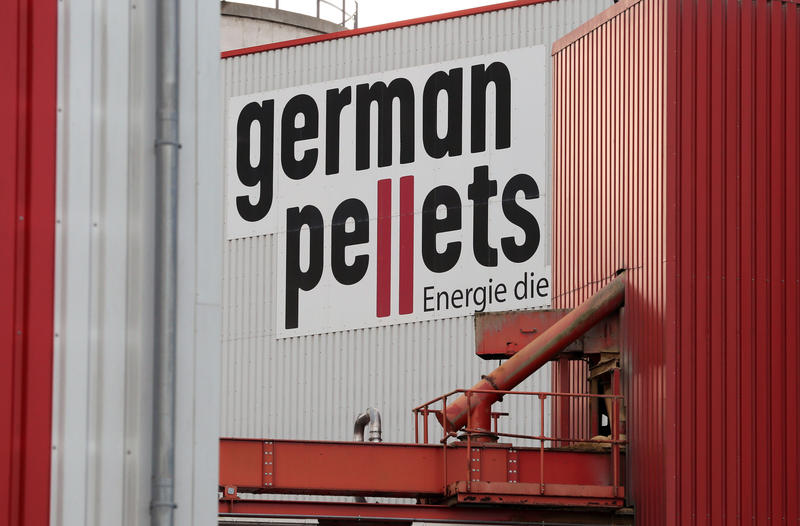
130 companies interested in buying German Pellets

130 companies have shown their interest in buying the insolvent German Pellets GmbH. They sent their requests to Bettina Schmudde, provisional solvency administator for Wismar’s wood pellets producer. Apparently, the company will have a future despite the fact that it went bankrupt on the 10th of February.

Wolfgang Weber-Thedy, spokesman for the insolvency administrator, stated that "the large number of prospective customers is very gratifying. The best would be the continuation of the company's new trainer."

The 130 companies interested in German Pellets are very qualified, as they include financial investors and industrial enterprises from the wood industry. Yet, "as for the names of the candidates, we are obliged to maintain strict silence.” Thedy said.
German Pellets GmbH filed for insolvency on the 10th of February at the regional court of Amtsgericht Schwerin, Germany and Lawyer Bettina Schmudde from Kanzlei White & Case law firm was appointed as provisional solvency administrator.
 
 
[gravityform id="1" title="true" description="true"]
 
[gravityform id="2" title="true" description="true"]



Italian woodworking giants, SCM&Biesse, achieve considerable growth in 2015

Italian woodworking machinery giants have reported a considerable growth in 2015. One of the giants of the industry, the SCM Group, held its press conference with the 2015 results on the 17th of March 2016 as part of the 18th Holz-Handwerk trade fair in Nuremberg, Germany.
The SCM Group is a leading producer of technology solutions for the woodworking industry. The Group, headquartered in Rimini, Italy, includes 20 overseas branches, 3 main production centres in Italy with total area of 600,000 square meters, and over 3,000 employees, 1,000 assistance technicians and over 350 distributors and agents operating in 120 countries.

"We are extremely pleased with the 2015 results. We closed the year with over 500 million Euro in sales, a 10% growth compared to 2014, and with 56 million of gross operating margin, a net profit of 17 million and debt down to zero," said Andrea Aureli, the SCM Group Chief Executive Officer.

SCM"We also recorded significant achievements in overseas markets, which account for 90% of our business. We opened three new branches in Dubai, Kuala Lumpur and the U.S. West Coast, expanding our already widespread international network," he continued.
“With our Woodworking Machinery Division – whose offering addresses the entire secondary wood processing sector, with a market value estimated at 3,300 million Euro – we have reached a turnover exceeding 380 million Euro, a brilliant result which places us as the second player in the sector. The Division’s turnover has increased by 23% compared to 2014, with over 17,000 machines sold," said Mr. Luigi De Vito, Director of the SCM Group Woodworking Machinery Division
Biesse reports 21.5% increase in sales
Biesse, the second global manufacturer of woodworking machinery, reached sales of EUR 519.1Biesse1 million that represented an increase of 21.5% compared to 2014 (EUR 427.1 million). EBITDA in 2015 reached EUR 64.1 million compared to EUR 40.9 million in 2014 for an increase of 52.9%.
This important improvement in 2015 allowed the Italian machinery manufacturer to improve its profit by 52.9% reaching EUR 21.1 million, compared to EUR 13.8 million in 2014. All geographical markets grew in 2015 led by North America (+51.9%) and Asia Pacific (23.0%). The company, according to its latest 3-year plan, expects to reach EUR 704 million in sales in 2018.
On the basis of the results achieved it seems fair to say that in 2015 Biesse has significantly outperformed the indications given for its core sectors, both in terms of order intake and in terms of growth in its production order book. Total order intake for the Biesse Group in 2015 was 17.8% higher than in 2014, while the order book totalled more than Euro 141 million at end-2015 (+21.5% compared to 2014).
In the breakdown of revenues by division, the Wood Division was responsible for 73.2% (72.5% in 2014), Glass/Stone Division for 15.6% (15.5% in 2014), Mechatronics Division for 14.2% (14.8% in 2014) and the Tooling Division for 2.0% (2.3% in 2014).
2015- A good year for the Italian woodworking industry
Overall, the year 2015 will not be remembered as a season of records, but for the Italian woodworking technology industry last year was undoubtedly better than expected. The trends based on the positive figures of the preliminary balance published by the Italian machinery and equipment manufacturers association (Acimall) show encouraging signals.
Production of the Italian woodworking industry has increased to Euro 1,790 million, 7.2% more than Euro 1,669 million in 2014, when the industry had already achieved an excellent increase by 8.6% over 2013. The trend towards the restoration of pre-crisis levels (in 2008 the Italian industry turnover exceeded Euro 2 billion) is clear and consistent. Export remains the key strength of the Italian woodworking companies: in 2015, they managed to increase shipments by 6.8% as compared to 2014.
 
[gravityform id="1" title="true" description="true"]
 
[gravityform id="2" title="true" description="true"]

Italian woodworking giants, SCM&Biesse, achieve considerable growth in 2015

Italian woodworking machinery giants have reported a considerable growth in 2015. One of the giants of the industry, the SCM Group, held its press conference with the 2015 results on the 17th of March 2016 as part of the 18th Holz-Handwerk trade fair in Nuremberg, Germany.

The SCM Group is a leading producer of technology solutions for the woodworking industry. The Group, headquartered in Rimini, Italy, includes 20 overseas branches, 3 main production centres in Italy with total area of 600,000 square meters, and over 3,000 employees, 1,000 assistance technicians and over 350 distributors and agents operating in 120 countries.

"We are extremely pleased with the 2015 results. We closed the year with over 500 million Euro in sales, a 10% growth compared to 2014, and with 56 million of gross operating margin, a net profit of 17 million and debt down to zero," said Andrea Aureli, the SCM Group Chief Executive Officer.

SCM"We also recorded significant achievements in overseas markets, which account for 90% of our business. We opened three new branches in Dubai, Kuala Lumpur and the U.S. West Coast, expanding our already widespread international network," he continued.

“With our Woodworking Machinery Division – whose offering addresses the entire secondary wood processing sector, with a market value estimated at 3,300 million Euro – we have reached a turnover exceeding 380 million Euro, a brilliant result which places us as the second player in the sector. The Division’s turnover has increased by 23% compared to 2014, with over 17,000 machines sold," said Mr. Luigi De Vito, Director of the SCM Group Woodworking Machinery Division

Biesse reports 21.5% increase in sales

Biesse, the second global manufacturer of woodworking machinery, reached sales of EUR 519.1Biesse1 million that represented an increase of 21.5% compared to 2014 (EUR 427.1 million). EBITDA in 2015 reached EUR 64.1 million compared to EUR 40.9 million in 2014 for an increase of 52.9%.

This important improvement in 2015 allowed the Italian machinery manufacturer to improve its profit by 52.9% reaching EUR 21.1 million, compared to EUR 13.8 million in 2014. All geographical markets grew in 2015 led by North America (+51.9%) and Asia Pacific (23.0%). The company, according to its latest 3-year plan, expects to reach EUR 704 million in sales in 2018.

On the basis of the results achieved it seems fair to say that in 2015 Biesse has significantly outperformed the indications given for its core sectors, both in terms of order intake and in terms of growth in its production order book. Total order intake for the Biesse Group in 2015 was 17.8% higher than in 2014, while the order book totalled more than Euro 141 million at end-2015 (+21.5% compared to 2014).

In the breakdown of revenues by division, the Wood Division was responsible for 73.2% (72.5% in 2014), Glass/Stone Division for 15.6% (15.5% in 2014), Mechatronics Division for 14.2% (14.8% in 2014) and the Tooling Division for 2.0% (2.3% in 2014).

2015- A good year for the Italian woodworking industry

Overall, the year 2015 will not be remembered as a season of records, but for the Italian woodworking technology industry last year was undoubtedly better than expected. The trends based on the positive figures of the preliminary balance published by the Italian machinery and equipment manufacturers association (Acimall) show encouraging signals.

Production of the Italian woodworking industry has increased to Euro 1,790 million, 7.2% more than Euro 1,669 million in 2014, when the industry had already achieved an excellent increase by 8.6% over 2013. The trend towards the restoration of pre-crisis levels (in 2008 the Italian industry turnover exceeded Euro 2 billion) is clear and consistent. Export remains the key strength of the Italian woodworking companies: in 2015, they managed to increase shipments by 6.8% as compared to 2014.


[gravityform id="1" title="true" description="true"]


[gravityform id="2" title="true" description="true"]

21 March celebrates the International Day of Forests

On 21 March we celebrate the International Day of Forests. This event creates an excellent opportunity to bring multiple forest values to the attention of all of us. The day aims to “raise awareness of the importance and strengthen the sustainable management, conservation and sustainable development of all types of forests” .
Forests cover one third of the Earth's land mass, performing vital functions around the world. Around 1.6 billion people - including more than 2,000 indigenous cultures - depend on forests for their livelihood.
Forests are the most biologically-diverse ecosystems on land, home to more than 80% of the terrestrial species of animals, plants and insects. They also provide shelter, jobs and security for forest-dependent communities.
Yet despite all of these priceless ecological, economic, social and health benefits, global deforestation continues at an alarming rate - 13 million hectares of forest are destroyed annually. Deforestation accounts for 12 to 20 percent of the global greenhouse gas emissions that contribute to climate change.
The theme of the 2016 International Day of Forests is “forests and water”. To mark the Day, an UNECE and FAO joint celebration of the International Day of Forests and World Water Day will be held on Monday, 21 March 2016 in the UN Economic and Social Council Chamber.
The event entitled “Forests and Water | Sustain Life and Livelihoods” will raise awareness of the interconnections between forests and water and their contributions to the implementation of the 2030 Agenda for Sustainable Development.
 
[gravityform id="1" title="true" description="true"]
 
[gravityform id="2" title="true" description="true"]

Price of Austrian wood pellets drops in March

In March 2016, the price of wood pellets in Austria dropped slightly. Moreover, the price is well below the same month of 2015.
This month, Austrian Enplus A1 pellets cost on average € 235.4 per tonne, -0,7% compared to February and -4.7% cheaper than March 2015.
Austrian wood pellets presently offer a price advantage of -14.3% as opposed to extra light heating oil and -43.3% as opposed to natural gas.
Wood pellets in bags cost an average of 3.99€ per 15 kg sack (when ordered by the pallet).This represents a -1.2% decrease over March 2015, but a +0.2% increase as compared to February 2016.

€ Price evolution of wood pellets in Austria (June-2014/March-2016)

Price of wood pellets in Austria
Create line charts

 
[gravityform id="1" title="true" description="true"]
 
[gravityform id="2" title="true" description="true"]

Lower US sawn hardwood imports at start of 2016

US imports of all sawn hardwood fell one third from December 2015 to January 2016. 53,221 cu.m. of sawn hardwood were imported in January worth US$33 million.
Tropical sawnwood imports declined 30% in January to 14,524 cu.m. Tropical sawnwood accounted for 27% of all sawn hardwood imports in January, compared to 23% in 2015 for the entire year.
The only tropical species to gain significantly in January was keruing. Keruing imports recovered from low volumes last December and reached 1,699 cu.m. in January.
Imports of meranti sawnwood increased to 876 cu.m., but imports of all other major species declined in January. Balsa imports were down 29% (3,686 cu.m.). Sapelli posted the smallest decline from the previous month at 2,328 cu.m. (-7%).
Imports from Brazil fell by one third the previous month due to lower US imports of ipe and jatoba in January. Cameroon’s shipments to the US grew 17% month-on month.
Sapelli imports from Cameroon increased to 1,026 cu.m. despite an overall decline in sapelli imports in January. Acajou d’Afrique imports from Cameroon were also slightly up from December at 753 cu.m.
Sawnwood imports from Malaysia more than tripled in January, but December imports had been exceptionally low. In January the US imported a total of 1,806 cu.m. from Malaysia, including 1,336 cu.m. of keruing.
Tropical imports from all other major suppliers were down in January, both compared to the previous month and to January 2015.

Source of Sawn Hardwoods January 2016 cubic meters Change in % on December 2015
Ecuador 3,686 -27%
Brazil 2,078 -33%
Cameroon 1,954 17%
Malaysia 1,806 236%
Congo (Brazzaville) 905 -60%
Peru 34 -82%
Indonesia 894 -22%
Ghana 504 -13%
Cote d'Ivoire 386 -16%
Source: US Department of Commerce, US Census Bureau, Foreign Trade Statistics

 
[gravityform id="1" title="true" description="true"]
 
[gravityform id="2" title="true" description="true"]

Limited access to certification for wood imported from outside EU

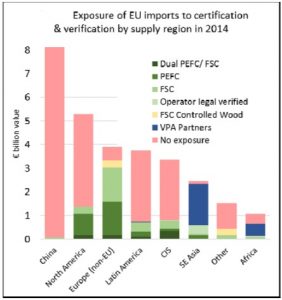
In contrast to intra-EU trade, level of exposure to some form of certification or legality verification of all EU timber products imports from outside the EU was only around 25% in 2014. While low, this figure is heading in the right direction, rising from 19% in 2007, as ITTO reported.
The assessment also indicates that if all timber from the 17 countries that are now engaged in FLEGT VPAs had been licensed in 2014, the level of exposure to legally verified timber in EU external trade would have been 8% higher, at 33%.
EUcertificationThe increase due to VPA countries excludes areas already certified or legally verified in these countries (notably by SVLK in Indonesia, PEFC/MTCS in Malaysia and FSC in Central Africa) which are already included in the 25% figure.
Obviously that leaves a large proportion of imports which are unlikely to be from third party certified or legally verified sources. The chart on the left shows that China dominates amongst EU-supplying countries with low exposure to verified timber. China's level of exposure to certification is set to increase significantly.
The 2014 data does not include figures for the China Forest Certification System (CFCS) which was endorsed by PEFC in February 2014 but had yet to register any PEFC-certified forest at the end of that year.
By the end of 2015, 5.6 million hectares were registered as PEFC certified in China and more recent reports from the China State Forestry Administration indicate that around 10 million hectares of forest are now certified – although most of that area is natural protection forest and China’s large area of production plantation forest is still largely uncertified.
North America is identified as another region with “low exposure” to legality verification and certification. Most commercial forest land in Canada is certified. In contrast, the U.S. has a large area of private non-industrial forest land which is not certified. The US government also has a long-standing policy commitment not to pursue certification of federal forest lands.
Latin America is assessed to have relatively low level of exposure to certification and verification. However this figure is severely distorted by reliance on forest area to calculate the index.
The Amazonian rain forest is, of course, huge and only a tiny proportion is certified. But this area only contributes a relatively small volume of timber to international trade.
Most of wood product imported into the EU from Brazil now constitutes softwood or eucalyptus from plantations outside the tropical zone, many of which are certified.
Therefore the index probably underestimates the real level of exposure of Latin American wood products in trade.
While the VPA process captures only a relatively small proportion of total EU imports of timber and timber products, it is very significant amongst tropical supplying countries in South East Asia and Africa.
If all timber products imported by the EU from VPA countries were FLEGT licensed, the level of exposure to verified timber from Southeast Asia would rise from 25% to 95% and from Africa from 11% to 60%.
 
[gravityform id="1" title="true" description="true"]
 
[gravityform id="2" title="true" description="true"]

Russia and Canada main sources of sawnwood for China

Russia was the main sawnwood supplier to China in 2015 accounting for 36% of the national total. Imports from Russia totalled 9.29 million cubic metres, a year on year increase of 18%. The second ranked supplier of sawnwood was Canada at 5.38 million cubic metres, accounting for 21% of the national total. In 2015 a year on year decline of 19% was recorded for sawnwood imports from Canada.
The decline in average prices for imported sawnwood from Canada (-12%) was larger than that from Russia (- 4%).
Top 10 countries shipping sawnwood to China

2015 imports mil. cubic meters Change in % 2014/2015
Russia 9,290,000 18%
Canada 5,380,000 -19%
Thailand 3,050,000 37%
US 2,740,000 -2%
Chile 680,000 -20%
Finland 570,000 44%
Sweden 490,000 12%
New Zealand 440,000 19%
Gabon 340,000 41%
Germany 340,000 -24%

Data source: China Customs
Average sawnwood prices from top 10 suppliers

2015 average price US$/cubic meter Change in % 2014/2015
Russia 189 -4%
Canada 200 -12%
Thailand 338 -26%
US 495 -5%
Chile 258 -7%
Finland 259 -9%
Sweden 250 -8%
New Zealand 242 -23%
Gabon 645 -2%
Germany 313 -3%

Data source: China Customs
 
[gravityform id="1" title="true" description="true"]
 
[gravityform id="2" title="true" description="true"]

US lumber prices rise in mid-March

Framing lumber prices pushed higher, as mild weather across much of the U.S. spurred consumption. Although rain and flooding were factors in some areas, traders widely agreed that, on top of a mild winter, spring weather had arrived about a month earlier than normal. The activity and upward first-quarter push in prices had traders debating whether they had pulled business forward or mild conditions were making room for builders to get more done in 2016. The Random Lengths Framing Lumber Composite Price rose for a seventh straight week.

This Week
Mar 18
Last Week
Mar 11
Year Ago
2015
Random Lengths Framing Lumber Composite Price* $332 $322 $335
KD Western S-P-F #2&Btr 2x4 R/L Mill Price 299 290 282
KD Eastern S-P-F #1&2 2x4 R/L, delivered Great Lakes 375 366 389
Green Douglas Fir Std&Btr 2x4 R/L (Portland) 328 322 300
Southern Pine (Westside) #2 2x4 R/L 381 373 395
KD Coast Hem-Fir #2&Btr 2x4 R/L 337 325 312
Ponderosa Pine (Inland) #2&Btr 1x12 R/L 675 675 665
* Weighted average of 15 key items

 
Random Lengths Panel Market Report

Structural panel trading was lackadaisical. OSB activity in most regions was on the quiet side, but by the end of the last week producers had generally pushed order files into April. Most Southern Pine plywood producers marked another quiet but solid week of sales. Notable exceptions were a few mills in Louisiana where highways and rail lines remained flooded. Western Fir plywood producers struggled to build on last week’s uptick in sales and prices. But the effort paid off, as they nudged order files further out and prices up.

(f.o.b. mill prices) This Week
Mar 18
Last Week
Mar 11
Year Ago
2015
Random Lengths Structural Panel Composite Price* $350 $349 $374
Southern (west-east) 15/32-inch 3-ply rated sheathing plywood 370-397 370-397 439-495
Southern (west-east) 15/32-inch 4-ply rated sheathing plywood 375-400 373-400 442-505
Western 1/2-inch 4-ply rated sheathing plywood 340 332 419
North Central 7/16-inch Oriented Strand Board 220 225 183
*Weighted average of 11 key items

 
[gravityform id="1" title="true" description="true"]
 
[gravityform id="2" title="true" description="true"]

China recovers its forests at the expense of other nations

China’s forests are regenerating from decades of logging, creating thus a deforestation issue for other nations which export wood to the country with the biggest population in the world, according to a new study made by researchers at Michigan State University in the United States.
Nearly 1.2% of China’s land recovered its lost trees between 2000 and 2010 and China decided to stop cutting their own trees for wood products for exports. Instead, it became one the most important timber importers.

 "It is encouraging that China's forests have been recovering in the midst of its daunting environmental challenges,Jianguo Liu, a professor of sustainability and the study's co-author, stated.

Still, even if China recovers its forests, it also forces deforestation overseas, a thing that could produce global warming, as there would be no trees left to absorb the carbon dioxide gas out of the atmosphere. As the researchers stated after compiling data from NASA and other official information, there is a government programme which bans logging in some areas and controls the illegal timber harvesting, which works.
There are countries such as Madagascar, Vietnam or Indonesia that cut their trees to fulfill the Chinese demand, thus hurting the environment.

Liu added that "the exporting countries are suffering from deforestation. A large proportion of the wood products imported to China have been used to make furniture for developed countries such as the USA and those in Europe.”

Further studies are needed to be done in order to see how changing the patterns of deforestation could affect the land rights of communities who live in the damaged forests.
 
[gravityform id="1" title="true" description="true"]
 
[gravityform id="2" title="true" description="true"]


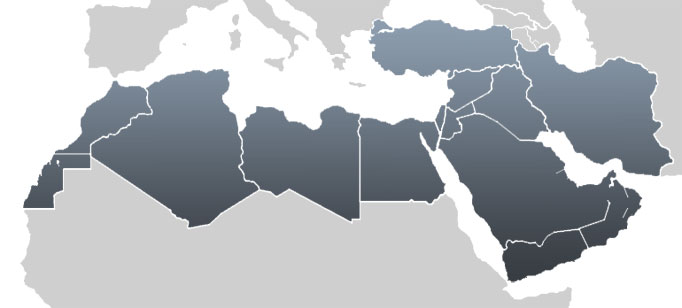
Middle East and Mena- important destinations for American softwoods

American softwoods are needed more and more in the Middle East and North Africa (Mena region) as construction and the housing market are starting to develop rapidly, according to GDN Online.
American Softwoods (AMSO) will be present at the Dubai WoodShow 2016, which will run from April 4 to 6 at the Dubai International Convention and Exhibition Center, and will bring out the importance of US softwoods.
Three important US softwood trade associations will form the promotional partnership to be introduced at Dubai WoodShow.
As GDN Online reported, in 2015, the total exports of US softwood to the Mena region summed $20 million. Yet, there is an overall decrease because of the dollar strength, which is set to change in the future as the United Arab Emirates registered 1,127% increase in value of exports of American softwood lumber in January 2016, compared to the same month of 2015. Also, during the first nine months of 2015, the softwood lumber trade increased, compared to the same period of 2014.
There is a global increase in softwood lumber, which will take over the mentioned regions of Africa, while UAE remains an important hub for timber processing and re-export for the Mena region.

“The Mena region's need for high-quality wood products for its construction, furniture, and housing markets amongst others creates widespread opportunities for us to assist in the growth of US softwood exports to the region,” said Charles Trevor, consultant to American Softwoods.

 
[gravityform id="1" title="true" description="true"]
 
[gravityform id="2" title="true" description="true"]


The global sawlog price down sharply in 2015

Sharp reductions of sawlog prices occurred in Russia, Brazil, Central Europe and Western Canada in 2015 because of weaker currencies, less demand for lumber and reduced trade of logs, reports the Wood Resource Quarterly. European sawlog prices have fallen faster than prices in most other regions of the world.
The Global Sawlog Price Index (GSPI) continued its two-year decline in the 4Q/15 when the Index fell another 4.8% quarter-over-quarter.. In just two years, the GSPI has fallen 21.6% both because of a strengthening US dollar and lower demand for lumber in Asia, the MENA countries and in Europe.
There have been some spectacular price reductions in US dollar terms in a number of countries over the past two years including Russia (-48%), Brazil (-32%), Norway (-31%), Austria (-30%), Germany (-28%) and British Columbia (-26%). The only region experiencing higher sawlog prices in late 2015 than in 2013 was the US South, where prices have slowly trended upward for much of the past three years because of increased production levels at the region’s sawmills.
Sawlog prices in Europe have generally fallen faster than in other parts of the world, with the Central European prices decreasing by almost one-third in two years. In the 4Q/15, the European Sawlog Price Index (ESPI) reached US$91.00/m3, the lowest level since the 1Q/09. Much of decline in prices can be attributed to the weakening of the currencies in Europe against the US dollar. In the local currencies, changes in sawlog price have been more modest and they have even gone up in a few countries including Sweden and Poland.
Global trade of softwood sawlogs fell ten percent from 2014 to 2015 with Asian countries importing substantially less because of a decline in the demand for lumber.
Wood Resource International estimates that global log trade fell from approximately 84 million m3 in both 2013 and 2014 to just over 75 million m3 in 2015. Although import volumes to the three major destinations in Asia, China, South Korea, and Japan, fell substantially in 2015, they still imported almost half of globally traded softwood logs in 2015. Other major importing countries included Germany, Austria, Sweden and the Czech Republic.
[gravityform id="1" title="true" description="true"]
 
[gravityform id="2" title="true" description="true"]

France: First CLT tower buildings to be built in Bordeaux

Two tall timber buildings will be constructed in Bordeaux, France. The first wooden towers in the county will reach 50m and 57m in height and will be developed in the center of Bordeaux Euratlantique, according to Global Construction Review.
Hypérion”, the 18-storey project (57m), will have 82 apartments and will be built by Eiffage, specialist wood contractor Woodeum, social landlord Clairsienne and architect Jean-Paul Viguier & Associés.
French developer Kaufman & Broad will work on the “Silva50m tower office, according to a design made by local architect Art & Build. The building will be made out of 80% cross-laminated timber (CLT), with glulam plywood bracing.
As GCR reported, the two projects will be completed in 2020. The building of Hypérion will begin in September 2017 and its scheme was approved by environmentalists too.

Canddie Magdelenat, who heads the Sustainable Cities Programme at the WWF, said that “this is a major contribution to the development of this technology. On more traditional sites, the construction phase is very energy-intensive and really needs to be improved. CLT has the additional merit of using very little glue, and therefore to limit emissions of pollutants such as volatile organic compounds.”

CLT technology is still under development in France. As Guillaume Poitrinal, the president of Woodeum, said, this material is better than concrete when it comes to fire hazards. Even if concrete doesn’t burn, it may collapse if the temperatures get very high. With CLT, as Pointrinal pointed out, the first flame appears at 400o C.
 
Image credit: courtesy of Jean-Paul Viguier & Associés
 
[gravityform id="1" title="true" description="true"]
 
[gravityform id="2" title="true" description="true"]


Holmen sells its newsprint mill in Spain to International Paper

Holmen has signed an agreement to sell its newsprint mill in Madrid, Spain, including energy and recycled paper operations. The buyer, International Paper, will convert the mill into containerboard production.

“This transaction allows us to focus on developing our successful speciality paper strategy at our Swedish mills,” says Henrik Sjölund, Holmen CEO and President. “Holmen has the base in renewable forest and energy assets supplemented by industrial operations in paperboard, printing paper and sawn timber. After the sale of the Madrid mill, the printing paper operations have the potential to deliver good profitability.”

International Paper will continue to produce newsprint at the mill until the second half of 2017 when it is scheduled to be converted into containerboard. During this period, Holmen will sell the newsprint produced at the mill and continue to serve its customers.

Included in the transaction is also the recycled paper collector Cartón y Papel Reciclado S.A. (Carpa) and Holmen´s 50 per cent shareholding in the energy producer Peninsular Cogeneración S.A.

Closing of the transaction is subject to satisfaction of certain conditions, including anti-trust approval.

Holmen is a forest industry group that manufactures paperboard, printing paper and sawn timber and runs forestry and energy production operations. In 2015 Holmen’s net sales were SEK 16 billion and the group has approx. 3,300 employees.
 
[gravityform id="1" title="true" description="true"]
 
[gravityform id="2" title="true" description="true"]

Newsletter

Subscribe to our digital newsletter for your daily digest of essential news, views and analysis from the international wood industry delivered directly to your inbox.


0