

As usual for the end of the heating season, the price of wood pellets has fallen sharply in Central and Western European countries in April. Continue reading "The price of wood pellets in Central and Western Europe falls sharply in April"
Article archive
Södra to boost CLT production capacity

Södra has decided to invest in an additional CLT facility at Värö and aims to become a leader in the Nordic region.
“Society’s driving forces for reducing greenhouse gas emissions are strong, and the interest in sustainable construction is growing in the market. A higher rate of timber construction is playing a key role in the growing bioeconomy. It is also an important step in our mission to process the wood raw material delivered by our 52,000 forest-owning members,” said Lars Idermark, President and CEO.
The new facility will be established at the combined plant in Värö, where Södra’s first CLT facility has already been co-located with Södra’s pulp mills and sawmills.
“Two production lines will create both delivery reliability and flexibility for our customers. Södra’s total production capacity for CLT will eventually be about 140,000 m³ per year, equivalent to 5,000 apartments. We are now creating opportunities to make a climate-conscious choice in the housing market,” said Jörgen Hermansson, President of Södra Building Systems.
Canfor to curtail operations at all British Columbia dimension mills; citing low lumber prices
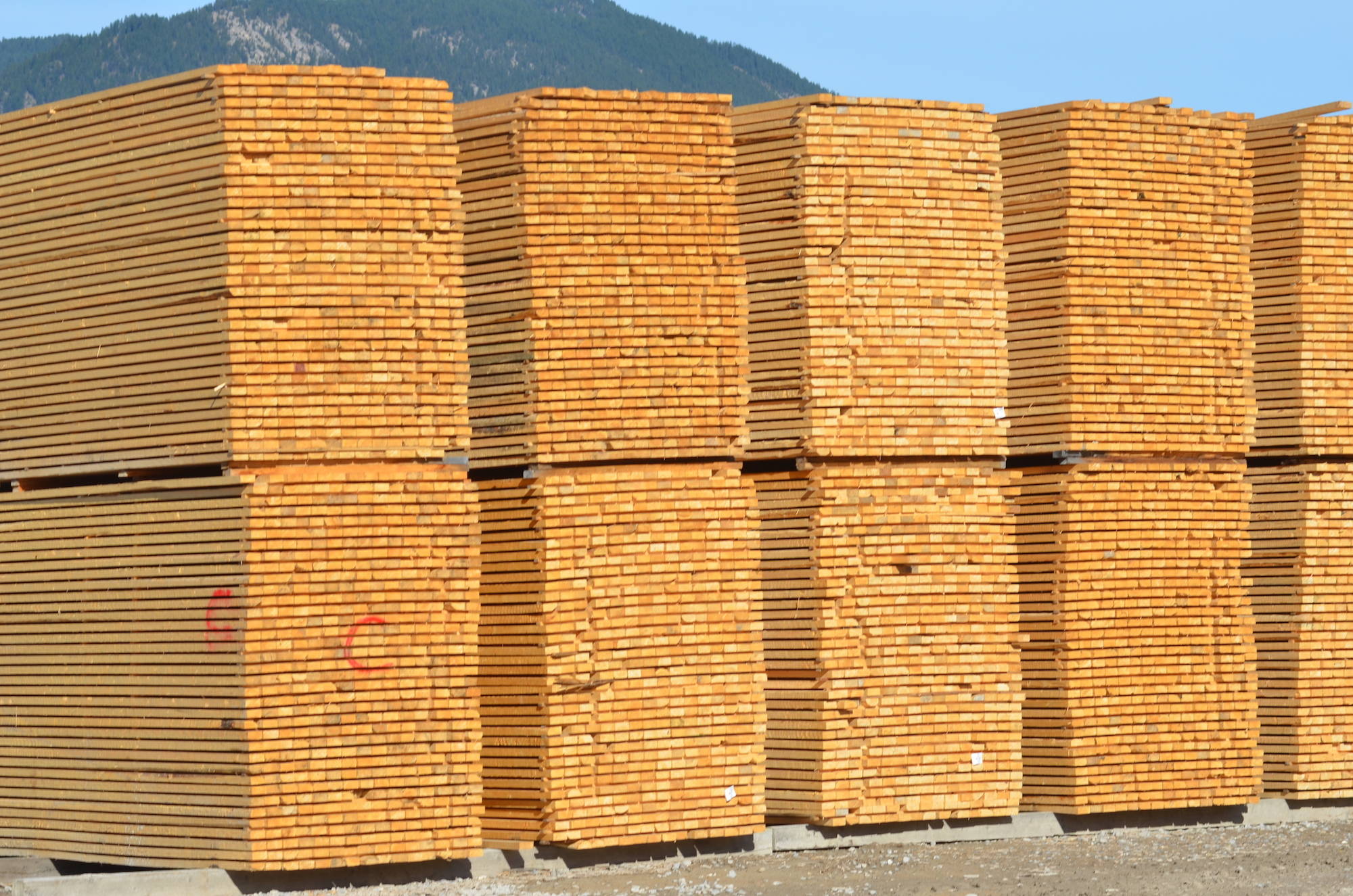
Canfor Corporation will be temporarily curtailing operations at all British Columbia dimension mills effective April 29, 2019 due to low lumber prices and the high cost of fibre.
According to the announcement, the curtailment will reduce Canfor’s production output by approximately 100 million board feet.
Canfor has 13 sawmills in Canada, with total annual capacity of approximately 3.8 billion board feet.
Back in February 2019, Canfor restricted production at its Vanenby plant for six weeks and for one week at Houston and Mackenzie mills. These curtailments reduced the company's production output by around 40 million board feet.
This year’s Salone del Mobile Milano closes with a positive trend
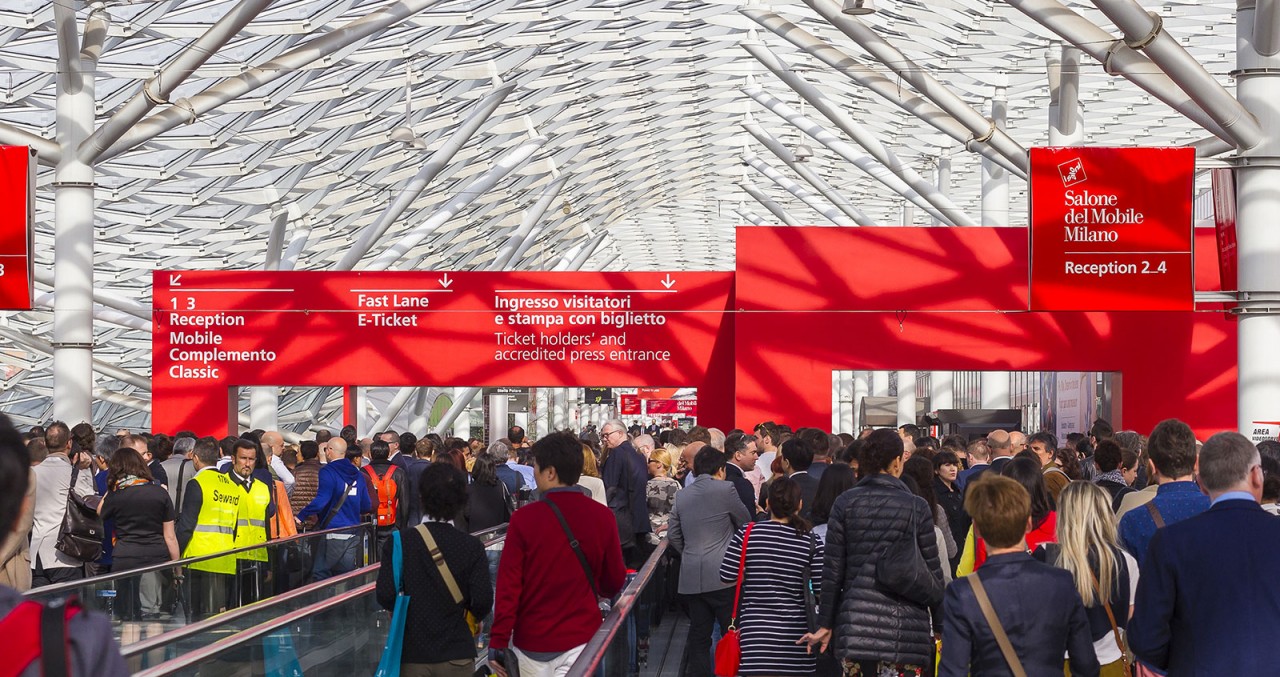
The 58th edition of the Salone del Mobile Milano ended on an extremely high note. The 386,236 attendees, over the 6 days of the event, from 181 different countries made for an 12% increase over the 2017 edition, which also featured Euroluce and Workplace3.0.
“We are closing this edition of the Salone del Mobile with a very positive feeling. We invested in quality and have demonstrated once again our desire to do even better, working closely with designers, artisans, and communication and cultural professionals to keep on producing product and process innovations and ‘narratives’ that serve to boost the value of design objects. Consequently, we have seen sales rise but in particular we have seen that everyone has taken note of our enthusiasm, our ability to create a system and take things much further than just business, offering a global experience, in which ideas are what counts. The Salone del Mobile is therefore a unique event of its kind, with the power to draw in professionals and the general public with what is now a trade fair in the round, with deeply rooted ties to Milan and its institutions while also being a significant international presence,” said Salone del Mobile President Claudio Luti.
Recognition of the importance of the Salone del Mobile and the furnishing sector also came from the presence of high-ranking government and institutional figures, proof of the Salone’s standing as one of the drivers of the Italian economy, thanks to the fruitful relationship between business, city and region that it manages to generate each year.
2,418 exhibitors, 34% of them from 43 different foreign countries, were split between the Salone Internazionale del Mobile, the International Furnishing Accessories Exhibition, Euroluce, Workplace3.0 and S.Project, including the 550 designers under 35 who took part in SaloneSatellite.
Emanuele Orsini, President of Federlegno Arredo Eventi, had this to say: “Investment, creativity and enthusiasm are the words that sum up an event that has seen the entrepreneurs take on the challenge of helping to make a success of an edition which, yet again, has demonstrated the importance of a sector that can pull together to tackle the challenges of international markets. A global success achieved also thanks to the staunch and unwavering support of the institutions – not least the Italian Trade Agency ICE, which has recognized Salone del Mobile.Milano as a crucial player in the expansion of Made in Italy around the world – and Confindustria which, for the first time in its history, held its General Council meeting at our event, underscoring the need to carry forward a very real dialogue with politics in order to support and underpin the businesses that, as well as contributing to the success of the trade fair, are one of the jewels in the crown of the national economy.”
The next edition will take place from April 21-26, 2020.
German building materials giant Knauf completes acquisition of USG Corporation

German building materials maker Knauf and USG Corporation jointly announced the completion of Knauf’s acquisition of USG.
USG stockholders will receive $43.50 in cash for each share of USG common stock held at the effective time of the merger, without interest and subject to tax withholding as applicable. This closing consideration is in addition to the special dividend of $0.50 per share of USG common stock that was previously paid on October 2, 2018 to holders of record as of the close of business on August 21, 2018.
This acquisition creates a global building materials industry leader that combines two highly complementary businesses, product portfolios and global footprints.
“This transformational transaction is the largest acquisition in Knauf’s history and, accordingly, presents significant opportunities to create a stronger, more sustainable company for our employees, customers and communities,” said Alexander Knauf, General Partner of Knauf. “We greatly admire USG’s strong brands, leading market positions in North American wallboard and ceilings, and highly talented employee base. We are excited to welcome USG employees to the Knauf family and look forward to working together to accelerate growth and profitability and even better serve our customers.”
Chris Griffin, incoming CEO of USG, further commented, “I am excited to be back at USG, working with a talented USG team and Knauf leadership to make this combination a huge success. Our immediate priorities are ensuring a smooth transition for our employees, helping our customers be successful by putting them at the center of everything we do and driving operational excellence across the business.”
Shares of USG common stock will cease trading on the New York Stock Exchange (“NYSE”) and the Chicago Stock Exchange (“CHX”) and will be delisted from the NYSE and CHX.
About Knauf
Gebr. Knauf KG is the ultimate parent company of the German based Knauf Group. Knauf is a leading manufacturer of building materials operating more than 220 factories worldwide. In 2018, Knauf generated revenue more than $8 billion and employed more than 28,000 people.
About USG Corporation
USG Corporation is an industry-leading manufacturer of building products and innovative solutions. Headquartered in Chicago, USG serves construction markets around the world through its Gypsum, Performance Materials, Ceilings, and USG Boral divisions. Its wall, ceiling, flooring, sheathing and roofing products provide the solutions that enable customers to build the outstanding spaces where people live, work and play. Its USG Boral Building Products joint venture is a leading plasterboard and ceilings producer across Asia, Australasia and the Middle East.
Top global softwood lumber producers in 2018

As it has since 2007, West Fraser is the world’s largest softwood lumber producer: in 2018, the company produced 6.6 billion bf.
The Billion Board Foot list is based on companies with reported softwood lumber production exceeding one billion board feet (bf) on a nominal basis (or, for mills outside North America, in excess of ~2.3 million m3 on a net count basis). Fifteen firms made the list with a combined output of 36.7 billion bf nominal (61.9 million m3 net) in 2018, an increase of 1.1 billion bf from 2017’s 35.6 billion bf (+3.1%). This compares to total global lumber production of 223 billion bf nominal in 2018 and growth of an estimated 8% as compared to 2017. In 2018, the global market share of the largest 15 sawmilling companies was near 16% – a slight decrease from 2017.
The top five global lumber producers include (in descending order): West Fraser, Canfor, Weyerhaeuser, Interfor and Georgia-Pacific.
Four of the top ten largest global firms are based in B.C. (West Fraser, Canfor and Interfor, with Tolko now having two U.S.-based joint venture mills), with all now holding substantial sawmilling assets in the U.S. Collectively, these four companies own 49 U.S. sawmills (including joint-ventures) as compared to only 38 in Canada.
Of note, there are 4-5 European companies bubbling just below the billion-board-foot (2.3 million m3 net) threshold. Most non-North American mills produce lumber that is sold on the actual (or net) size of lumber produced; their North American counterparts sell lumber on a nominal basis (e.g., 2×4 is actually 1.5″ x 3.5″). As a result, if the rankings are viewed on a cubic-metre, net-size basis, non-North American mills (in Europe and South America) have higher output in terms of solid wood – a more accurate basis on which to make comparisons.

SCA will take over the entire pellet production of Moelven Pellets
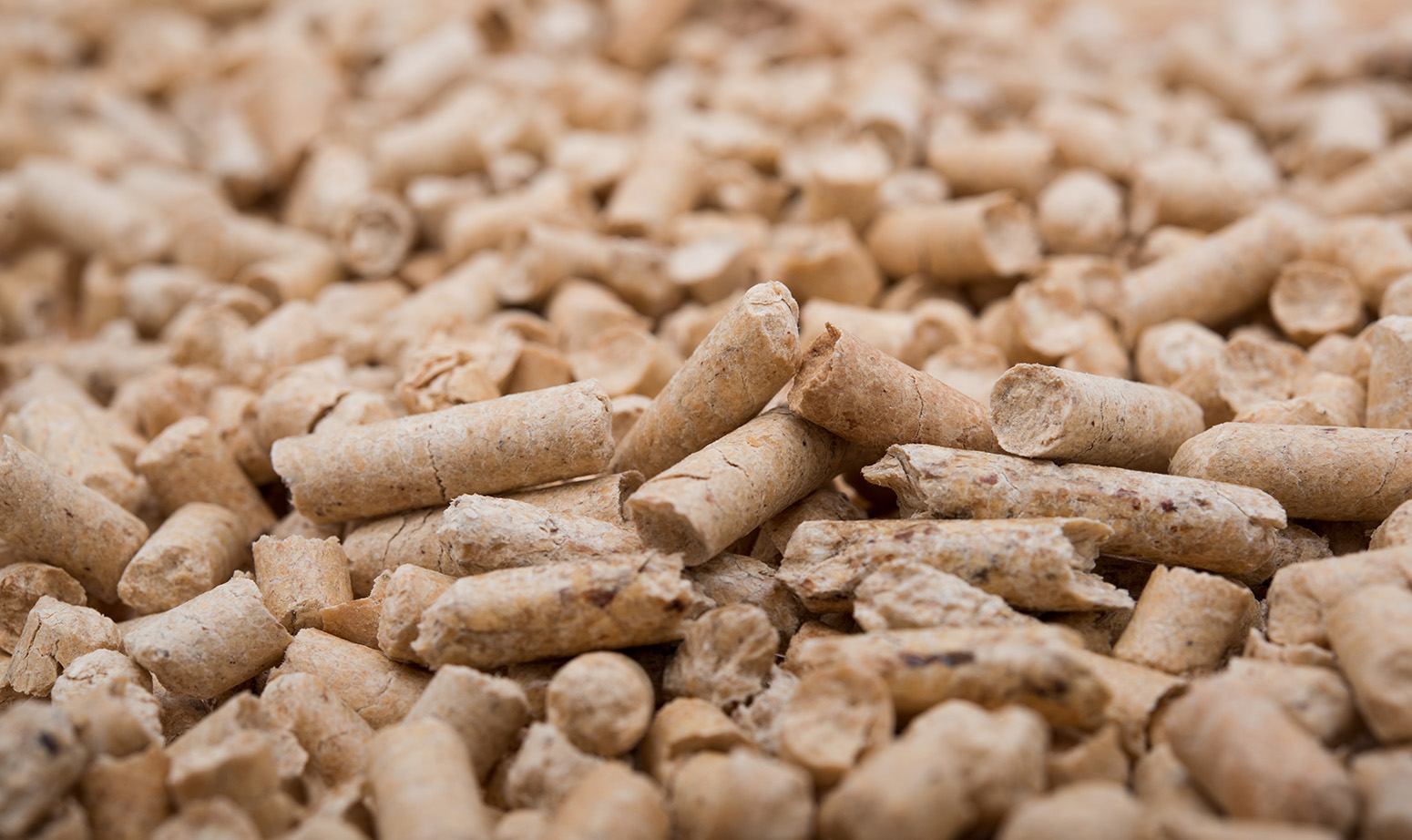
SCA will take over the entire pellet production of the future 80,000 t plant of Moelven Pellets A/S in Sokna of the Norwegian Moelven Industrier.
The production will start in the fall of 2019 and the collaboration will provide SCA with a long-term and exclusive supply agreement of 80 000 tonne per annum, which is the entire production volume from Moelven Pellet’s factory in Sokna in Eastern Norway.
As SCA is growing within the area of renewable energy, we have, among other things, an increasing need for wood pellet.
''I look forward to cooperating with Moelven, and I’m pleased that we have been trusted to convey this large volume of quality pellets to the market”, says Stefan Rönnqvist, Bioenergy Manager.
''In the transition towards a more sustainable society, we see an increasing need for biofuels. This applies to all sectors, but especially within the transport sector. Together, SCA and Moelven can contribute to a positive development for renewable energy, says Rönnqvist.
''This is a massive agreement for Moelven Pellets, a company that will first start its operations in the fall of 2019. - We are proud to become a supplier to such an experienced group like SCA, with exciting ambitions regarding renewable energy, says CEO Lars Storslett in Moelven Pellets AS.
Moelven is a Scandinavian industrial group that produces building products and systems for the construction industry.
The boom in Vietnamese forestry products exports continues this year

The export value of Vietnam's forestry products increased by 17.8% year on year to take in US$3.278 billion in the first four months of 2019.
The US, Japan, the EU, China and the Republic of Korea have remained the five largest importers of Vietnamese forest products, accounting for some 87% of the industry’s total export value, according to recent statistics from the Vietnam Administration of Forestry.
As of April 18, more than 29 hectares of concentrated forests were planted, accounting for 21.6% of the yearly plan. Meanwhile, the number of forest law violation cases was brought down by nearly 1,076 or 25% from last year. The area of damaged forest was also reduced by 58 hectares or 23%.
Prime Minister Nguyen Xuan Phuc recently issued Directive No.08/CT-TTg, outlining measures to increase forestry shipments to US$11 billion in 2019, US$12-13 billion in 2020, and US$18-20 billion in 2025.
Vietnam has 4,500 enterprises processing and exporting wood and forestry products, 1,863 of which are exporters. They include more than 700 foreign-invested businesses with large production scales and the application of advanced technologies in production.
Substantial growth in China’s tropical sawnwood imports from Brazil

Thailand still is the main tropical sawnwood exporter to China. China’s tropical sawnwood imports from Thailand in 2018 were 4.44 million cubic metres valued at USD1.407 billion. However, the proportion of Thai tropical sawnwood exports to China plummeted 8%.
The top 5 countries supplied 84% of China’s tropical sawnwood requirements in 2018, namely Thailand (62%), Gabon (8%), Brazil (6%), Indonesia (5%) and the Philippines (4.5%).
In contrast, just 5 countries supplied over 92% of China’s tropical sawnwood requirements in 2017 namely, Thailand (72%), Gabon (6%),the Philippines (5%), Indonesia (5%), Malaysia (4%).
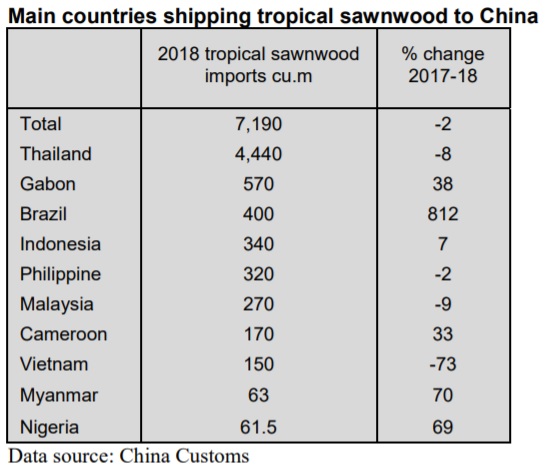
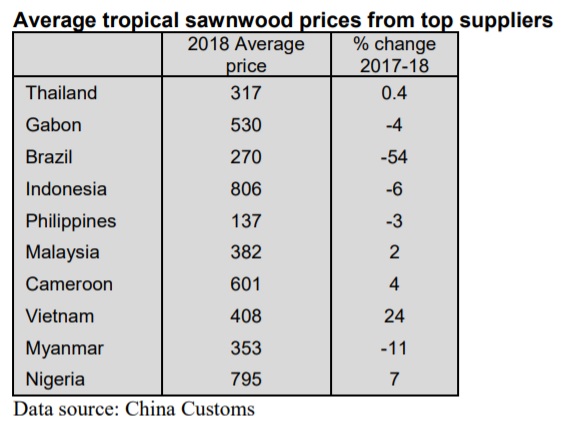
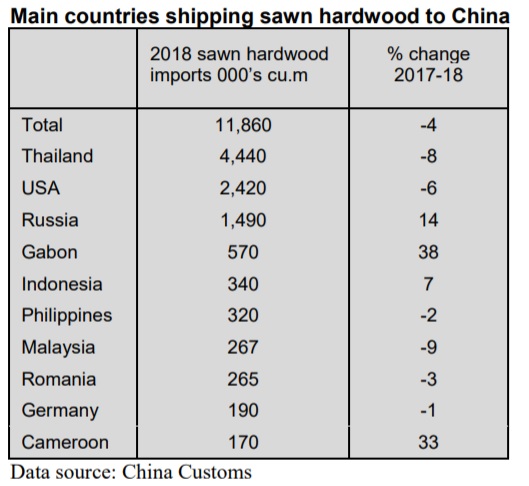
China’s tropical sawnwood imports from Brazil grew substantially in 2018 but the average price fell 54% year on year as much of this was plantation timber.Tropical sawnwood imports from Myanmar, Nigeria, Gabon and Cameroon rose 70%, 69% , 38% and 33% year on year respectively and imports from Vietnam, Malaysia and the Philippines, fell 73%, 9% and 2% year on year respectively.
Vietnam fades from list of main sawn hardwood suppliers
China’s sawn hardwood imports from Vietnam plummeted 73% to 150,000 cubic meters in 2018 from 540,000 cubic metres in 2017. Vietnam disappeared from the list of main countries shipping sawn hardwood to China because most was utilised by Chinese furniture factories in Vietnam.
Latest market trends in the European parquet market

The European parquet markets are generally showing stable to slightly positive trends. When compared to the same period last year, the provisional results for the three first months of 2019 indicate stable or moderately increasing parquet consumption except for Belgium, the Netherlands, Switzerland and the United Kingdom which are reporting limited declines in parquet sales. On the other hand, parquet consumption restarted to grow in Germany.
While there is no shortage of raw material for the time being, affordability is decreasing also for layers (HDF, plywood) other than the top one. Continue reading "Latest market trends in the European parquet market"
Sweden: Martinsons gets record order for 80 meters high CLT and Glulam construction

Martinsons has secured its single largest order ever. It concerns the delivery and assembly of the CLT- and glulam framework for the Skellefteå Culture Centre in Sweden. The order is worth around 10 million Euro.
For Martinsons’ part, the order follows on from projects such as IFU Arena in Uppsala and Trikåfabriken in Hammarby Sjöstad. IFU Arena was appointed Arena of the Year 2018 by financial newspaper Dagens Industri’s Sport & Business section and superstructure Trikåfabriken covering nearly 9,000 square meter of office space.
The Skellefteå Culture Centre building will be approximately 80 meters high comprising 20 floors. For Martinsons part, the volumes in the order include around 10,000 cubic meter of cross-laminated timber and 2,200 cubic meters of glulam.
Production starts at the Martinsons factory in Bygdsiljum outside Skellefteå in April. Construction starts in June and is expected to last for nearly eighteen months.
The construction components delivered by Martinsons will bind nearly 9,000 tonnes of carbon dioxide throughout their lifetime. This corresponds to return flights Stockholm to New York for over 13,000 people. Emissions throughout the production chain will correspond to 900 flights.
US DoC to continue investigations on anti-dumping duties for Chinese kitchen furniture imports

The United States International Trade Commission (USITC) determined that there is a reasonable indication that a U.S. industry is materially injured by reason of imports of wooden cabinets and vanities from China that are allegedly subsidized and sold in the United States at less than fair value.
As a result of the Commission’s affirmative determinations, the U.S. Department of Commerce will continue with its anti-dumping and countervailing duty investigations concerning imports of these products from China, with its preliminary countervailing duty determination due on or about May 30, 2019, and its preliminary anti-dumping duty determination due on or about August 13, 2019.
the American Kitchen Cabinet Alliance (AKCA) is commending the affirmative preliminary injury vote at the International Trade Commission (ITC) – an important first step in a long fight against unfairly traded Chinese imports of wooden cabinets and vanities.
On March 6, 2019, the American Kitchen Cabinet Alliance (AKCA) initiated one of the largest trade cases ever filed against Chinese imports at the ITC and the Department of Commerce.
Sweden: Sawlog prices in 1Q 2019 much higher than last year

Sawlog prices in Sweden had a different development during the 1Q 2019. The Northern and Southern regions showed marginal price increases of 0.3% and 0.5%. The prices decreased by 2.2% in the Central region.
In comparison to the 1Q 2018 prices increased in the whole country for both pulpwood and sawlog. Pulpwood prices increased by 15.2% and sawlog prices by 8.4%.
Pulpwood prices increased the most in the Northern and Central regions by about 18% and by 13.2% in the Southern region.
Sawlog prices had the highest increase in the Southern region by 9.5%. In the Central and Northern regions the sawlog prices increased by 6.7% respective by 5.1% Pulpwood delivery prices in Sweden increased by 1.8% during the 1Q 2019 compared to the 4Q 2018.
At the same time the price of sawlogs decreased by 0.6%, as the Swedish Forest Agency reported.
Delivery purchase is a method which means that the forest owner himself, with or without the help of employees or contractors, delivers the work on the roadside. Delivery prices account for some 9% of the total sold quantity.
The pulpwood price increased in all four quarters of 2018 and continued to increase in the 1Q 2019. The largest increase was in the Northern region by 3.5%, thereafter the Central region by 2.5% and close to unchanged in the Southern region.
Arauco inaugurates its giant plant in Grayling, Michigan
Last week, Arauco held a ribbon-cutting ceremony at its state-of-the-art particleboard and lamination facility in Grayling, Michigan.
With an investment of USD 450 million and an 800,000 m3 annual capacity, Grayling is the most modern particleboard plant of its kind in the world, the largest in the United States and is, in turn, the largest Chilean investment in North America.
Considered a “modern manufacturing marvel,” the operation in Grayling is the company’s first greenfield facility in the United States, its 11th North American manufacturing site and the largest of its kind globally. The operation is designed to be one of the most productive in the world and houses North America’s highest-capacity, single-line particleboard press, two thermally infused laminating (TFL) lines and a large stocking warehouse for just-in-time service delivery. The plant currently staffs more than 200 full-time employees and has generated approximately 700 additional jobs in related supplier and logistics industries since construction commenced in Spring 2017.
“This is a historic day and milestone for our company,” said Matías Domeyko, Chief Executive Officer, Arauco. “The official start of production at Grayling exemplifies the outstanding innovation and sustained growth Arauco is known for globally, and what has been central to propelling our positive business results. The Grayling mill achievement also is the culmination of unwavering commitment from our valued investors who shared our vision for capturing significant market opportunity in North America. We offer heartfelt thanks for their dedication and support in making this remarkable, new manufacturing plant possible.”
During his remarks at the grand opening ceremony, Kelly Shotbolt, President of Arauco North America, acknowledged the significant contributions of the Grayling project managers, and praised state of Michigan officials and local Crawford County representative for creating an environment conducive to undertaking such a large-scale business endeavor.
“Grayling is a prime example of positive collaboration between the public and private sector,” said Shotbolt. “We are grateful for the incredible support received both from Grayling community leaders and the state of Michigan. It has been vital to enabling Arauco to renew our industry in North America through what is arguably the most advanced, automated and large-scale facility of its kind anywhere in the world.”
“While known for automobile manufacturing, Michigan also is the office furniture capital of the world,” said Shotbolt. “We are pleased to substantially expand our production capacity to assure a strong, sustainable supply of quality, raw and finished product for this growing region.”
Building on tropical hardwood’s construction potential

Advocacy for using timber as a mainstream modern construction material is increasing in Europe and other regions. Faced with the need to satisfy growing global housing need, while simultaneously reducing the construction industry’s environmental footprint, wood is becoming the building material of choice for a growing number of architects, engineers, designers and contractors.
Adding impetus to this trend are the development and increasing application of more technically advanced structural timber products. These are allowing the construction sector to build bigger and ever more ambitiously in wood and enabling it to compete head-on with energy intensive rival materials, steel and concrete.
At the same time, there are early signs that architects and others are looking to broaden their timber building product palette, exploring the structural capabilities of hardwood as well as softwood and, while it is yet to hit the headlines, considering the possibilities of using tropical as well as temperate species.
This could not only help provide much needed, affordable, low carbon housing, but also act as an added incentive to sustainably manage forests for timber production.
Continue reading "Building on tropical hardwood’s construction potential"
China: Imports of sawnwood drop, but prices rise
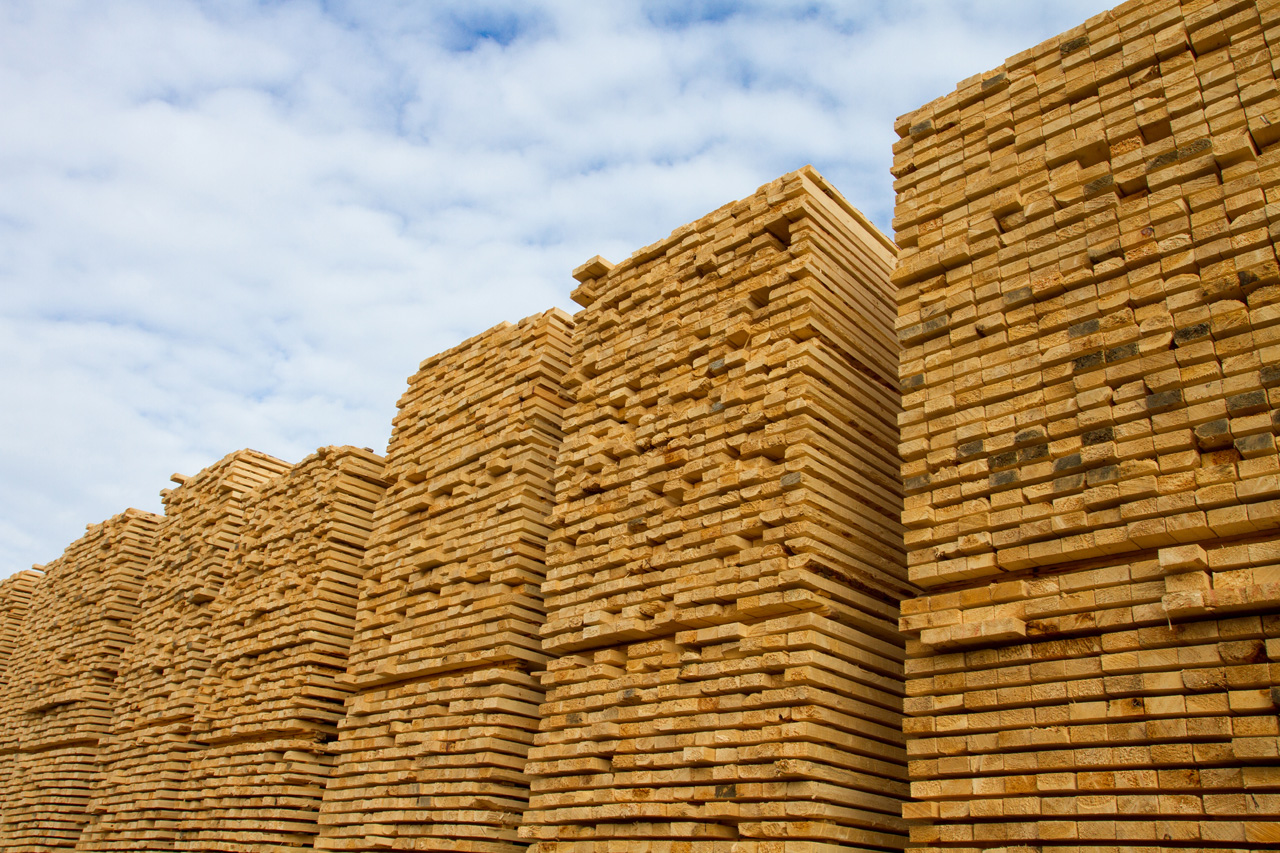
According to China Customs, 2018 sawnwood imports totalled 36.74 million cubic metres valued at US$10.13 billion, a year on year decline of 2% in volume and a slight increase (1%) in value.
The average price for imported sawnwood was US$216 per cubic metre, up 2% on 2017. Both sawn softwood and sawn hardwood imports declined in 2018.
Of total sawnwood imports, sawn softwood imports fell 1% to 24.88 million cubic metres, Continue reading "China: Imports of sawnwood drop, but prices rise"
US lumber prices in free fall
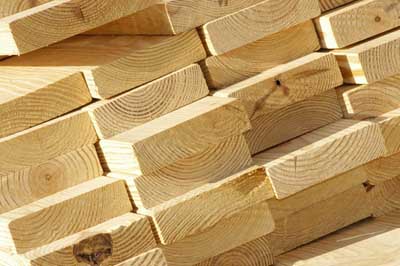
Prices of framing lumber the US continued to retreat amid a slow-developing increase in seasonal demand.
Traders widely reported that ample supplies were available at all levels of the distribution system, going back to the mills. That generated little urgency, and left suppliers struggling to move loadings that didn’t nicely fit buyers’ immediate needs.
Steadily eroding prices in most producing regions pushed the Random Lengths Framing Lumber Composite Price down $3, an eighth straight weekly drop.
| Week Apr 19 |
Last Week Apr 12 |
Year Ago 2018 |
|
| Random Lengths Framing Lumber Composite Price* | $350 | $353 | $498 |
| KD Western S-P-F #2&Btr 2x4 R/L Mill Price | 312 | 328 | 556 |
| KD Eastern S-P-F #1&2 2x4 R/L, delivered Great Lakes | 418 | 427 | 630 |
| Green Douglas Fir Std&Btr 2x4 R/L (Portland) | 295 | 290 | 530 |
| Southern Pine (Westside) #2 2x4 R/L | 405 | 405 | 554 |
| KD Coast Hem-Fir #2&Btr 2x4 R/L | 365 | 375 | 560 |
| Ponderosa Pine (Inland) #2&Btr 1x12 R/L | 860 | 860 | 755 |
| * Weighted average of 15 key items | |||
Random Lengths Panel Market Report
Structural panel sales were a grind, and prices slipped. The downward spiral in OSB prices was unabated and taxed traders’ patience. Supplies continued to outstrip demand, and loads were available for quick shipment. Sporadic and inconsistent demand for Southern Pine plywood generated enough orders for producers to maintain order files, but a lack of urgency among buyers applied modest downward pressure on prices. Struggles to sell western Fir plywood continued, and frustration mounted. Activity was spotty all week. Order files extending into May allowed a few Canadian plywood producers to hold to their quotes. Others lowered prices after lead times eroded.
| (f.o.b. mill prices) | Week Apr 19 |
Last Week Apr 12 |
Year Ago 2018 |
| Random Lengths Structural Panel Composite Price* | $357 | $361 | $529 |
| Southern (west-east) 15/32-inch 3-ply rated sheathing plywood | 372-400 | 375-403 | 500-545 |
| Southern (west-east) 15/32-inch 4-ply rated sheathing plywood | 377-412 | 380-415 | 505-550 |
| Western 1/2-inch 4-ply rated sheathing plywood | 357 | 362 | 520 |
| North Central 7/16-inch Oriented Strand Board | 185 | 190 | 405 |
| *Weighted average of 11 key items | |||
Global sawmill sector's shrinking profit margins in late 2018
Softwood lumber prices have generally fallen faster than the costs for sawlogs throughout the world in late 2018, resulting in lower margins for the sawmilling sector. In western US and western Canada, margins fell to unprofitable levels and many sawmills in the region curtailed production in late 2018 and early 2019.
Lumber prices in North America continued their decline from the 3Q/18 with another quarter of substantial reductions. Average lumber prices for southern yellow pine were down 12% quarter-over-quarter in the 3Q/18, which was then followed by a reduction of 17% in the 4Q/18. With practically no change in log or chip prices, gross margins, and the EBIDTAs, have plunged in the Southern states, after having reach a 13- year high in the 2Q/18. However, the region’s sawmill margins were still well above their ten-year average margin. With lumber prices continuing to decline faster than log prices in early 2019, profit margins have continued to slide in the 1Q/19.
Sawmills in British Columbia have also seen the prices for lumber in the US market come down substantially during the second half of 2018. Despite the weaker lumber market, sawlog prices still increased from the 3Q/18 to the 4Q/18 because of tighter supply and a rise in hauling costs. Sawmills saw their gross margins plunge to unprofitable levels and many companies decided to take market-related downtime in late 2018 and early 2019.
In Europe and Russia, market prices for lumber were much less volatile than in North America, with only small price adjustments from the 4Q/17 to the 4Q/18. Log costs were unchanged in Finland during most of the year, while the costs for spruce sawlogs in Sweden jumped in late 2018. Gross margins for sawmills in both countries are still at healthy levels and, in the 4Q/18, were close to the highest they have been in four years.
Sawmills in Siberia continue to expand exports to China with fairly stable lumber export prices the past three years. However, in the 4Q/18, lumber prices fell to their lowest level in almost two years. This occurred at the same time as sawlog costs remained unchanged from the previous quarter, resulting in reduced gross margins for many lumber producers at the end of 2018. Sawmill margins for 2018 were slightly below their five-year averages, but still higher than the average for the past 14 years.
Global sawmill sector’s shrinking profit margins in late 2018

Softwood lumber prices have generally fallen faster than the costs for sawlogs throughout the world in late 2018, resulting in lower margins for the sawmilling sector. In western US and western Canada, margins fell to unprofitable levels and many sawmills in the region curtailed production in late 2018 and early 2019.
Lumber prices in North America continued their decline from the 3Q/18 with another quarter of substantial reductions. Average lumber prices for southern yellow pine were down 12% quarter-over-quarter in the 3Q/18, which was then followed by a reduction of 17% in the 4Q/18. With practically no change in log or chip prices, gross margins, and the EBIDTAs, have plunged in the Southern states, after having reach a 13- year high in the 2Q/18. However, the region’s sawmill margins were still well above their ten-year average margin. With lumber prices continuing to decline faster than log prices in early 2019, profit margins have continued to slide in the 1Q/19.
Sawmills in British Columbia have also seen the prices for lumber in the US market come down substantially during the second half of 2018. Despite the weaker lumber market, sawlog prices still increased from the 3Q/18 to the 4Q/18 because of tighter supply and a rise in hauling costs. Sawmills saw their gross margins plunge to unprofitable levels and many companies decided to take market-related downtime in late 2018 and early 2019.
In Europe and Russia, market prices for lumber were much less volatile than in North America, with only small price adjustments from the 4Q/17 to the 4Q/18. Log costs were unchanged in Finland during most of the year, while the costs for spruce sawlogs in Sweden jumped in late 2018. Gross margins for sawmills in both countries are still at healthy levels and, in the 4Q/18, were close to the highest they have been in four years.
Sawmills in Siberia continue to expand exports to China with fairly stable lumber export prices the past three years. However, in the 4Q/18, lumber prices fell to their lowest level in almost two years. This occurred at the same time as sawlog costs remained unchanged from the previous quarter, resulting in reduced gross margins for many lumber producers at the end of 2018. Sawmill margins for 2018 were slightly below their five-year averages, but still higher than the average for the past 14 years.
Sharp fall in pellet prices in Germany
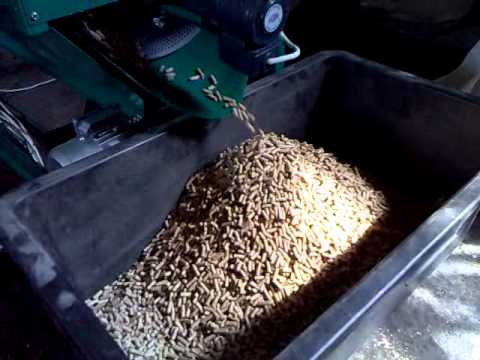
The price of wood pellets in Germany has fallen sharply in April 2019.
One tonne of quality ENplus A1 pellets cost on average € 252.65 / t if 6 t are ordered. This represents a 5.6% decrease as compared to March 2019. Also, it corresponds to a price of 5.05 cents / kWh heat from pellets. The same amount of heat from heating oil costs 6.70 cents and from natural gas 6.21 cents. Pellets increased their price advantage to 24.6% compared to heating oil and 18.6% compared to natural gas.
The price level is practically identical to that of the same month of the previous year. In April 2018, a ton of pellets cost an average of 252.25 euros.
Regional prices
Southern Germany: 249.74 EUR / t
Central Germany: 255.51 EUR / t
North and East Germany: 257.99 EUR / t
Larger quantities (26 t):
South: 233,25 EUR / t, Central: 236,02 EUR / t, North / East: 239,89 EUR / t (all incl. VAT).

