

For the future, large investment in Finnish forest industry are planned: nearly 1.5 billion euros will be invested, which will increase Finland's use of wood by about 10 million cubic meters per year.
"Finland and the European economic outlook is still weak and no significant improvement in demand in our main markets are in sight. Despite the weak economic situation, the forest industry has faith in the future, as demonstrated by the ongoing large-scale investment projects in Finland," said Finnish Forest Industries Federation's President and CEO, Timo Jaatinen.
"The investments will ensure the active timber market and logistics, as wood is needed significantly more. Our competitiveness is also needed to make improvements for the long-term, to support the energy industry, as well as the productivity, and also increase the flexibility of the labor market," stresses Timo Jaatinen.
In the January-August period, exports of the Finnish forest industry, including furniture, amounted 7.5 billion euros. Thus the value was largely at the 2013 levels.
The paper industry continued to be challenging, pulp and paperboard production declined slightly.
The paper industry cut production in January-September 2014, in particular in the graphic papers segment consumption reduced. Graphic printing and writing papers were produced in January-September, in a quantity of 4.6 million tonnes, which is about 4 percent less than the previous year.
Pulp production in Finland in January-September amounted 5.2 million tonnes. The decrease compared to the corresponding period in the previous year was 2 percent.
Sawn timber and plywood production increased slightly
Sawn timber production increased in January-September by 7 percent compared to the same period last year and amounted to almost 8.2 million cubic meters. Plywood production increased by 7 percent to slightly more than 850 000 cubic meters.
Timber sales remained steady in the summer holiday period. Finnish Forest Industries Federation member companies purchased in January-September from private forests 23.1 million cubic meters of wood, one percent more than in the corresponding period of 2013.
Article archive
China's massive log exports rises prices and profits in the US

In northwestern United States, logging activity is in full mode in the forests of Douglas fir and hemlocks (Tsuga heterophylla or western hemlock). ''Logging companies are operating at full capacity,'' said Garett Weaver of the Oregon Loggers Association. If you want to find the reason for this situation, you have to look towards Asia.
At the moment, including British Columbia, about 11 million m3 of unprocessed logs are being shipped every year to China (about 70% of the total). This represents an increase of 30% over 2012-2013. And this trend is confirmed in 2014, when in the first months of this year, exports were up 14%, followed by a further increase of 10% in the second quarter compared to the first.
The states of northwestern USA are the main contributors to exports (53% of the total), followed by British Columbia (41%). This phenomenon is now spreading in the south of the United States, where export of yellow pine logs rose 130% in the first five months of 2014. These exports, destined mainly to China and India, increased share from 2% to 6% of the US total in just two years.
''Half of forest harvesting on the west coast of the US and Canada are going as unprocessed logs to China. Volumes increased significantly in 3 years and log prices follow the same progression,'' said Darren Hadlock of the Quadco company. This boom in log exports to China have great consequences for forest owners. Thus, prices of Douglas jumped 78% since 2009 and 17% since 2012. The price surge of hemlock is even more impressive: +93% since 2009 and 18% since 2012 (see table below).
Manufacturers of forestry machines are ''rubbing their hands''. This renewed activity is increasing their business. ''After the 2008 crisis, our clients had rounded back. But today we are witnessing a renewal of our machinery fleet. On the northwest sector of which I am responsible, we went from 10 heads sold in 2009 to 60 in 2014,'' says Darren Hadlock, who also speaks about an explosion in orders spanning on over 4 months now.
| PRICE OF LOGS IN THE NORTHWEST of US Washington State (USA), Avg $ per MBF |
|||||||||
|
Domestic market: |
|||||||||
| 2007 | 2008 | 2009 | 2010 | 2011 | 2012 | 2013 | 09/2014 | 10/2014 | |
| Douglas | 520 | 448 | 348 | 436 | 551 | 538 | 611 | 613 | 628 |
| Hemlock | 418 | 345 | 288 | 370 | 481 | 471 | 530 | 546 | 556 |
|
Exports: |
|||||||||
| Douglas | 652 | 668 | 583 | 562 | 666 | 662 | 729 | 743 | 759 |
| Hemlock | 522 | 500 | 417 | 516 | 613 | 542 | 720 | 635 | 649 |
| Red cedar | 1016 | 1096 | 657 | 925 | 867 | 838 | 955 | 1136 | 1179 |
|
1 MBF = 2,36 m3 |
|||||||||
Source : Northwest Forestry Services
China’s massive log exports rises prices and profits in the US
In northwestern United States, logging activity is in full mode in the forests of Douglas fir and hemlocks (Tsuga heterophylla or western hemlock). ''Logging companies are operating at full capacity,'' said Garett Weaver of the Oregon Loggers Association. If you want to find the reason for this situation, you have to look towards Asia.
At the moment, including British Columbia, about 11 million m3 of unprocessed logs are being shipped every year to China (about 70% of the total). This represents an increase of 30% over 2012-2013. And this trend is confirmed in 2014, when in the first months of this year, exports were up 14%, followed by a further increase of 10% in the second quarter compared to the first.
The states of northwestern USA are the main contributors to exports (53% of the total), followed by British Columbia (41%). This phenomenon is now spreading in the south of the United States, where export of yellow pine logs rose 130% in the first five months of 2014. These exports, destined mainly to China and India, increased share from 2% to 6% of the US total in just two years.
''Half of forest harvesting on the west coast of the US and Canada are going as unprocessed logs to China. Volumes increased significantly in 3 years and log prices follow the same progression,'' said Darren Hadlock of the Quadco company. This boom in log exports to China have great consequences for forest owners. Thus, prices of Douglas jumped 78% since 2009 and 17% since 2012. The price surge of hemlock is even more impressive: +93% since 2009 and 18% since 2012 (see table below).
Manufacturers of forestry machines are ''rubbing their hands''. This renewed activity is increasing their business. ''After the 2008 crisis, our clients had rounded back. But today we are witnessing a renewal of our machinery fleet. On the northwest sector of which I am responsible, we went from 10 heads sold in 2009 to 60 in 2014,'' says Darren Hadlock, who also speaks about an explosion in orders spanning on over 4 months now.
| PRICE OF LOGS IN THE NORTHWEST of US
Washington State (USA), Avg $ per MBF |
|||||||||
|
Domestic market: |
|||||||||
| 2007 | 2008 | 2009 | 2010 | 2011 | 2012 | 2013 | 09/2014 | 10/2014 | |
| Douglas | 520 | 448 | 348 | 436 | 551 | 538 | 611 | 613 | 628 |
| Hemlock | 418 | 345 | 288 | 370 | 481 | 471 | 530 | 546 | 556 |
|
Exports: |
|||||||||
| Douglas | 652 | 668 | 583 | 562 | 666 | 662 | 729 | 743 | 759 |
| Hemlock | 522 | 500 | 417 | 516 | 613 | 542 | 720 | 635 | 649 |
| Red cedar | 1016 | 1096 | 657 | 925 | 867 | 838 | 955 | 1136 | 1179 |
|
1 MBF = 2,36 m3 |
|||||||||
Source : Northwest Forestry Services
Metsä considers cuts in sawn timber production

The balance between demand and supply in sawn timber has weakened due to increased supply in the Nordic countries, says the Finnish company Metsä in its latest financial report. Metsä says that production of sawn timber might have to be restricted during the remainder of the year. The weak trend in construction in the company's main markets in Europe decreases demand for wood products, Metsä points out. In other markets demand is picking up.
However, Metsä expects its sales in the wood products segment to slightly grow in the fourth quarter of 2014, compared to both the third quarter and the corresponding period in the previous year. The strengthening exchange rate of the US dollar supports the sales prices and competitiveness of wood products in markets outside Europe.
Financial details
For the first three quarters of 2014, Metsä Group’s sales amounted to EUR 3,723 million (1–9/2013: EUR 3,719 million). The company's operating result excluding non-recurring items was EUR 301 million (1-9/2013: EUR 256 million).
For the third quarter alone, Metsä Group’s sales were slightly lower than in the third quarter of 2013 (EUR 1,204 million Vs. EUR 1,214 million in 2Q/2013). The group's operating result was EUR 104 million, higher than in the 3Q/2013 (EUR 73 million).
The president and CEO of, Kari Jordan, Metsä Group commented on the results: “Metsä Group has maintained its solid financial performance by means of cost-efficiency and high productivity. Because economic growth in Europe is at a standstill and no market recovery is in sight, we are also seeking growth outside of our main market Europe, in particular in North America and Asia. Our paperboard business is on a good growth track in North America, and our wood products industry has also strengthened its position outside Europe. Approximately one quarter of our pulp deliveries are shipped to Asia, which is an interesting market area for our other business operations as well.”
China makes progress towards a `green` wood industry
According to Tao Yiming, vice President and Secretary General of the China Timber and Wood Products Distribution Association (CTWPDA) , a „green‟ wood industry must be created which would involve setting environmental standards along the complete wood industry chain. This would involve „green‟ procurement, production, distribution and marketing.
To achieve this, says the CTWPDA , three requirements should be met. First, raw materials should meet the requirements of sustainable forest management. Secondly, the manufacturing processes should satisfy the requirements of product standards. Thirdly, how to recycle wood products needs to be addressed.
Despite the latest initiatives problems remain in achieving development of a green wood industry chain in China:
- The standards for market access for timber and wood products are not perfect. Whether it is the standards of industry or national standards most are voluntary. There are few man datory standards for timber and wood products.
- The supervision, inspection and testing of product quality is not well established and there is no oversight or control of wood products placed on the market.
- The preparation of up-to-date laws and a system that builds credibility is slow.
- Consumers awareness and the ability to identify and reject wood products with toxic and harmful substances is low.
The CTWPDA has offered suggestion to address these problems. First the authorities should develop and ensure implementation of the „green‟ wood industry policy; it should speed development of laws, regulations and standard for a „green‟ wood industry; it should strengthen market supervision to eliminate marketing of wood products with toxic and harmful substances. In addition, systems should be put in place to ensure the legality of wood products for the domestic and international market.
German and Italian furniture production continues to fall
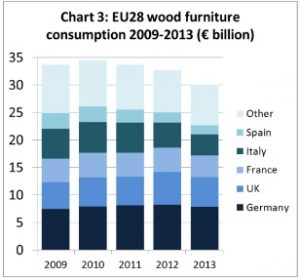
The value of wooden furniture production in Italy is estimated to have fallen 8% to €7.45 billion in 2013, continuing the decline of the previous two years. Italian manufacturers recorded a 1% decrease in export market sales during 2013, from €4.27 billion to €4.21 billion. Continuing weakness in the Italian domestic furniture market led to a sharp 9% decline in imports from €702 million to €636 million. Overall wooden furniture consumption in Italy is estimated to have fallen 15% from €4.57 billion to €3.88 billion during 2013.
After a year of relative stability in 2012, the German wooden furniture market declined in 2013. German wooden furniture production is estimated to have fallen by 5% from €6.91 billion in 2012 to €6.57 billion in 2013, mainly due to a 6% decrease in domestic market consumption from €8.27 billion to €7.81 billion in 2013. Between 2012 and 2013, German wooden furniture exports decreased 14% from €2.65 billion to €2.28 billion, while imports decreased 12% from €4.01 billion to €3.52 billion.
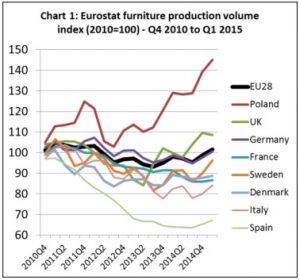
Meanwhile Poland, a country which has seen significant inward investment in furniture production capacity in recent years, recorded a 7% increase in production value from €3.81 billion in 2012 to €4.01 billion in 2013. This reverses a slight decline the previous year. The rise in production was mainly due to growth in the local market. Poland's domestic consumption of wooden furniture increased 30% to reach €936 million in 2013, the highest level for four years. Poland‟s wooden furniture exports remained stable at around $3.35 billion in both 2012 and 2013.
Record profits for the British timber industry
Data from Britain's Structural Timber Association (STA) shows a record number of orders for the UK's timber sector last year, with some organisations doubling their business, according constructionindex.co.uk. STA suggests that some members had seen sales increase as much as 163% and by 84% in the last three months.
STA says that there had been growth across all structural timber materials, from timber frame to structural insulated panels (SIPs) and cross-laminated timber (CLT). The STA sought to claim credit for the improving business of its members, saying that “the increase in timber contracts is largely as a result of work done by the STA in building awareness of the benefits of timber”. Until a rebranding last year the STA was called the UK Timber Frame Association (UKTFA).
Barry Armstrong of Robertson Timber Engineering agreed that there had been a greater appreciation of the benefits of timber but shortage of other materials was also a factor. SIPs Eco Panels sales manager Peter Keogh said: “I think the surge in demand has been led by the tightened Part L insulation regulations that came into force in April forcing builders to look more and more at energy efficient solutions like SIPs. This added to the desire to use a form of construction that can help make a project watertight as quickly as possible to minimise onsite delays has led to a strong increase in demand for our SIPs.”
B&K Structures managing director Nick Milestone said: “This year we have seen timber volumes triple since 2010, with structural engineered timber such as glulam or CLT now being used in over 90% of our projects. We have also seen a 77% increase in sales on projects using engineered timber for the structure, and in 2014 our glulam volumes are already at 185% of their 2011 value, while in 2013 CLT volumes were at six times that of 2011.”
STA chief executive Andrew Carpenter added: “As an association we have worked hard to build an understanding of timber in terms of sustainability and performance, coupled with the relationships we have forged with other organisations. As we now see the industry recognising that timber is the way forward for all these reasons and learn that stocks of brick and block, as well trained bricklayers are in short supply, it is no wonder that the time for timber has come.”
Södra to double sawn timber production capacity at two sawmills
Södra Wood has applied for a permit to expand production at sawmills in Unnefors and Orrefors (both in Sweden). At Orrefors, Södra plans to double capacity up to 150,000 cubic meters of sawn timber ( currently 75,000), while in Unnefors the planned capacity expansion should reach 200,000 m3 of sawn timber (currently 110,000).
The Swedish Environmental Advisory Board will take the final decision, which is expected at the turn of 2015/2016.
''Both sawmill have performed well in terms of both production and profitability, and are important in Södra Wood's future strategy,'' says Håkan Svensson, CEO of Södra Wood.
At Orrefors, Södra saws small logs which are meant to complement the company's large sawmills product range. At Unnefors, Södra saws good qulity pine logs which are targeted for key export markets.
Mixed price movements for German wood products
The German wood products price index registered some mixed developments in September. Except lumber and reserve square timber, all sawn timber assortments lost ground compared to August. The sharpest decline was recorded in KVH price, which had declined both as compared to August, as well as compared to September 2013.
A positive price trend can be noticed in the hardwood area. In particular, hardwood lumber and beech frames were up considerably.
In wood materials, raw particle boards price increased slightly over August, and almost 15% against September 2013. The price of laminated particle boards also surged and managed to offset the August decline. Pellets again show an upward trend, however, chips still remain at a low level.
| Germany's Producer Price Index Commercial Products (2000=100) |
Sep. 2013 |
Aug. 2014 |
Sep. 2014 |
Change Sep. '13 to '14 |
| Spruce and Fir lumber (Picea abies Karst.) | 114.2 | 116.4 | 116.1 | 1,66% |
| Lumber according to DIN 4074/S10 | 117.5 | 116.6 | 117.2 | -0,26% |
| Finger-jointed squares and beams (KVH) | 107.6 | 104.4 | 103.1 | -4,18% |
| Boards, width over 16 cm | 116.1 | 122.6 | 122.0 | 5,08% |
| Boards, width from 8 to 16 cm, size from 15 to 24 mm | 113.9 | 110.6 | 110.4 | -3,07% |
| Roof battens according to DIN 4074/S10 | 115.2 | 121.7 | 121.4 | 5,38% |
| Reserve squared timber, A/B, 10X10 - 12X12 | 113.1 | 114.2 | 114.6 | 1,33% |
| Softwood, size>6mm, planed, sanded, finger-jointed | 114.7 | 112.4 | 112.4 | -2,01% |
| Wood chips from softwood | 112.8 | 96.4 | 96.3 | -14,63% |
| Pellets and Briquets, compressed | 129.7 | 117.5 | 118.6 | -8,56% |
| Hardwood lumber | 106.6 | 108.9 | 110.1 | 3,28% |
| Beech blocks, A/B, size 50-60 mm, length 3m, damped | 104.2 | 102.3 | 102.6 | -1,54% |
| Beech frames, size 26-32 mm, length 3m, undamped | 106.9 | 109.6 | 110.9 | 3,74% |
| Particle boards, raw or sanded | 102.4 | 117.1 | 117.4 | 14,65% |
| Particle boards, laminated with decor | 114.4 | 113.9 | 115.2 | 0,70% |
| HDF panels, size > 800 kg/m³, raw/sanded | 111.3 | 112.1 | 111.9 | 0,54% |
| Laminate floorings, density > 800 kg/m³ | 110.2 | 109.1 | 109.2 | -0,91% |
New CLT projects in U.S.
Oregon BEST last week announced a new round of commercialization funding that will team southern Oregon-based DR Johnson Lumber Co. with Oregon State University researchers to determine how a new engineered building material made from lumber might catapult Oregon wood products to the forefront of construction innovation and technology.
Production of cross laminated timber, or CLT, has taken off in Europe in the recent years, but only two plants produce structural grade CLT in North America, both located in Canada. CLT panels, which can be up to 10 feet wide (3 meters) by 60 feet long (18 m) and up to 18 inches (45 cm) thick, are made by bonding together perpendicular layers of dimensional lumber, such as 2-by-4s, 2-by-6s or other dimensions, to create massive panels that can be erected and used for walls, floors structures and roofs.
In taller buildings, CLT becomes a cost-effective replacement for steel or concrete, and using it in construction sequesters carbon. Sample blocks of CLT also allows the use of shorter pieces of wood that can’t be used in traditional glulam beams, as well as lumber from smaller diameter forest resources.
“This is not merely a new engineered composite panel product,” said Lech Muszynski, a professor in the OSU Dept. of Wood Science and Engineering. “It's an entirely new building technology that is revolutionizing the use of timber in construction and dramatically cutting the overall time for construction projects.”
"Right now, we have an unprecedented opportunity here in Oregon to be the national leader in CLT production and innovation," said Ken Vaughn, Director of Commercialization Programs at Oregon BEST. "This catalytic commercialization funding will help this Oregon lumber company speed initial production, testing and the establishment of standards that could potentially position Oregon as the U.S. hub for CLT manufacturing."
DR Johnson was founded in 1951 in Riddle, Ore., a small town south of Roseburg. The funding will enable Riddle Laminators, the glue-laminate operation of DR Johnson, to collaborate with a research team of OSU faculty and students to construct a pilot manufacturing line for CLT at its facility and to test the CLT produced at the plant.
"Currently, in the U.S, it's kind of a chicken-and-egg situation with CLT," said Valerie Johnson, President of DR Johnson. "There is significant and rapidly growing interest in using CLT, but the cost to import panels from Canada or Europe for construction is not cost competitive." By working with OSU and the American Plywood Association, DR Johnson will manufacture and test CLT panels in order to obtain independent certification. "That third-party certification is absolutely essential in order for us to go to market with this product," she said.
DR Johnson is the first company in the country to set up initial production of structural grade CLT panels, Johnson said, but the project is part of a larger statewide effort involving many groups and nonprofits to open up a broader market for CLT.
”There’s tremendous interest in CLT right now,” said Paul Barnum, executive director of the Oregon Forest Resources Institute, a state agency charged with public education about forest management and forest products.
“This investment by Oregon BEST has the potential to reduce time to market and pave the way for other firms to get on board. It’s great that Oregon is leading this effort.” Johnson said there is a growing buzz around using CLT because it "meets or beats" traditional construction materials on every front.
"Architects and engineers are eager to design and specify this new construction technology because they're convinced it is the environmentally and seismically advanced way to build," she said. "It beats the socks off other building processes when it comes to carbon sequestration, so we believe the market will develop very quickly."
Johnson said CLT manufacturing is a natural next step in the evolution of DR Johnson/Riddle Laminators. "It's really just another glulam product but in a different shape, so we feel very confident we can do this," she said. "It's now a matter of working with a local machine design and manufacturing firm on the development of a commercial press capable of expanding in length as markets develop. Once the press design is complete and assembled, we will manufacture panels for testing and certification, and the Oregon BEST funding is helping us launch that initial process."
About Oregon BEST
Oregon BEST is the nexus for clean technology innovation, building capability, convening collaborations, and accelerating solutions to environmental challenges that deliver prosperity in all corners of Oregon. Oregon BEST brings together Oregon’s significant R&D strengths in clean technology to support the commercialization of new products and services.
About DR Johnson/Riddle Laminators
Founded in 1951, the DR Johnson production facility in Riddle, Oregon, specializes in the manufacture of 3" & 6" Douglas Fir. Primary products are 3x6 and wider, #1 and #2 structural joists and planks, 6x6 through 6x12 posts, beams and timbers, and full-sawn industrial clears and scaffold planks. Riddle Laminators manufactures structural glue-laminated beams from Douglas fir and Alaskan yellow cedar from the best available lamination stock that is fabricated into glulam beams in accordance with customers' needs.
North American wood pellets exports to Europe plateaued
Pellet shipments from the US and Canada to Europe have gone in opposite directions in 2014, with the shipments from the US South being up ten percent from the 4Q/13 to the 2Q/14, and Canadian volumes declining 25% during the same period, according to the North American Wood Fiber Review. The new expanding markets for pellet producers in Western Canada have instead been Japan and South Korea.
Total shipments of wood pellets from North America to Europe plateaued in 2014 after almost four years of continuous increases. During the first two quarters of 2014, exportation from Canada and the US were just over 1.3 million tons in each of the two quarters. This was down from the all-time-high of almost 1.4 million tons in the 4Q/13.
Pellet volumes shipped out of Canada to Europe have actually fallen by almost 25% from the 4Q/13 to the 2Q/14, while volumes leaving the ports in the US South did go up ten percent during the same time period.
Practically all wood pellets produced in British Columbia since the first major pellet plant was built over 15 years ago have been consumed by energy companies in Europe. However, since late last year, there has been a shift in direction for some of the pellets manufactured in the province; rather than being sent on the 16000 kilometer long journey to the United Kingdom or the Netherlands, they are being shipped to markets in Asia, a trip that is only about half as far.
South Korea and Japan together imported about 100,000 tons of pellets from British Columbia in the 2Q/14, which accounted for 17% of the total exports from the province that quarter. This can be compared to a quarterly average of only 30,000 tons during the period 2010-2012. This shift to markets in Asia is likely to continue because demand for biomass is rising in this region.
The reduced shipments to Europe from Western Canada can be expected to benefit other supplying regions to Europe, including the US South, Eastern Canada and Northwestern Russia. There are multiple factors which are likely to increase pellet shipments from the US South to Europe in the second half of 2014. These factors include continued interest from governments in Europe in shifting from fossil fuels to renewable energy sources, the approaching winter, with its increased demands for fuel to heat homes, and the soaring tensions between Ukraine and Russia, which have implications for energy security for Europe.
Forecast: Finland's forest industry’s export revenues projected to grow
Weak economic growth will slow down the growth of Finnish forest industry’s exports this and next year, according to the latest PTT (Pellervo Economic Research) forecast. Despite this, the export revenues of all forestry products except for paper exports will rise. As a result of several investments the production capacities of pulp, paper board and sawmilling industries will increase next year.
Good shape of sawn goods exports earlier this year now changing direction The market outlook for sawn goods exports has become more challenging as the year has progressed. Intensifying competition will reduce the percentage increases of the export amount and price by the end of the year.
The export amount for year 2014 is estimated to increase by 4 percent and the average export price of sawnwood by 3-4 percent compared to last year. Production is expected to increase relatively less, because of reductions in domestic supplies. Next year the production of sawnwood will increase by 2-3 percent. This is caused by the growth of demand in exports and the addition of production capacity. The challenging market situation will not enable any increases in next year’s average export price of sawnwood.
Paper production reducing, machine closures will continue
The production of paper in Finland will reduce this year by 1-2 percent and by 2-4 percent next year. This is caused by weak economic growth and continuing replacement of paper by electronic communication devices. The reduction in Finnish paper production is also caused by previously announced or recent machine closures. The average export price of paper will decrease this and next year. The prerequisite for a more permanent increase in average paper price is still a distinct decrease in paper production capacity in Europe.
The output of paper board will increase this and next year, while the demand remains good and the production capacity in Finland will grow by next year. The export price is estimated to increase next year as well. The trade sanctions against Russia will bring uncertainty in the paper board industry.
Pulp market remains strong
The demand for pulp has been strong for the past few years. As it continues to remain strong the export of pulp will keep increasing next year. Capacity expansions in Finland support this development. The export price of pulp will increase as a result of strong demand for softwood pulp and the weakening of euro against US dollar.
Key forecast variables for the Finnish forestry in 2014–2016
|
|
2014f %-change |
2015f %-change |
||
|
Export markets
|
||||
|
Volume |
Price |
Volume |
Price |
|
|
Paper |
-2 |
-3;-2 |
-4;-2 |
-2-0 |
|
Pulp |
-1 |
6-7 |
3-4 |
3-4 |
|
Paperboard |
1 |
-1-0 |
3-4 |
1-3 |
|
Sawn wood |
4 |
3-4 |
3-5 |
-1-0 |
f PTT’s forecast
Forecast: Finland’s forest industry’s export revenues projected to grow
Weak economic growth will slow down the growth of Finnish forest industry’s exports this and next year, according to the latest PTT (Pellervo Economic Research) forecast. Despite this, the export revenues of all forestry products except for paper exports will rise. As a result of several investments the production capacities of pulp, paper board and sawmilling industries will increase next year.
Good shape of sawn goods exports earlier this year now changing direction The market outlook for sawn goods exports has become more challenging as the year has progressed. Intensifying competition will reduce the percentage increases of the export amount and price by the end of the year.
The export amount for year 2014 is estimated to increase by 4 percent and the average export price of sawnwood by 3-4 percent compared to last year. Production is expected to increase relatively less, because of reductions in domestic supplies. Next year the production of sawnwood will increase by 2-3 percent. This is caused by the growth of demand in exports and the addition of production capacity. The challenging market situation will not enable any increases in next year’s average export price of sawnwood.
Paper production reducing, machine closures will continue
The production of paper in Finland will reduce this year by 1-2 percent and by 2-4 percent next year. This is caused by weak economic growth and continuing replacement of paper by electronic communication devices. The reduction in Finnish paper production is also caused by previously announced or recent machine closures. The average export price of paper will decrease this and next year. The prerequisite for a more permanent increase in average paper price is still a distinct decrease in paper production capacity in Europe.
The output of paper board will increase this and next year, while the demand remains good and the production capacity in Finland will grow by next year. The export price is estimated to increase next year as well. The trade sanctions against Russia will bring uncertainty in the paper board industry.
Pulp market remains strong
The demand for pulp has been strong for the past few years. As it continues to remain strong the export of pulp will keep increasing next year. Capacity expansions in Finland support this development. The export price of pulp will increase as a result of strong demand for softwood pulp and the weakening of euro against US dollar.
Key forecast variables for the Finnish forestry in 2014–2016
|
|
2014f %-change |
2015f %-change |
||
|
Export markets
|
||||
|
Volume |
Price |
Volume |
Price |
|
|
Paper |
-2 |
-3;-2 |
-4;-2 |
-2-0 |
|
Pulp |
-1 |
6-7 |
3-4 |
3-4 |
|
Paperboard |
1 |
-1-0 |
3-4 |
1-3 |
|
Sawn wood |
4 |
3-4 |
3-5 |
-1-0 |
f PTT’s forecast
Global demand for Chinese plywood on the rise
The international demand for Chinese plywood has improved since the beginning of 2014 according to the latest statistics from China Custom. In the period January to August 2014 China's plywood exports rose 15% to 7.81 million cubic metres, up around one million cubic metres from the same period of 2013. The USA remains the main destination for China's plywood exports growing 28% to 1 million cubic metres or 13% of the national total up to August .
China's plywood exports to Japan rose 2% to 563,200 cubic metres, exports to the UK rose 0.7% to 446,300 cubic metres and exports to UAE 465,200 cubic metres.
In addition, China's plywood exports to Hong Kong amounted to 132,600 cubic metres, to Thailand 211,300 cubic metres, Vietnam 161, 800 cubic metres, to Saudi Arabia 365,400 cubic metres, to Canada 125,600 cubic metres, to Russia 113,300 cubic metres and to Chile 49,700 cubic metres.
Manufacturers in Shandong and Jiangsu provinces produce around 75% of the national plywood output for export. Plywood exports of Shandong Province rose 18% to 3.76 million cubic metres between January to August (48% of the national total) while plywood exports from Jiangsu Province rose 16% to 2.20 million cubic metres (28% of the national total).
Lower Chinese furniture exports as EU and US demand weakens
According to the latest statistics from China Customs, the value of China's furniture exports has declined year-on-year for two consecutive quarters. The value of China's furniture and parts exports fell 8.1% to US$11.31 billion in the first quarter and fell 7.6% in the second quarter.
The main reason cited for the decline is the weakening of demand in the USA and European Union. These two markets account for around 50% of the China's total furniture exports.
In the first quarter of 2014, the value of China's furniture exports to the USA fell 0.9% to US$3.45 billion (now 31% of t he national total) while exports to the EU fell marginally to US$2.44 billion (now 22% of the national total).
Another factor squeezing Chinese furniture exports has been the transfer of business by US importers to suppliers in Vietnam where export prices are very competitive compared to China which suffers from rising labour, energy and transaction costs.
According to local experts raising per capita productivity in China will help restore competitiveness. But to sustain the export markets which are so important since domestic demand is fading due to China's demographics it will be necessary for Chinese companies to change their business models from a focus on made to order to one of branding and buyer loyalty.
HOMAG bought by Dürr AG for €228 million
Dürr has completed the majority acquisition of HOMAG Group AG, which had been announced on July 15, 2014. Dürr Technologies GmbH, a wholly owned subsidiary of Dürr AG, now holds 55.9% of HOMAG’s capital. A sum of € 228.1 million was paid for the acquisition. HOMAG is being fully consolidated within the Dürr Group from October 1, 2014.
Dürr acquired 53.7% of HOMAG’s capital from various principal shareholders of the company, including Deutsche Beteiligungs AG, which relinquished its entire package of shares in HOMAG (39.5%), as well as the Schuler/Klessmann shareholder group, which sold 3.0% of HOMAG’s capital to Dürr.
Under the voluntary public takeover bid, which expired on October 7, 2014, Dürr acquired a further 2.1% of the company’s shares on October 14, 2014. The relevant national and foreign anti-trust authorities had previously approved the acquisition.
Dürr acquired HOMAG using its own funds. With a 28% share of the global market, HOMAG is the largest provider of production technology for the wood-processing industry, generating sales of € 789 million and an EBIT margin of 4.4% in 2013.
HOMAG expects to achieve higher order receipts, sales and earnings this year. Within the Dürr Group, the HOMAG brand name will be retained, with the company forming the newly created Wood Processing Systems division.
Including HOMAG, Dürr generates sales revenues of some €3.2 billion and has over 13,700 employees around the world.
Ralf W. Dieter, CEO of Dürr AG: “Alongside Dürr Systems and Carl Schenk, HOMAG forms the third pillar of our Group. The company is a global market and technology leader and has further growth and earnings potential. Dürr knows the mechanical engineering business very well. This is reflected in our success in areas like balancing, testing and filling technology. We will use our expertise and support HOMAG in optimizing its processes and structures. The automotive industry remains our core sector – but the HOMAG acquisition will enable us to position ourselves more broadly.”
Dürr Technologies GmbH plans to enter into a control and/or profit and loss transfer agreement with HOMAG Group AG. Approval for this proposal will be sought at an extraordinary shareholder meeting or the regular shareholder meeting of HOMAG Group AG in the first half of 2015. For this purpose, Dürr can rely on a total of 77.9% of the votes as it has entered the Schuler/Klessmann shareholder group’s voting pool with 3% of its shares. The Schuler/Klessmann shareholder group holds 22.1% of the voting rights and, among other things, has given an undertaking to Dürr to vote in favor of a corporate agreement. There are no plans for the remaining HOMAG shareholders to be squeezed out or for the company to be delisted.
The Dürr Group is one of the world's leading mechanical and plant engineering firms. Products, systems and services offered by Dürr enable highly efficient manufacturing processes in different industries. Business with automobile manufacturers and their suppliers accounts for approximately 65% of Dürr's sales. Other market segments include, for example, the mechanical engineering, chemical and pharmaceutical industries and – since the takeover of HOMAG Group AG in October 2014 – the woodworking industry. Dürr has 94 business locations in 28 countries and generates annual sales of approx. € 3.2 billion with around 13,700 employees.
Central Africa: EU demand weak
Central/West African producers are satisfied with the current order book positions and consider these as about normal levels for this time of year. They are now more confident about log supplies and have indicated they could meet any increase in demand from EU buyers should they begin to restock. However, producers are not expecting any significant change in the flow of orders from Europe. The Ukraine conflict and sanctions on Russia are beginning to weaken the economies of some EU member states, particularly Germany and France, compounding the impact of the depressed construction sector in many EU member states.
The UK economy is in better shape than that of most EU member states and the housing sector is very active. With a general election due in May 2015 it is likely that the UK government will continue with current fiscal policies.
Although recently there was an improvement in EU tropical timber imports from the very low levels in the first half of the year, buyers in the EU are uncertain of how demand will develop in the final quarter of the year. The pressure to tighten up on implementation of the EUTR is just one factor that could depress growth in imports. Meeting the tough specifications in quality and dimensions is a major challenge for producers and this, coupled with the very narrow range of species required for the EU market, producers are keen to develop those new markets which are open to a larger range of sizes and qualities as profit margins tend to be better.
Finely balance supply and demand
Over the past two weeks no price changes have been reported for either logs or sawnwood. Analysts say it is unlikely there will be any substantial change in the flow of orders over the coming weeks. However, reports are circulating that, due to the Ebola outbreak, Liberia may suspend timber exports which will result in a diversion of orders to countries that are less affected.
At the moment supply and demand appear to be very finely balanced against a background of generally weak economic and market conditions in the EU but steady demand from the Middle East and China.
Boost to housing growth in China will benefit exporters
Demand from buyers for the Chinese market is strong and log and sawnwood prices have settled at around 15% higher than the average in 2013. The recent easing of credit flows in China and the actions of regional administrations to boost housing growth could benefit West African producers.
Producers report demand from companies in Vietnam is good and the expansion of the woodworking and furniture industries is encouraging. The current market outlook is positive with the expectation that the fine balance in supply and demand will maintain the current price stability into the final quarter of 2014.
Log Export Prices
| West Africa logs, FOB | € per m³ | ||
| Asian market |
LM
|
B
|
BC/C
|
| Acajou/ Khaya/N'Gollon |
220
|
220
|
155 |
| Ayous/Obéché/Wawa |
230
|
230
|
150
|
| Azobe & Ekki |
235
|
230
|
150
|
| Belli |
290
|
290
|
-
|
| Bibolo/Dibétou |
150
|
145
|
|
| Iroko | 330 |
290
|
260
|
| Okoume (60% CI, 40% CE, 20% CS) (China only) | 340 | 340 | 260 |
| Moabi | 320 | 300 | - |
| Movingui | 220 |
220
|
180
|
| Niove |
160
|
155
|
-
|
| Okan |
280
|
280 |
-
|
| Padouk |
300
|
275 |
210
|
| Sapele | 340 | 340 | 240 |
| Sipo/Utile |
360
|
360 |
220
|
| Tali | 315 | 315 |
-
|
Sawnwood Export Prices
| West Africa sawnwood, FOB |
€ per m³
|
|
| Ayous | FAS GMS | 350 |
| Bilinga | FAS GMS | 520 |
| Okoumé | FAS GMS |
480
|
| Merchantable | 275 | |
| Std/Btr GMS | 350 | |
| Sipo | FAS GMS |
660
|
| FAS fixed sizes | 660 | |
| FAS scantlings | 670 | |
| Padouk | FAS GMS | 820 |
| FAS scantlings | 870 | |
| Strips | 500 | |
| Sapele | FAS Spanish sizes | 660 |
| FAS scantlings | 670 | |
| Iroko | FAS GMS | 620 |
| Scantlings | 695 | |
| Strips |
440
|
|
| Khaya | FAS GMS |
450
|
| FAS fixed |
470
|
|
| Maobi | FAS GMS |
580
|
| Scantlings |
560
|
|
| Movingui | FAS GMS |
420
|
European parquet market shrinks further
The Board of Directors of the European Federation of the Parquet Industry met on 30 September 2014 and discussed amongst others both the parquet situation and recent economic indicators on the European market. A brief per country recap is provided in the table below.
Market overview
| Austria | The market declined by an estimated 3% compared to the same period last year. |
| Belgium | The information provided to FEP points in the direction of a stable market compared to the same period of last year. |
| Denmark | The market remains stable when compared to the first 8 months of 2013. |
| Finland | Parquet sales are down by an estimated 5 to 7%. The activity on the market is rather low and greatly dependant on Russia. The economy follows a downward trend. |
| France | The market saw a decline of 10 to 12% in the first 9 months of 2014. The trend forecast is negative as well. The confidence at the end-consumers level is quite low and they have adopted a “wait and see” attitude. |
| Germany | The positive development of the first 4 to 5 months of 2014 has unfortunately not continued. June, July & August were predominantly regressing. Compiled data indicate that parquet sales in the first 8 months of the current year have declined by 1 to 2%. |
| Italy | The positive development of the first 4 to 5 months of 2014 has unfortunately not continued. June, July & August were predominantly regressing. Compiled data indicate that parquet sales in the first 8 months of the current year have declined by 1 to 2%. |
| Netherlands | The market is still characterised by an important overcapacity in production (facilities). The contraction of the past years did not affect the production capacity. Therefore, producers look for export possibilities. The parquet consumption continues to fall, but at a slower pace than expected. Despite the fact that the economy is recovering slowly, this development remains to be seen in the parquet sector. |
| Norway | The Norwegian parquet market showed no major changes compared to last year, the market is stable. |
| Spain | Generally speaking, the public attitude is one of waiting for the tax reforms. Unemployment remains a major problem. Nevertheless, the market seems stable, but at a low level. |
| Sweden | The Swedish market has grown by some 3%. House building is picking up, especially the construction of one family houses. |
| Switzerland | For the first time in 10 years, the market is flat. Both mosaic and 3-strip products are further declining. DIY chains now represent an estimated 10% of the total market. LVT is picking up. |
Cross laminated timber building competitive in North America
Cross laminated timber (CLT) construction is cheaper than conventional methods, but not by much, a new study shows. However, the study predicts that in the future, building material could get a lot cheaper. The study, the first of its kind, was conducted by Mahlum, Walsh Construction and Coughlin Porter Lundeen Engineering to determine the feasibility of CLT construction in the U.S. Pacific Northwest, mainly focusing on Seattle.
The study states that CLT means fewer skilled labourers are needed, shorter construction times, better tolerances and quality, safer work, and utilization of local and sustainable materials. It was also found to reduce the carbon footprint of buildings.
"As a new, unproven material in the Pacific Northwest, this study investigates the competitiveness of CLT versus traditional materials for low high-rise buildings," it states.
The study defined "low high-rise buildings" as being taller than 75 feet but shorter than 125 feet. When compared to the base 10-storey concrete building, the CLT option offered an estimated four per cent cost saving.
Lynn Embury-Williams, executive director of Wood WORKS! BC said that while four per cent is not significantly cheaper, it shows that CLT is definitively competitive. Embury-Williams said the biggest savings come from building times.
"The key is having the building expertise. Once contractors really become familiar with this system I think the cost savings will continue," she said.
There is also an issue of supply. Embury-Williams said that for all of western North America, there is only one company making CLT materials –Structurlam in Penticton, B.C. Some builders purchase from KRH based in Austria, which is considering a North American branch.
"It's a relatively new product, certainly demand has been building for it," Embury-Williams said. "It looks like the demand over here is occurring in a similar way as it had in Europe."
She believes that next year's update to the national building code could surge the use of CLT and wood building ahead.
Five years ago, B.C. allowed six-storey residential wood buildings.
This resulted in more than 50 structures being built and another 250 are in the planning stages.
Ontario recently altered its building code to allow for six-storey wood residential structures.
New national codes will allow for six-storey wood buildings with mixed use. The commercial, office and retail construction will require much more wood technology than residential, which will push the industry forward, she said.
EU glulam imports recover in 2014
The EU imported 61,400 cu.m of glulam products in the first half of 2014, 9% more than the same period in 2013. Imports from Russia increased 54% to 13,300 cu.m in the first six months of this year. As a result Russia has overtaken Malaysia to become the largest external supplier of glulam to the EU this year.
However there was also a 16% increase imports from Malaysia to 11,000 cu.m this year. Meanwhile imports declined 2% to 10,700 cu.m from Indonesia and 14% to 6,900 cu.m from China. Imports of glulam account for around 5% of total EU consumption of this commodity.
Much of the imported glulam consists of dimension product for window manufacturing. Glulam imports from Russia and China are primarily pine and larch. Imports from Malaysia and Indonesia consist of meranti.
EU28 imports of joinery products (excluding flooring) from China had a value of €54.5 million in the first 6 months of 2014, 3% more than the same period the previous year. This partially reverses the 9% decrease (to €108m) in EU28 imports of Chinese joinery products between 2012 and 2013.
Doors make up the bulk of EU joinery trade with China, with total value of €88.5 million in 2013. The EU and Romania are the main European markets for China's wooden doors and both countries have been importing rising quantities over the last 2 years.
Imports of Chinese wooden doors by France, the third largest market, declined between 2012 and 2013, but have increased again this year.
The UK is the only EU country importing significant quantities of glulam products from China, with value of around €8.7 million in both 2012 and 2013. UK imports of Chinese glulam products were €3.8 million in the first 6 months of 2014, 1.6% less than the same period in 2013.
EU imports of finished wood windows from China are negligible and declining. EU imports of this commodity fell from €3.7 million in 2012 to €2.1 million in 2013. In the first half of 2013, EU imports of Chinese wood windows were only €1 million, mainly destined for France and Poland.

