

SY Energy performs test runs on its new wood pellets production facility in Jincheon, Chungcheongbuk-do province. Continue reading "SY Energy starts test runs on South Korea’s largest wood pellet plant"
Article archive
FSC plans to reach global market share of 20% by 2020
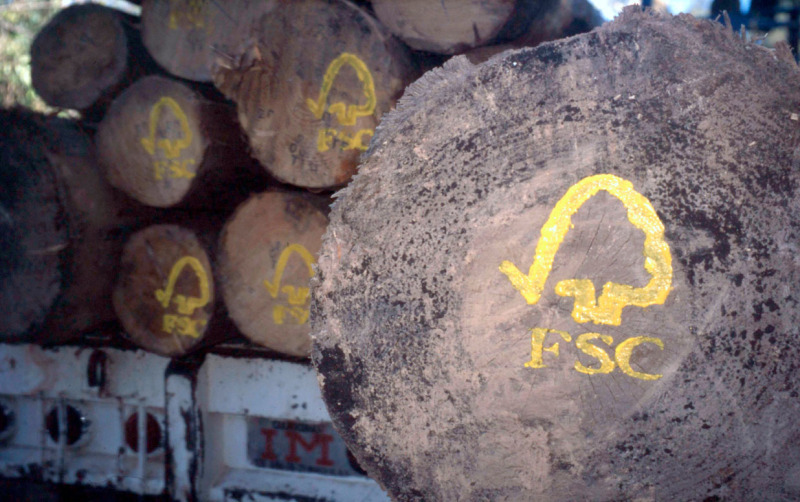
The first estimates of FSC’s presence in the forest products supply chain are now available for 2016. The FSC Global Strategic Plan calls for FSC to reach 20% market share in global forest-based trade by 2020. Continue reading "FSC plans to reach global market share of 20% by 2020"
Egger Group reports stable results for the business year 2016/2017
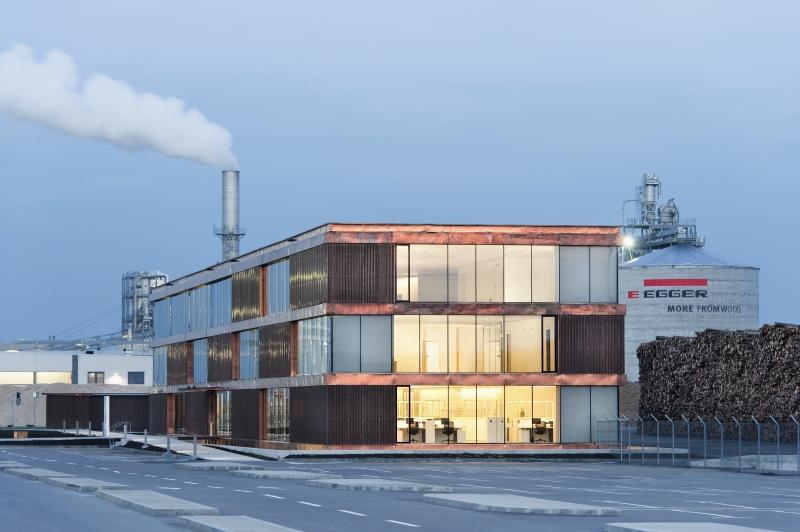
The Egger Group announced a positive development of key indicators during the annual press conference, which took place on 27th July 2017 at the headquarters in St. Johann in Tirol. Continue reading "Egger Group reports stable results for the business year 2016/2017"
Germany: Wood pellets production up by 24% in H1/2017

German pellet producers have significantly increased their production output in 2017, as compared to the previous year. Continue reading "Germany: Wood pellets production up by 24% in H1/2017"
Södra to boost Långasjö sawmill production capacity
Södra is currently investing over SEK 100 million in the Långasjö sawmill and at the middle of July most of the project investment reached its first milestone. Continue reading "Södra to boost Långasjö sawmill production capacity"
Costs for pellet plants in North America have trended downward in the past year
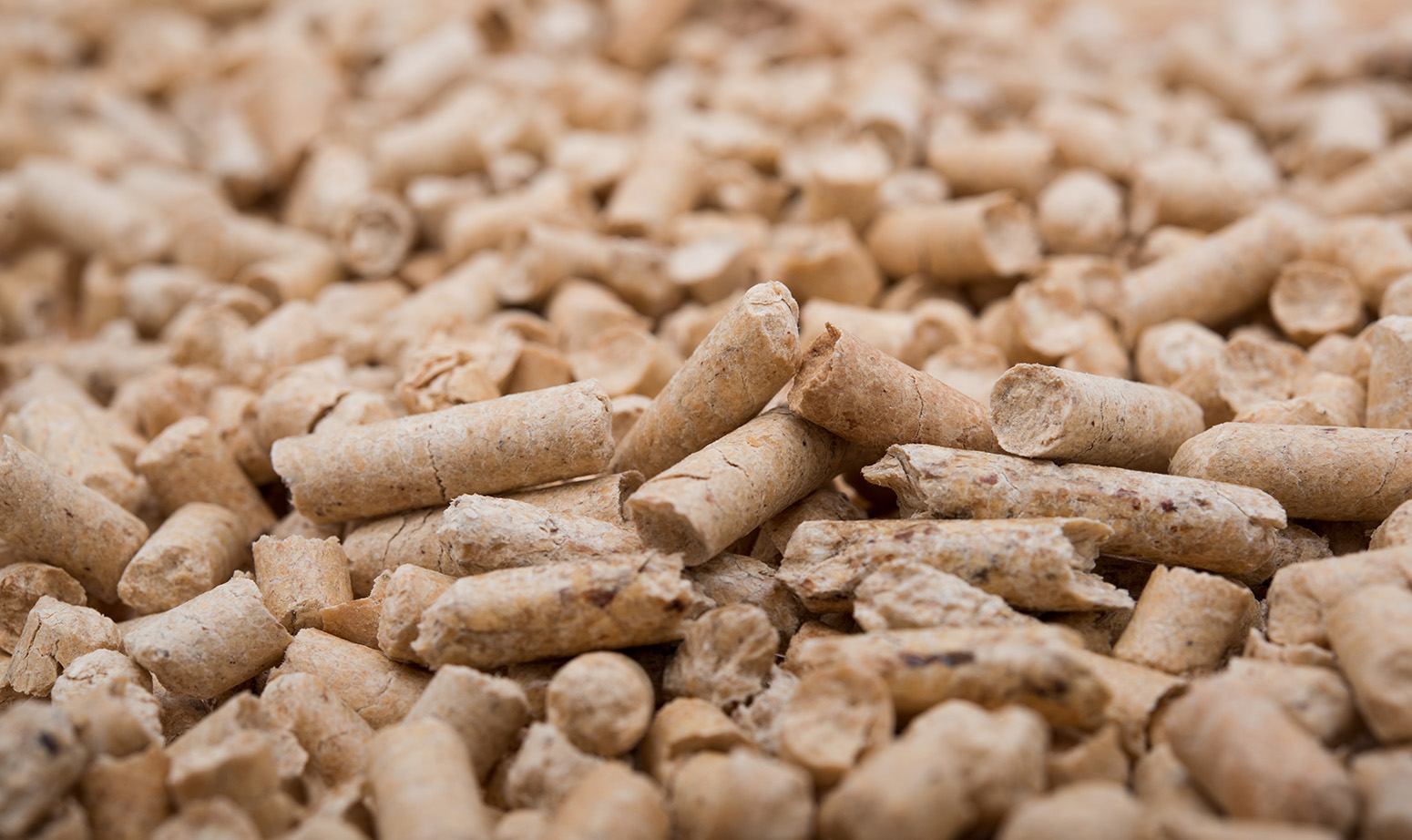
The fiber costs for pellet plants in North America have trended downward the past year with the US and Canadian Pellet Feedstock Price Indices reaching their lowest levels in over four years in the 2Q/17.
With the feed stock shifting towards lower cost fiber, including industry and forest residues, total wood costs for pellet manufacturers fell during 2016 and early 2017. The PFPI price indices for the US and Canada have fallen 16% and 26%, respectively since 2013.
Wood pellet manufacturers in North America consume wood fiber from a variety of sources with different price levels, trends and cost drivers. The WRI pellet feedstock price indices for Canada and the US (PFPI-US and PFPI-CA), which were launched in 2013, show a quarterly volume-weighted price for the fiber consumed by each country’s pellet sector. Each individual facility’s estimated mix of fiber (roundwood, sawdust, shavings, microchips, etc.) are calculated using local fiber pricing to determine a weighted price, which is further combined with production capacity and operating rate to calculate the final regional index price.
The price indices for both the US and Canada have trended downward the past few years and reached record lows in both countries in the 2Q/17. The PFPI-US has fallen 15% from its peak in the 3Q/13 to the 2Q/17. Slightly declining roundwood prices, plummeting sawdust costs, and a change in the feedstock mix towards lower cost residuals in both the Gulf States and the Atlantic States were the major reasons behind the decline in the PFPI-US Index the past year.
A snapshot of the various feedstocks currently being used by the US export pellet sector shows 50 percent was roundwood in the 2Q/17, followed by significant volumes of sawdust and shavings, and an increasing supply of forest microchips.
The Canadian price index, PFPI-CA, which combines the larger Western export pellet sector primarily in BC with the smaller Eastern sector found in Ontario, Quebec, New Brunswick and Nova Scotia, has fallen more than the US index (in US dollar terms), mostly because of the weaker Canadian dollar. However, wood fiber costs for pellet manufacturers have also fallen slightly in Canadian dollar terms because of lower costs for logs the past few years. From its record high in early 2013 to the 2Q/17, the PFPI-CA declined 26%. The lower indexed price in the 2Q/17 primarily reflected the falling costs of sawdust and shavings and incremental increases in the usage of these feedstock forms over higher cost roundwood.
Significant increase in US wooden furniture imports
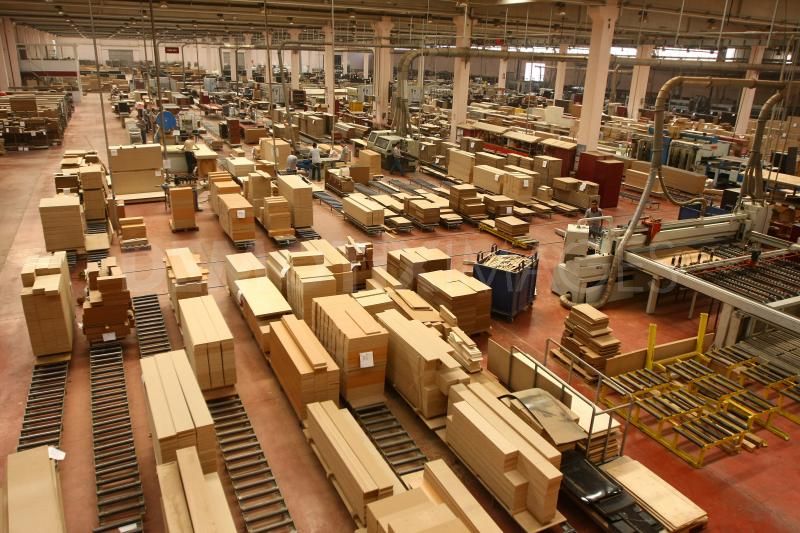
US wooden furniture imports grew 11% in May to US$1.63 billion. Year-to-date imports were up 10% from May 2016.
The strongest growth in imports was again from Vietnam and China. Furniture imports from Vietnam grew 22% to US$336.4 million. Imports from China were worth US$662.1, up 16% from April.
Malaysia’s exported US$51.2 million worth of wooden furniture to the US in May, a 12% increase from the previous month. Imports from Indonesia grew at the same rate to US$51.7 million. Mexico and India also exported more to the US in May.
Imports of all types of wooden furniture grew in May, except office furniture. Imports of bedroom furniture increased 17%, followed by seats (+13%) and wooden furniture for other uses (+13%).
US furniture manufacturing up
The most recent estimate by the Bureau of Economic Analysis revised GDP growth in the first quarter of 2017 up from previously 1.2% to 1.4%. In the fourth quarter, real GDP increased 2.1%. The unemployment rate remained almost unchanged at 4.4% in June. The rate has declined 0.4 percentage points since January.
Economic activity in the manufacturing sector expanded in June, according to the latest survey by the Institute for Supply Management. Furniture manufacturing reported the highest growth in June of all manufacturing industries.
Raw material prices increased in June for the furniture industry. The wood products industry also grew and reported strong growth in new orders.
Confidence in the economic outlook continued to decline in early July, according to the University of Michigan’s survey of consumers. Hope for strong economic growth after President Trump was elected appears to have largely vanished. However, consumers’ confidence in current economic conditions was high. Based on the survey data personal consumption will grow 2.4% in 2017.
China: Thousands of wood-based panel mills cease operation

It has been reported that nearly 3,000 wood-based panel enterprises in Wen’an County, Langfang City, Hebei province have been told to cease production.
This will have an immediate impact on the domestic panel market and jobs. The affected enterprises employ around 10,000 workers
Some enterprises have been required to re-tool to meet environmental requirements and some have been encouraged to relocate to their original home provinces, such as to Shandong Linqing, Liaoning Benxi, Xinjiang Yanqi and Hebei Xunxi.
A series of workshops on ‘Returning to Hometown to Invest’ have been held to encourage wood-based panel enterprises to return to their hometown and invest there. .
The affected enterprises were found to be generating and emitting pollutants which had contaminated surrounding farmland. It has been estimated that when these enterprises stop production or relocate it will be possible to rehabilitate around 2,700 hectares of farmland.
The softwood market in the UK shows signs of slowing down this summer

The softwood market in the UK decreased as the trade during July was tempered by the political outfall from the general election and Brexit uncertainty.
As TTJ reported, the Grenfell Tower fire tragedy raised questions regarding construction designs, refurbishment and flammability on high-rise and public buildings, to include the reversal of cladding fixes (albeit metal and fibre rather than wood-based) has impacted on sections of the construction industry.
Specification, product performance and accreditation are now taking centre stage and public opinion is against low-cost choices in favour of ‘fit for purpose’. This mood will undoubtedly dictate that more stringent tests are carried out on building materials, and from a fire resisting perspective, wood-based productstreated with exterior and interior retardants might find favour in future markets.
Now, designers will be obliged to guarantee a high level of factual guidance from the industry and, with the recent successes in the CLT high-rise market there is little doubt that fire-preventing designs will be the primary consideration in the product’s future.
In the softwood market generally, there have been some excess volumes of C24 carcassing circulating from both landed stock and inventories held at some Swedish mills. Overall, production appears to be under control and most European markets are lively and mills are still raising prices. The UK is lagging behind other markets (once again) in achieving replacement prices of imported softwood, and the situation is being additionally accentuated by the fragile and volatile value of sterling. There is still a large gap between imported and home produced softwood prices which shows no sign of closing in the near future, this does create a ‘drag-factor’ on imported products, TTJ reported.
Considering the holiday period and the fact that many sawmills are getting ready to close for the summer maintenance, it is likely possible that the stock gaps will recover in August. Also, buyers are urged to ensure they have suitable stocks ready to draw from. Most mills are now outsold through to September.
Western Forest Products announced the indefinite curtailment of its Somass sawmill
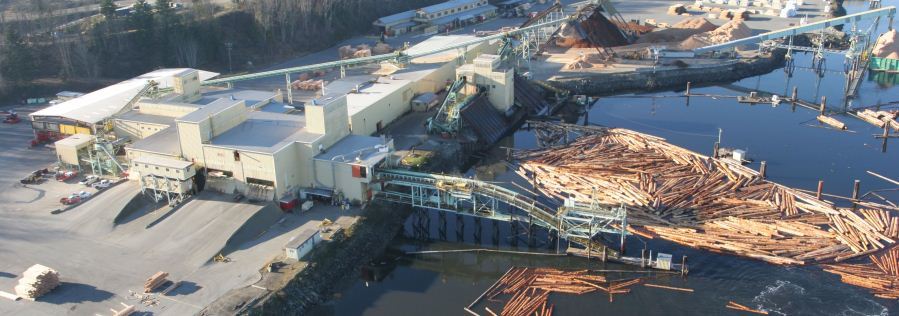
The Somass Sawmill has been temporarily curtailed since February 2017, prior to which it operated on a single shift basis. Western intends to offer voluntary severance to its Somass Sawmill hourly employees.
The decision to indefinitely curtail operations is in response to the lack of log supply to operate the mill efficiently, as well as the uncertainty caused by duties recently applied to Canadian softwood lumber products sold into the United States. Western is focused on reducing costs to remain competitive. Cost reductions will be delivered through operational consolidation. The company expects to offset lost production from Somass by increasing production at its other operations on Vancouver Island.
We have made the announcement today to provide clarity and options for our Somass employees. We will be encouraging employees to explore opportunities for employment at Western's other sawmills on Vancouver Island," said Don Demens, President and Chief Executive Officer of Western.
Western is committed to creating the most competitive specialty softwood lumber manufacturing business possible. We have invested over $300 million on the coast of B.C. since 2012, including $100 million in modernizing our Vancouver Island manufacturing facilities, and we remain focused on ensuring the long-term viability of our business for the benefit of our employees, shareholders, and the communities in which we operate," he added.
Western Forest Products Inc. is an integrated Canadian forest products company and is the largest coastal British Columbia woodland operator and lumber producer. The company has an annual available harvest of approximately 6.1 million cubic metres of timber, of which approximately 5.9 million cubic metres is from Crown lands.
West Fraser acquires the Gilman Companies for $430 million
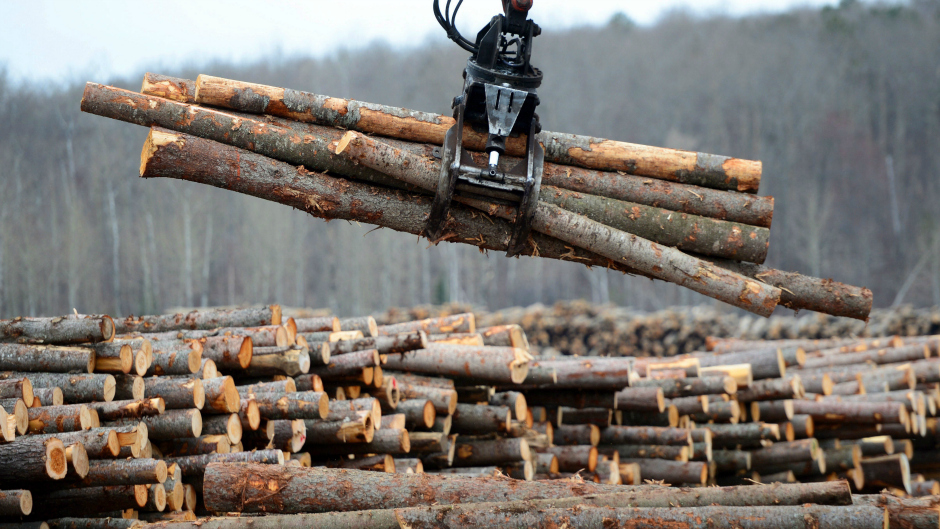
West Fraser Timber Co. Ltd. today announced that it has entered into an agreement to acquire the operations of the Gilman Companies from the Howard Gilman Foundation and other shareholders for approximately US$430 million, subject to certain post-closing adjustments. Continue reading "West Fraser acquires the Gilman Companies for $430 million"
India’s timber demand drops by 40% after GST implementation
After the implementation of Goods and Services Tax (GST) earlier this month in India, the demand for timber has taken a serious downturn, while industry players report their orders down by almost a half. Continue reading "India’s timber demand drops by 40% after GST implementation"
US lumber prices trending upwards

During last week in the US, trading in framing lumber was mixed, but most price trends pointed upward. Continue reading "US lumber prices trending upwards"
Export log prices in New Zealand have weakened in July

New Zealand export log prices mostly declined over the past month, due to the fact that the gain in the New Zealand dollar made the country's products less competitive. Continue reading "Export log prices in New Zealand have weakened in July"
Wood pellets price in Austria on the rise in July

The price for EN plus A1 wood pellets in Austria reached an average of EUR 227.2/tonne, which represents a 2% increase over July 2016. Also, the price is 0.7% higher than in June. Continue reading "Wood pellets price in Austria on the rise in July"
Södra Wood division increases its profits in the Q2/2017
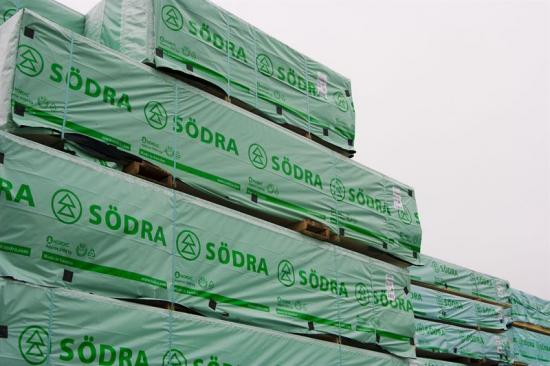
Södra’s timber division recorded a sharp profits increase in the second quarter of 2017, reaching SEK 50 million, as compared to the same period last year.
The increase for the Swedish sawmiller was mainly due to the improved earnings for sawn timber and, in addition, the Q2/2016 was influenced by a non-recurring cost of SEK 204 million related to the restructuring of Södra Wood’s sawmill operations.
“The overall forest economy remains strong, which is to Södra’s advantage,” said Lars Idermark, president and CEO. “Higher prices for both market pulp and sawn timber contributed to a strong quarter for Södra. A firmer customer and market orientation is also yielding results. In addition, the expansion investments at our pulp mills and the restructuring process in the sawmill operations had a positive impact on operating profit.”
The operating profit for Södra amounted to SEK 464 million for the Q2/2017 and this was boosted by favourable demand for Södra’s products, higher prices and internal operational improvements.
20,000 plus FLEGT licenses issued in Indonesia

Since the launch of the FLEGT Indonesia license scheme on November 15, 2016 Indonesia has issued 20,778 licenses for the export of wood products to the EU.
These licenses were for products worth US$730 million and had a shipping weight of 343,000 tonnes.
At a recent meeting, Michael Bucki of the European Commission Delegation in Jakarta, reminded that the EU timber regulation has three principles:
- it prohibits placing in EU markets timber products which have not been verified legal
- it requires EU merchants importing wood products for the EU market to conduct 'due diligence' procedures;
- it requires EU operators to archive all data of their suppliers and buyers
Dr. Rufiie of the Ministry of Environment and Forestry noted that FLEGT licensed wood products shipped to the EU have a competitive advantage but that there are other factors that contribute to determining the competitiveness of a product, such as design, quality and price.
This is why Indonesian manufacturers must continue to assess competitors in Vietnam and Malaysia for example as they will be vying for a larger share of the EU market.
Tropical wood continues to lose share in European flooring market

European consumption of real wood flooring (i.e. excluding laminates) remains flat and the role of tropical timber in this sector is declining. This is apparent from combined analysis of Eurostat trade data and the latest market report by the FEP (European Federation of the Parquet Industry) released on 16 June 2017 at the Federation’s annual general meeting in Budapest, Hungary.
Prior to the global financial crises, nearly 20 million sq.m of the 100 million sq.m of real wood flooring manufactured in Europe was faced with tropical hardwood. Another 20 million sq.m was imported directly from the tropics.
However, in the last decade a host of factors have conspired to drastically reduce the role of tropical wood in this sector, including the shift to engineered flooring products, intense competition from Eastern European and Chinese manufacturers for market share, a progressive switch to oak at the expense of all other hardwoods, a glut in supply of cheaper laminates and non-wood alternatives, the development of new and improved look-alike surfaces, and an increasing focus on legality due diligence and certification.
Drawing on information from member companies and affiliated national associations, FEP provides detailed data on real wood consumption and production in 16 European countries covered by the FEP.
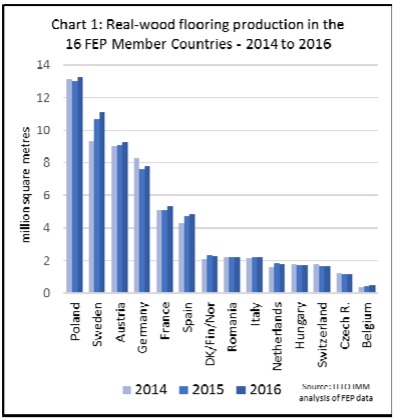
This data shows that consumption increased 1.7% in 2016 to 77 million sq.m in the 16 FEP countries, building on a 0.5% gain in 2016. It also shows that production in these countries increased 2.5% to 65.6 million sq.m, with notable gains in Poland, Sweden, Austria, Germany, France and Spain (Chart 1).
According to FEP, in 2016 multilayer parquet floors accounted for 80% of wood floors manufactured in the 16 FEP countries, up from 79% in 2015 (the majority comprising three-layer parquet). Solid wood flooring accounted for 18% of production, down from 19% in 2015, while mosaic accounted for 2%.
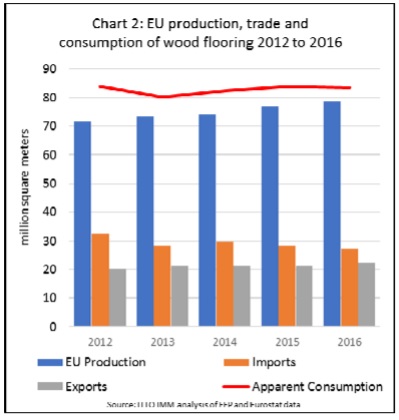
Data in the FEP annual report also indicates that total realwood flooring production in the EU28 as a whole increased 2.4% from 76.9 million sq.m in 2015 to 78.7 million sq.m in 2016.
Combining this with Eurostat trade data, which shows a 3.9% decline in imports and a 5.5% rise in exports by the EU in 2016, consumption within the trading block appears to have declined slightly, by 0.5%, during the year (Chart 2).
The combination of FEP and Eurostat data shows that the share of all real-wood flooring supplied into the EU single market by domestic manufacturers was 74.4% in 2016, up from 73.2% in 2015 and from 68.6% in 2012.
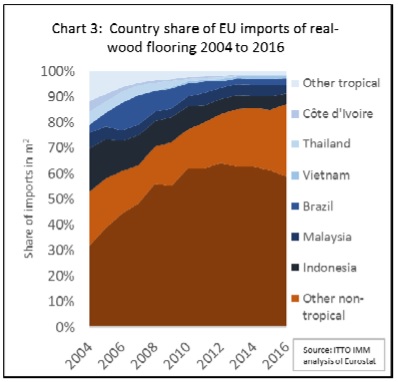
This analysis confirms that external suppliers into the EU continue to lose share in the wood flooring sector. Eurostat data also reveals that, amongst external suppliers to the EU, tropical countries are rapidly losing share to temperate countries.
EU28 imports of real wood flooring from the tropics declined 18% to 3.46 million sq.m in 2016. Imports from China also fell in 2016, by 8% to 15.9 million sq.m. In contrast, imports from Ukraine increased 28% to 3.99 million sq.m, 21% from Switzerland to 1.28 million sq.m and 25% to 1.2 million sq.m from Bosnia. The continuous shift away from tropical suppliers of real-wood flooring is made apparent in Chart 3.
Wood pellets demand in co-firing to increase in the next decade

By the end of 2027, approximately 35% of the global wood pellets sales will be accounted by their end-use in industrial pellet co-firing.
A new report on the global market for wood pellets, released by Future Market Insights, shows that the market is expected to reach US$9.204.9 million by the end of 2017. The report further projects that global sales of wood pellets will soar at a CAGR of 8.7% to bring in over US$21.1 million by the end of 2027.
In the report, titled ‘Wood Pellet Market: Global Market Analysis 2012–2016 and Forecast 2012–2027’, there is also shown that in 2016, approximately 37.5 million t of wood pellets were sold across the globe. Increasing investments in new technologies & pelleting machines, coupled with higher demand for wood pellets in electricity generation, are some of the prominent trends influencing the growth of global wood pellets market during the forecast period.
End-use offerings, such as use of pellets in residential and commercial heating and industrial pellet end-use in CHP/district heating, will also experience growth on the market.
According to the report, increasing consumption of wood pellets is triggered by promotion of reusing agricultural produce or forest wood in industrial processes. North America’s climate change concerns are compelling the region’s wood pellet manufacturers towards resource & feedstock optimization.
Meanwhile, wood pellets are successfully replacing fossil fuels such as charcoal in specific heating applications. The report reveals that 1 t of wood pellets have the potential to provide raw thermal energy equivalent to that of 2.8 barrels of crude oil. In the future, wood pellets are also expected to be in great demand for their low carbon emission properties, compared to fossil fuels. However, the market’s robust growth is likely to be restrained by inability of pellet manufacturers in fulfilling certification criteria, and the gradual reduction in sawmill residue caused by technological intervention in sawing industries. Electricity generation, however, is observed as a lucrative opportunity for boosting the use of wood pellets.
Starting in 2017, almost 70% of the global market sales will be concentrated in Western Europe. Although, towards the end of 2027, Western Europe’s market share is poised to witness a dip, while Eastern Europe, Japan and Asia-Pacific excluding Japan (APEJ) regions will witness a significant rise in their market share.
Egger plans to build a wood-based materials plant in the US

During an official meeting with the Governor of North Carolina, Roy Cooper, and representatives of local authorities, which took place on 24.07.2017, Michael Egger and Walter Schiegl, Egger Group Management Technology/Production, announced plans to build a wood-based materials plant in Lexington, North Carolina.
The project implementation is scheduled to take place in several stages, the first being the construction of a chipboard plant with coating capacities. The first project phase involves an investment volume of approximately EUR 260 million and will create 400 direct jobs over the next six years. Assuming all agreed framework conditions are fulfilled and the relevant permits are obtained, construction should start by the end of 2018. Production should start in 2020.
The North Carolina plant will have ultramodern facilities for producing laminated chipboard, and will allow Egger to better serve its customers in North-America. Egger’s previous sales activities in the USA and Canada have already clearly shown that the range of products, the quality, and the price structure of the product portfolio are very attractive for architects, designers, distributors, and industry customers.
“The planned production location in Lexington, North Carolina, will play a decisive role for Egger’s increasing presence on the North-American market for wood-based materials, as well as ensure product availability and delivery speed for our customers”, said Walter Schiegl, Egger Group Management Technology/Production.

