

In US, 2015 ended with a 4% increase in new furniture orders over 2014, according to the Smith Leonhard industry survey of residential furniture manufacturers and distributors. Just over half of the companies surveyed reported higher orders in 2015 compared to the previous year. Growth in furniture orders slowed from 2014 when orders were up 7% from 2013.
US shipments were up 6% in 2015 from 2014. Almost two thirds of companies reported higher shipments in 2015.
Inventory levels at distributors and manufacturers were slightly up in December compared to the previous month, but 7% higher than in December 2014. It appears inventory built earlier in the year remained higher because orders declined towards the end of 2015.
Retail sales at furniture stores in the US increased 4% in December from the previous month, according to US Census Bureau estimates. Furniture sales were 6% higher than in December 2014.
Advance estimates for retail sales at furniture and home furnishing stores for January 2016 indicate sales were only slightly up (+1.6%) from January last year.
2015 was overall a good year for furniture manufacturers and retailers, despite a slowdown in growth at the end of the year. Wooden furniture imports grew 11% in 2015 from the previous year.
2016 will likely not be a year of strong growth according to Smith Leonhard. Consumer confidence declined February. The housing market continues to recover, but rising home prices may slow sales.
[gravityform id="1" title="true" description="true"]
[gravityform id="2" title="true" description="true"]
Article archive
North America log exports to Japan dropped 17% in 2015

North America log exports to Japan decreased by 17.1% in 2015, reaching 2,565,063 cbm, the lowest level since 2010. The Canadian log export dropped by 30%, to 802,687 cbm, while the US log exports declined 8.7%, reaching 1,762,000 cbm. Thus, the log share of the US to Japan (of the N. American exports) increased to 68.7%, compared to the 62.5% in 2014.
The Canadian log exports declined because the Japanese plywood mills cut a lot of their production in the second half of 2015. Thus, the demand of Canadian Douglas fir logs, which is used for long length plywood, sharply decreased. In 2015, the volume of Canadian Douglas fir log was 36.5% less, reaching 623,000 cbm.
The total Canadian log exports to Japan reached 802,000 cbm, being the lowest since 2009, when the housing starts dropped down to 780,000 units after the Lehman shock. The Douglas fir logs imported from the US were 8% less, to 1,693,000 cbm.
The US’s share of Douglas fir logs increased to 66%, but the difference between the strong dollar and the weak yen pushed the imports costs so high, that Japan’s imports of all the other wood species in the US dropped.
Thus, the hemlock import dropped by 10% and the Canadian volume reached only 125,000 cbms, 6.3% less than the previous year, while the US imports dropped 56.2%, to 4,136 cbm. The yellow cedar logs decreased by 45.3%, with 9,635 cbm from Canada, 34.7% less and 4,085 cbm from the U.S.A,, 60.5% less.
Yet, western red cedar increased by 72%.from the US, reaching 2,559 cbm, while Canada exported only 7,043 cbm to Japan, 325% more.
[gravityform id="1" title="true" description="true"]
[gravityform id="2" title="true" description="true"]
EU wood products imports jump to highest level since financial crisis

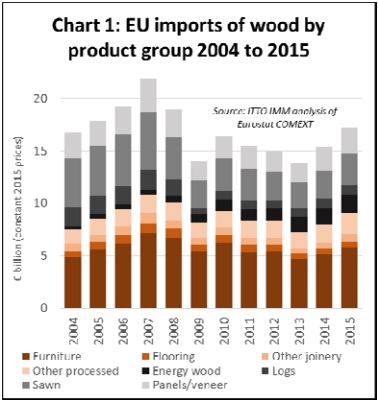
The total value of EU imports of wood products was euro17.20 billion in 2015, 12% more than in 2014. This followed an increase of 10% to euro15.3 billion in 2014. In 2015 EU import value was at the highest level since 2008 just before the global financial crises (Chart 1), ITTO reported.
The surge in the euro value of imports in 2015 was partly owing to the weakness of the euro which on average was valued around 20% less against the dollar in 2015 compared to 2014. This meant that euro import prices for most products from the Americas and Asia increased. Import volumes also increased across most wood product groups in 2015 but to a lesser extent than euro value.
The euro value of imports increased across all wood product groups in both 2014 and 2015 (Chart 2). Imports of wood furniture, which had been declining to 2013, rebounded 10% in 2014 and 13% in 2015 to reach euro5.78 billion.
Imports of sawn wood rebounded from a low in 2013, rising 10% in 2014 and 12% in 2015 to reach euro3.04.
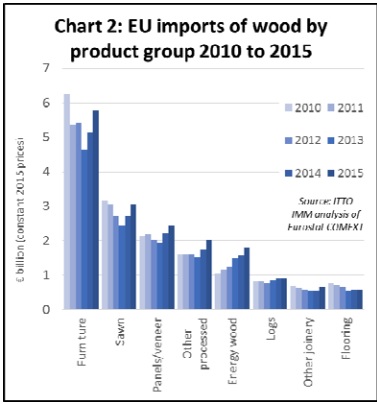
Similarly imports of panels (mainly plywood) increased 13% in 2014 and 11% in 2015 to reach euro2.44 billion. The long term rise in imports of energy wood continued in 2015 to reach an all-time high of euro900 million. Imports of other joinery products (mainly doors and LVL for window frames) were flat in 2014 but increased 22% to euro658 million in 2015.
According to ITTO, total imports of wood products from tropical countries increased 15% from euro3.28 billion in 2014 to euro3.78 billion in 2015. This followed a 6% increase between 2013 and 2014. In terms of share of overall EU imports, 2015 was notable for registering the first reversal in the fortunes of tropical countries in the last decade.
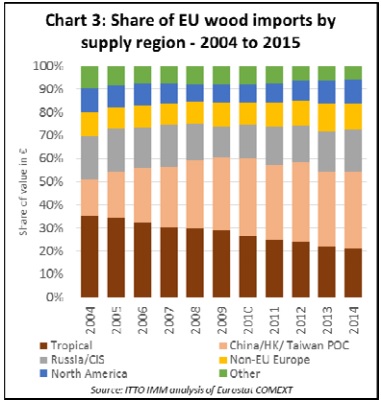
The share of tropical countries in total EU wood product import value fell continuously from 35% in 2004 to a low of 21.4% in 2014, before rebounding slightly to 22.0% in 2015.
Tropical countries lost share initially to China in the period 2009 to 2010, and then to North American, Russian and non-EU European countries in the period 2011 to 2014.
However in 2015, tropical countries regained a little share in import value mainly at the expense of Russia and nonEU European countries. China’s share in EU imports remained stable at 32.7% in both 2014 and 2015 (Chart 3).
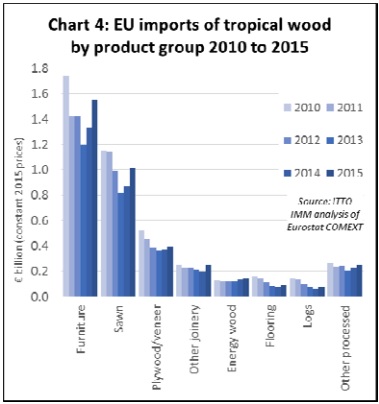
The recovery in EU imports of tropical wood products in 2014 and 2015 was particularly pronounced for furniture and sawn wood, although there were more minor gains for all other product groups (Chart 4).
EU imports of wood furniture from tropical countries increased 11% to euro1.33 billion in 2014 and by a further 16% to euro1.55 billion in 2015. Imports of sawn wood from tropical countries increased 7% to euro0.87 billion in 2014 and by a further 16% to euro1.02 billion in 2015. Imports of plywood and veneer from tropical countries increased more slowly, by 1.4% to 371 million in 2014 and by 6% to euro394 million in 2015.
The long-term shift in EU tropical wood imports away from primary and secondary wood products in favour of tertiary products continued in 2014 and 2015. The value of tertiary processed tropical wood products imported by the EU increased from 55% of total import value in 2013 to 57% in 2015.
[gravityform id="1" title="true" description="true"]
[gravityform id="2" title="true" description="true"]
France: Largest residential building made from Stora Enso's CLT

France will get to have its largest residential building from solid wood made with CLT (Cross Laminated Timber). Stora Enso has taken upon the project "QUAI DE LA BORDE" and it will provide some 1800 m3 of CLT. The building will have 140 apartments and its construction will be completed within 13 months.
The building will be completed on such short notice thanks to the completely pre-cut CLT, which was manufactured in the Bad St. Leonhard in Austria, Stora Enso’s unit. Also, Promicea, a company which sustains wood-based solutions for residential building projects in France, will help to complete the project.
There is a growing housing demand for innovative and environmentally new concepts in France and this large residential building will make use of sustainable produced and certified wood sourced mainly from Austria.
[gravityform id="1" title="true" description="true"]
[gravityform id="2" title="true" description="true"]
France: Largest residential building made from Stora Enso’s CLT
France will get to have its largest residential building from solid wood made with CLT (Cross Laminated Timber). Stora Enso has taken upon the project "QUAI DE LA BORDE" and it will provide some 1800 m3 of CLT. The building will have 140 apartments and its construction will be completed within 13 months.
The building will be completed on such short notice thanks to the completely pre-cut CLT, which was manufactured in the Bad St. Leonhard in Austria, Stora Enso’s unit. Also, Promicea, a company which sustains wood-based solutions for residential building projects in France, will help to complete the project.
There is a growing housing demand for innovative and environmentally new concepts in France and this large residential building will make use of sustainable produced and certified wood sourced mainly from Austria.
[gravityform id="1" title="true" description="true"]
[gravityform id="2" title="true" description="true"]
Finland: Log prices rise slightly at the beginning of the year
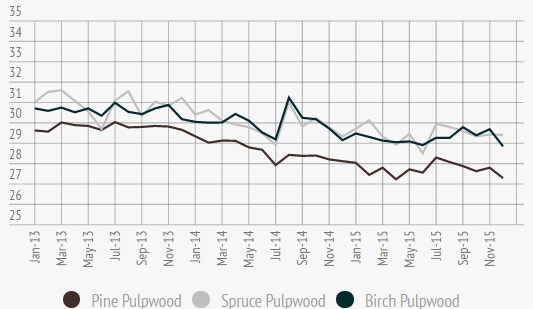
Roundwood prices in Finland rose slightly in January with only few exceptions. This applies both when compared with the previous month as well as compared to the same month of last year.
On average, sawlog assortments became more expensive over December by about 1 percent, while pulpwood prices are higher by about 0.50 percent.
After a downward trend in the past few months (check infographic below), spruce sawlog price increased by EUR 0,72/m3. Moreover, it is also higher over January 2015. On contrast, pine sawlog price has become cheaper over the same month of last year by almost EUR 1/m3.
TABEL
Roadside prices of roundwood in Finland EUR/m³ over bark |
January 2015 | December 2015 | January 2016 | Change Dec./2015 to Jan./2016 |
Change Jan./2015 to Jan./2016 |
| LOGS | |||||
| Pine | 56.92 | 55.78 | 56.08 | +0.53% | -1.47% |
| Spruce | 54.70 | 54.83 | 55.55 | +1.31% | +1.55% |
| Birch | 46.99 | 46.34 | 46.97 | +1.35% | % |
| PULPWOOD | |||||
| Pine | 28.04 | 27.29 | 27.47 | +0.65% | -2.03% |
| Spruce | 29.72 | 29.41 | 29.85 | +1.49% | +0.43% |
| Birch | 29.84 | 28.85 | 28.73 | -0.41% | -3.31% |
INFOGRAPHIC
[gravityform id="1" title="true" description="true"]
[gravityform id="2" title="true" description="true"HIC]
NZ forestry industry blames China for not keeping up free trade promises

China is accused by the forestry industry in New Zealand that is adding costs to imported log products, despite the fact that it had promised free trade. As Brian Stanley, Wood Council chairman, said, this is an "unfair treatment,” according to TZNZ.
"From the forest industry's point of view, we don't have a free trade agreement with China at all. We're getting nothing out of it. For sawn lumber going into China, it's all 17 per cent value-added-tax. If we could get it down to 13 per cent, even that four per cent is the difference between the margin that a sawmill can make by exporting up to China. Value-added-tax is just one of the areas that we see as a non-tariff trade barrier to China,” he added.
Sawmills in New Zealand are affected because if more sawn lumber is exported to China, then there would be more sawmills cutting the timber, thus providing more jobs.
Winston Peters, New Zealand First Leader, warned the industry about this issue and wants the Government to make a call on the World Trade Organization. Also, the Wood Products Council raised concerns on the issue and Todd McClay, the Trade Minister, has already taken note of it.
[gravityform id="1" title="true" description="true"]
[gravityform id="2" title="true" description="true"]
UK forestry market increased by 200% in the last 5 years

The UK forestry market value has risen to more than 200% in the last 5 years. The research “'Spotlight on the UK Forestry Market 2016”, which presented this result, also showed that more than £130 million were traded in 2015 and the average value per hectare also increased, according to FarmingUK.
Following a stable market of the last 4 years, the transactions of the forestry areas increased by 30% to 21,000 hectares in 2015, compared to 16,000 hectares in 2014.
This increase was due to the sales which happened off-market, such as the 16 properties sold by UPM to the Church Commissioners, for which they received £50 million. Also, during 2015, the average value per productive hectare reached £8,615, rising by 13.5%.
As FarmingUK reported, the South Scotland region had the highest value, followed by the Borders, both of them being focused on timber production. England and Wales follow, where the prices have strengthen over the mentioned period.
“In 2015 we saw some polarisation in the market, with forest properties that did not tick all of the boxes, in terms of normal investment criteria, sticking on the market unless competitively priced. Forest values are increasingly influenced by the productive capacity of the asset. Well managed commercial spruce forests, that are high yield class with good access to timber markets, will remain in strong demand. Younger forests, or land for new planting, may also tempt those who anticipate a seismic shift in timber prices in the long term, say 20 to 30 years,” said Jamie Adamson of Scottish Woodlands.
He added that investors should consider a 10-year “investment horizon” and that wood will reach a higher demand as there already is a strong order for wood fiber, an increasing wood use in construction and an increasing world population.
[gravityform id="1" title="true" description="true"]
[gravityform id="2" title="true" description="true"]
SCA Timber invests in a new site in Rochefort, France

SCA will invest in a new site in Rochefort, France. The working operations that SCA Timber France has in Rochefort will be combined on one site by 2018. The offices and the two operations (import and industry) will be relocated at the end of the process.
The new site is located just near the current site. The geographic situation by the harbour in Rochefort gives SCA Timber France a good position for import and export operations. The relocation to the new site will be performed in two phases. In the first phase, SCA Timber France will move all the import operation. In phase two, in 2018, the industrial part will be relocated. This matter will continue to be investigated in autumn 2016.
“We should be able to modernise production within a period of three years. This is something we have really longed for. But to make the modernisation happen, we need a decision on further investments. When we modernise our equipment, we will be able to increase productivity. Production will be safer and more efficient, with less of an impact on the environment. ,” says Benjamin Bodet, Managing Director, SCA Timber France.
[gravityform id="1" title="true" description="true"]
[gravityform id="2" title="true" description="true"]
UPM closes paper mill in U.S.

UPM-Kymmene Inc. and Northern SC Paper Corp., a subsidiary of the New York Times Company, announced the dissolution of their partnership, Madison Paper Industries, in the USA. The partnership's paper business will end and paper production is expected to conclude by the end of May at the latest. Hydro power assets located at the mill site will be sold.
With the closure of the mill, UPM will reduce production of a total of 195,000 tons of its supercalendered paper capacity.
The closure will impact approximately 214 employees located at the mill site.
"Despite everyone's best efforts, the difficult decision has been made to cease paper production at Madison. Demand for SC papers declined significantly in 2015 and the decline is expected to continue. The Madison mill is not cost-competitive and has lost a significant amount of sales in the recent past," says Ruud van den Berg, Senior Vice President of UPM Paper ENA.
[gravityform id="1" title="true" description="true"]
[gravityform id="2" title="true" description="true"]
The Arctic might provide great opportunities for Finnish and Russian bioenergy

The US Ambassador to Finland, Charles Adams Jr., considers that the forestry resources in the Arctic might represent a very important opportunity for the developing of renewable energy in Finland and Russia, according to Bioenergy Insight.
Also, the forestry sectors in Finnish Lapland and Russian Kola Peninsula might be a renewable energy source not only for Finland and Russia, but also for the bioenergy industry in the EU’s countries. Besides the economic opportunities, the Arctic communities might win a new non-fossil source of energy from bioenergy.
"Renewable energy, biofuels, forestry byproducts — that is going to be a huge new vector for the Finnish economy, also, by the way, for the Russian economy. I’m not talking about the next generation, it is happening as we speak,” Adams said.
As the Finnish Foreign Ministry reported, 70% of Finland’s renewable energy is provided by the bioenergy production from the forest industry. On the other hand, the renewable energy in Russia accounts only for 5% of the energy production. In Russia, the energy production from wood waste in the logging sector reaches 8 billion tonnes of oil.
[gravityform id="1" title="true" description="true"]
[gravityform id="2" title="true" description="true"]
Enviva reports strong performance despite challenging market

Despite challenging market conditions in the broader energy sector, Enviva LP completed 2015 with continued strong operating performance, said Chairman and CEO John Keppler during the company’s Q4 2015 and year-end financial earnings call.
For Q4 2015, Enviva reported net revenue of $116.8 million, a $37.8 million, or 48 percent, increase over Q4 2015, and Keppler said that Enviva expects to distribute at least $2.10 per unit for 2016, a 27 percent increase over the annualized minimum quarterly distribution announced at our IPO less than a year ago.
Keppler emphasized one of the year’s highlights was the “Southampton dropdown,” Enviva’s acquisition of a 510,000-ton-per-year pellet plant located in Southampton County, Virginia. The facility was developed by its sponsor, Enviva Holdings LP, under a joint venture with affiliates of John Hancock Life Insurance Co., and includes a 10-year take-or-pay off-take contract (385,000 metric tons in the first year), and a matching 10-year shipping contract.
After the financial portion of the call, Keppler went on to discuss current and potential market opportunities.
In Europe, Enviva’s core market, many countries are still behind major renewable energy requirements, Keppler pointed out. “The U.K. is still our largest and currently projected consumer of industrial wood pellets, and there have been several positive developments from a policy standpoint, as well as progress at the individual plant level.”
On the policy front, the U.K. Department of Energy and Climate Change recently announced plans to close all coal fired plants by 2025, Keppler noted. “As such, renewable energy will play a larger role in U.K. power supply.”
He added that policymakers are beginning to compare renewable energy options on a total-cost basis, appropriately including the cost of backup generation and intermittent power sources. He quoted the head of DECC and U.K. energy secretary, who recently said, “In the same way generators should pay for the cost of pollution, we want intermittent generators to be responsible for the pressures they add to the system when the wind does not blow or the sun does not shine.”
With the success power generators have already achieved converting coal-fired plants 100 percent biomass, and its cost-effectiveness compared to other renewables, Keppler said that Enviva expects biomass and demand for wood pellets to continue to grow significantly. “Not mention additional demand expected due to the enhanced renewable heat incentive the U.K. government announced as well,” he said.
At the plant level in the U.K, there have been some recent key developments, according to Keppler, one being the European Commission’s approval of state aid for the 420-MW Lynemouth coal-to-biomass conversion, and its sale from RWE to EP UK Investments Ltd., which intends to convert to wood pellet fuel by the end of 2017 and is estimated to require about 1.5 million tons annually.
The second development was Drax’s third 660-MW unit entering the next stage of the EU state aid approval process. It is expected to create demand for an additional 2 million tons of wood pellets annually, Keppler said.
Moving on, Keppler pointed to MGT Power’s 299-MW Teesside Renewable Energy Plant, which is expected to commence construction during the second quarter of this year. Enviva Wilmington Holdings LLC, Enviva’s sponsor’s joint venture with affiliates of John Hancock Life Insurance Company, has executed a new take-or-pay contract to be the sole source supplier for imported biomass fuel, with nearly 1 million tons needed annually. Deliveries under the contract are expected to commence in 2019, Keppler said.
He also addressed German Pellets GmBH’s relationship to the Langerlo power facility conversion in Belgium. E.ON completed the sale of the 556-MW plant to a German Pellets affiliate last year, and Enviva secured an off-take contract to supply wood pellets to the plant beginning in 2017. Keppler said that though German Pellets has filed for insolvency, the filing doesn’t involve the current owner of the facility. However, given the financial distress of the affiliated entity, Enviva is closely monitoring the situation, he said. “We believe a system-relevant plant like Langerlo will ultimately get converted, whether by this owner or industry party. We expect to get our share of the fuel supply regardless of who does the conversion. “
Keppler said there isn’t a direct link between German Pellets and its affiliate in terms of capitalization and financial structures, and that there is no common legal structure. “But these things can bleed over, and we will make sure our interests are protected,” he said, adding that it’s an important plant to the Belgium power supply.
Keppler also discussed opportunity in the Dutch market, which is considering phasing out coal generation, potentially leading to a significant demand in biomass, and pointed to substantial wood pellet demand growth in Asia. He also noted that though while not a part of Enviva’s base assumptions of global market growth, the U.S. EPA’s Clean Power Plan remains a potential upside to market growth, and the company continues to work at the invitation of the EPA on the role of biomass in the plan.
[gravityform id="1" title="true" description="true"]
[gravityform id="2" title="true" description="true"]
Logs, sawnwood, plywood; domestic and export prices in Brazil
| Brazilian logs, mill yard, domestic | US$ per m3 | ||
| Ipê | 136▼ | ||
| Jatoba | 76▼ | ||
| Massaranduba | 80▼ | ||
| Muiracatiara | 83▼ | ||
| Angelim Vermelho | 76▼ | ||
| Mixed redwood and white wood | 66▼ | ||
Export Sawnwood Prices
| Sawnwood, Belem/Paranagua Ports, FOB | US$ per m3 | ||
| Ipe | 1451 | ||
| Jatoba | 973 | ||
| Massaranduba | 772 | ||
| Muiracatiara | 765 | ||
| Pine (KD) | 209 | ||
FOB Belém/PA; Paranaguá/PR; Navegantes/SC and Itajaí/SC Ports. High quality wood (no cracks / without knots) / Measuring 2,50 m in length; 15 cm wide; and 30 mm thick.
Domestic Sawnwood Prices
| Brazilian sawnwood, domestic (Green ex-mill) | US$ per m3 | ||
| Ipê | 660▼ | ||
| Jatoba | 329▼ | ||
| Massaranduba | 299▼ | ||
| Muiracatiara | 311▼ | ||
| Angelim Vermelho | 275▼ | ||
| Mixed red and white | 174▼ | ||
| Eucalyptus (AD) | 161▼ | ||
| Pine (AD) | 116▼ | ||
| Pine (KD) | 131▼ | ||
Export Plywood Prices
| Pine Plywood EU market, FOB | US$ per m3 | ||
| 9mm C/CC (WBP) | 323 | ||
| 12mm C/CC (WBP) | 293 | ||
| 15mm C/CC (WBP) | 291 | ||
| 18mm C/CC (WBP) | 288 | ||
Domestic Plywood Prices (excl. taxes)
| Parica | US$ per m3 | ||
| 4mm WBP | 454▼ | ||
| 10mm WBP | 359▼ | ||
| 15mm WBP | 313▼ | ||
| 4mm MR | 407▼ | ||
| 10mm MR | 302▼ | ||
| 15mm MR | 281▼ | ||
Domestic taxes include taxes and may be subject to discounts
Prices For Other Panel Products
| Domestic ex-mill Prices | US$ per m3 | ||
| 15mm MDParticleboard | 197▼ | ||
| 15mm MDF | 276▼ | ||
Export Prices For Added Value Products
| FOB Belem/Paranagua Ports | US$ per m3 | ||
| Decking Boards | |||
| Ipê | 2,608 | ||
| Jatoba | 1,613 | ||
Price source: ITTO
China International Furniture Fair expects 3,800 exhibitors

The world-leading China International Furniture Fair (CIFF) (Guangzhou) will open at China Import and Export Fair Complex (Pazhou Complex) and Poly World Trade Centre Expo (PWTC) on March 18 and will feature more than 3,800 exhibitors from over 30 countries and regions worldwide, and visitors from 190 countries and regions.
Now in its 19th year, the 2016 CIFF is upgrading the exhibition by offering 750,000 square meters of exhibition space to accommodate participating companies throughout the two phases of the fair, with the first phase for home furniture to take place from March 18 to 21 and second phase for office furniture from March 28 to 31.
The one-stop fair that cover all fields in the furniture industry will feature themed halls from home furniture, home décor and housewares, to home textiles, outdoor and leisure. It's also the only platform with a keen focus on outdoor furniture and lifestyle.


In addition to the largest vintage furniture sector in China, CIFF (Guangzhou) is focusing on current design trends, technologies and products and presents the latest products and services in the Innovative Design Hall and Custom Furniture Pavilion.
Another highly anticipated sector of the 2016 CIFF (Guangzhou) is the presentation of smart home solutions demonstrating the latest home automation systems and cutting-edge technologies.
Leading companies in the smart home industry including Manwah, Somnopro and Eon Living will set up booths at the exhibition, demonstrating latest products such as a smart mattress that can track sleeping conditions and a sofa equipped with reading and wireless charging functions.
"As the technologies mature, smart homes with advanced and reliable products are now more affordable," one CIFF spokesperson said. "Now people can not only embrace a simple and smart lifestyle, but also enjoy an all-new experience that combines home entertainment, smart controls and intelligent safeguard systems."
An international platform for the growing furniture industry, the International Furniture Hall will also be the largest in history with 30,000 square meters of exhibition area to showcase different styles of furniture design by acclaimed international companies.
The committee added, "As a professional platform that offers huge opportunities to both exhibitors and buyers, CIFF (Guangzhou) is growing stronger year by year. Our focus on matching market demand is what makes the fair the top choice for furniture companies around the world."
About CIFF
As the first and largest furniture fair in China, the 37th CIFF will be organized by China National Furniture Association, China Foreign Trade Center (Group), Guangdong Furniture Association, Hong Kong Furniture & Decoration Trade Association and hosted by China Foreign Trade Guangzhou Exhibition General Corp.
The CIFF Guangzhou is located in Haizhu District with easy access to the local transportation network. The fair is 40 minutes' drive from Guangzhou Baiyun Airport with free shuttle buses available. Visitors can also take Metro Line 8 to Pazhou Metro Station or Xingangdong Station.
[gravityform id="1" title="true" description="true"]
[gravityform id="2" title="true" description="true"]
IKEA set to open first store in Morocco

After months of diplomatic difficulties between Morocco and the Swedish government, IKEA will finally open its first store in the disputed area. The difficulties were encountered because of Sweden’s plans to recognize the independence of Western Sahara territory, according to Quartz Africa.
Africa’s last colony, Western Sahara, is quarreled about for the Moroccan government because the Sahrawis claim the right to independence, even if the Moroccan forces tried to annex the territory and is investing billions of dollars for Moroccans to move there.
Last year, in September, Morocco didn’t allow IKEA to open its store because it didn’t have the proper licensing regarding its stance for Western Sahara. This also blocked other Swedish companies, such as H&M and Volvo.
Sweden has filled an internal review, which concluded in January that its government won’t recognize Sahara as an independent state. Thus, the relations with Morocco improved and IKEA managed to open its first store in the Casablanca outlet.
Now, the Swedish furniture and home decorating company has reached 375 stores in the whole world. For the Casablanca outlet area in Morocco there is already a website that’s running, but there hasn’t been given any official opening date.
[gravityform id="1" title="true" description="true"]
[gravityform id="2" title="true" description="true"]
Indonesian furniture association won't support EUTR anymore

The Forest Law Enforcement, Governance and Trade (FLEGT) process in Indonesia is threatened with possible failure at the last hurdle, after a decade of negotiations and hard work by both the Indonesian authorities and representatives of the European Union.
Indonesia was one of the first countries to start negotiating a Voluntary Partnership Agreement (VPA) with the EU and was the first Asian country to initial a VPA, yet to be implemented.
When the EU Timber Regulation (EUTR) got into force in March 2013, under the FLEGT Action Plan, many small furniture producers were created a lot of trouble, as well as for those producers who used composite and various materials. That warning seems to have been well-founded by the events of recent weeks in Indonesia, a country that has received outstanding assistance for capacity building and cooperation.
The Indonesian Minister of Trade has recently re-confirmed that SVLK wouldn’t be necessary for furniture, a thing which will be reversed in the next couple of months. Sources close to the ASEAN Furniture Industries Council (AFIC) stated that the Asian countries have encountered many problems as to comply to the EUTR, while no prosecutions were established in Europe for imports of products deemed illegal.
Since the EUTR got into force, many ENGOs have identified a lot of illegal shipments to the EU. Despite of these actions, four EU-member countries had not even set up monitoring arrangements as they were required. At the moment, there is only one Member State that hasn’t put its house in order and at last two Member States have actually started prosecuting two of their importers, one in the Netherlands over timber from Cameroon, and another one in Sweden over timber from Myanmar that was processed into flooring in Thailand.
There were a lot of Southeast Asian furniture shows taking place this March, among which the IFEX in Jakarta, supported by the furniture association AMKRI, where it was expected that SVLK licenced products would dominate. Even if the Jakarta team organised a public dialogue at the show initially promoted by the organisers, it has been unilaterally cancelled by them at short notice, apparently on the orders of AMKRI, saying that “IFEX 2016 DOES NOT SUPPORT SUSTAINABILITY OF INDONESIAN FORESTS”.
The unilateral cancellation represented a huge disadvantage, as SVLK in Indonesia is under government policy and has been perfected for the past 10 years, with the specific aim of keeping Indonesia’s forests sustainable, and to bolster Indonesia’s timber and wood products’ bargaining position in the global market.
The press release of the company stated that ”We strongly regret that IFEX does not support government policy concerning SVLK assurance, which means that IFEX also does not support protection of sustainability for Indonesia’s precious forests,” and demanded a public apology or face court proceedings.
[gravityform id="1" title="true" description="true"]
[gravityform id="2" title="true" description="true"]
Indonesian furniture association won’t support EUTR anymore
The Forest Law Enforcement, Governance and Trade (FLEGT) process in Indonesia is threatened with possible failure at the last hurdle, after a decade of negotiations and hard work by both the Indonesian authorities and representatives of the European Union.
Indonesia was one of the first countries to start negotiating a Voluntary Partnership Agreement (VPA) with the EU and was the first Asian country to initial a VPA, yet to be implemented.
When the EU Timber Regulation (EUTR) got into force in March 2013, under the FLEGT Action Plan, many small furniture producers were created a lot of trouble, as well as for those producers who used composite and various materials. That warning seems to have been well-founded by the events of recent weeks in Indonesia, a country that has received outstanding assistance for capacity building and cooperation.
The Indonesian Minister of Trade has recently re-confirmed that SVLK wouldn’t be necessary for furniture, a thing which will be reversed in the next couple of months. Sources close to the ASEAN Furniture Industries Council (AFIC) stated that the Asian countries have encountered many problems as to comply to the EUTR, while no prosecutions were established in Europe for imports of products deemed illegal.
Since the EUTR got into force, many ENGOs have identified a lot of illegal shipments to the EU. Despite of these actions, four EU-member countries had not even set up monitoring arrangements as they were required. At the moment, there is only one Member State that hasn’t put its house in order and at last two Member States have actually started prosecuting two of their importers, one in the Netherlands over timber from Cameroon, and another one in Sweden over timber from Myanmar that was processed into flooring in Thailand.
There were a lot of Southeast Asian furniture shows taking place this March, among which the IFEX in Jakarta, supported by the furniture association AMKRI, where it was expected that SVLK licenced products would dominate. Even if the Jakarta team organised a public dialogue at the show initially promoted by the organisers, it has been unilaterally cancelled by them at short notice, apparently on the orders of AMKRI, saying that “IFEX 2016 DOES NOT SUPPORT SUSTAINABILITY OF INDONESIAN FORESTS”.
The unilateral cancellation represented a huge disadvantage, as SVLK in Indonesia is under government policy and has been perfected for the past 10 years, with the specific aim of keeping Indonesia’s forests sustainable, and to bolster Indonesia’s timber and wood products’ bargaining position in the global market.
The press release of the company stated that ”We strongly regret that IFEX does not support government policy concerning SVLK assurance, which means that IFEX also does not support protection of sustainability for Indonesia’s precious forests,” and demanded a public apology or face court proceedings.
[gravityform id="1" title="true" description="true"]
[gravityform id="2" title="true" description="true"]
China: Tropical log imports down 10%; average import prices drop 25%

Chinese tropical log imports in 2015 totalled 8.9 million cubic metres accounting for 20% of the national total and were valued at US$2.8 billion reflecting a 10% decline in volume and a 32% decline in value.
The average price for imported tropical logs was US$319 per cubic metre, a year on year drop of 25%.
China imported tropical logs mainly from Papua New Guinea (36%), Solomon Islands (25%), Equatorial Guinea (7.4%), Cameroon (6.2%), Nigeria (6.1%) and Congo Brazzaville (5.9%).
Just 10 countries supplied 96% of China’s tropical log requirements in 2015.
Log imports from Equatorial Guinea grew 32% in 2015 and imports from Cameroon expanded 14% over the same period.
Countries from which tropical log imports declined included Malaysia (-47%) and Laos (-43%). The main point for tropical log imports in 2015 was Nanjing Port which accounted for 84% of all tropical log imports.
Average tropical hardwood log prices, 2015
| Average price US$/cu.m. | Change in % 2014-2015 | |
| PNG | 209 | -14% |
| Solomon Is. | 198 | -8% |
| Equatorial Guinea | 272 | -24% |
| Cameroon | 336 | -14% |
| Nigeria | 627 | -9% |
| Congo (Brazzaville) | 337 | -20% |
| Laos | 1292 | -24% |
| Malaysia | 329 | -3% |
| Liberia | 271 | -13% |
| Suriname | 318 | -10% |
Source: China Customs
Top tropical hardwood log sources, 2015
| 2015 import in m3 | Change in % 2014-2015 | |
| PNG | 3162900 | -4% |
| Solomon Is. | 2221900 | 1% |
| Equatorial Guinea | 657800 | 32% |
| Cameroon | 549200 | 14% |
| Nigeria | 546000 | 8% |
| Congo (Brazzaville) | 526100 | -8% |
| Laos | 261200 | -43% |
| Malaysia | 200000 | -47% |
| Liberia | 119400 | 17% |
| Suriname | 90800 | -14% |
Source: China Customs
[gravityform id="1" title="true" description="true"]
[gravityform id="2" title="true" description="true"]
Malaysian timber giant might loose FSC certification in NZ

Local stakeholders in the East Coast region of New Zealand’s North Island have lodged a complaint against the Malaysian Samling Group with the Forest Stewardship Council (FSC), an international body that issues sustainability certificates to timber operators. Samling is accused of boycotting local efforts to build up a wood-processing industry and failing to provide sufficient economic opportunities to one of New Zealand’s economically weakest regions.
Samling is being criticized for exporting the bulk of timber harvested in New Zealand as unprocessed logs. Despite being a key player in the local timber business, the Malaysian group has consistently refused to provide timber at market rates to a new wood-processing facility built up by the Gisborne District Council, the Eastland Community Trust and Activate Tairawhiti in a joint effort to revive the local economy.
According to FSC principles, a timber operator is required to enhance local communities’ social and economic well-being and should maintain and enhance long term economic, social and environmental benefits from the forest.
Samling operates a 25,000 hectare forest farm planted with North American Pinus radiata trees in the Gisborne region. During the 2013-2014 harvesting period, it cut 780,000 tonnes of timber, of which 97% were exported as unprocessed logs. The plantation has been FSC-certified since 2005 and was recertified last year by the Rainforest Alliance.
According to Carrick Graham, spokesperson for the complainants, FSC have acknowledged the receipt of the complaint. Samling’s Hikurangi Forest Farms Ltd are currently expected to reply to the complainants, according to the FSC Dispute Resolutions system.
In case of non-compliance with the FSC principles, Samling may face a loss of its certification. In 2007, Samling lost the FSC certification for its operations in Guyana. Later on, the company was fined for illegal logging and blacklisted by the Norwegian Government Pension Fund.
[gravityform id="1" title="true" description="true"]
[gravityform id="2" title="true" description="true"]
International Paper sells Asian corrugated packaging business to Chinese company

International Paper announced that it has entered into a definitive agreement to sell its corrugated packaging business in China and Southeast Asia to Xiamen Bridge Hexing Equity Investment Partnership Enterprise. International Paper's corrugated packaging business in Asia has 18 plants and a workforce of approximately 3,000 employees.
Under terms of the transaction, International Paper will receive a total of approximately RMB 1 billion (approximately US$150 million at current exchange rate), subject to post-closing adjustments and other payments, including the buyer's assumption of the liability for loans of approximately US$50 million to be paid to International Paper within six months of closing of the sale.
The transaction is expected to be completed in the next few months, subject to satisfaction of closing conditions, including obtaining required governmental approvals.
International Paper is a global leader in packaging and paper with manufacturing operations in North America, Europe, Latin America, Russia, Asia and North Africa. Its businesses include industrial and consumer packaging along with uncoated papers and pulp. Headquartered in Memphis, Tenn., the company employs approximately 55,000 people and is strategically located in more than 24 countries serving customers worldwide. International Paper net sales for 2015 were $22 billion.
[gravityform id="1" title="true" description="true"]
[gravityform id="2" title="true" description="true"]

