
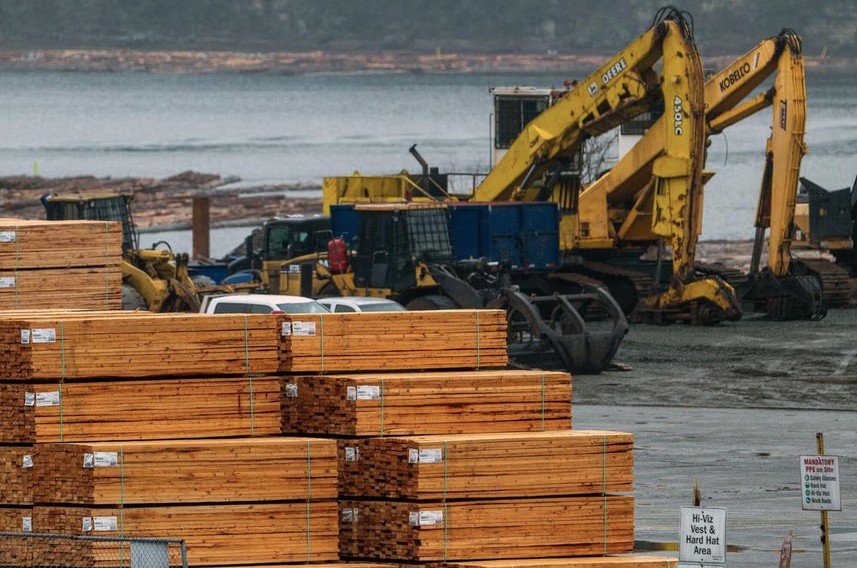
China’s lumber imports fell sharply in the first quarter of 2026, as weak construction activity, lower Russian supply and seasonal factors weighed on demand.
According to China Customs, China imported 5.02 million m³ of lumber in the first quarter of 2026, with a total value of US$1.42 billion. This was a decline of 14% in volume and 6% in value compared with the same period of 2025. The average CIF import price rose by 10% year-on-year to US$283/m³, indicating that the contraction was mainly volume-driven.
Softwood lumber accounted for most of the decline. Imports of softwood lumber fell by 23% to 2.73 million m³ and represented 54% of China’s total lumber imports. The average CIF price for imported softwood lumber increased by 3% year-on-year to US$213/m³.
Hardwood lumber imports were more stable. They rose slightly, by 0.2%, to 2.29 million m³ and accounted for 46% of total lumber imports. The average CIF price for imported hardwood lumber increased by 9% year-on-year to US$367/m³.
Within hardwood lumber, imports from tropical countries reached 1.81 million m³, valued at US$583 million CIF. This was an increase of 7% in volume and 27% in value compared with the first quarter of 2025. Tropical lumber accounted for 36% of China’s total lumber import volume, while its average CIF price rose by 18% to US$322/m³.
China’s lumber imports, first quarter of 2026 — volume
| Category | 2026 Q1, mil. m³ | YoY change |
|---|---|---|
| Total lumber imports | 5.02 | -14% |
| Softwood lumber | 2.73 | -23% |
| Hardwood lumber | 2.29 | 0.2% |
| Of which tropical lumber | 1.81 | 7% |
Data source: China Customs
China’s lumber imports, first quarter of 2026 — value
| Category | 2026 Q1, US$ mil. | YoY change |
|---|---|---|
| Total lumber imports | 1,420 | -6% |
| Softwood lumber | 580 | -21% |
| Hardwood lumber | 840 | 9% |
| Of which tropical lumber | 583 | 27% |
Data source: China Customs
Average lumber CIF prices, first quarter of 2026
| Category | 2026 Q1, US$/m³ | YoY change |
|---|---|---|
| All lumber imports | 283 | 10% |
| Softwood lumber | 213 | 3% |
| Hardwood lumber | 367 | 9% |
| Of which tropical lumber | 322 | 18% |
Data source: China Customs
Why imports declined
The fall in China’s lumber imports was mainly caused by the continued weakness in new housing construction, which reduced demand for construction-grade softwood lumber. The contraction in Russian supply also played a major role, while the Spring Festival holiday created an additional short-term slowdown.
The import volume of construction lumber, especially softwood lumber such as fir, spruce and Scots pine, fell significantly. These species account for nearly half of China’s total lumber imports, so the decline dragged down the overall quarterly result.
Imports from Russia dropped by almost 30% year-on-year. Russia’s share of China’s total lumber imports fell from 47% to 39%. Russian exports to China were affected by a strategic shift toward Central Asia and the Middle East, while Chinese buyers remained cautious.
China’s lumber imports in February 2026 fell by 25% year-on-year. Volumes partly recovered after the Spring Festival, with the decline narrowing to 16% in March, but the overall first-quarter volume still contracted significantly.
Higher-value hardwood species, including ash and North American hardwoods, recorded some growth. However, their share was not large enough to offset the decline in overall lumber imports. At the same time, some lumber originally sourced from the United States and Canada is now reaching China through Viet Nam, suggesting a restructuring of supply chains rather than a straightforward fall in demand.
Imports from Russia and Thailand declined
China’s lumber imports from Russia and Thailand, the two largest suppliers, both declined in the first quarter of 2026. Imports from Russia fell by 29% to 1.935 million m³, while imports from Thailand fell by 6% to 1.048 million m³. The decline from these two suppliers was a direct factor behind the overall reduction in China’s lumber imports.
Russia remained the largest supplier of lumber to China, accounting for 39% of total import volume. This share was down by 7 percentage points from the first quarter of 2025. Thailand was the second-largest supplier, accounting for 21% of China’s total lumber import volume, up by 2 percentage points year-on-year.
Together, Russia and Thailand supplied 60% of China’s total lumber imports in the first quarter of 2026.
China’s imports of Russian lumber species declined across the board. Imports of spruce and fir, Korean pine and Mongolian Scots pine, birch, oak, ash, poplar and maple fell by 32%, 29%, 17%, 26%, 24%, 59% and 3% respectively.
By contrast, China’s lumber imports from Viet Nam and Myanmar rose sharply, by 295% and 165% respectively.
Main lumber suppliers, first quarter of 2026 — volume
| Supplier | Volume, 000 m³ | YoY change |
|---|---|---|
| Total | 5,017 | -14% |
| Russia | 1,935 | -29% |
| Thailand | 1,048 | -6% |
| Canada | 295 | 26% |
| Belarus | 239 | 10% |
| Philippines | 189 | -1% |
| USA | 188 | -32% |
| Viet Nam | 160 | 295% |
| Gabon | 125 | -9% |
| Sweden | 112 | -14% |
| Myanmar | 109 | 165% |
Data source: China Customs
Main lumber suppliers, first quarter of 2026 — value
| Supplier | Value, US$ mil. | YoY change |
|---|---|---|
| Total | 1,420 | -6% |
| Russia | 430 | -26% |
| Thailand | 297 | 3% |
| Canada | 73 | 38% |
| Belarus | 47 | 9% |
| Philippines | 15 | 8% |
| USA | 132 | -27% |
| Viet Nam | 109 | 508% |
| Gabon | 52 | 15% |
| Sweden | 24 | -15% |
| Myanmar | 34 | 37% |
Data source: China Customs
Main softwood lumber sources
Russia was the largest supplier of softwood lumber to China in the first quarter of 2026. It accounted for 65% of China’s softwood lumber imports, although volumes from Russia fell by 30% year-on-year to 1.765 million m³.
China’s softwood lumber imports from Sweden, Chile, Brazil and the United States also declined. Imports from Chile fell by 28%, from Brazil by 60% and from the United States by 52%. By contrast, imports from Canada, Belarus, Finland, New Zealand and Uruguay increased by 26%, 10%, 4%, 5% and 10% respectively.
Main softwood lumber sources, first quarter of 2026 — volume
| Supplier | Volume, 000 m³ | YoY change |
|---|---|---|
| Total | 2,729 | -23% |
| Russia | 1,765 | -30% |
| Canada | 275 | 26% |
| Belarus | 239 | 10% |
| Sweden | 112 | -14% |
| Finland | 96 | 4% |
| New Zealand | 47 | 5% |
| Chile | 39 | -28% |
| Uruguay | 35 | 10% |
| Brazil | 24 | -60% |
| USA | 21 | -52% |
Data source: China Customs
Main softwood lumber sources, first quarter of 2026 — value
| Supplier | Value, US$ mil. | YoY change |
|---|---|---|
| Total | 580 | -21% |
| Russia | 380 | -27% |
| Canada | 57 | 36% |
| Belarus | 47 | 9% |
| Sweden | 24 | -15% |
| Finland | 22 | 0% |
| New Zealand | 11 | 4% |
| Chile | 9 | -35% |
| Uruguay | 7 | 1% |
| Brazil | 4 | -62% |
| USA | 3 | -47% |
Data source: China Customs
Hardwood lumber imports from Viet Nam surged
According to China Customs, China’s hardwood lumber imports from Viet Nam surged by 295% year-on-year to 160,000 m³ in the first quarter of 2026. Imports from Myanmar also increased sharply, rising by 165% to 109,000 m³.
Thailand remained the largest supplier of hardwood lumber to China. It supplied 46% of China’s hardwood lumber imports, although volumes from Thailand fell by 6% to 1.048 million m³.
Hardwood lumber imports from the Philippines, Russia, the United States, Gabon, Romania and Malaysia declined by 1%, 19%, 29%, 9%, 6% and 1% respectively. By contrast, imports from Papua New Guinea rose by 68% in the first quarter of 2026.
Main hardwood lumber sources, first quarter of 2026 — volume
| Supplier | Volume, 000 m³ | YoY change |
|---|---|---|
| Total | 2,288.3 | 0.2% |
| Thailand | 1,048.4 | -6% |
| Philippines | 189 | -1% |
| Russia | 170 | -19% |
| USA | 167 | -29% |
| Viet Nam | 160 | 295% |
| Gabon | 125 | -9% |
| Myanmar | 109 | 165% |
| PNG | 58 | 68% |
| Romania | 32 | -6% |
| Malaysia | 23 | -1% |
Data source: China Customs
Main hardwood lumber sources, first quarter of 2026 — value
| Supplier | Value, US$ mil. | YoY change |
|---|---|---|
| Total | 840 | 9% |
| Thailand | 297 | 3% |
| Philippines | 15 | 8% |
| Russia | 50 | -18% |
| USA | 129 | -26% |
| Viet Nam | 109 | 507% |
| Gabon | 52 | 15% |
| Myanmar | 34 | 37% |
| PNG | 20 | 103% |
| Romania | 16 | -6% |
| Malaysia | 9 | 11% |
Data source: China Customs
Tropical lumber imports increased
China’s lumber imports from tropical countries rose by 7% year-on-year to 1.813 million m³ in the first quarter of 2026. The top three tropical suppliers were Thailand, the Philippines and Viet Nam. Thailand accounted for 58% of China’s tropical lumber imports, the Philippines for 10% and Viet Nam for 15%. Together, the three countries supplied 84% of China’s tropical lumber imports in the quarter.
The surge in imports from Viet Nam was the main factor behind the increase in tropical lumber imports. China imported ash, oak and other North American hardwoods from Viet Nam. It also imported some cherry, Chinese redwood, maple, poplar and beech lumber for the first time in the first quarter of 2026.
Imports of tropical lumber from Myanmar, Papua New Guinea and Indonesia also rose strongly, by 165%, 68% and 67% respectively. The sharp increase from Myanmar was mainly due to larger volumes of teak lumber.
By contrast, imports from Thailand, the Philippines, Gabon, Malaysia, Cameroon and the Republic of Congo fell by 6%, 1%, 9%, 1%, 7% and 14% respectively.
Lumber imports from tropical countries, first quarter of 2026 — volume
| Supplier | Volume, 000 m³ | YoY change |
|---|---|---|
| Total | 1,813 | 7% |
| Thailand | 1,048 | -6% |
| Philippines | 189 | -1% |
| Viet Nam | 160 | 295% |
| Gabon | 125 | -9% |
| Myanmar | 109 | 165% |
| PNG | 58 | 68% |
| Malaysia | 23 | -1% |
| Indonesia | 17 | 67% |
| Cameroon | 17 | -7% |
| Republic of Congo | 14 | -14% |
Data source: China Customs
Lumber imports from tropical countries, first quarter of 2026 — value
| Supplier | Value, US$ mil. | YoY change |
|---|---|---|
| Total | 583 | 27% |
| Thailand | 297 | 3% |
| Philippines | 15 | 8% |
| Viet Nam | 109 | 508% |
| Gabon | 52 | 15% |
| Myanmar | 34 | 37% |
| PNG | 20 | 103% |
| Malaysia | 9 | 11% |
| Indonesia | Not specified | Not specified |
| Cameroon | Not specified | Not specified |
| Republic of Congo | Not specified | Not specified |
Data source: China Customs
Note: In the supplied source text, the final table labelled as value data for tropical lumber repeats the same figures and units as the volume table. The table above keeps the available value figures that can be cross-checked from the hardwood and tropical totals, while entries not specified in the source are marked accordingly.

