


Martinsons wants to develop a new standard that enables even taller buildings to be built using wood.
“When constructing tall buildings, oscillations and vibrations are calculated in order to determine how high you can build. However, the current building standard does not take into account the fact that wood behaves differently to steel and concrete. The result is unnecessary height restrictions for wooden buildings. We therefore need a building standard that also includes wood as a material,” says Greger Lindgren, Technical Manager at Martinsons.
Martinsons launched the first part of the Tall Buildings project in autumn 2015. This involved measuring vibrations and the damping capacity at roof level at Strandparken in Sundbyberg (Sweden), among other places.
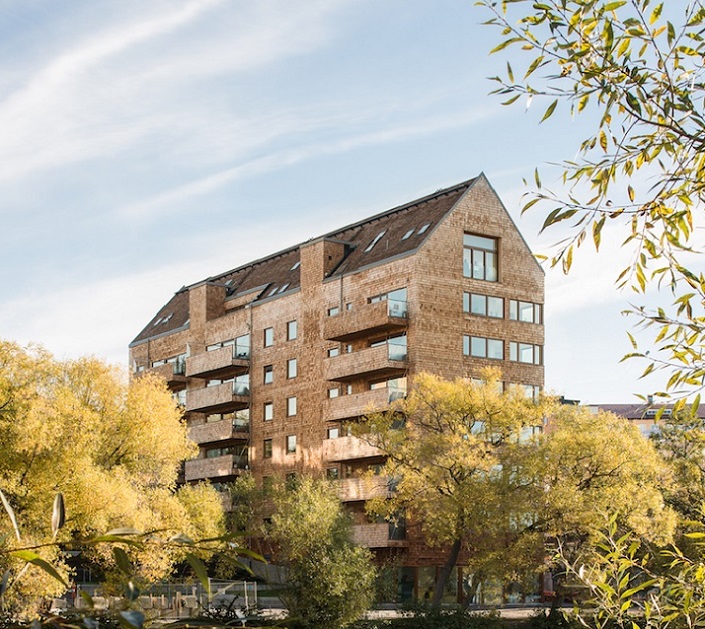
With eight floors, Strandparken (in the pictures) is currently Sweden’s tallest residential building
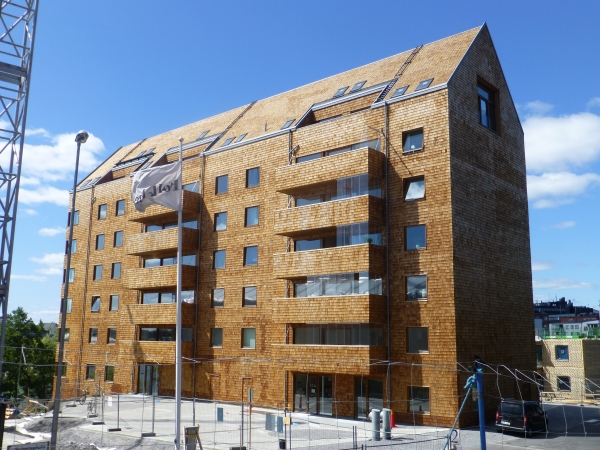
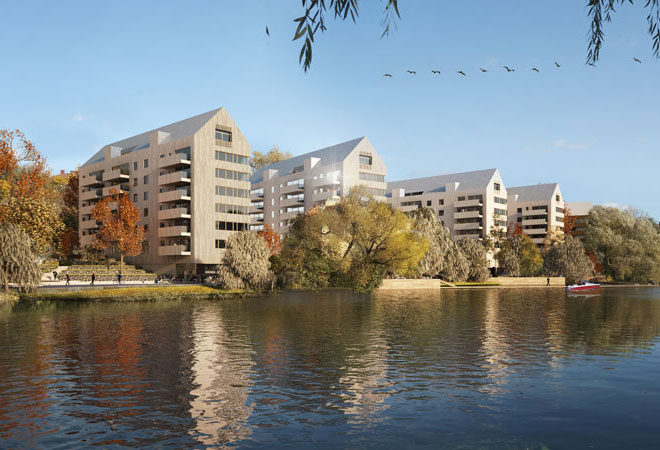
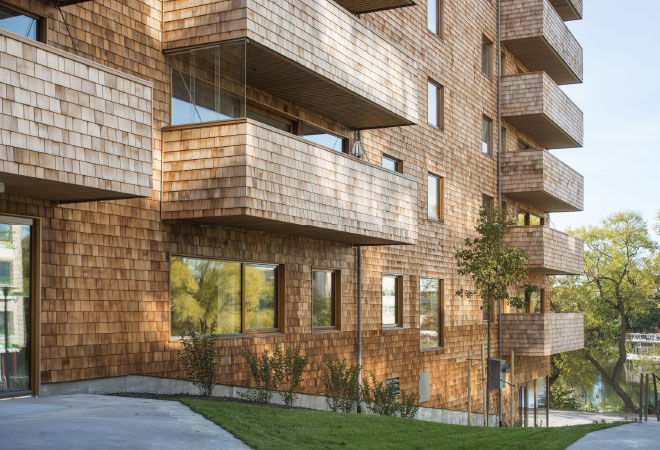
constructed from wood. With support from Vinnova and Swedish Wood (Svenskt Trä), the project is now moving forward, with the aim being to produce documentation for a new building standard that also includes wood.
The surveys conducted during the first part of the Tall Buildings project aimed to establish how accurate Martinsons’ own calculations are.
“Our surveys show that the building standard we currently follow does not reflect reality, because it was developed with other materials in mind. The calculation methods set out in the standard quite simply cannot be applied to a lightweight material like wood,” continues Greger Lindgren.
The second part of the Tall Buildings project is intended to make a substantial contribution to the development of a new standard that is also suitable for wooden buildings. The current standard makes it problematic to construct wooden buildings with more than eight to ten floors. Greger believes that a standard that takes into account the properties of wood could enable buildings with up to fifteen floors to be constructed.
“It’s not an easy job, however. We have to be able to provide evidence of the issues we encounter in the existing calculation models,” says Greger.
The project will run for three years and will commence during the spring.
[gravityform id="1" title="true" description="true"]
[gravityform id="2" title="true" description="true"]