


As IRENA (International Renewable Energy Agency) specified in their most recent report, the biomass and energy crops in the US are expected to increase their total share of primary energy. IRENA has made an assessment (Remap 2030) on how many countries can contribute to double the share of renewable energy in the global energy mix by 2030.

As main findings the executive summary report shows the following KEY achievements and results from the IRENA REmap 2030 assessment:
* The renewable energy share in the US energy mix was 7.5% in 2010 (the base year of REmap 2030 analysis). This included 2.5% renewable power, 1.6% liquid biofuels and the remaining, 3.4%, largely solid biomass used for heating in the manufacturing industry and buildings.
* Under a conservative “business as usual” case, known in this report as the Reference Case, this share will only increase to 10% by 2030. The REmap analysis shows that it is technically feasible and cost-effective to increase the renewable energy share in total final energy consumption to 27% by utilizing existing renewable energy technologies.
* Increasing the renewable energy share to 27% would save the US economy between USD 30 and USD 140 billion per year by 2030 when accounting for benefits resulting from reduced health effects and CO2 emissions.
* Increasing the renewable energy share to 27% would require an additional investment of USD 38 billion per year in energy capacity over business as usual, resulting in total investment flows into renewable energy capacity of USD 86 billion per year.
As for the energy crops, IRENA has conducted a biomass supply analysis for the US and has come to a similar result for the high supply potential, but with lower end supply potential.
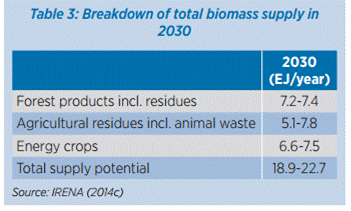
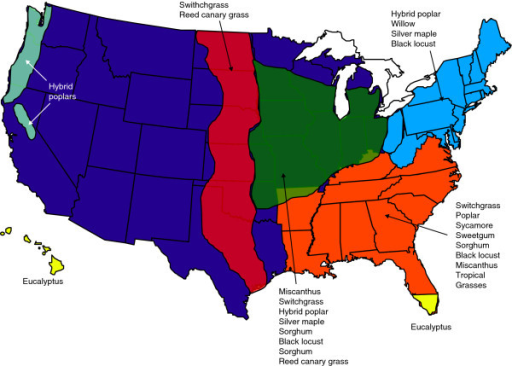
According to other similar studies, the energy crops offer a great opportunity to expand the energy production from biomass. Especially, the energy crops include tall grasses like switchgrass and miscanthus, and fast-growing trees like hybrid poplar and willow. As much as 400 million dry tons of these crops could be produced each year by 2030.
Also, the energy crops produce energy efficiently, requiring only modest amounts of fertilizer and pesticide, and less fertile soil than is needed for other types of agriculture. Time and significant changes in agricultural practices are needed to realize the full potential of energy crops, but expanding the role of perennial grasses in agriculture offers important climate and water quality benefits.
As this analysis shows, the biomass supply potential of seven different biomass types for more than 100 countries, the lower end of the supply potential for the US could be approximately 18.9 EJ by 2030. The higher end is estimated at 22.7 EJ, including 7.5 EJ of biomass crops on surplus agricultural land or wood/grasses crop potential on marginal land; an additional 7.2-7.4 EJ of forestry residue biomass resulting from logging/forest thinning operations; agricultural crop residues as well as food and animal waste up to 7.8 EJ by 2030.
Total biomass supply potential in the US is about 15-20% of the total global biomass supply potential of 95-145 EJ (IRENA, 2014c). If all the US biomass supply potential was to be deployed, about 20% of the US total primary energy supply today would be provided by bioenergy.
